
By Carlos Mendoza-Álvarez
∂
In recent weeks, Mexico has been the scene of social unrest stemming from the population's weariness with the violence of drug cartels that increasingly control more and more territory. The state of Michoacán has become the epicenter of this violence against the population, particularly against avocado and lime producers who hold that cursed "green gold" in their hands.The less glamorous side of Mexico's new 'green gold'This is devastating environmental and social systems. It is an expression of the predatory economy that is part of the extractive society in which we have been trapped for decades worldwide. The political class tries in vain to promote regional development plans with great media impact, but with few results for the victims and many alliances that maintain "stability" in the region to consolidate the privileges of criminal mafias.
As analysts of similar cases of narco-economies, such as Colombia decades ago and now Mexico, had already predicted (Terrorism and organized crimeWhat is happening is an escalation of violence perpetrated by criminal networks, which first affects local populations and then rises to reach the political and business classes in order to increase profits, political power, and control over territories. Even the United States government is intimately familiar with these criminal networks and manipulates them as it benefits its role as guarantor of democracy in the world within a new "multipolar order" (Trump is making a grave strategic error if he thinks he can divide the world with authoritarian powers and achieve peace.) negotiated with the authoritarian regimes of China and Russia.
Ordinary citizens—an expression often applied today to the most dangerous professions, such as journalism and, unfortunately, academic life in universities subject to censorship—are left bewildered, defenseless, and astonished by this avalanche of insecurity, crimes in public squares, and false promises from the authorities. The churches, for their part, attempt, without much success, to promote "peace plans," or better yet, "pacification" plans, to restore the broken social fabric. As I mentioned in my previous post a few days ago... National Dialogue for Peace which the Catholic Church has been promoting for three years in an unusual alliance between the Mexican episcopate, religious orders and Christian-inspired civil organizations.
The problem that arises in initiatives coming from the political, business, and religious spheres is the subject. That is, the communities in their own places of life seem to be absent as actors in the proposals. Because what is urgent is "the refounding of Mexico from the perspective of the victims," as Javier Sicilia has insisted for the last fifteen years.Open letter from Javier Sicilia to López Obrador).
Today, perhaps, heeding the many voices that have emerged from the tragedies caused by systemic violence, we could say that it is a matter of embracing the diversity of autonomies (subjective, territorial, political, and even religious) to reclaim "the political" from below. This is the central theme of the collective book in preparation for the American publisher Orbis Books, which I am coordinating with the splendid editorial support of Nathan Wood-House and Francis Boccuzzi.
∂
∂
∂
Last Sunday I attended the march called by the Hat Movement from Michoacán, founded by the assassinated mayor Carlos Manzo. Some groups joined these protests, which took place in thirty-five cities across the country. Generation Z which represents the digital nomadic youth who have already shaken centers of power around the world, such as in Nepal and Peru. Some twenty thousand people attended in Mexico City, with a toll of more than one hundred injured (Generation Z will decide the next elections in Mexico), where there were violent disturbances at the end of the march in the Zócalo, caused by hooded people trying to enter the National Palace, where they were repelled by riot police, after they knocked down one of the immense metal fences with which the authorities had "protected" the emblematic building of the central power of the country. Eighteen people were arrested And eight of them are in pretrial detention facing charges for threatening the lives of some guards who were beaten and injured, like many other people at the march that no one talks about, some of them without having been involved in any violent action.
Although the facts and the legal procedures still need to be clarified, this growing social unrest remains, turning into indignation and peaceful, sometimes violent, protest against a government that is paralyzed, if not colluding, with the aforementioned mafias.
Last Thursday, November 20, the national anniversary of the Mexican Revolution, the protests of the Generation Z They were held again in several cities across the country, with particular anger expressed once more in the main public square of the nation's capital.
∂
∂
∂
To march or not to march, that is the question that citizens in Mexico and the world are asking themselves today as an existential, ethical, political and spiritual question to express their weariness with the multiple heads of the hydra of necropower that have taken over the world.
Political parties and churches claim to "represent" the people, but they have lost credibility. Civil society organizations have been overwhelmed by the tides of insecurity, impunity, and terror.
What is left to do amidst the ruins of a nation-state overwhelmed by the powers of today's extractive capitalism?
Marching in public squares as citizens in peaceful resistance is the path that many peoples in modern times have followed as a form of profound social transformation.
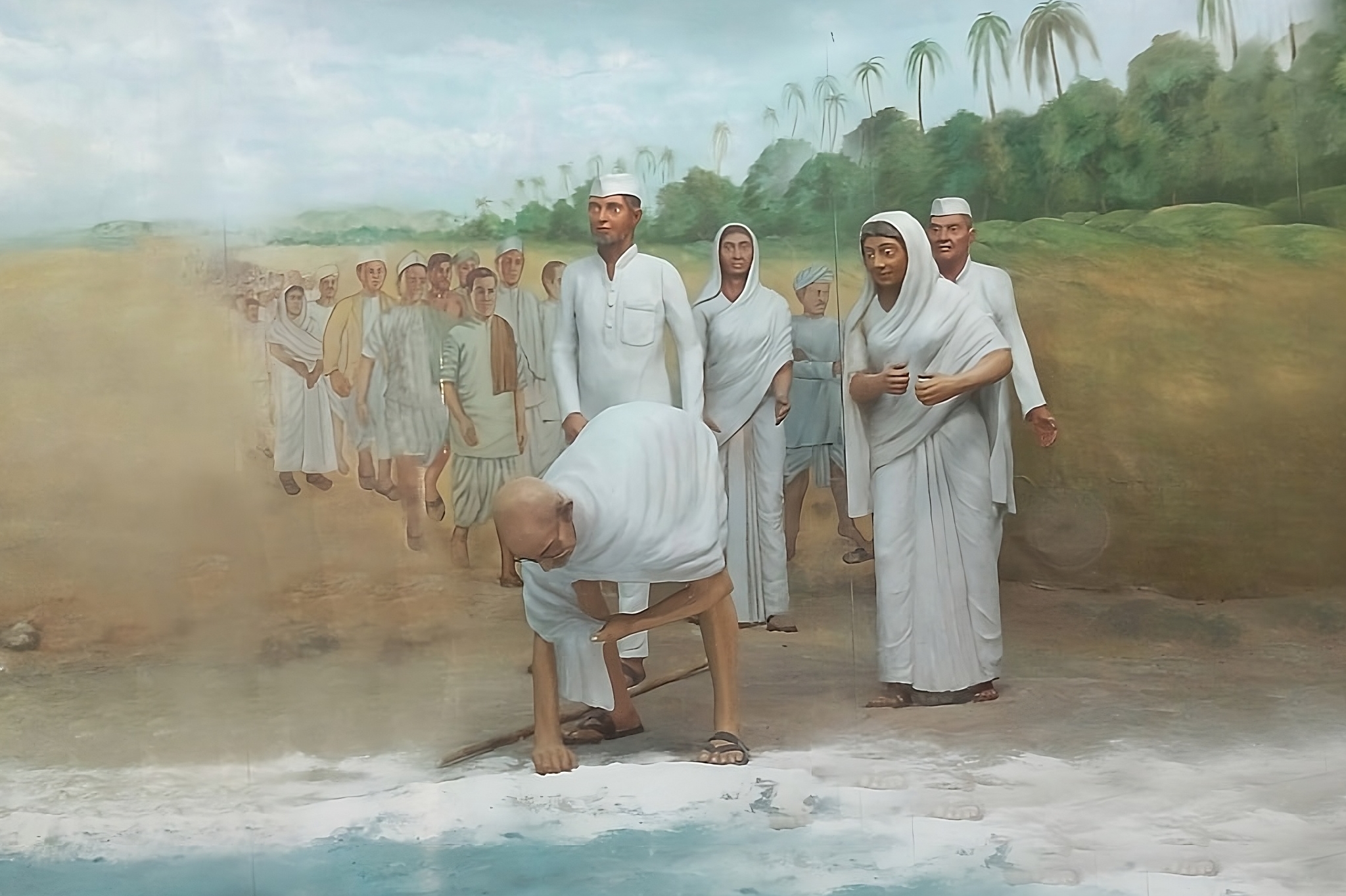
A symbol of this social journey—still alive in modern memory—is the famous Salt March Gandhi began this journey almost a century ago, in 1930, starting with a handful of eighty people, marching from Ahmedabad to the Guarat coast, gathering more people along three hundred kilometers to protest against the British Empire in a centuries-old site of oppression for India's poor. By the end of that year, sixty thousand people had joined the protest, which became the turning point that paved the way for India's independence.
In Mexico, Pietro Ameglio (Civil disobedience and other texts ) has kept alive the memory and reflection on that ethical and political act of civil disobedience, in the context of the March for Peace with Justice and Dignity initiated in April 2011. Some will say that —almost fifteen years after that outcry— Mexico is still lost, falling into the chaos of a failed state produced by necropower.
Others of us today advocate returning to the source of the "autonomies" that arise in liberated subjectivities, bodies, and territories, where human beings take root, flourish, and die to endure; this is the clue proposed by the anti-systemic thinking of the Cuernavaca School.
At its mystical core, the only way to halt the spiral of hatred is by exposing one's own body. This is how Saint Paul described it when referring to Christ: "He broke down the wall of hatred in his own body" (Ephesians 2:14). This is the quintessential messianic gesture, pristinely experienced by Jesus of Nazareth on a horrific cross imposed by the Roman Empire with the complicity of the religious authorities of the Temple in Jerusalem. A tragic destiny, but not a final one, because that offered life was transformed by his heavenly Abba and by his community of survivors into a seed of new life.
Ultimately, these are autonomous regions with a mystique of a fulfilling life, born from the excluded of all times. That is the march of dignity that never ends.
To march or not to march.
The question remains open for us today.
∂
Oaxaca, November 22, 2025
∂
Note: I would appreciate your feedback at the end of this page.

Deja un comentario