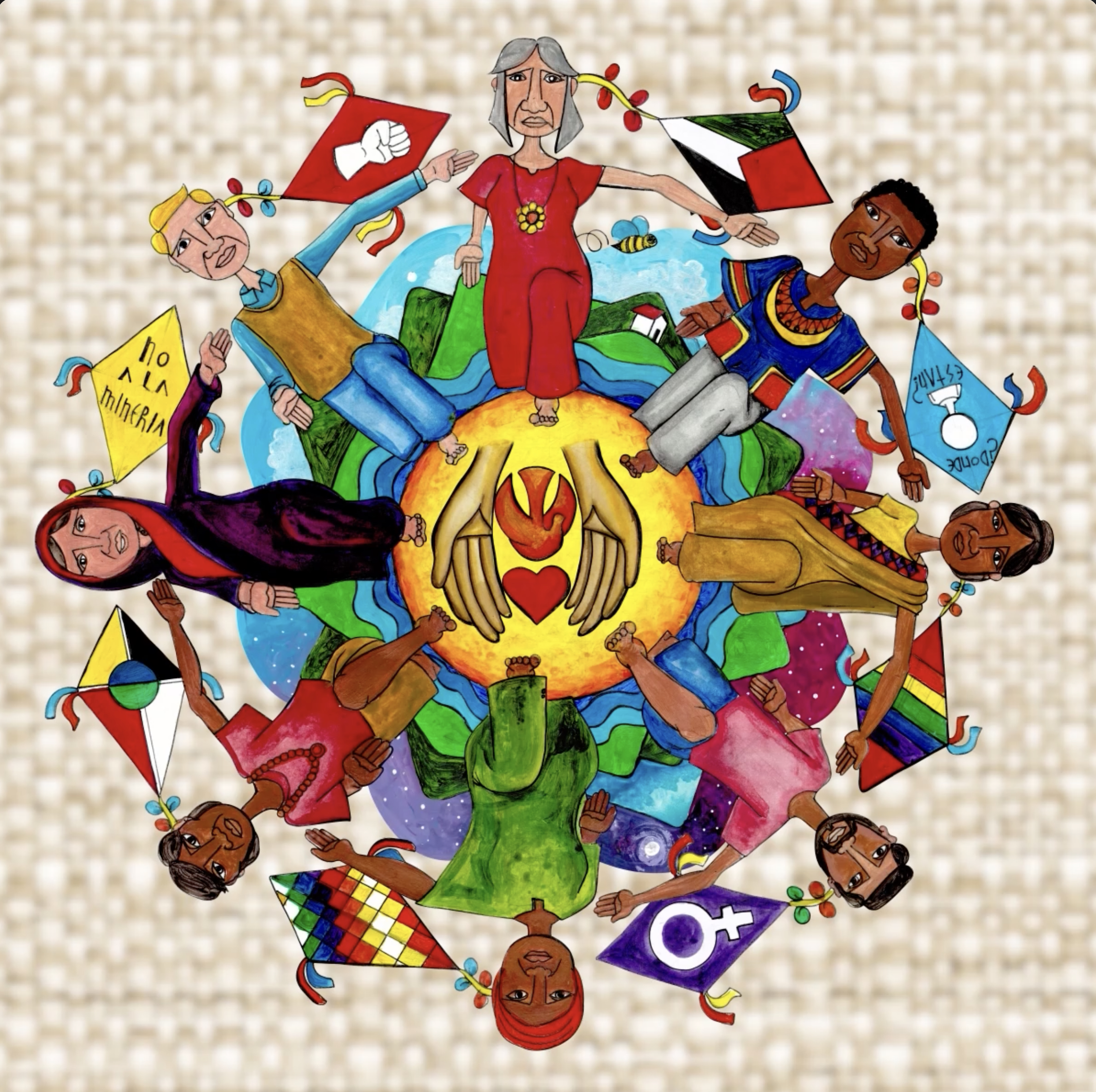
Category: Memory, victims and justice

  • JobeLab Una iniciativa de pensamiento crítico y espiritualidades diversas desde San Cristóbal de Las CasasJobeLab | San Cristóbal de las Casas, Chiapas | 2026

    JobeLab An initiative of critical thinking and diverse spiritualities from San Cristóbal de Las Casas

    By Carlos Mendoza Álvarez

    From the second half of the 20th century, Chiapas became a laboratory of new ways of inhabiting and thinking about the world, with the creative confluence of important social, political, cultural and spiritual processes.

    Among them, dynamism stands out synodal (or shared path by all the believing people with their diversity of ministries) of six decades, implemented by the Diocese of San Cristóbal de Las Casas with jTatik Samuel Ruiz as pastor walker And hundreds of local, regional, and international communities and groups, convened for justice and peace for the Indigenous peoples and other communities of this region of Chiapas. In an astonishing confluence of paths, the Indigenous Congress of 1974 marked the beginning of the public presence of Indigenous peoples with their own voice. Indigenous, mestizo, and international social and cultural movements also emerged, with research projects on the rich Mayan heritage, both ancient and modern, developed by teams of social anthropologists, archaeologists, and linguisticists. Waves of researchers arrived from Latin America, the United States, and Europe, and, with an academic model still largely based on extractive practices, made significant discoveries in the social sciences and humanities. The translation of the Bible into Mayan languages, initially promoted by the Summer School of Bible as part of a U.S. interventionist plan, evolved into intercultural dialogue, continued to this day by various Christian churches, including the Roman Catholic Church. Finally, the Zapatista movement, with its armed and media-driven uprising of 1994, became the watershed moment of a social, political, and cultural insurrection that continues to this day as one of the most radical critiques of the hegemonic system of the multi-headed capitalist hydra, including patriarchy and colonialism.

    The “San Cristóbal School” is a name proposed decades ago by Pablo Romo and others in academia and the arts to evoke the legacy of critical thought, resistance, and spirituality that emerged in Chiapas, as a counterpart to the Cuernavaca School, analyzed by Humberto Beck. In their connections and differences, both represent significant contributions to critical thought that arose in Mexico during the last century.

    In this way, recognizing the individuals, groups, organizations, and initiatives of civil society that have been an active part of these processes, as a collective inspired by them, with JobeLab -apocope of Jobel which is the Tsotsil name of San Cristóbal de Las Casas and laboratory To designate this city as a laboratory, we seek to give continuity to such a legacy in a new context, focusing on critical thinking and the spiritualities that have sustained them, such as those of the native peoples, Catholic Christianity, and more recently Buddhism and Islam.

    Through the initiative JobeLab. Ongoing dialogues and mutual support for re-existences We will continue to cultivate this heritage in the new scenario of the civilizational crisis that humanity faces in the second quarter of the 21st century, where peaceful coexistence between nations and the balance of planet Earth are at risk and call us to promote processes of resistance and re-existence.

    We will nurture this initiative based on two inspiring attitudes that are, at the same time, transversal axes of the talks, meetings and festivals that we will organize in various spaces of the city: hospitality and commensality.

    The hospitality It is one of the human gestures that most powerfully expresses our shared human condition, that is, our way of becoming individuals and communities as beings in relation to one another. This radical attitude of openness to otherness is a fundamental ethical and political act, where the religions and spiritualities of humanity celebrate a glimpse of divinity.

    The commensality, Like the other side of the moon, it is the nourishing soil where we receive the otherness of Mother Earth, of other humans who become our neighbors, and of Divinity, through food and drink created by the unique genius of each people. We celebrate this gift as an inclusive banquet where Divine Sophia prepares a table for all nations and creatures of the cosmos.

    Together with Carmen Reyes and Ricardo Hernández, Angélica Evangelista and Abraham Mena, I am enthusiastically participating in this project, drawing on the Dominican tradition of life and thought. In these exchanges, we seek to discover new expressions of the divine and human Word as a creative fire that redeems, animates, and shelters us in our present circumstances. times of hardship as a human species that puts itself and the Common Home at risk, leading us to the precipice of annihilation.

    This week two events will be the formal presentation of JobeLab, after the first event where the initiative germinated, on January 28, with a presentation on Gaza and Chiapas at the Charity temple in the city of San Cristóbal de Las Casas.

    On Wednesday, March 25th at 5:30 pm, we will hold the discussion “The School of San Cristóbal,” with the participation of Pablo Romo, who was one of the key figures in the diocesan process of promoting human rights, paving the way for the creation of the Fray Bartolomé de Las Casas Human Rights Center. Martha Elena Welsh, choreographer who animates in Xitla House In Mexico City, workshops were held to support people in situations of extreme vulnerability, facing various forms of violence. And Juan Carlos La Puente, a Peruvian with extensive international experience in providing spiritual support to human rights defenders, has been developing a methodology for this purpose from his base in Oregon, USA. permanent discernment as a path of body for people and communities in re-existence.

    And then, on Friday, March 27th at 5 p.m., we will explore another facet of re-existence: forgiveness as a path to reconciliation in contexts of violence. With the Muslim community of San Cristóbal de Las Casas, represented by Shaykh Yahya Rhodus and Shaykh Mudar Abudlghani, we will discuss forgiveness in Christian and Muslim traditions as a common path to peace, at a critical moment of violence in the Middle East. And we will do so accompanied by the extraordinary music and song of Nader Khan, a Canadian Sufi artist.

    We invite you to be a part of JobeLab From wherever we may be, whether attending talks and meetings, or imagining and creating similar spaces where we can come together and flourish as individuals and communities in resistance and re-existence, going beyond the spiral of violence that surrounds us, towards a world another world of hospitality and commensality.

    Jobel, March 23, 2026

  • Alégrate, humanidad desoladaAntún Kojtom | Guardian of Mirrors | Tenejapa, Chiapas | 2021

    Rejoice, desolate humanity

    By Carlos Mendoza Álvarez

    In the era of the Monroe Doctrine 2.0, launched last week for the “Western Hemisphere” by the global despot as National Security Strategy From the United States, it seems foolish to talk about joy.

    Some analysts, such as Michel Ignatieff, predict the end of the West along with the the civilizational erasure of Europe. Today, something is at stake. global geopolitical strategy With areas of power divided among the three dominant military and economic powers—the United States, China, and Russia—each brazenly administering a region of the planet for its own benefit, the military intelligence apparatuses of the United States and the other powers are already in operation to control entire populations and their territories through a vast military-digital system, subjugating individuals and nations that choose to oppose the might of the Maga empire and its counterparts.

    The creation of Western Hemisphere Command The deployment of the U.S. military, announced by the Trump administration this week, is part of a geopolitical strategy that has already declared war on mass immigration within its borders. It is also worth highlighting the war already underway against drug cartels, which are portrayed as terrorist groups threatening U.S. security, regardless of the civilian "collateral damage" that this new colonialism will cause, as the Israeli state has already demonstrated in Palestine before the astonished eyes of the world. The strategy of constantly threatening new tariffs that Trump has used in his first year in office has been another attempt to promote a new mode of deglobalization which seeks to subordinate the economies of its "backyard" now called the "western hemisphere" to the interests of the transnational corporations that sustain its wealth.

    The nations that for centuries were swallowed up in the Western Hemisphere during early modernity will now be trapped in the web of the voracious monster's hegemonic power. But that giant has feet of clay and one day it will fall. Until then, the destruction it leaves in its wake will be a cause of desolation on a planetary scale. Such a scenario is what Nelson Maldonado-Torres calls the Great Catastrophe —a concept I develop in a collective book on political philosophy and theology that I am currently preparing for an American publisher— seems unrelated to a reflection on the joy What could humanity expect in this hour of global misfortune? But it is precisely the only place where it is possible to speak of a meaning that transcends the apparent immeasurability of the evil that stalks us.

    Tomorrow, Christian communities will celebrate the third Sunday of Advent, known as Gaudete. The name comes from a poem by an anonymous disciple of the prophet Isaiah in Babylon, announcing to Jerusalem, the desolate city, that the time of its liberation after the exile had arrived: Gaudete Ierusalem,Rejoice, Jerusalem! (Isaiah 66:10). Like echoes of that ancient voice of resistance, the same song could also resonate in today's exiles, with new melodies according to the genius of each era and culture, as in the case of the Palestinian people, whom we will evoke at the end of these lines.

    Christianity discovered centuries later the radical motive and scope of the joy of the messianic proclamation, extending God's closeness not only to the desolate Hebrew city, but to all. messianic communities scattered throughout the Roman diaspora of that time, who have now entered the new era thanks to faith in the redeeming God, according to the words of the apostle Paul (Philippians 4:4-7):

    Rejoice in the Lord always. I will say it again: Rejoice!

    Let your kindness be evident to all.

    The Lord is near.

    Don't worry about anything […].

    And the peace of God, which surpasses all understanding,

    He will guard their hearts and their thoughts in the Messiah Jesus.

    It is about God's consolation for the little ones of the Kingdom of Heaven. They live in the interrupted time Precisely at the heart of the catastrophe. A way of existing that the dispossessed of the earth experience in their lives in a way messianic, That is, as a power to untie the knots of hatred and resentment in their bodies and territories. It is possible to perceive that murmur of a peaceful present amidst desolation in the Gregorian chant antiphon for this third Sunday of Advent, which is known precisely as Rejoice in the Lord.

    But let's turn to our own time. Who can proclaim such hope today amidst global desolation? Paradoxically, it is the victims themselves who possess that hope. power. Something that executioners will never have because their hearts have been paralyzed and are incapable of opening to joy until they reach the depths of their own desolation and annihilation. This is how Daniela Rea and Pablo Ferri describe it in the book The Troop: Why Does a Soldier Kill? by interviewing hitmen in Mexico who have come to terms with their crimes. In a collective way, the Houses of Memory which promoted in recent years in Colombia the Truth Commission They bear witness to that complex process of moving from violence to peace, based on the strength of the victims summoning the perpetrators, in order to open paths to transitional justice in a country that suffered more than thirty years of war, with four hundred and fifty thousand dead and almost eight hundred thousand internally displaced persons.

    In such experiences of transforming systemic violence from the margins of society, thanks to the persistence of individuals and communities of survivors, it is possible to receive the good news of Sunday. Gaudete from Christian liturgy as a call to learn to live an ethic of care and a summons to cultivate a spirituality of mutual accompaniment among survivors, both processes enriching each other to pave the way for fighting hope.

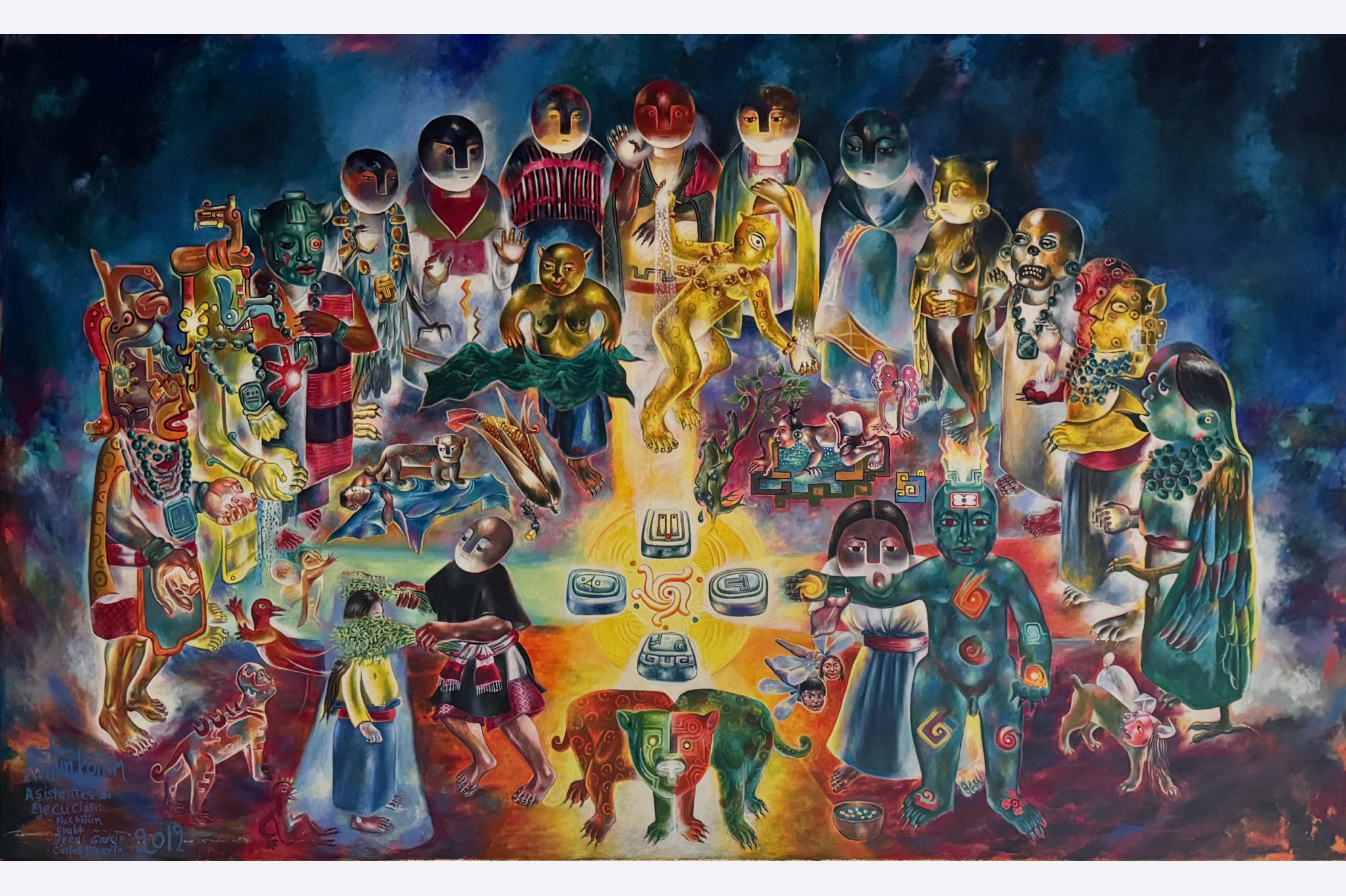
    Therefore, there is a change in tone in the hopelessness. From the purple of Advent, which symbolizes desolation, we move today to pink, the luminosity of consolation that emerges from the shadows like a small but real spark, illuminating everyone, like the painting by the Mayan artist Antún Kojtom that accompanies this post. other tonality, typical of messianic times, arises thanks to the victims who establish the sorry, That is, the overabundance of the gift. A realistic hope that does not mean blindness to evil and its perpetrators, nor a renunciation of accountability and justice, but rather a reinvention of violent history based on the overabundance of love that recreates the world.

    A new way of existing which is no longer just desolation. Nor mere resistance. But the creation of something new, Amid the ruins, from the scars left by violence, but which are transfigured as a glimmer of hope and joy: “After two hundred and fifty years of the occupation of the white settlers we are still here and that is why there is hope,” said smiling Cecelia Firethunder, shaman and historian of the Lakota people, at the past Re-existe 2025 meeting in Guadalajara.

    It is a joy that also arises as rebellious imagination from the rubble turned into a home by the Sumud or the creative resistance experienced by the Palestinian people who never tire of waiting, as the Tunisian artist sings. Emel Mathlouthi walking through the streets of an occupied Palestine:

    Broken hope

    deep

    furious

    friendly

    deceptive

    that penetrates arduous times

    eternal

    happy

    unwavering

    new

    A hope that fills my life and renews it.

    Thanks to the acts of resistance of the victims to the violence of today's global power, we can say with profound joy, without triumphalism, and with great courage: Rejoice, Gaza! Rejoice, desolate humanity! For the day of our liberation is near.

    Zinacantán, December 13, 2025

    Note: I look forward to reading your comments about possible hope today in the section below this post.

  • Sobre la esperanza en tiempos inciertosSearching Mothers | NTR | Zacatecas, 2025

    On hope in uncertain times

    By Carlos Mendoza-Álvarez

    At dusk this Saturday, the first Advent vigil begins, when Christian communities throughout the world embark on a journey, in the midst of the darkness of time, to receive the human and divine light of dignity and hope that the Messiah brings. The ancient hymn will resonate during the nighttime celebrations, Rorate caeli , whose lyrics and melody are like a lament that rises to heaven from the desolate city, crying out that “the clouds rain down on the Righteous One,” as the prophet Isaiah (45:8) implored during the exile in Babylon.

    Each year, this four-week calendar leading up to Christmas is accompanied by symbols of light, greenery, carols, sweets, tenderness, and community. According to each culture, the waiting period for the Messiah's arrival evokes the awareness that "something is lacking" for the fulfillment of those desires for new times of justice, truth, compassion and peace, not only for a people who arrogantly claim to be the only chosen ones, but for all of humanity and even for the entire cosmos.

    Every generation has seen terrible signs that the world is ending, whether through epidemics that make us feel how vulnerable our bodies and knowledge are; whether through wars waged by empires against emerging powers that threaten their arrogance; whether through the uncertainty of life itself, diminished by age, illness, failure, loneliness, or hopelessness.

    The biblical texts that we, the believing communities, meditate on these days speak of the expectation of the messiah, first with a strong apocalyptic tone that announces the destruction of the corrupt world, reaching the entire cosmos with a catastrophe that will destroy everything because of the human pride that has taken over creation.

    Then, as the date of the celebration of the Nativity of the Messiah Child, a Nazarene, approaches, the tone of the texts becomes more hopeful with the announcement of a God who is near, humanized, small, and fragile. It is the incarnate promise of a divine and human life that begins in complete vulnerability in the story of a migrant family with a newborn baby, trying to survive on the periphery of the empire and fleeing the fury of the local ruler, eventually finding refuge in Egypt, from where a definitive chapter in the history of human redemption will begin to be written.

    However, the collective depression we are experiencing today as humanity due to the escalation of hatred to extremes – which is spreading across the planet in an apocalyptic way “like a lie of Satan,” as René Girard said in an interview he gave me in 2007 in Paris (Hope as apocalypse)– this seems to render any narrative of hope for our uncertain times illusory. The genocide in Gaza continues as the climax of the Nakba or Catastrophe that began in 1947 with the expulsion of nearly a million Palestinians from their lands, paving the way for the creation of the state of Israel in 1948, this systemic violence continues today before our digital screens, met with indifference by social media and the international community. The wars in Ukraine, Congo, and South Sudan have become so “normalized” that they no longer make the front page of newspapers, much less a trending topic in the digital world. In Mexico, public indifference to urgent issues such as the crisis facing corn, lemon, and avocado farmers—caused by the violence in Michoacán—along with the persistent femicides and forced disappearances, speaks to a growing discontent among the population, expressed through strikes, road blockades, and street protests. But the masses seem numb, retreating into bubbles of entertainment and unrestrained holiday shopping, which, among other ills, leaves household finances in ruins for months and years to come.

    Religious consumerism is also part of the overwhelming Christmas marketing, amidst kitschy decorations and echoes of folk crafts used to make piñatas featuring popular characters. It will certainly be present at Mexican posadas, Trump's piñata , which is sold in various markets in Mexico and the United States, will receive blows as a ritual of revenge amid laughter and boos until the cardboard breaks and the blond wicks of the tyrant fly out like shooting stars in some tenement courtyard in Mexico City, Chicago or Los Angeles for the delight of all.

    A few families may perhaps rediscover the “mystical” meaning of the Advent wreath, following the Avatar of Carlo Acutis explaining Advent 2025. This video, which is circulating online, aptly explains the spiritual significance of the ritual of lighting each of the four candles during this season that prepares for Christmas. The light lit each Sunday of Advent symbolizes the "people who walked in darkness and have seen a great light" (Isaiah 9:2), which the prophet foretold to the Hebrew people devastated by the division between the small kingdoms of Israel and Judah, with their leaders corrupted by the idolatry of power, seeking alliances with neighboring Syria to defeat the rival tribe.

    And like a non-place amidst so much noise, creating a void in the midst of the urban clamor, in Mexico the collectives of Searching Mothers (Searching mothers light Christmas tree) will set up Christmas trees covered with ornaments bearing the faces of those we have lost. They are today “the voice crying in the wilderness” (John 1:23) because they speak on behalf of the victims of the narco-state war and the idolatry of the necropower of our time.

    Perhaps this is where the theological core of this season lies: the absence of the Messiah is something that has inspired Hebrew and Christian generations for centuries to mobilize in order to make the messianic times present through acts of remembrance, justice and an (im)possible reconciliation.

    Beyond a folkloric celebration of the coming of God-with-us, what we are about today is going to the other side of history to contemplate there, in the silence of the night, some glimmer of light that announces the arrival of the Messiah. And those who feel in every second of their lives, in every breath—like Vero and Fabiola, mothers searching for their missing children who shared their hope with us in a recent meeting in Guadalajara—the absence that hurts and motivates them to search out of love, are the ones who teach us what hope means in times of uncertainty, the heart of Advent.

    Next Monday, December 1st, the documentary Re-exists 2025 will be presented online (Presentation of the documentary Re-exists 2025), prepared by Uruguayan filmmaker Juan Meza. There, some of the stories of awakening, healing, and embodiment shared by people from seventeen countries and different religious and spiritual traditions from four continents facing diverse forms of violence where it has been possible to spell out hope.

    Advent is a time to continue weaving networks of combative hope , say the social movements on the peripheries of the empire, so that our world does not fall into the abyss. And it is possible to do so by listening to the people who for years and centuries have resisted and now accompany us in re-existing.

    Because there will always be hope as long as there are people and communities who live the end times, so insistently emphasized by Javier Sicilia and Elías González, as the opportunity to enter into another way of existing amidst violence but pregnant with the active expectation of messianic times.

    Happy Advent season!

    Mexico City, November 29, 2025

    Note: I would appreciate your feedback at the end of this page.

English