Category: Contemporary violence

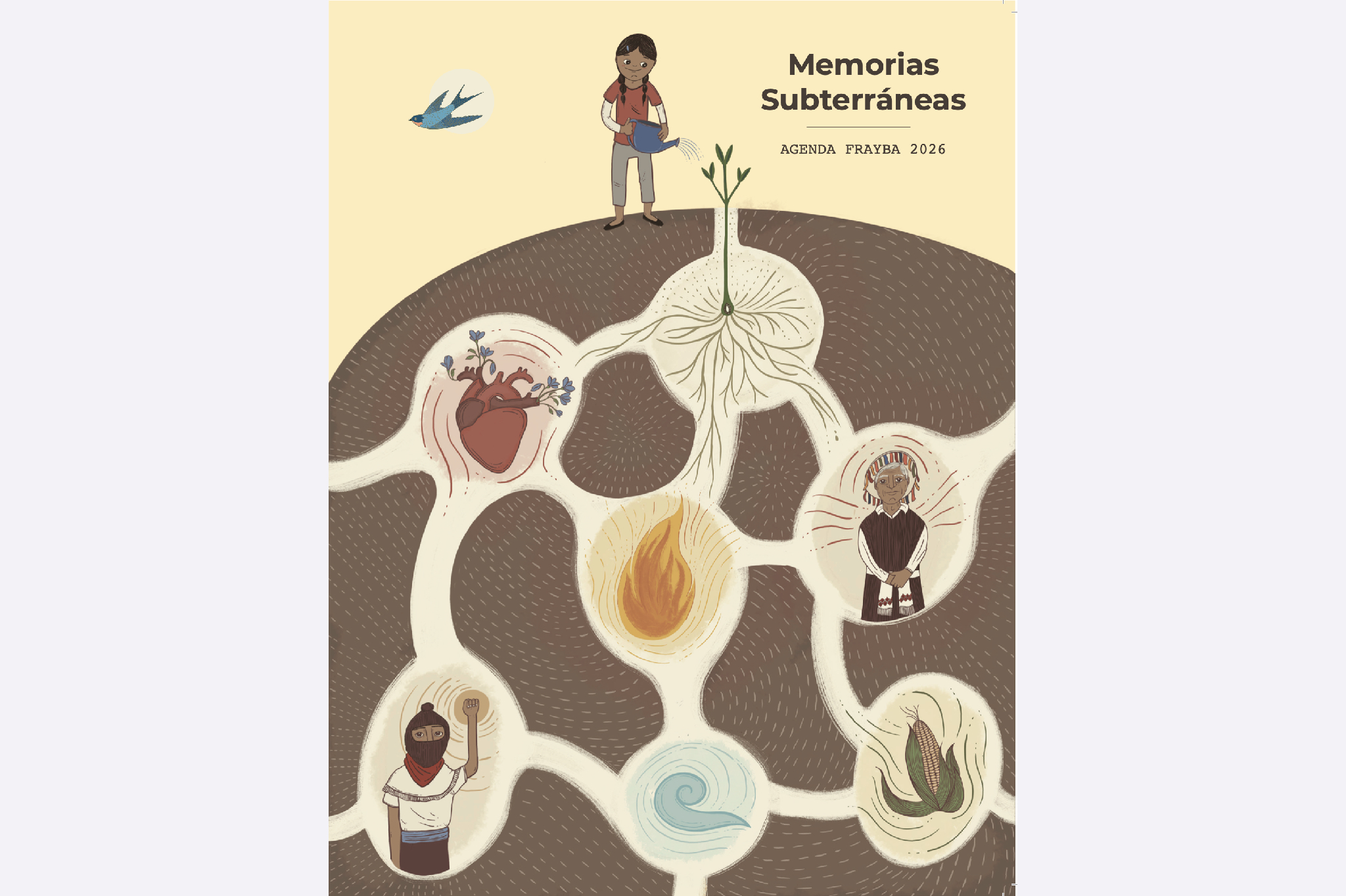
  • La paz como caminos de insurrección mesiánica Sobre la Agenda Frayba 2026 Memorias subterráneasGabriela Soriano | Underground Memories | San Cristóbal de las Casas, Chiapas | 2026

    Peace as a path to messianic insurrection About the Frayba Agenda 2026 Underground Memories

    By Carlos Mendoza Álvarez

    Last Wednesday, the presentation of the fifteenth edition of the Frayba Agenda Titled “Underground Memories,” it was prepared by the Fray Bartolomé de Las Casas Human Rights Center in Chiapas. This annual publication, since 2011, preserves the living memory of the actions carried out in the promotion and defense of the human rights of the indigenous peoples of Chiapas, as well as of people in forced migration and refugees, who have been supported by this civil society organization over several decades. Frayba -as this organization is affectionately called- was born inspired by the winds of conciliar renewal of the diocese of San Cristóbal de Las Casas and the social processes that emerged as an expression of the indigenous movement of the second half of the twentieth century.

    Three articles reflecting on the local, regional, and national context—by Jorge Santiago, founder of several ecclesial and civil organizations, Susana Montes de la Commission for Support of Community Reconciliation (Coreco) and an interview with Carlos González, a member of the Coordination of National Indigenous Congress of Government Created by Pedro Faro, these are accompanied by a valuable graphic record of the key moments of three decades of peacebuilding in Chiapas. The editorial design and illustrations by Gabriela Soriano Segoviano reflect, with beautiful strokes of contemporary folk art, the connections of the underground memories of resistance that inspire the indigenous peoples of today, as well as civil society and the churches that walk with them.

    Below, I transcribe my participation in the round table discussion, on that rainy afternoon in San Cristóbal de Las Casas.

    “There is no path to peace, peace is the path”

    Mahatma Gandhi

    This year we are commemorating three decades of peacebuilding in Chiapas: Frayba, Coreco, Sipaz, the National Indigenous Congress, the Zapatista Movement, the San Andrés Accords, and many other initiatives of civil society, churches, and social movements. These networks emerged from the fertile soil of Chiapas, prepared more than six decades ago by the pastoral plan of the Diocese of San Cristóbal with the arrival of Bishop [name missing]. jTatik Samuel Ruiz, who, after an arduous and patient conversation and journey with the native peoples, led to the birth of an indigenous Church.

    A decade later, the Indigenous Congress of 1974 fostered the emergence of a collective consciousness among Indigenous peoples as historical subjects. And finally, the rise of the Zapatista movement, with its support bases and militias, proposed a different way of living and creating the political sphere as a shared endeavor. All these processes were accompanied by a vibrant and creative current of critical thought, which arose in the Highlands of Chiapas and the canyons of the Lacandon Jungle throughout the second half of the 20th century.

    The San Cristóbal School, so named by Pablo Romo, along with the Cuernavaca School, analyzed by Humberto Bech, have been, in my opinion, the two main Mexican contributions to critical thought in the second half of the 20th century. Both provide us today with a precise direction for confronting with clarity the growing spiral of systemic violence that, with the Puerto Rican decolonial thinker Nelson Maldonado-Torres, we call here the Great Catastropheand.

    Jorge Santiago's reflection on the Frayba Agenda 2026. Underground Memories The work we present today rightly underscores the centrality of the San Andrés Accords as a crucible of decades of struggle for peace with justice and dignity. The thinker from San Cristóbal points out that the historical demands of Indigenous peoples remain relevant, and that the Mexican state still owes a debt for honoring these historic accords.

    Two pastoral letters from jTatik Samuel Ruiz and Don Raúl Vera prepared the celebration of the Third Diocesan Synod, which took place from 1995 to 1999. This process allowed the diocese to reap the harvest of half a century of pastoral life and thus give a clear path of synodality to the life and commitments of this diocese. Both letters arose in a context of uncertainty due to the animosity and conflict on the part of Vatican authorities of that time, fueled by the Club of Rome, or a group of Mexican bishops who were declared enemies of liberation theology in Mexico and Latin America.

    The first pastoral letter So that justice and peace may meet (1996) is an ecclesial response to the armed uprising of 1994. It reflects the struggle for land by indigenous peoples, as well as the commitment to justice and peace made by this diocese, following the impetus of the Second Vatican Council and the Second General Conference of Latin American Bishops in Medellín. The second pastoral letter From pain to hope, The agreement, signed by both bishops in 1998, after the Acteal massacre, is a commitment to hope amid the pain of the survivors and a pledge to continue seeking peace with justice and dignity.

    The Vatican's violence against this pastoral project would later be unleashed against Don Raúl Vera, who was transferred to the Diocese of Saltillo on December 30, 1999, in a failed attempt to dismantle the synodal process. What his detractors never imagined was that this perverse decision would become the opportunity to sow the seeds of a liberating Church, now in lands of mining extraction and gender violence, which Don Raúl would embrace with fidelity to his mission as a pastor in those desert lands of northern Mexico.

    Finally, I would like to make two final comments to continue the conversation.

    The challenges of moving forward, after three decades of peacebuilding, are now unprecedented, as we find ourselves in the uncertain moment of civilizational collapse. A commitment to justice for Indigenous peoples is no longer enough; it is essential to integrate other forms of justice, such as gender justice (sexual diversity) and ecological justice, to understand the rebellions. transmodern that build individuals and collectives of survivors in contexts of global violence. The historical strength of the poor, which the first generation of liberation theology envisioned, is giving way to the unsubmissive reason of social and ecclesial movements that are already weaving networks of mutual support, dignity, resistance and diverse re-existences.

    It is also time to reformulate the theoretical framework for thinking about systemic violence. Liberation theology requires a radicalization that arises from dialogue with decolonial thought and theory. queer/cuir /queer and intersectionality to continue supporting peace processes, transitional justice, and diverse spiritualities of life that face the ongoing Great Catastrophe.

    Let us not forget that it is our task to honor the legacy of the ancestors of the liberating Church, but from the new subjectivities, bodies and territories in resistance, with the fruits of thought, art and spirituality that emerge as messianic insurrections anticipating other worlds, of dignity and life for everyone.

    The spirituality of messianic time is an interruption of the linear time of that Chronos that devours its children on altars of bloody sacrifices. Such a messianic force arises as an insurrection. peaceful In the face of systemic violence, that is, as a break from the vicious cycle of rivalry and violence, to establish processes of mutual recognition, beyond the violence that produces poverty, exclusion, and subjugation to hegemonic powers. It is a spirituality of life in the midst of death. Another time that (in)emerges as an anticipation of other possible worlds from the survivors of yesterday and today.

    Next Wednesday, March 25, at 6 p.m., we will continue our discussion on critical thinking emerging from Chiapas, with reflections by Pablo Romo on the San Cristóbal School and experiences of a spirituality of mutual support amidst violence, presented by our friend and Peruvian colleague Juan Carlos La Puente. Both reflections will be followed by a dance performance by Martha Elena Welsh.

    See you at the restaurant Belil, in the historic center of San Cristóbal de Las Casas, where with Ricardo and Carmen as hosts, along with Angélica and Abraham, we will continue opening dining spaces, where resistances and spiritualities emerge as a commitment to permanent dialogue and mutual support in the care of life.

    San Cristóbal de Las Casas, March 7, 2026

  • Amores no patriarcalesComet Ludo | The struggle doesn't continue, it's ongoing | 2014

    Non-patriarchal loves

    By Carlos Mendoza Álvarez

    “The patriarchy is a judge that judges us for being born | and our punishment is the violence you see […] And it wasn’t my fault, not how I walked, not how I dressed | and it wasn’t my fault, not how I walked, not how I dressed…” Thus began the performance by the Chilean collective Las Tesis at the height of the #MeToo movement, shortly before the Covid-19 pandemic that would later ravage humanity. I remember how, in 2020, protests spread across the world like a rising tide: gatherings in public squares, clotheslines denouncing sexual harassment in universities, companies, government offices, and public parks. A green-and-black wave of women’s collective action confronting patriarchy.

    At that time, colleagues at Universidad Iberoamericana Mexico City denounced fellow students, professors, and administrators through the clothesline for acts of sexual harassment. Thanks to these protests, a formal institutional protocol for reporting harassment was later established at the university, managed by various institutional committees and commissions. A human rights culture was also promoted to combat gender violence, integrating this issue into the curriculum and establishing the Center for Critical Gender Studies and Feminisms. Years earlier, a doctoral program had been created to investigate this phenomenon in contemporary society from an interdisciplinary perspective, thus contributing to the strengthening of feminist and LGBTQ+ collectives, while also designing proposals for the establishment of public policies on gender equality. I was tasked, along with feminist and queer colleagues, with exploring the best ways to support this initiative from the Division of Humanities and Communication, where I worked as a divisional coordinator at that time with a formidable team of young colleagues, experts in philosophy, communication, graphic arts, administration, and academic management.

    During those years, there was also a surge in denunciations from public figures emerging in diverse cultural spheres, such as the artistic, academic, and religious communities, expressing the outcry of more than half the world's population, fed up with gender-based violence, primarily against women, but also against queer individuals and groups. Thanks to this collective awakening, I discovered the admirable work of the Indian theologian Kochurani Abraham with women victims of gender-based violence inflicted against them by male leaders of three traditional Indian religions: Hinduism, Islam, and Christianity. Their work consisted of making this age-old violence visible and accompanying women on their path to liberation from the patriarchal burden by inventing new forms of belonging to their spiritual tradition, nurtured by mutual care and creativity in their commitment to intertwining spirituality with social justice and gender equality.

    But there were also excesses, such as cancel culture, which destroyed, with a click, the lives and careers of people accused without evidence, sometimes as a settling of scores, other times as the rotten fruit of rivalry, and still others with sufficient grounds for an anonymous denunciation out of fear of the corruption networks that kept the patriarchal pact intact, a political phenomenon analyzed by Rita Segato as a mandate of masculinity in her work Counter-pedagogies of cruelty.

    The case of Boaventura de Sousa Santos touched me very personally because years earlier I had organized, together with my dear colleague and friend Pablo Reyna, a colloquium on his scientific and poetic work, to frame the Honorary Doctorate through which he was awarded five degrees from universities within the Jesuit University System of Mexico for his notable contributions to epistemologies of the South, the World Social Forum, and the ecology of knowledges. A group of colleagues from the Center for Social Studies (CES) at the University of Coimbra accused him of sexual harassment in a British publication, which was later retracted. The accusation abruptly ended his career. This crisis, at the same time, brought to light a hidden problem of rivalry within Portuguese academia and its global connections. Now, five years later, we know that the accusations have not been proven, although the damage has already been done, according to the recent account of the Brazilian philosopher Marilena Chaui. As part of this sad story, Maria Paula Meneses, the Mozambican academic, who was one of the people accused of covering up for the Portuguese author, has just passed away, and a farewell message she made public last July before her death can be read.

    How to maintain the relevance of a colossal work like that of Boaventura, Maria Paula and Marilena, with their network of conversations about the world with decolonial and anticolonial colleagues such as Silvia Rivera-Cusicanqui   and  Gladys Tzul Tzul struggling from below, honoring first the memory of the victims of patriarchy, as well as those trapped in the spiral of resentment and hatred that expands in diverse human collectives, while continuing to call for the necessary accountability and the challenge of the communal discovery of truth?

    This week I participated in the Seminar on non-patriarchal practices led by our dear friend and fellow anthropologist Abraham Mena at Ecosur. It was a virtual session that allowed us to include critical theology in the academic conversation in this intercultural and Indigenous city, as an interlocutor with other social sciences and the humanities, in order to reflect on paths for overcoming patriarchy and its toxic masculinities.

    In my presentation I emphasized the need for intersectionality as a method to connect the diverse forms of violence suffered by "the wretched of the earth," starting with women, but including people rendered disposable by a hegemonic, patriarchal, capitalist, classist, and white supremacist society.

    I was surprised by the online questions that focused on best practices for dismantling patriarchy. My guiding thread in the dialogue was non-patriarchal loves like a compass to escape the entanglement of hegemonic power with its many heads, like the capitalist hydra the Zapatistas warned us about some years ago.

    These non-patriarchal loves are dissident loves that dismantle the toxic way of affirming the human condition as power, control, and the mandate of masculinity. Diasporic loves of queer people, but also the love of cisgender people who embrace diversity in their own bodies, minds, and spirits. And as an expression of that love, I also emphasized the importance of ritual that collectives create in their diversity to celebrate life as survivors: the mothers of disappeared persons, the migrants facing the train of horror, not by chance named La Bestia, and the native peoples intertwining ancestral tradition with Christianities of diverse confessional tones.

    I recounted, as a reference point for these new forms, the history of feminist liturgies that recreate their own sacramentality from the passage of divinity through lives, the bodies and the struggles of women, as she has explored Marilú Rojas in her research on the feminist ecotheology of liberation. She also brought to heart the queer/cuir liturgies of LGBTQ+ collectives, which never cease to celebrate the queer God as an incarnate divinity. As Ángel Méndez points out, there is nothing more queer than a humanized God.

    Non-patriarchal loves are, ultimately, diasporic loves, that is to say, going out towards others in all their diversity. Gender-fluid loves that are constantly being reconceptualized, as analyzed by Sylvia Marcos in the case of Zapatista women. What matters are the people who risk living each human relationship and creature in the context of love that does not control, impose, or kill, but celebrates life in its amazing diversity.

    Non-patriarchal loves that must be discovered in each story of those who dare to go out and encounter others (across differences and beyond them) as gift, offering, call, caress, cry, and communion.

    San Cristóbal de Las Casas, February 14, 2026

    Note: How do you weave together non-patriarchal loves?

  • Las flechas de San Sebastián Luces y sombras de una fiesta zinacantecaCarlos Mendoza Alvarez | San Sebastian | Sot'sleb, Chiapas | 2026

    The arrows of Saint Sebastian Lights and shadows of a Zinacantecan festival

    By Carlos Mendoza-Álvarez

    One of the emblematic martyrs of the time of Roman persecution in the beginnings of Christianity, pierced by arrows in his naked and vulnerable body, has been venerated for seventeen hundred years by diverse peoples who recognize in Saint Sebastian humanity mortally wounded by empires that supplant divine glory.

    In the Highlands of Chiapas, the saints are adorned with flowery cloaks, colorful ribbons, and mirrors that reflect alternate worlds where the Ch'ulel It dwells, with its avatars that protect or threaten those who approach its spheres of power. In Chamula, according to oral history, the saints can be punished for a time if they do not respond to the pleas of their faithful devotees: they are placed against a wall for a while, until their grace manifests itself. I have not found that custom in the lands of Sot'sleb, or place of bats, known as Zinacantán, a name documented by the famous anthropologist and linguist Robert Laughlin. But I have been surprised by the profusion of life in the garments with which they adorn the images of the saints: the Christ of Esquipulas, the Guadalupana, Saint Jude, Saint Lawrence and Saint Sebastian are the images that increase their clothing for their annual festival, in an overabundance of colors and textures that leave their faces and hands exposed, with their bodies imperceptible before such a profusion of life.

    What lies behind so much flowery beauty? How can I approach with devotion those images that transcend the ordinary in such an avalanche of flowers and decorations that sometimes seem to overwhelm those we reverently invoke?

    I found the key in the arrows of San Sebastián during its three days of popular festival in the municipal capital of Zinacantán.

    People from all the surrounding areas and neighboring towns flood the streets of the village and the plaza next to the church of the martyred saint in a lively festival that blends ancestral traditions like the jaguar tree with fleeting horse races. Asking the young catechists about the meaning of these traditions... performances Today, I heard different interpretations, more or less confused, which always concluded with the laconic phrase: “it is the custom”The jaguar climbs the trunk of a tree that was chosen a year in advance in the sacred hills The surrounding area. This tree is visited and venerated three times by those in charge of the tradition before being cut down and taken to the center of the plaza. During the festival, the trunk becomes the center of a ritual that commemorates the three days of darkness spent praying for rain and abundant harvests. From this trunk, standing upright in the ground, a man dressed as a jaguar—wearing a suit of Chinese fabrics crudely imitating the skin of the rain guardian—throws stuffed squirrels and eggs to the crowd gathered around, accompanied by young people dressed in black who play and dance as a troupe during the festival rituals. The horse race runs along the main avenue at the beginning of the day and again in the afternoon, recalling, according to some, the arrival of the Spanish—a memory that marks the time and space of the festival brought by the friars?

    During those days, like stepping back in time, the popular festival blends traditional dance and music—performed with deliberate slowness before the Tsotsil green altar of the Three Crosses, where the image of Saint Sebastian is placed—with the deafening roar of the band in the bandstand, which overwhelms those present but provides the perfect soundtrack for the celebration. And at night, everyone eagerly awaits the Sinaloan band concert, when the thumping drums mingle with the firecrackers and fireworks displays prepared to light up the sky.

    Amidst that endless surge of color, sound, and movement, I pause to approach the saint who is the reason for the festivities. I look for him on the altar in the atrium and then inside the church at the main altar. In both places, I can barely make out his face. Through his vestments, an arrow pierces his arm. And there is no way to see his lacerated body.

    Then I recall conversations I've had in past and recent years with young Indigenous people from diverse sexual orientations who have confided in me about their suffering from living in the shadows in their communities. It was unimaginable for them to be able to celebrate San Sebastián as their patron saint, to be part of the celebration, as so many Catholic communities around the world do. They celebrate it only in the silence of their hearts and their prayers. And I realize the arrows that continue to pierce the wounded body of the martyr. The vulnerable bodies of these young people today are adorned with floral fabrics, like everyone else in the community, but those bodies are not recognized in their difference by an ancestral culture to this day.

    I wonder if those bodies that live in the shadows today will one day be able to come into the light, with the love and responsibility that calls us all, as other Indigenous cultures have done for centuries. Years ago, the same question arose in conversations with women from the Zapatista grassroots and civil society who were forging a path in their own personal and communal histories to be recognized as life partners, living together as mothers with their children, and with a clear community and political commitment to defend their peoples. Today, the Zapatista narrative speaks to us of others –as he masterfully recounts Sylvia Marcos by exploring gender fluidity in Mesoamerica - finally making visible the experience of different lives and bodies as valuable and essential voices in the human symphony and the world to come.

    With a burning heart I sow a candle in front of San Sebastián in the name of those young people so that they may soon emerge of the shadows of the shadows of the shadows and live their lives joyfully in the midst of the community.

    The lights and shadows of the San Sebastián festival continue to be a revelation and a concealment that calls us to see with wide-open eyes the world around us where divine and human glory bursts forth as a promise of life for all.

    Sots'leb, January 24, 2026

    Note: I look forward to your comments below to continue the conversation.

English