Autor: mendocinomx

  • De manglares, esteros y mundos otrosCarlos Mendoza Álvarez | Altar with bat-jaguar-snake face | Old Church, Structure C-3 | Tonalá, Chiapas, 2026

    Of mangroves, estuaries and other worlds

    By Carlos Mendoza Álvarez

    The tide is visible in the distance on the horizon that opens up at the back of the estuary, among the mangroves of Boca del Cielo. The poetic name of this secluded beach in Chiapas is a prelude to the much-desired rest for the small community of friars, exhausted after forty intense days of religious and cultural activities in the Highlands of Chiapas. This period culminated in the climax of Holy Week, experienced with profound devotion by diverse communities throughout these lands.

    The Chiapas coast is still protected by mangroves and estuaries that stretch along its shoreline, from Oaxaca in the northwest to Guatemala in the southeast. Small-scale tourism has not yet disrupted the lives of its inhabitants, mostly Zoque people who have lost their language and customs, but retain a vibrant spirit in their eyes and open smiles. Mariana welcomes us to her palapa with seafood dishes from her coast, such as sea bass, shrimp, and tilapia, accompanied by refreshing drinks of mango, pineapple, melon, and tamarind. She is the heart of the business, along with her teenage son and their pet, Oso, a beautiful white puppy with curly fur and dark circles under his eyes that make him look like a panda in reverse.

    Instead of a swimming pool, the small hotel has direct access via a short flight of steps to the estuary's warm, calm waters, occasionally enlivened by a strong current in the farther area, near the sandbar that protects the channel from the open sea. Further out, a few lizards hide, having fled to sparsely populated areas, where some communities—like the Madresal ecotourism complex—preserve them in breeding centers. It must be said, however, that these initiatives are modest compared to the urgent need to protect the estuaries and their endangered wildlife. The turtle hatchery on Boca del Cielo beach, for example, is only operational for a couple of months each year during the summer, neglected by the local population focused on tourism services, and left to languish due to the indifference of the local government.

    Due to the melting of the polar ice caps caused by climate change, the scientific community predicts the disappearance of many of the planet's low-lying coastlines, such as mangroves and their estuaries, with the sea invading these areas of biodiversity at the boundary between salt and fresh water as tides rise.

    Two millennia ago, in the mountains bordering these beaches, the Mixe-Zoque culture flourished. The archaeological remains of the sacred site—today known as Old Church The crosses carved into some of the stones on the pyramid slopes are of impressive symbolic richness. A central pyramid represents the body of a turtle, its corners mimicking the flippers of the reptile of longevity. The giant head lies at the foot of the stairway, welcoming the pilgrim in a gesture of cosmic sacredness. Stelae of varying sizes, weathered by relentless time and broken in two by ceiba tree roots, are engraved with polymorphic faces that combine the ears of a bat with the snout of a jaguar and the eyes of a monkey and a snake.

    And in the heart of one of the central plazas of the sacred site, which covers more than sixty hectares—located on the plateaus of Tepancuintla Hill, some 700 meters above sea level in what is now the municipality of Tonalá—lies a monumental stone of iconic power similar to the Aztec Sun Stone or the stele of Pakal's tomb in Palenque. The black granite monolith has four faces, each pointing to a cardinal direction: three are human (two men and one woman), and one is zoomorphic, a hallucinatory fusion of sacred animals from the mountains that shelter its inhabitants.

    The local guide told us that this jet-black stone takes on blue hues at certain times of day, convinced that it's like a gateway to the world of the ancestors. To honor his word, I approach it with reverence, walk around it, caress it without touching it, and perceive an ancestral memory that dwells within it and welcomes us with force.

    Two hundred kilometers to the south, the Mokaya culture sowed the seeds of Mesoamerican cultures four thousand years ago, even before the Olmecs, who are recognized as the cultural matrix of Mesoamerica. I already cherish in my heart a future trip to those lands, near the border with Guatemala, to let myself be touched by their wisdom made of stone and pottery, unknown to us today only in their music and oral traditions.

    I began this story by recounting tales of estuaries and mangroves. But upon rereading it, I realize they were merely a gateway to another world, one inhabited by the Mixe-Zoque and Mokaya peoples who lived in these mountains and navigated these waters millennia ago. Their ancestral memory became a cosmogony carved in stone, pyramids constructed with enormous monoliths of granite and volcanic rock, marked with cosmic and human symbols, such as the sun, the knot, the face, and the hand.

    What memory will we leave for future generations two thousand years from now, when someone visits the ruins of our neighborhoods and cities, now dominated by steel and cement? Will they find technological ruins of algorithms and avatars on the internet that can be rescued from oblivion? Perhaps some holograms will be preserved in the cloud, concentrating the wisdom of humanity, lost today in its pursuit of power and money.

    For now, the door to other worlds remains open.

    Boca del Cielo, April 11, 2026

  • De triduos pascuales en las grietas del mundoCarlos Mendoza Álvarez | Easter Vigil | Sots'leb 2026

    Of Easter Triduums in the Cracks of the World

    By Carlos Mendoza Álvarez

    A microcosm unfolds at every turn in the Highlands of Chiapas, like parallel worlds with secret passageways connecting ancestral traditions and modernity. It's possible to explore them by sharpening your gaze and silencing the outside noise to listen to the sounds that resonate within each space.

    Here you can step through the tunnel of time in an instant upon entering the temple of Sots'leb where women and men dressed in flowery costumes wander about, engaged in prayer, sowing candles to the saints, adorning the images with thousands of flowers. The processions in the atrium are like a spiral of cries mixed with pom Or incense, colors, chants, and prayers. All that religious commotion stops at the culminating moment of Christ's elevation on the cross. Then the entire community falls to its knees before the Nazarene, accompanied by his Mother, with Mary Magdalene and John the Evangelist at his sides.

    And suddenly, in the same town of Zinacanteco, ministers appear filming with their cell phones, media personnel are live-streaming the procession with their cameras mounted on stabilizers, and young people are chatting with their friends in Tsotsil about the upcoming praise concert that the Alfarero group will offer on Easter Sunday in Navenchauk. Technology connects them to cyberspace.

    Just a few kilometers away, in the coastal region, another ritual, now mestizo and baroque, celebrates Good Friday with pious fervor. Hooded penitents, images of the Holy Burial, Our Lady of Sorrows, Saint Mary Magdalene, and Saint John the Evangelist are carried on litters, accompanied by the faithful advancing solemnly in the silent procession. The procession begins with a tall cross and two processional candles, followed by friars in their white habits and black capes, and some hooded figures playing the mournful drum. We walk slowly along the pedestrian walkway filled with tourists who stroll, stop, film with their cell phones, and continue on their way with disdain. A few people cross themselves, but most ignore the religious ritual. A group of young urban Indigenous women caught my attention; they were coming from the opposite direction. As if angry and laughing mockingly, they sped past, challenging the group of worshippers. Was their anger that of adolescent youth, or did it express some centuries-old resentment? I'll never know. Shopkeepers and drivers grew nervous at the slow pace of the procession, but they didn't honk their horns. In contrast, the loudspeakers of businesses that try to attract customers with loud, vulgar music didn't stop blaring. Their noise drowned out the rumble of the silent procession's drum, despite the attempts of some believers who approached and asked the employees to turn off their horns for a few minutes. Nevertheless, the faithful advanced undeterred in the procession, while the spectators on the sides followed its course like flies to other delicacies.

    This is how the holy days pass, between parallel worlds that sometimes touch, but most of the time ignore each other.

    In a suburb of Jobel, the Zapatista community gathers to talk about love and heartbreak, about criticisms of the pyramids of privilege, and about resentment as well.

    More than five hundred people registered, from more than forty different “geographical” places, to hear the wisdom of Commander Moses lecturing - with a slow narrative, accompanied by powerful flashes - on the Common as an alternative to the pyramids of yesterday and today, structures of privilege and command, including the Ezln organization itself.

    The presence of three girls at the table represented children in resistance, accompanying the Subcomandante and the Captain. A symbol of the Zapatista movement's intergenerational vision that envisions other possible worlds In 120 years, to gradually bring them closer as a legacy for new generations of children and youth. Through communal agreements, from now on the assemblies will include the Zapatista base and other communities that do not necessarily share their organization, but do share the yearning and commitment to justice: “Nothing for us, for everyone… the Commons,” declared the insurgent Subcomandante Moisés emphatically.

    One day, the Captain surprised many people and communities by speaking of “the progressive Catholic Church that wanted to destroy us.” This is a topic that deserves careful consideration by its main actors, explored within the social and religious context of the time, to move beyond accusations that perpetuate the spiral of rivalry, resentment, and hatred. One cannot simply erase six decades of a liberating Church—with its strengths and weaknesses, of course—that has yielded rich fruits of collective memory, dignity, and the empowerment of the Mayan peoples in these lands.

    On Saturday night, thousands of Christian communities around the world gathered to celebrate that Life is stronger than death with the new fire ceremony. In Sots'leb, the Easter Proclamation, sung in Tsotsil by Paco Torre, enveloped the community in the darkness with the radiance of the light of the Crucified one who awoke.

    The Easter Vigil reminds us that - in the midst of the night that the victims of yesterday and today are going through - AbbaJesus pronounces a Yes, definitely., rescuing his son from Sheol, the abyss, the underworld, to open in the walls of the past and present hegemonic world a crack of hope through which full life emerges for the entire cosmos.

    And it will be a woman, Mary Magdalene, who first dares to see, to recognize, and to mobilize her grieving community to move beyond rivalry and resentment over the torture and execution of their Rabbi Jesus as a criminal on a Roman cross, with the complicity of the enraged mob in an exemplary lynching. Together with the other women of the Galilean community, the call is to “go to Galilee,” to encounter their resurrected friend and teacher, continuing his dream of a humanity wounded and healed by the unconditional love of God. Abba in the strength of his Ruah divine.

    By rereading the Hebrew Scriptures, like the disciples on the road to Emmaus, that nascent messianic community was able to receive glimpses of another world come from the God of life.

    Happy Easter!

    Sots'leb, Jobel and Navenchauk, April 5, 2026

  • Trilogía cuaresmal en los Altos de ChiapasCarlos Mendoza | Ansetik, Lent in Sots'leb | 2026

    Lenten Trilogy in the Highlands of Chiapas

    By Carlos Mendoza Álvarez

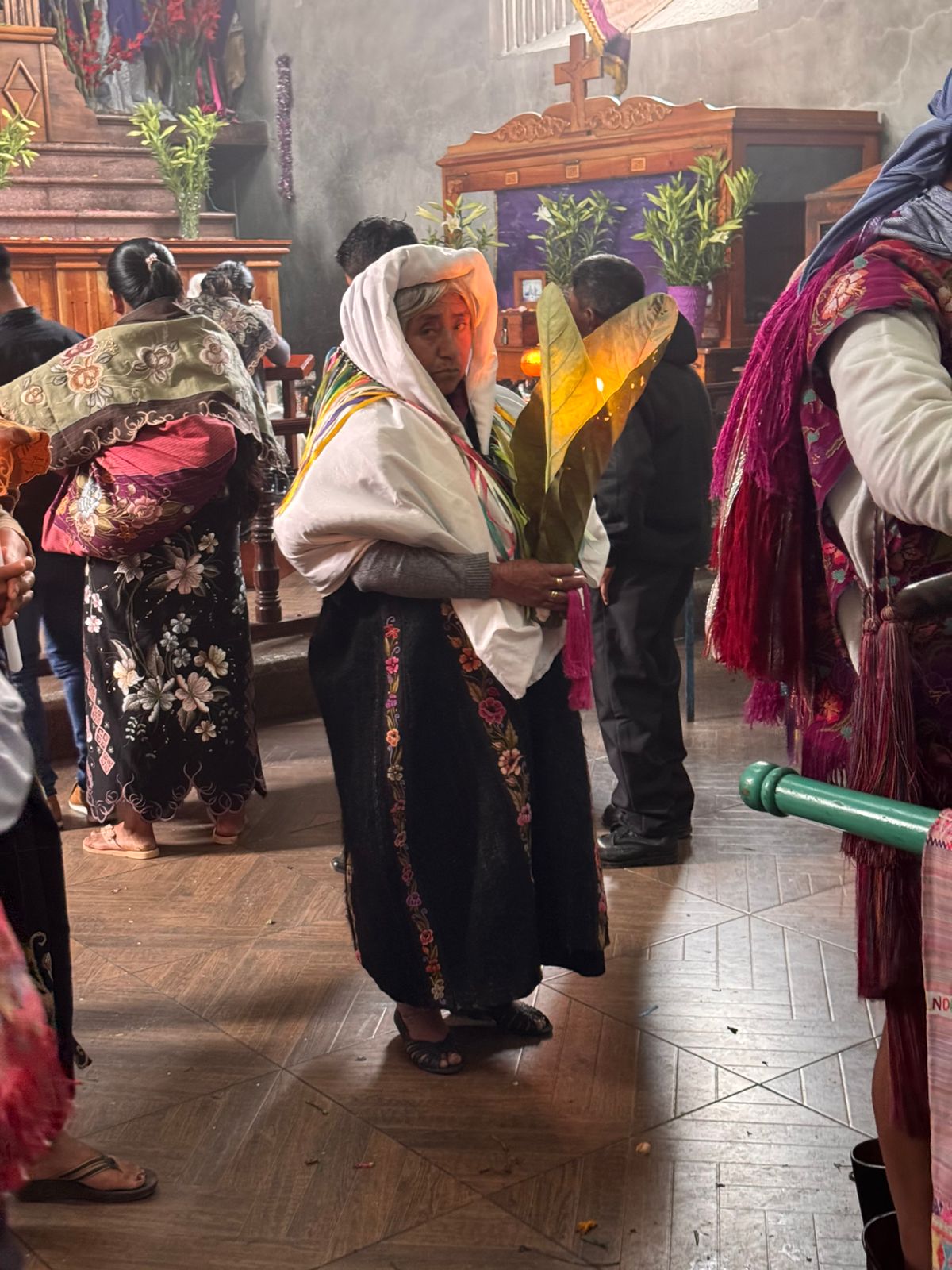
    On the fourth Friday of Lent, it is a Zinacantecan tradition to begin the rituals of covering the saints with purple cloths over their faces and placing flower mats at their feet, accompanied by prayers, candles, incense, and ancestral music, to prepare them for Holy Week, the culmination of the celebrations. Mayordomos, alférez, temples, and sacristans—titles of the lay guardians of the tradition—bear the heavy burden of the preparations, while the ansetik (Women) lie for hours, dressed in their black skirts embroidered with flowers and a white headdress on their heads, adorned with colorful ribbons, sitting hieratic with a candle in their hands, wrapped in large leaves of Ch'entikal jabnal, praying to the cohort of saints on behalf of the community.

    At the same time, in several Zinacanteco-related areas, massive concerts are being organized for Easter Sunday, featuring modern Christian music that will bring Tsotsil youth together around famous international worship groups. These concerts have a charismatic and intimate devotional style, closer to the urban, Protestant-influenced trends so popular in Central America, Brazil, and the United States. The organizational effort for these events is evident, as are the high costs involved, and the colonization of the collective imagination that these forms of modern Christian music represent. These modern Christian music is so popular for its use of pop rhythms and instruments, and its individualistic and sentimental mystical tone, so prevalent in the Western world.

    Both currents of Christian religious culture, traditional and modern, coexist in the same Zinacanteco territory, sometimes flowing like streams into a single river, other times running through separate channels leading to different paths. The crucial question is whether both currents can nourish the communities and strengthen their unity in the face of the new challenges posed by the flower industry and the burgeoning commerce that has significantly raised the standard of living for the Zinacanteco people, bringing new ways of life. Or, will these religious differences provoke a schism that weakens the social fabric that, for centuries, has withstood cultural onslaughts in both colonial and modern times?.

    Just 12 kilometers away, the city intercultural San Cristóbal de Las Casas is a bastion of Roman Catholic religiosity, with a strong emphasis on vibrant pious devotions and a sacramental practice unlike anything I have ever witnessed in Mexico in my thirty-eight years of ministry. In the last four months, I have seen confessions unlike any I have ever seen in my entire pastoral life. Thousands of people approach the confessional with devotion and trust, most with a conscience focused more on the complexities of sexuality and individual vices than on caring for their neighbor like the Good Samaritan of Jesus' teachings and caring for Mother Earth as the poorest of the poor, as Leonardo Boff reminded us, a message echoed by Pope Francis. Devotional celebrations are multiplying in every neighborhood, whether to celebrate the patron saint or to observe Lent with prayers and rigorous religious practices.

    In that context, I proposed a series of Lenten meditations in the Temple of Santo Domingo, during four Thursdays of Lent, to offer alternatives for preparing for the Easter of Jesus inspired by the spiritual tradition of the Dominicans and the mysticism of the Mothers and Fathers of the desert.

    Following the meditative path of Lectio Divina, Every Thursday we began with a light meal, as a way to prepare for biblical meditation. At the start of the meeting, I would highlight some central theological points of the narrative to be meditated upon, read through the lens of medieval and contemporary theology, such as the feminist exegesis of the prophet Hosea and the Samaritan woman, the decolonial theology of disability, and mysticism. apophatic or the refusal of Meister Eckhart.

    The following minutes were intended to focus on body posture, external and internal silence, and rhythmic breathing, in accordance with the ancient practice of heart prayer. Hesychasm, tuning the inhalation to the ancient phrase Kyrie eleison to thus receive divine compassion within, holding the air-spirit for a few seconds, followed by exhalation with Christe eleison to offer the world the life they had received. With the help of Abraham Mena as instructor, that initial breath was accompanied by brief reflections to focus the heart on the biblical text for each Thursday: the desert as a spiritual place, Jesus in the desert, the man born blind, and the Samaritan woman, as stories to learn to to be born againwhich is the Lenten journey that leads us to Easter. One of those sessions was accompanied by music from Handpan, a modern percussion instrument created in Switzerland at the beginning of this millennium, inspired by the ghatam Indian and the gamelan Indonesian music to be played with the hands, music that awakens to the sound of divine harmonies.

    Once our bodies, minds, and hearts were prepared, we carefully read the passage from the Bible that told the story of Jesus' encounters with vulnerable people in the process of resurrection, inviting each person to pause on a phrase, perhaps a single word, that captured our intention, to inhabit this text and allow ourselves to be inhabited by a sonorous word that is alive as the divine Word.

    We concluded with a reflection to connect what we had experienced with everyday life, in the present context, and with a song from the musical tradition of the ecumenical community of Taizé, in France, which allowed us to close with a moment of gratitude and praise, to be sent back into the everyday world to bear witness to what we had meditated on.

    And as part of the Lenten triptych in the Highlands of Chiapas, we launched the initiative JobeLab with a discussion about the San Cristóbal School as one of the vertices of the triangle of critical thinking, re-existences of collectives confronting violence and the mutual support of people and communities open to the breath of Ruah divine in the cracks of society.

    The exhaustion of the civilizational model we knew as modernity, with its expression of colonial Christendom, had already been diagnosed sixty years earlier in Cuernavaca by figures such as Ivan Illich, Don Sergio Méndez Arceo, Abbot Lemercier, and Sylvia Marcos. In Chiapas, jTatik Samuel Ruiz, the indigenous movement and the academic community close to the Mayan peoples had also grasped the need for new ways of life, communal organization and renewed ancestral spirituality as paths to follow in times of escalating violence and exclusion.

    We had the privilege of hosting a gathering with the Chamula Muslim community of the city, accompanied by Sheikh Mudar Abdulghani. Together, we welcomed Sheikh Yahya Rodus and an international group of Sufi students for a shared reflection on God's forgiveness as a path to reconciliation among peoples in this time of violence perpetrated in God's name that is spreading throughout the world. With music by Nader Khan, a Pakistani-Canadian musician, we celebrated the meeting of two venerable spiritual traditions, Christianity and Islam, which, in their Sufi and Dominican versions, have experienced moments of mutual learning in the mysticism of silence, detachment, and the source of divine mercy.

    From the Highlands of Chiapas now, as part of a flow of diverse thought and spiritualities that runs through these lands, we explore those porous areas of thought, culture and modes of communality that heal wounded humanity and the devastated Common Home.

    Announcement of another possible world which, in Christian terms, we call messianic anticipations of the resurrection.

    Sots'leb and Jobel, April 1, 2026

English