Autor: mendocinomx

  • La llamada a la itinerancia De Boston a la Condesa y JovelAntún Kojtom | Drop of water in the navel of the earth | Tenejapa, Chiapas | 2020

    The Call to Itinerancy From Boston to La Condesa and Jovel

    By Carlos Mendoza-Álvarez

    .

    It has been seven months since I left Boston, following the unfortunate episode of academic censorship and the growing risk of criminalizing university research in the Trump era.

    Upon returning to my homeland, I had the good fortune to stay for several months at the Dominican house located in a hipster neighborhood of Mexico City. The liturgical atmosphere of Holy Week deepened the process of mourning and resurrection that such a loss entailed, creating a pause to allow my emotions to settle and prepare me for the next stage of life. The Easter Triduum helped me feel how divine Life flows in the depths of my heart. This perception grew in the following months, thanks to the company of extraordinary people and communities I was able to visit during the summer in various parts of the world as part of my theological service.

    Extraordinary scenes from that journey come to mind, like the gaze of a refugee pleading for empathy, or the sound of the waves crashing against the South African cliffs. I carry in my heart the image of the modest altar—true in its prayerful simplicity and closeness to others—of the Jesuit community in Mapuche territory. The conversations in Turkey with a handful of friars and sisters of the Dominican Order still resonate in my ears, as we searched for signs where today we might recognize the messianic times that are slow in coming. Each morning, the rituals of women healers from Malaysia, Dakota, India, and Kenya, gathered in Guadalajara, rise powerfully from the depths of my heart, with scenes that remain etched in the documentary Re-Existing 2025, lingering like flashes in the middle of the night.

    During several months spent in Mexico City, I was able to glimpse the changes taking place due to gentrification in an urban neighborhood, brought about by mobile populations—in this case, the “digital nomads” from the Global North who displace impoverished inhabitants in the South, while simultaneously enriching the local culture with new flavors and knowledge. In religious terms, as I mentioned earlier, I became aware of the fragmentation of the world of human interiority, which some call spirituality, but which designates a wellspring of transcendence that flows in every person as it evokes Lanza del Vasto in his poetry A Holy Source often desiccated by the vulgar marketing of religion. I was surprised to find in the temples a revival of popular Catholicism of devotions among young people who cling to piety without much interest in the prophetic spirit of Christianity of the conciliar renewal of more than half a century ago that placed justice linked to the experience of faith at the center of Latin American Christianity.

    .

    .

    And finally, after a wait filled with days and nights of uncertainty, I was able to travel to Chiapas to put down roots and build connections in those Mayan lands in the years to come. I was looking for a “place” to inhabit, or, as the beloved master of the Dominican order, Friar Timothy, now Cardinal Radcliffe, said in his book The fountain of hope, an “ecological niche where we can flourish”, amidst the diversity of flora and fauna of the human condition, another way of describing our similarities and oddities when it comes to living in community.

    Jovel, either land of wetlands and pastures, the valley where the colonial city of San Cristóbal de Las Casas was established, as the indigenous peoples called it, had received the Dominican novices in 1980 when we visited these lands, accompanied by our teacher, Friar Raúl Vera, who even then showed a pastoral zeal for the peasants in Amecameca and for the mayan villages from Chiapas and Guatemala. Since then, a little piece of my heart has remained here, revived by the annual visits to San Cristóbal and Ocosingo with my university classmates from Servandus Missions of the University Parish animated by the Dominicans in Mexico City.

    My several-month stay in Ocosingo in 1994, following the EZLN uprising, is an experience that has left an indelible mark on my connection to the indigenous liberation movement and the mystique that sustains it. This insurrectionary movement had found fertile ground in the work of jTatik Samuel Ruiz, the Wanderer, accompanying the indigenous and mestizo peoples of the Diocese of San Cristóbal de Las Casas since 1961. His conversion to the poor, inspired by the The Pact of the Catacombs. During the Second Vatican Council, his commitment was further solidified by his active participation in the Latin American episcopal conferences in Medellín, Puebla, Santo Domingo, and Aparecida. The Indigenous Congress of 1974 —where the Dominican friar Enrique Ruiz Maldonado actively collaborated on the occasion of the fourth centenary of the death of Friar Bartolomé de Las Casas, the first diocesan bishop of San Cristóbal— a watershed moment would be marked in the adoption of the indigenous cause as the backbone of the preferential option for the poor made by the diocese located in the Highlands of Chiapas and the Cañadas of the Lacandon Jungle. As a corollary to this path, the Third Diocesan Synod which concluded in 1999, as one of its participants, Sister Celia Rojas recounts, would ratify four decades of opting for the poor and promoting an Indian Mayan theology as the most complete expression of the inculturation of the Gospel according to the conciliar spirit.

    Returning to these lands permanently, forty-five years later, now means being prepared to face new challenges that were unforeseen in the last century. One of these is perhaps the situation of migrant Indigenous children and youth in symbiosis with urban culture and digital media, which is generating new Indigenous subjectivities caught between tradition and modernity. Thanks to dear friends like Geovanni Nájera of Semillero 259 Yara and Sebsor of Psicolexia,For example, I'm beginning to enjoy and understand a little more those other expressions of contemporary indigenous urban tribes. Through urban gardens, hip hop and rap, street art and graffiti, among other aesthetic and social expressions, the initiatives they promote are the seeds of something new.

    .

    .

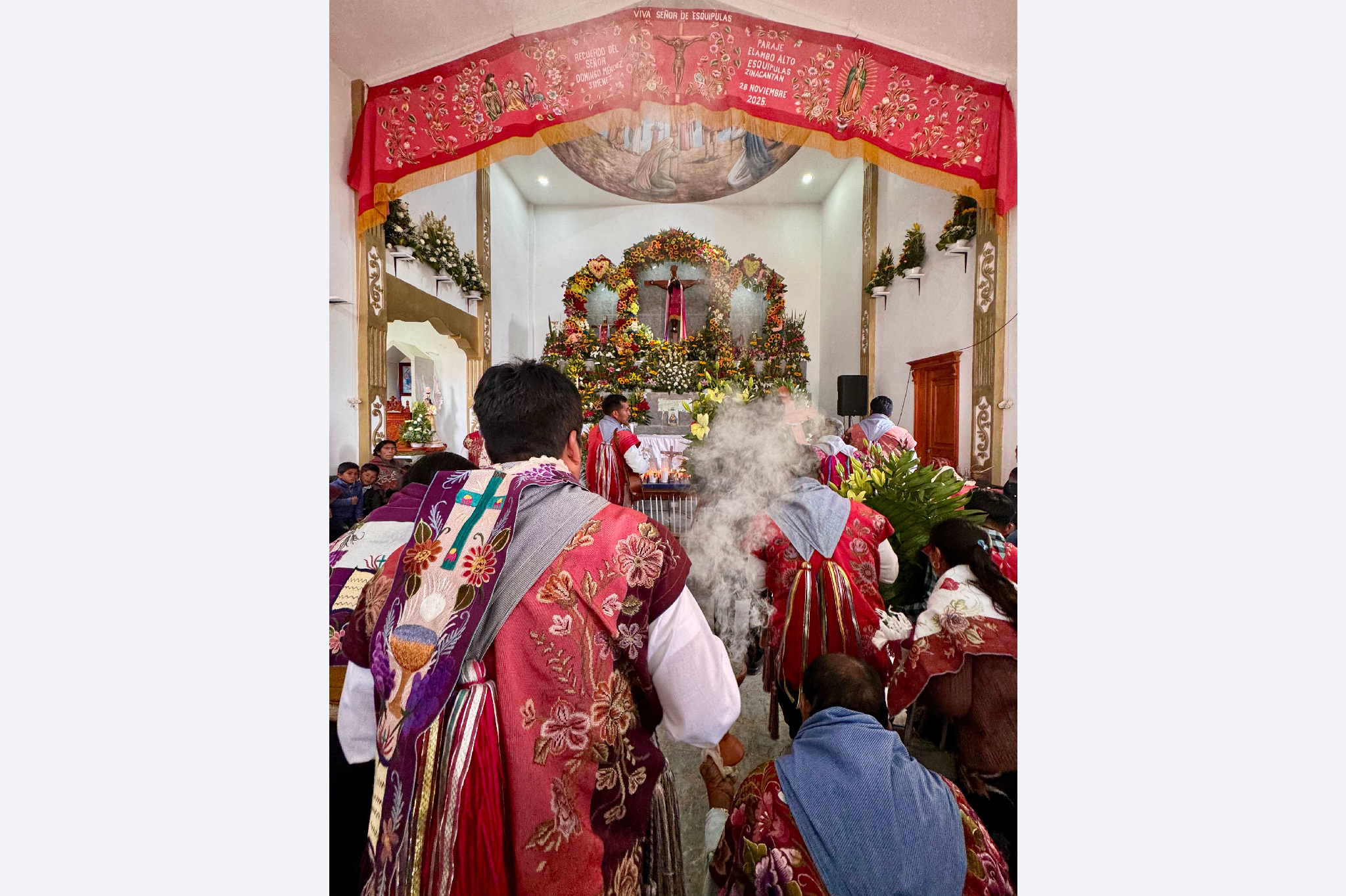
    An immersion bath in the Tsotsil ecclesial community took place these days in the Parish of Saint Lawrence the Martyr, Founded by Dominican friars in 1545, this community, nearly five centuries later, boasts forty-five villages with sixty churches and chapels, a testament to the vitality of the faithful in these highlands of Chiapas. Here, catechists, extraordinary ministers of Holy Communion, and traditional authorities coexist with youth choirs and women's groups, accompanied by Dominican friars and sisters. This presence was renewed in 1961 when the Dominicans returned to this community after a long hiatus following the Reform Laws of 1857, the Revolution, and its aftermath in the first half of the 20th century, as vividly recounted by Friar Pablo Iribarren..

    A couple of days were enough to immerse myself in another world, with its vibrant symbolic and linguistic tradition. Although I had already glimpsed it as a visitor, a new horizon now opened before me, a chance to learn how to be present as part of the community of friars accompanying these communities. I felt it was a call to continue my journey in diverse ways. It is about embarking on a new path alongside these peoples, with their own unique character, their intergenerational tensions, their expressions of Catholic religious tradition, yet also ancestral, all of it shaped by the tensions between capitalist modernity and visions of other ways of life, governance, and spirituality.

    A major challenge for me will be learning the Tsotsil language and navigating amidst the powerful traditional symbols of the Zinacanteca culture, while listening with empathy to those generations of young people who are transforming the tradition of their ancestors with new ways of life.

    Another significant challenge will be the cultural life in the city of San Cristóbal, cosmopolitan and provincial at the same time, with centers of critical thought of international stature such as the Colegio de la Frontera Sur, the Universidad de la Tierra-Cideci, the Fray Bartolomé de Las Casas Chair in the Faculty of Law of the Autonomous University of Chiapas, and several centers of culture and arts.

    Some novel ideas are emerging, like sparks, to begin a dialogue with the cultures present in Jovel and Zinacantán. The traditional radio program run by the friars in recent decades reached a specific, more religiously oriented audience. But an online portal with podcasts and video clips featuring content on the mysticism of religions, their similarities and differences, or on political theology in today's world that abuses religion to justify genocide, would reach a younger and more diverse segment of the population.

    For now, the content is yet to be defined within the community to achieve the right tone and approach for a theology that is grounded in the street and born from the street,developed through dialogue with people both inside and outside of churches who are willing to discuss their deepest concerns and intuitions regarding the meaning of life, social justice, beauty in so many traditions, cultural pluralism, and the survival of our common home. I hope to soon share some of the first steps on this new path here.

    What will give strength to these dreams is undoubtedly the vitality of today's Mayan communities, in their interaction with other urban and digital cultures. Therein lies the fertile ground for them to flourish in these lands.

    The calls of itinerancy will always be uncertain, but from here I travel them confident in the knowledge of ancestral and modern peoples who will be a light on the path.

    .

    Jovel, December 6, 2025

    .

    Note: I would like to read your comments in the final section of this page.

  • Sobre la esperanza en tiempos inciertosSearching Mothers | NTR | Zacatecas, 2025

    On hope in uncertain times

    By Carlos Mendoza-Álvarez

    At dusk this Saturday, the first Advent vigil begins, when Christian communities throughout the world embark on a journey, in the midst of the darkness of time, to receive the human and divine light of dignity and hope that the Messiah brings. The ancient hymn will resonate during the nighttime celebrations, Rorate caeli , whose lyrics and melody are like a lament that rises to heaven from the desolate city, crying out that “the clouds rain down on the Righteous One,” as the prophet Isaiah (45:8) implored during the exile in Babylon.

    Each year, this four-week calendar leading up to Christmas is accompanied by symbols of light, greenery, carols, sweets, tenderness, and community. According to each culture, the waiting period for the Messiah's arrival evokes the awareness that "something is lacking" for the fulfillment of those desires for new times of justice, truth, compassion and peace, not only for a people who arrogantly claim to be the only chosen ones, but for all of humanity and even for the entire cosmos.

    Every generation has seen terrible signs that the world is ending, whether through epidemics that make us feel how vulnerable our bodies and knowledge are; whether through wars waged by empires against emerging powers that threaten their arrogance; whether through the uncertainty of life itself, diminished by age, illness, failure, loneliness, or hopelessness.

    The biblical texts that we, the believing communities, meditate on these days speak of the expectation of the messiah, first with a strong apocalyptic tone that announces the destruction of the corrupt world, reaching the entire cosmos with a catastrophe that will destroy everything because of the human pride that has taken over creation.

    Then, as the date of the celebration of the Nativity of the Messiah Child, a Nazarene, approaches, the tone of the texts becomes more hopeful with the announcement of a God who is near, humanized, small, and fragile. It is the incarnate promise of a divine and human life that begins in complete vulnerability in the story of a migrant family with a newborn baby, trying to survive on the periphery of the empire and fleeing the fury of the local ruler, eventually finding refuge in Egypt, from where a definitive chapter in the history of human redemption will begin to be written.

    However, the collective depression we are experiencing today as humanity due to the escalation of hatred to extremes – which is spreading across the planet in an apocalyptic way “like a lie of Satan,” as René Girard said in an interview he gave me in 2007 in Paris (Hope as apocalypse)– this seems to render any narrative of hope for our uncertain times illusory. The genocide in Gaza continues as the climax of the Nakba or Catastrophe that began in 1947 with the expulsion of nearly a million Palestinians from their lands, paving the way for the creation of the state of Israel in 1948, this systemic violence continues today before our digital screens, met with indifference by social media and the international community. The wars in Ukraine, Congo, and South Sudan have become so “normalized” that they no longer make the front page of newspapers, much less a trending topic in the digital world. In Mexico, public indifference to urgent issues such as the crisis facing corn, lemon, and avocado farmers—caused by the violence in Michoacán—along with the persistent femicides and forced disappearances, speaks to a growing discontent among the population, expressed through strikes, road blockades, and street protests. But the masses seem numb, retreating into bubbles of entertainment and unrestrained holiday shopping, which, among other ills, leaves household finances in ruins for months and years to come.

    Religious consumerism is also part of the overwhelming Christmas marketing, amidst kitschy decorations and echoes of folk crafts used to make piñatas featuring popular characters. It will certainly be present at Mexican posadas, Trump's piñata , which is sold in various markets in Mexico and the United States, will receive blows as a ritual of revenge amid laughter and boos until the cardboard breaks and the blond wicks of the tyrant fly out like shooting stars in some tenement courtyard in Mexico City, Chicago or Los Angeles for the delight of all.

    A few families may perhaps rediscover the “mystical” meaning of the Advent wreath, following the Avatar of Carlo Acutis explaining Advent 2025. This video, which is circulating online, aptly explains the spiritual significance of the ritual of lighting each of the four candles during this season that prepares for Christmas. The light lit each Sunday of Advent symbolizes the "people who walked in darkness and have seen a great light" (Isaiah 9:2), which the prophet foretold to the Hebrew people devastated by the division between the small kingdoms of Israel and Judah, with their leaders corrupted by the idolatry of power, seeking alliances with neighboring Syria to defeat the rival tribe.

    And like a non-place amidst so much noise, creating a void in the midst of the urban clamor, in Mexico the collectives of Searching Mothers (Searching mothers light Christmas tree) will set up Christmas trees covered with ornaments bearing the faces of those we have lost. They are today “the voice crying in the wilderness” (John 1:23) because they speak on behalf of the victims of the narco-state war and the idolatry of the necropower of our time.

    Perhaps this is where the theological core of this season lies: the absence of the Messiah is something that has inspired Hebrew and Christian generations for centuries to mobilize in order to make the messianic times present through acts of remembrance, justice and an (im)possible reconciliation.

    Beyond a folkloric celebration of the coming of God-with-us, what we are about today is going to the other side of history to contemplate there, in the silence of the night, some glimmer of light that announces the arrival of the Messiah. And those who feel in every second of their lives, in every breath—like Vero and Fabiola, mothers searching for their missing children who shared their hope with us in a recent meeting in Guadalajara—the absence that hurts and motivates them to search out of love, are the ones who teach us what hope means in times of uncertainty, the heart of Advent.

    Next Monday, December 1st, the documentary Re-exists 2025 will be presented online (Presentation of the documentary Re-exists 2025), prepared by Uruguayan filmmaker Juan Meza. There, some of the stories of awakening, healing, and embodiment shared by people from seventeen countries and different religious and spiritual traditions from four continents facing diverse forms of violence where it has been possible to spell out hope.

    Advent is a time to continue weaving networks of combative hope , say the social movements on the peripheries of the empire, so that our world does not fall into the abyss. And it is possible to do so by listening to the people who for years and centuries have resisted and now accompany us in re-existing.

    Because there will always be hope as long as there are people and communities who live the end times, so insistently emphasized by Javier Sicilia and Elías González, as the opportunity to enter into another way of existing amidst violence but pregnant with the active expectation of messianic times.

    Happy Advent season!

    Mexico City, November 29, 2025

    Note: I would appreciate your feedback at the end of this page.

  • Marchar o no marchar, esa es la cuestiónGhandi's Dandi (Salt) March, 2012

    To march or not to march, that is the question

    By Carlos Mendoza-Álvarez

    In recent weeks, Mexico has been the scene of social unrest stemming from the population's weariness with the violence of drug cartels that increasingly control more and more territory. The state of Michoacán has become the epicenter of this violence against the population, particularly against avocado and lime producers who hold that cursed "green gold" in their hands.The less glamorous side of Mexico's new 'green gold'This is devastating environmental and social systems. It is an expression of the predatory economy that is part of the extractive society in which we have been trapped for decades worldwide. The political class tries in vain to promote regional development plans with great media impact, but with few results for the victims and many alliances that maintain "stability" in the region to consolidate the privileges of criminal mafias.

    As analysts of similar cases of narco-economies, such as Colombia decades ago and now Mexico, had already predicted (Terrorism and organized crimeWhat is happening is an escalation of violence perpetrated by criminal networks, which first affects local populations and then rises to reach the political and business classes in order to increase profits, political power, and control over territories. Even the United States government is intimately familiar with these criminal networks and manipulates them as it benefits its role as guarantor of democracy in the world within a new "multipolar order" (Trump is making a grave strategic error if he thinks he can divide the world with authoritarian powers and achieve peace.) negotiated with the authoritarian regimes of China and Russia.

    Ordinary citizens—an expression often applied today to the most dangerous professions, such as journalism and, unfortunately, academic life in universities subject to censorship—are left bewildered, defenseless, and astonished by this avalanche of insecurity, crimes in public squares, and false promises from the authorities. The churches, for their part, attempt, without much success, to promote "peace plans," or better yet, "pacification" plans, to restore the broken social fabric. As I mentioned in my previous post a few days ago... National Dialogue for Peace which the Catholic Church has been promoting for three years in an unusual alliance between the Mexican episcopate, religious orders and Christian-inspired civil organizations.

    The problem that arises in initiatives coming from the political, business, and religious spheres is the subject. That is, the communities in their own places of life seem to be absent as actors in the proposals. Because what is urgent is "the refounding of Mexico from the perspective of the victims," as Javier Sicilia has insisted for the last fifteen years.Open letter from Javier Sicilia to López Obrador).

    Today, perhaps, heeding the many voices that have emerged from the tragedies caused by systemic violence, we could say that it is a matter of embracing the diversity of autonomies (subjective, territorial, political, and even religious) to reclaim "the political" from below. This is the central theme of the collective book in preparation for the American publisher Orbis Books, which I am coordinating with the splendid editorial support of Nathan Wood-House and Francis Boccuzzi.

    Last Sunday I attended the march called by the Hat Movement from Michoacán, founded by the assassinated mayor Carlos Manzo. Some groups joined these protests, which took place in thirty-five cities across the country. Generation Z which represents the digital nomadic youth who have already shaken centers of power around the world, such as in Nepal and Peru. Some twenty thousand people attended in Mexico City, with a toll of more than one hundred injured (Generation Z will decide the next elections in Mexico), where there were violent disturbances at the end of the march in the Zócalo, caused by hooded people trying to enter the National Palace, where they were repelled by riot police, after they knocked down one of the immense metal fences with which the authorities had "protected" the emblematic building of the central power of the country. Eighteen people were arrested  And eight of them are in pretrial detention facing charges for threatening the lives of some guards who were beaten and injured, like many other people at the march that no one talks about, some of them without having been involved in any violent action.

    Although the facts and the legal procedures still need to be clarified, this growing social unrest remains, turning into indignation and peaceful, sometimes violent, protest against a government that is paralyzed, if not colluding, with the aforementioned mafias.

    Last Thursday, November 20, the national anniversary of the Mexican Revolution, the protests of the Generation Z They were held again in several cities across the country, with particular anger expressed once more in the main public square of the nation's capital.

    To march or not to march, that is the question that citizens in Mexico and the world are asking themselves today as an existential, ethical, political and spiritual question to express their weariness with the multiple heads of the hydra of necropower that have taken over the world.

    Political parties and churches claim to "represent" the people, but they have lost credibility. Civil society organizations have been overwhelmed by the tides of insecurity, impunity, and terror.

    What is left to do amidst the ruins of a nation-state overwhelmed by the powers of today's extractive capitalism?

    Marching in public squares as citizens in peaceful resistance is the path that many peoples in modern times have followed as a form of profound social transformation.

    A symbol of this social journey—still alive in modern memory—is the famous Salt March Gandhi began this journey almost a century ago, in 1930, starting with a handful of eighty people, marching from Ahmedabad to the Guarat coast, gathering more people along three hundred kilometers to protest against the British Empire in a centuries-old site of oppression for India's poor. By the end of that year, sixty thousand people had joined the protest, which became the turning point that paved the way for India's independence.

    In Mexico, Pietro Ameglio (Civil disobedience and other texts ) has kept alive the memory and reflection on that ethical and political act of civil disobedience, in the context of the March for Peace with Justice and Dignity initiated in April 2011. Some will say that —almost fifteen years after that outcry— Mexico is still lost, falling into the chaos of a failed state produced by necropower.

    Others of us today advocate returning to the source of the "autonomies" that arise in liberated subjectivities, bodies, and territories, where human beings take root, flourish, and die to endure; this is the clue proposed by the anti-systemic thinking of the Cuernavaca School.

    At its mystical core, the only way to halt the spiral of hatred is by exposing one's own body. This is how Saint Paul described it when referring to Christ: "He broke down the wall of hatred in his own body" (Ephesians 2:14). This is the quintessential messianic gesture, pristinely experienced by Jesus of Nazareth on a horrific cross imposed by the Roman Empire with the complicity of the religious authorities of the Temple in Jerusalem. A tragic destiny, but not a final one, because that offered life was transformed by his heavenly Abba and by his community of survivors into a seed of new life.

    Ultimately, these are autonomous regions with a mystique of a fulfilling life, born from the excluded of all times. That is the march of dignity that never ends.

    To march or not to march.

    The question remains open for us today.

    Oaxaca, November 22, 2025

    Note: I would appreciate your feedback at the end of this page.

English