Category: Cultural pluralism

  • La IA, ¿amenaza o compañera? Sobre los retos del mundo digital y la conmemoración 500 OP ChiapasFreepik | Digital art, AI-generated resource | 2026

    AI: threat or partner? On the challenges of the digital world and the 500th anniversary of the Chiapas Open Air Movement

    By Carlos Mendoza Álvarez


    In recent days, the topic of artificial intelligence (AI) has gone viral on social media due to Pope Leo XIV's first encyclical letter. Ironically, in this age of systems—as Ivan Illich termed this new social paradigm that should be considered when analyzing the digital world—the pontiff's warnings have already been devoured by algorithms and accounts on Instagram, X, TikTok, and Facebook (for the older generation of the digital world). Memes of Pope Leo battling AI have flooded social media, such as the one of the pontiff with his staff firmly warning Palantir: "You shall not pass." And to top it all off, thousands, perhaps millions of people have used AI to create a summary of the encyclical, mostly out of curiosity, sometimes with the aim of criticizing the Pope or the power of the companies that produce and control it. A slow, personal reading of the encyclical letter would be worthwhile to analyze its content.

    Without losing sight of the ethical critique and the international legal regulation that must be promoted for the production and use of AI, it seems to me that it is important to first realize that we are already immersed in that tangle of data driven by individual, corporate and governmental wills, with an ever-increasing “autonomy” of what was called years ago “the internet of things” (IoT)., Internet of ThingsThis network of digital data flow systems is here to stay, monitoring information circulating in the digital environment in an automated way within systems created by humans, but operating with increasing “autonomy” to generate new data and produce unprecedented social, commercial, scientific and cultural effects.

    The dystopian science fiction series Black Mirror, Created in Great Britain in 2011, the series depicted fascinating and chilling episodes of a society controlled by technology, where the boundaries between human reality and the virtual world were so porous that they created apocalyptic scenarios. Fifteen years ago, this reality of the algorithm's power seemed like a figment of the imagination. Today, it's already part of our daily lives.


    I am currently preparing a couple of talks on AI. I will be giving the first one this week at the Diocesan House in San Cristóbal de Las Casas to a group of priests from Generations X and Y—both born after 1965, following the generation of the Baby boomers- until 1982 when the Millennials. Of course, this classification, proposed by British and Canadian colonial sociology to designate first a generation without a defined desire, and then the first generation of digital natives, is relevant for describing certain social strata in each country. But it also designates the other side of the coin of globalization, due to the technological impact that television and computers have had on the lives of all people.

    Later, with the team of JobeLab We will hold a discussion on AI at the end of June in the Temple of Charity to reflect on the recent Encyclical Letter Magnificent Humanity by Pope Leo XIV, published last Monday, May 24th. We will approach this from an interdisciplinary perspective, first giving voice to colleagues in computer science, education, and philosophy. There, I will offer some reflections on the meaning theological of the problem in question, from a phenomenological and decolonial perspective, deepening an intuition present in the Encyclical Letter, human vulnerability, but unfortunately not developed sufficiently by Pope Leo.

    There are many ecclesial, university, and social forums where we must open intelligent conversations, with creative imagination, to think together about the digital reality that has already reached us, with its enormous possibilities for the flow of information and its challenging scenarios of post-human control of production and knowledge processes that we have never imagined.

    AI is perceived today as a threat, even though it's already part of our digital-age "customs and practices." Perhaps we should learn to coexist with it as a "creature," that is, as a reality marked by the finiteness of all creation and, therefore, incapable of supplanting our imagination and creativity—much less divine glory—though we must remain vigilant against the danger of its control over our lives and destinies. Today more than ever, the bastion mystical The human condition is presented more clearly as a source of freedom in times of AI.


    500 OP Chiapas


    This Thursday, June 4th, we begin the commemorative events for the 500th anniversary of the arrival of the Dominican friars to Tierra Firme of the American continent, on June 23, 1526 in Villa Rica de la Veracruz, as the first anchor of European colonization and the arrival of the Gospel with its model of Western Christianity.

    In Chiapas, the small community of Dominican friars in San Cristóbal de Las Casas, along with friends and colleagues, has prepared cultural and liturgical events to commemorate this historic event. We will begin on Thursday, June 4th, with a concert by the San Cristóbal de Las Casas Symphony Orchestra and Choir at the Santo Domingo Church, where this youth ensemble will perform works of Baroque and modern classical music, with interludes that will briefly recall the friars' arrival in these lands, their evangelizing mission, their heyday during the colonial period, and their subsequent decline in the 19th century, leading up to their gradual resurgence in the 20th century.

    On Friday, June 5, an academic colloquium on the Dominicans' contribution to Chiapas culture will take place at the friars' former convent in San Cristóbal de Las Casas, now the Museum of the Highlands of Chiapas. Two historians specializing in Dominican architecture in Chiapas during the colonial period will participate. The event will also feature the presentation of Friar Pablo Iribarren's latest book on the Dominicans in the 20th century, focusing on their evangelization efforts in dialogue with the indigenous peoples of Chiapas. Marimba music by the Díaz Sisters will provide a festive atmosphere.

    On Saturday, June 6th, the celebration will take place in Zinacantán, thanks to the generous collaboration of the faithful communities of the Parish of Saint Lawrence the Martyr. A solemn Mass of Thanksgiving at the Church of Saint Lawrence the Martyr, the parish seat, will be followed by the cultural event “Transfigurations: Mayan Spiritualities Today,” which I have had the honor of organizing along with two masters of contemporary Mayan art. We will begin with the unveiling of the mural 500 OP Chiapas, a masterful work by Antún Kojtom, a Tseltal artist from Tenejapa, depicting the encounter between the spiritual traditions of the Tsotsil people and other Mayan communities of the Highlands and Rainforest of Chiapas with the Dominican friars throughout history. Tsotsil poetry by Xun Betán and some of his students from the creative writing workshop, held this month in preparation for this event, will be accompanied by traditional Tsotsil music performed by musicians from the parish church. And in the afternoon, a talk about the Dominicans in Zinacantán will be given by Friar Pablo Iribarren, as a framework for a closing liturgical act in which young people from Zinacantán will make their initial promises as members of the Dominican Youth Movement.

    And to conclude the commemorative events, on Sunday, June 7, with a Eucharist presided over by Don Rodrigo Aguilar, current bishop of the Diocese of San Cristóbal de Las Casas, the Dominican family and the faithful of the city will give thanks to the God of Life for this half-millennium of preaching, with its lights and shadows, invoking divine mercy to walk with hope as the people of God in the arduous times we are living through, to bear witness to the Gospel of liberation with justice and peace for all creatures of the cosmos.

    We look forward to seeing you soon in Chiapas.

    San Cristóbal de Las Casas, May 31, 2026

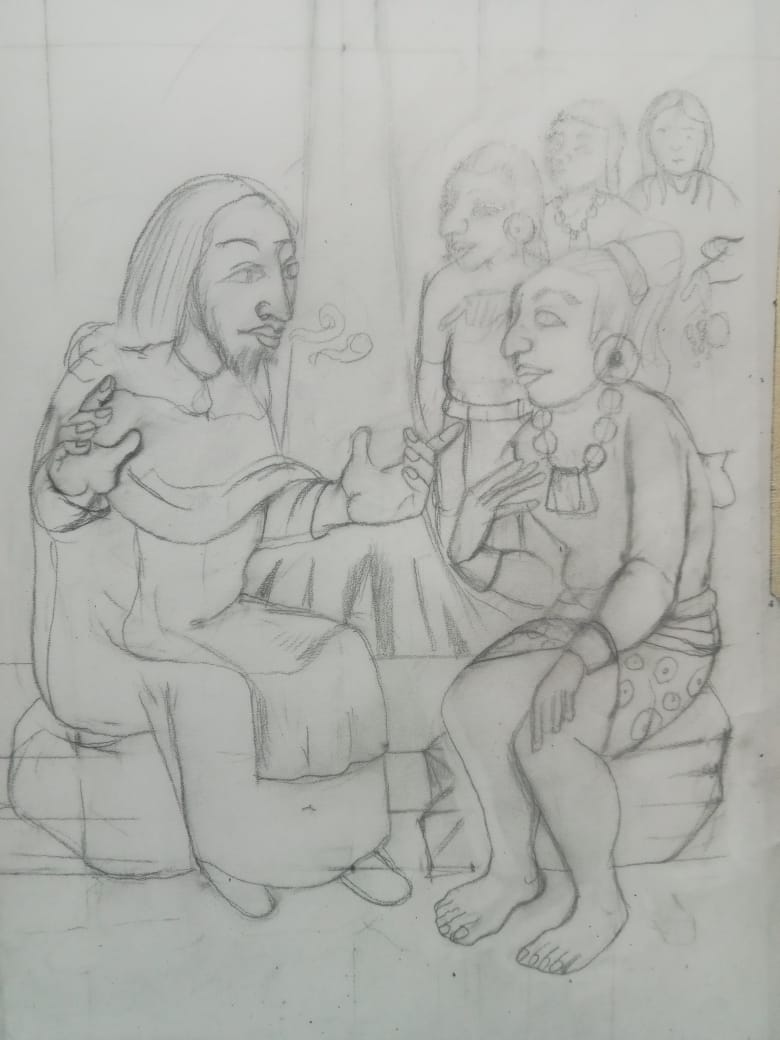
  • La fiesta de la Ruah divina Reflexiones sobre la memoria viva de los pueblos en movimientoAntún Kojtom | Mural 500 OP Chiapas | Detail: sketch of Friar Pedro Lorenzo de la Nada with Lacandon Sage | Sots´leb, 2026

    The Feast of the Divine Ruah Reflections on the living memory of peoples on the move

    By Carlos Mendoza-Álvarez

    Fifty days after Easter, Christian communities around the world celebrate the overabundance of divine love, reaping the fruits of the messianic age, gathered with joy in the midst of suffering, as the Hebrew poet says: “Those who sow in tears will reap with songs of joy” (Psalm 126:5).

    Two thousand years ago, after mourning the brutal execution of Jesus, the Galilean, by the Roman Empire—in collusion with the Temple authorities of Jerusalem and the enraged mob as part of the infernal mimetic cycle—a period of mourning was necessary for his community of friends and companions to grasp the senselessness of the innocent's death. This question still arises today in the grieving hearts of those who have survived lynchings, both ancient and modern. It is a questioning of the meaning of absence that also beats in the hearts of the Mothers Searching for their disappeared children in Mexico today, a cry that becomes a plea to find their offspring and help them "come home.".

    Celebrate that Love is as strong as death and, even more, that Love conquers hate or that Life resists and re-exists At first glance, it seems like an evasion that ignores the suffering of the victims and the urgency of justice. On the contrary, it seems to me that precisely in that hopeful suffering The heart beats with the ethical, political, and spiritual indignation of survivors of so much violence. A cry that is expressed in the public squares of Gaza and Tehran, Beirut and Mexico, Kakuma and Dadaab in Kenya, by those who dedicate their bodies, hearts, and minds to the service of life in the midst of death.

    The celebration of Pentecost is rooted in the joy of peoples who, after confronting horror, are able to go further in healing from trauma and quietly cultivating hope. Without denying the painful past, nor the undeniable need to hold the perpetrators accountable, what matters to those who survived is to stand up and live again with hope. This is what I have been learning, step by step, from the collectives queer/cuir  who face gender phobias of various kinds, women facing abuse and femicide, as well as indigenous peoples who strengthen their resistance through processes of autonomy of bodies and territories, from the Inuit in Canada to the Mapuche in the far south of our continent.

    How can we celebrate the harvest of the divine Ruah in these times of such profound uncertainty? We are witnessing alarming signs of a return to barbarism at the hands of genocidal governments in the Middle East and Africa, as well as in failed states trapped by the complicity of their rulers with transnational criminal organizations, as is the case in Mexico, El Salvador, and Nicaragua. This spiral of genocidal hatred is being transmitted in real time through the attacks of the Israeli Zionist state, which is committing crimes against humanity with the complicity of the United States and the European Union, and the indifference of the international community, against entire populations that stand in the way of its geopolitical power.

    Strengthening resistance movements must also confront fundamental debates to find the path to utopia in times of dystopia. Collective memory, which lies at the heart of these processes, is now a battleground. Who tells the story and how they tell it are questions the Zapatistas in Chiapas, like the Sumud Global Flotilla, are asking themselves, attempting to give visibility to those who always remain in the shadows of the power that kills.

    We Dominicans are not exempt from these debates, especially now that we commemorate 500 years since the arrival of the friars to what we now call Veracruz in Mexico, on July 25, 1526. The great feat of evangelization—which undoubtedly brought missionaries inspired by Renaissance utopia and by the zeal for reform of the religious orders to return to their origins of following Christ—was also marked by the libido dominandi of the conquerors who followed that maxim of Western modernity so forcefully expressed by Enrique Dussel: conquiro, ergo sum, that is, "I conquer, therefore I am".

    When recounting the history of the Dominican presence in this region of the continent—called Tierra Firme by Western navigators and Mesoamerica by later geographers—we cannot forget that a fundamental contradiction marked the evangelizing work of the Dominican friars in the 16th century, as rigorously studied by Friar Daniel Ulloa Herrero in his doctoral dissertation at El Colegio de México: an observant current led by Friar Domingo de Betanzos, and a prophetic tendency championed by Friar Bartolomé de Las Casas. Undoubtedly, there were many nuances between these two tendencies when it came to evangelizing the colonized lands that later gave rise to the golden age of New Spain, the era of the Baroque churches along the Dominican route from Mexico City to Guatemala, traversing the entire central and southern regions of the Viceroyalty of New Spain.

    The splendor of the Baroque art of the convent churches of Puebla, Oaxaca, and Chiapas has shaped a worldview in which Mexico was the axis mundi From that early era of modernity, a meeting point between Asia and Europe, Mexico City was also a laboratory for cosmopolitan culture, as Friar Julián Pablo Fernández liked to say when he was prior of the ruins of the Imperial Convent of Santo Domingo in Mexico City. This era gave birth to a Creole and mestizo culture of universal value, as UNAM historian José Rubén Romero Galván recounts. However, we cannot forget that this Creole culture subjugated and rendered invisible the Indigenous peoples, as contemporary decolonial readings emphasize.

    These reflections come to mind when accompanying a great Tseltal Maya painter, the master Antún Kojtom, who is currently creating a mural commemorating the arrival of the Dominicans in Chiapas, on a wall located in the main square of Sots'leb, between the temple and the market, in the municipal capital of Zinacantán.

    For the past six months we have been discussing the narrative of the emerging mural, emphasizing what we now call a "dialogue of knowledge" between the Mayan peoples of Chiapas and the Dominican friars.

    We chose a tone conversational The mural depicts scenes that highlight the ancestral religion of the Tsotsil people, particularly their religious roles such as grandmothers, seers, and stewards, with their ritual prayers on the hills, ancestral blessings, and community responsibilities. Through this narrative, we seek to underscore the centuries-old legacy that remains alive today in the pastoral life of the parish of San Lorenzo Mártir in Zinacantán.

    In the center of the mural appears the meeting between a Tsotsil steward and a Dominican friar, Fray Bartolomé de Las Casas, both standing with the same dignity, exchanging words, each with his symbol of authority, the staff of command for the first, the Bible for the second.

    On the right, a third scene brings together the prophetic Church that has flourished in the Highlands of Chiapas and the Lacandon Jungle from the 16th century to the present day: a group of friars, with Friar Matías de Córdoba who promoted the independence of Chiapas in the 19th century and Friar Raúl Vera with jTotik Samuel beside him, bishops of the Church of the poor and excluded in the 20th century. Above their heads, like kites moved by the wind of the divine Ruah, are the martyrs of the San Cristóbal Church of recent decades: Ignacio Pérez López, pre-deacon of Chicomuselo, Father Marcelo Pérez, parish priest of Guadalupe in Jobel, Simón Pedro Pérez López, member of Las Abejas de Acteal, and Guadalupe Vázquez Luna, survivor of the Acteal massacre.

    On the far right appears a highly symbolic scene for the recreation of the historical memory of the Dominican friars in Chiapas, recounting stories of creative rebellion: Friar Pedro Lorenzo de la Nada conversing with a Lacandon sage, both seated on rocks in the shade of a large ceiba tree, the sacred tree of the Maya, with the glyphs of the flowery word emerging from their mouths. The friar moves his hands, signifying eloquence, as he listens. The Lacandon sage touches his heart with one hand and points to Mother Earth with the other. One is dressed in his white habit and black cape; the other, adorned with a jade necklace and white loincloth. They are accompanied by a group of Lacandon women, young people, and children, attentive to the dialogue. This scene seeks to represent the apostolic adventure undertaken by a friar who wanted to go beyond the limits of Christian norms, as Jan de Vos masterfully recounts in his biography of Friar Pedro Lorenzo. What we felt was most important to highlight about the founder of modern Palenque was the audacity of the rebellious friar who "went into nowhere," as the prior of the Santo Domingo de San Cristóbal convent told him when Friar Pedro Lorenzo insisted on going into the jungle to find its inhabitants and announce the Good News. Escaping from the convent, he was lost for several years, later reappearing in the land of the Tsendal people, where he founded Palenque. During his apostolic journey, he reached Pochutla and Lake Lacam-Tum, now known as Miramar, a sacred center for the Lacandon people. From that time, some baptismal records are preserved in the diocesan archives, bearing his new name: Friar Pedro Lorenzo de la Nada (Friar Pedro Lorenzo of Nothingness).

    When sharing the sketches of the mural in progress with friends, there has been no shortage of praise for the initiative, especially since it was the result of a long dialogue with civil and religious authorities in Zinacantán. Others have appreciated that the invited artist is a renowned master of contemporary Mayan art. Some critical voices have pointed out the underrepresentation of women, or the prominence of the friars in the images. For my part, once I had agreed with Maestro Antún on the tone From the narrative with the importance of the symbols of the two traditions to be represented in the mural, I received with respect and great admiration the visual proposal of the artist who, with his own genius, will undoubtedly leave us a pictorial legacy that is the gift of the Dominican friars to the people of Zinacantán in this commemoration.

    In a couple of weeks we will be celebrating this event in San Cristóbal de Las Casas and Zinacantán.

    I'll tell you about the new seeds being sown on this path of living memory.

    Jobel, May 22, 2026

  • JobeLab Una iniciativa de pensamiento crítico y espiritualidades diversas desde San Cristóbal de Las CasasJobeLab | San Cristóbal de las Casas, Chiapas | 2026

    JobeLab An initiative of critical thinking and diverse spiritualities from San Cristóbal de Las Casas

    By Carlos Mendoza Álvarez

    From the second half of the 20th century, Chiapas became a laboratory of new ways of inhabiting and thinking about the world, with the creative confluence of important social, political, cultural and spiritual processes.

    Among them, dynamism stands out synodal (or shared path by all the believing people with their diversity of ministries) of six decades, implemented by the Diocese of San Cristóbal de Las Casas with jTatik Samuel Ruiz as pastor walker And hundreds of local, regional, and international communities and groups, convened for justice and peace for the Indigenous peoples and other communities of this region of Chiapas. In an astonishing confluence of paths, the Indigenous Congress of 1974 marked the beginning of the public presence of Indigenous peoples with their own voice. Indigenous, mestizo, and international social and cultural movements also emerged, with research projects on the rich Mayan heritage, both ancient and modern, developed by teams of social anthropologists, archaeologists, and linguisticists. Waves of researchers arrived from Latin America, the United States, and Europe, and, with an academic model still largely based on extractive practices, made significant discoveries in the social sciences and humanities. The translation of the Bible into Mayan languages, initially promoted by the Summer School of Bible as part of a U.S. interventionist plan, evolved into intercultural dialogue, continued to this day by various Christian churches, including the Roman Catholic Church. Finally, the Zapatista movement, with its armed and media-driven uprising of 1994, became the watershed moment of a social, political, and cultural insurrection that continues to this day as one of the most radical critiques of the hegemonic system of the multi-headed capitalist hydra, including patriarchy and colonialism.

    The “San Cristóbal School” is a name proposed decades ago by Pablo Romo and others in academia and the arts to evoke the legacy of critical thought, resistance, and spirituality that emerged in Chiapas, as a counterpart to the Cuernavaca School, analyzed by Humberto Beck. In their connections and differences, both represent significant contributions to critical thought that arose in Mexico during the last century.

    In this way, recognizing the individuals, groups, organizations, and initiatives of civil society that have been an active part of these processes, as a collective inspired by them, with JobeLab -apocope of Jobel which is the Tsotsil name of San Cristóbal de Las Casas and laboratory To designate this city as a laboratory, we seek to give continuity to such a legacy in a new context, focusing on critical thinking and the spiritualities that have sustained them, such as those of the native peoples, Catholic Christianity, and more recently Buddhism and Islam.

    Through the initiative JobeLab. Ongoing dialogues and mutual support for re-existences We will continue to cultivate this heritage in the new scenario of the civilizational crisis that humanity faces in the second quarter of the 21st century, where peaceful coexistence between nations and the balance of planet Earth are at risk and call us to promote processes of resistance and re-existence.

    We will nurture this initiative based on two inspiring attitudes that are, at the same time, transversal axes of the talks, meetings and festivals that we will organize in various spaces of the city: hospitality and commensality.

    The hospitality It is one of the human gestures that most powerfully expresses our shared human condition, that is, our way of becoming individuals and communities as beings in relation to one another. This radical attitude of openness to otherness is a fundamental ethical and political act, where the religions and spiritualities of humanity celebrate a glimpse of divinity.

    The commensality, Like the other side of the moon, it is the nourishing soil where we receive the otherness of Mother Earth, of other humans who become our neighbors, and of Divinity, through food and drink created by the unique genius of each people. We celebrate this gift as an inclusive banquet where Divine Sophia prepares a table for all nations and creatures of the cosmos.

    Together with Carmen Reyes and Ricardo Hernández, Angélica Evangelista and Abraham Mena, I am enthusiastically participating in this project, drawing on the Dominican tradition of life and thought. In these exchanges, we seek to discover new expressions of the divine and human Word as a creative fire that redeems, animates, and shelters us in our present circumstances. times of hardship as a human species that puts itself and the Common Home at risk, leading us to the precipice of annihilation.

    This week two events will be the formal presentation of JobeLab, after the first event where the initiative germinated, on January 28, with a presentation on Gaza and Chiapas at the Charity temple in the city of San Cristóbal de Las Casas.

    On Wednesday, March 25th at 5:30 pm, we will hold the discussion “The School of San Cristóbal,” with the participation of Pablo Romo, who was one of the key figures in the diocesan process of promoting human rights, paving the way for the creation of the Fray Bartolomé de Las Casas Human Rights Center. Martha Elena Welsh, choreographer who animates in Xitla House In Mexico City, workshops were held to support people in situations of extreme vulnerability, facing various forms of violence. And Juan Carlos La Puente, a Peruvian with extensive international experience in providing spiritual support to human rights defenders, has been developing a methodology for this purpose from his base in Oregon, USA. permanent discernment as a path of body for people and communities in re-existence.

    And then, on Friday, March 27th at 5 p.m., we will explore another facet of re-existence: forgiveness as a path to reconciliation in contexts of violence. With the Muslim community of San Cristóbal de Las Casas, represented by Shaykh Yahya Rhodus and Shaykh Mudar Abudlghani, we will discuss forgiveness in Christian and Muslim traditions as a common path to peace, at a critical moment of violence in the Middle East. And we will do so accompanied by the extraordinary music and song of Nader Khan, a Canadian Sufi artist.

    We invite you to be a part of JobeLab From wherever we may be, whether attending talks and meetings, or imagining and creating similar spaces where we can come together and flourish as individuals and communities in resistance and re-existence, going beyond the spiral of violence that surrounds us, towards a world another world of hospitality and commensality.

    Jobel, March 23, 2026

English