Category: Liberating spirituality

  • ¿Quiénes heredarán la tierra robada y gentrificada?Lucky Madlo Sibiya (South Africa, 1942), Untitled

    Who will inherit the stolen and gentrified land?

    By Carlos Mendoza-Álvarez OP


    The wars of yesterday and today are brutal rituals of territorial control as a space of privilege for a powerful group over the rest of the beings that inhabit it.

    Modern expansionism, which began in the late 15th century with interoceanic voyages financed by European kingdoms that became nascent empires, was an enterprise of control of routes and territories that expanded throughout the world in a brutal manner as an unprecedented colonization project. libido dominandi The conquistador found in this "civilizing" enterprise his perfect justification in the religious armor that accompanied the wars of conquest: those lands had to be conquered in the name of God.

    This is happening today in Palestine because of the greed of the Israeli state and the powers that support it to seize the territory of the Palestinian people, both Muslim and Christian. Such colonizing libido fuels the unbridled fury of Jewish settlers eager to seize more and more land in the West Bank and Gaza. This perverse logic leads a people who were victims of Nazism to now commit genocide against a brother nation.

    A similar, but even more perverse, greed fuels the transnational war industry for the benefit of corporations that enrich themselves exponentially by creating armed conflicts to fuel the war machine that generates trillions of dollars in profits each year around the world. In this case, it involves the control of financial and industrial territories to feed the arms industry in every corner of the planet.

    Israeli Zionism and Christian Zionism are two sides of the same coin. They write another disastrous page in the history of the greed for land as property, cynically manipulating the biblical promise of the land. Since the 19th century, this Zionism born in the United Kingdom was the one that paved the way for the later creation of the State of Israel, under the pretext of the Shoah. That same Zionism, in its version of perverse political messianism represented by the State of Israel, has now invented a criminal scenario with a Muslim enemy to be defeated in order to impose its military power in the Middle East, annihilating the Palestinian people and humiliating neighboring peoples, through the blatant manipulation of the Bible, as Mitri Raheb has shown in his essential book Decolonizing Palestine. The Bible, the land, the peopleThe Israeli machinery of drones, tons of missiles and millions of bots or automated accounts flooding social networks, has been spreading fake news throughout the virtual world that has left the entire world stunned, producing a “collective cognitive dissonance,” as analyzed in Brazil by João Cezar de Castro Rocha based on Leon Festinger's theory.


    ∂


    And, strange as it may seem, the ongoing gentrification in many cities around the world, from Barcelona to Mexico City, is another expression of that same colonizer's will to dominate, now in its gentle version. hipster. Only this time, it's not about conquering territories to govern them through military occupation armies with the aura of an imperialist religious flag. I'm referring to the digital nomadic colonizers who take advantage of the power of their currencies, emboldened by their dreams of white and technological primacy, to inhabit residential neighborhoods in vibrant cities at a much lower cost than they would have in their countries of origin. Thus, these hipster herds nurture their cosmopolitan illusions enclosed in their urban bubbles, without coming into close contact with the population of the place they inhabit, but rather displacing them or subordinating them to their tastes and interests. This phenomenon represents the most recent and perverse version of settler colonialism that displaces previous inhabitants from their land.

    For the past five years, I've spent a period of time each year in Mexico City's Hipódromo Condesa neighborhood, where the Dominicans have for almost a hundred years animated a parish that was a religious center for the Mexican middle class with aspirations for urban modernity, though not so much religious ones. Every year I return, I'm surprised to see that the former residents have left, selling their homes, converting them into Airbnbs, or outright opening hipster-trendy businesses, ranging from vegan restaurants and light ice cream shops to bistros with Mexican fusion menus. But what has surprised me most is the proliferation of businesses specializing in angels, candles, Tarot readings, physical therapy, Bikram yoga, and other types of yoga, as well as countless spas with massage menus ranging from reflexology to tantric, not to mention, of course, Reiki mixed with "ancestral" techniques from the heart of Mexico.

    On the other hand, the Catholic parishes in that area of the city collapsed financially due to the lack of alms, but above all, their traditional religious population was aging. To the surprise of many religious ministers, in recent decades, La Condesa has become a laboratory for new religious expressions, as Hugo Suárez has documented (Images of Faith. Audiovisual Sociology of the Condesa neighborhood), a sociologist from Guadalajara, in a recent comparative study of the religious practices of residents of Condesa and Ajusco in Mexico City, one a hipster neighborhood and the other a working-class one. To complete this quick overview, it's important to note that in recent years, there has been an upswing in the number of believers in Catholic churches, especially in South America, characterized by a traditional Catholicism of intense and highly moralizing individual piety. This is an unexpected effect of gentrification in those parts.


    ∂


    What criteria could help us understand the meaning spiritual From these old and new territorial control processes? Could humanity's religions pull from the vault of their memories some precious talisman that sheds light on us?

    The second beatitude of Matthew's Sermon on the Mount captures the poetic message of Christ as He preached in Galilee in a provocative way. This beatitude literally says: "Blessed are the meek, for they shall inherit the earth" (Matthew 5:5). The Greek word for the meek is πραΰς (praus). This term is associated with those who resist the powers that want to push them aside because they are considered redundant in the community. In Galilee in Jesus' time, these meek They were those who resisted the Roman power of taxes or military occupation.

    It is not, first and foremost, a question of understanding the meek as peaceful people according to the traditional reading of this text. Rather, it refers to those who resist violence without making a fuss, appearing invisible to the eyes of the world, because they deploy what today we might call strategies of resistance as survivors of many forms of violence.

    On the streets of our cities, we see some of these people out of the corner of our eyes, passing by us like shadows lying on a sidewalk, or living in cardboard houses under a bridge, or even lurking in the garbage looking for a piece of bread, a cigarette butt, or a can of beer with a drink to take. They are the disposables of consumer society, the ones surplus to requirements in a shopping mall, and whom we might bump into by chance or carelessness when entering the subway or when rolling down our car window at a stoplight at any urban intersection. When we approach these peripheries very close to us, we discover that, despite the subhumanization that surrounds them, these people organize, care for, and support one another.

    The promise of the land that Jesus announces to the meek It is subversive because it does not refer to the people of Israel, as imperial Davidic theology had previously intended and repeats today with its genocidal narrative. It is not about “possessing the land,” much less exploiting it, but about inherit it, that is, to receive it as a gift from the Abba who “makes his sun rise on the evil and the good, and sends rain on the righteous and the unrighteous” (Matthew 5:45). Jesus thus subverts the dominant narrative of his time, which consisted of distributing land according to religious strata that marked the economic and social scale, with the Temple playing a central role in Jerusalem as the religious capital of Judea.

    Therefore, the Galilean's greatest audacity lay in saying that the "meek" will inherit the earth, thus opening the promise of the earth to the most vulnerable in society. A world reversed from that produced by gentrification.

    To conclude these reflections, let us allow the Colombian poet José Eustasio Rivera to whisper that uncertain hope of those who resist colonization because they sense that, at the heart of their resistance, they are beginning to inherit the land:


    XIV


    I am a son of the mountain! For its coolest place
    I search, always singing, for the resounding hive;
    and in the silent caves my throat fills
    of nectarean honeycombs and of stone almonds.

    As I leave the waves, I fall asleep with pleasure
    on the dead leaves that my dog gleans;
    and through the branches, on my brown face
    the afternoon sun sets its moving arabesque.

    Inspired by a dream of distant tenderness,
    I caress the flowers; I crown myself with vines,
    and I embrace the trunks with deep emotion;

    that later, when I concentrate my thoughts alone,
    I seek the prize of the mountain, and in my spirit I find,
    the flowering shoot of a sweet illusion.


    Promised land, Bogotá, 1921.


    eSwatini, July 12, 2025
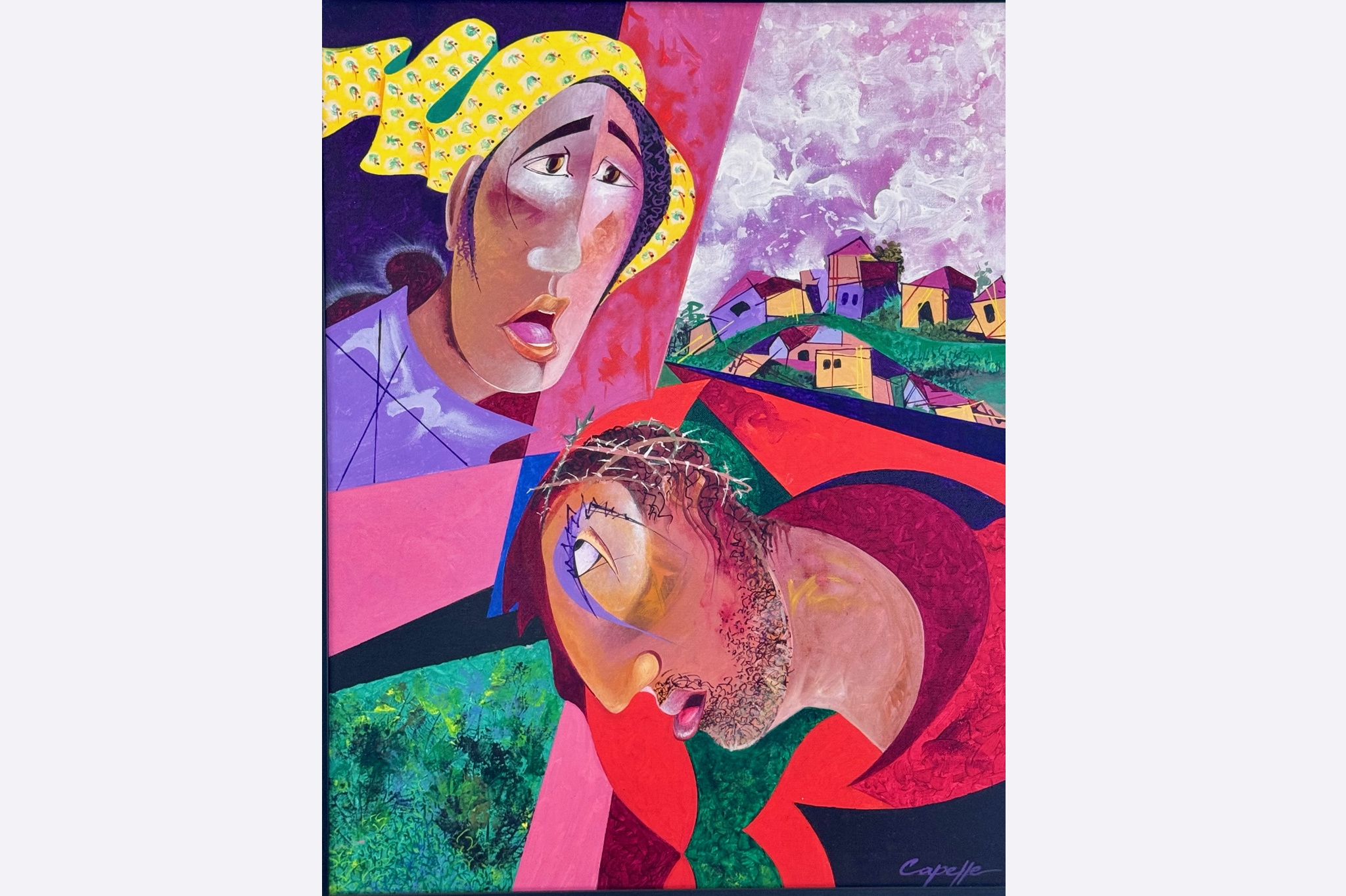
  • Sudáfrica, treinta y un años después del fin de ApartheidCapelle, Joseph. Stations of the Cross, IV: Jesus meets his mother, St. Martin de Porres Parish, Soweto, 2015

    South Africa, thirty-one years after the end of Apartheid

    By Carlos Mendoza Álvarez


    A Congolese refugee camp on the outskirts of Pretoria welcomes a small group of people from universities and churches interested in learning about their lives and stories. Ten families, each with four or five young children and some elders, greet us on the esplanade on a cold South African winter afternoon. Our guide is Lance Thomas, a colleague from the Centre for Faith and Community at the University of Pretoria (UP), who told us about his decolonial vision of accompanying vulnerable groups of houseless people and refugees. This is a splendid project that the university has been developing for more than ten years.

    During my visit to the UP a few days ago, I was struck by the creativity of this university community in connecting, among other ongoing projects, the world of unhoused people with different academic departments such as architecture, sociology, and theology, promoting a practical theology “on the street.” The recent inaugural lecture of the academic year by Prof. Stephan de Beer, discussing ways of building community and its spiritual dimension, while accompanying houseless families in creating projects to recover living spaces, is a prime example of this decolonial way of doing theology.

    Along the way, Lance warns us of the importance of not falling into the trap of victimization and the spontaneous desire to provide financial aid to the community we are about to visit. The aim is to see the conditions of that community up close to seek support strategies that address, as far as possible, the systemic causes that subject more than 250,000 refugees in South Africa from Burundi, the Democratic Republic of Congo, Rwanda, South Sudan, Somalia, and Zimbabwe, according to UNHCR.

    As I listen to Lance, I am strongly reminded of Ivan Illich’s warning never to lose sight of the importance of conviviality with others, as well as the friendship with the poor that was at the heart of Gustavo Gutiérrez’s liberation theology. Without falling into the trap of emotional manipulation, I resolved to be alerted to connect both poles: to think systemically and act compassionately.

    During spontaneous conversations with those who approached us at the camp to chat, I was struck by the deep gaze, as if open to painful memories, of two elderly people who told us stories of the seven years that had passed since they fled the war in the Democratic Republic of Congo. They have been jumping from one United Nations refugee camp to another in South Africa. Some were imprisoned for two years. The children who flit around with generous smiles and wide eyes “don't know what school is,” one of the community leaders tells me.

    A woman with an emphatic voice insists again and again on the discrimination they suffer as families from “their own South African brothers.” She shows me the document that UNHCR gave her seven years ago. Her only identity document, almost destroyed by the passage of time and dampened by her nervous hands, is not accepted by any South African authority. Another man approaches, full of anger and pain, saying that they can’t take it anymore and that if they don’t receive humanitarian aid, they will soon die. The woman returns, her voice desperate, to say that their neighbors threaten them at night and tell them to leave, to go back to their country. “But we have nowhere to go back to,” she says, heartbroken.

    One of our group members spent the entire time talking to one of the young women who is pregnant. The risk of inadequate medical care for her and her baby is real, due to the growing refusal of clinics in the country to accept refugees without valid permits. They immediately form a network of sisterhood.

    The impact of this visit, which I shared with a close group of friends and family in Mexico, sparked a desire to do something together with that refugee community. I will soon let you know here what we can do together.


    ∂


    I told this story a few days later to those who attend my talks on “Collective Healing and Community Hope.” It is a mixed group of South Africans, white and “of color,” elders and young people, some of them documented immigrants. They are part of a pastoral network in Cape Town and neighboring cities. We talk about the abyssal line that separates the world of privilege from that of exclusion. I emphasize the intersectionality that must be discovered between the various narratives of “coming out” of those who live in the shadows of poverty, gender violence, racism, ableism, and so many other stories of domination in our unequal societies. The audience immediately connects with the narrative that makes people with disabilities visible, but they are reluctant to recognize the connections with the narratives of queer/cuir Social justice concerns them, but even gender equality makes them uncomfortable. I take my talks a step further, talking about refugees in South Africa and my recent visit to a community in that country, describing them as those who live “in the shadows of the shadows of the shadows,” evoking Frantz Fanon’s powerful metaphor of “the zone of no-being" (Black skin, white masks). And the audience begins to open their minds and hearts, little by little, to discover the power, beauty, and spirituality in those who call us to cross into the “zone of no-being,” to dare to name the systemic violence that concerns us all, and to begin processes of mutual recognition, listening, and personal and communal transformation.


    ∂


    I realized then that when we talk about reconciliation with the South African people, we touch on a wound that is still open, even after decades of post-apartheid. “We are still segregated,” writes a colleague in a “silent conversation” we have as part of the afternoon workshop, commenting on flipcharts about violence in today's world. Thirty-one years after the collective trauma of apartheid for the peoples who inhabit these lands, no effective agrarian reform has yet been implemented, as 60% of the land belongs to white Afrikaners, contrary to the lies spread by Trump, who recently welcomed fifty Afrikaners as refugees fleeing “black persecution”. Another cynical deception by the dictator in office on land stolen from the indigenous peoples of North America. The distribution of wealth in the country of diamonds and tanzanite remains stalled by the corruption of the black elites who govern the country today. Many post-apartheid youths admire Elon Musk and Trevor Noah, hoping to one day migrate like them to the Big Apple or Los Angeles. Their dream is now reflected in the artificial world of the Netflix series “The Kings of Jo'burg", which is perceived by critical South African youth as a crude “Americanization” of life in this country.

    The wound of national reconciliation in the rainbow nation of Mandela and Desmond Tutu's time remains open. There is certainly skepticism in the country about its corrupt political class, as in my beloved Mexico. There is a certain resignation in the face of the failure of democracy, although small pockets of critical communities resist. The "3rd Black Power Pan-Afrikanist Decoloniality Winter School”, which will take place in Soweto at the end of July as a festival of combative decoloniality, will present another face of South Africa. One that emerges from the ancestral knowledge of African peoples.

    There is hope that South Africa, as the elder sister of the resistance movements of our times, will awaken from its slumber.


    Cape Town, July 5, 2025

  • El cuerpo del mesías: entre incertidumbre y alertaExocé Kasongo, Last Punk, print on demand, 2021

    The body of the Messiah: between uncertainty and alert

    By Carlos Mendoza-Álvarez


    A collective emotion of panic is sweeping through humanity from all four corners of the globe at the present time due to the war in the Middle East unleashed by Israel and Hamas, which is now spreading from Lebanon and Syria to the ancient land of Iran. This fire is being fanned by the boundless ambition of the United States, a new phase of modern imperialism, with its lackeys in various parts of the world. The recent protests under the slogan "#No King" in that country have only opened a small crack in the wall of white supremacy and Western capitalism, which, as the Zapatistas have been reminding us for a decade (Critical Thinking Against the Capitalist Hydra I) is like a many-headed hydra that reproduces more strongly each time one of its heads is cut off.

    The devastation in Gaza continues in real time, as digital media vividly reproduces scenes of burning buildings in Tehran and a desperate mass of Israelis trying to enter bomb shelters in Tel Aviv.

    Since 2007 René Girard (Clausewitz at the Extremes: Politics, War, and Apocalypse) had seen this "escalation to extremes" coming with a sharp apocalyptic eye, analyzing the logic of war as a final solution to eliminate the rival, from the Treatise on War of a Prussian general named Clausewitz. Girard interpreted this foretold catastrophe by stating that modern society had become the civilization that forgot Christ's invitation to dismantle "the lie of Satan." A path of mimetic violence that consists in believing that by sacrificing a few, the majority will be preserved from destruction. This "ancient path of wicked men," as the Book of Job (22: 15-16) says, commented on by Girard, is false because, despite the scapegoats, evil continues to nest in the human heart, marked by rivalry, contagion, and the sacrifice of others, which will continue to produce new victims until "the righteous people of history" stop this spiral of violence in their own bodies, as Saint Paul evokes in his letter to the Ephesians (2:14) when speaking of Christ on the cross.

    Such a victimizing process is carried out today by the states that perpetrate war. We see it spreading in Russia, the United States, Israel, El Salvador, and so many other countries where elites who govern with the cynicism of privileged minorities are willing to sacrifice "the disposable" for the sake of supposed national security, a prosperous economy, regional peace, or the "free world."

    The fear of the outbreak of nuclear war paralyzes us. We already saw its devastating effects eighty years ago in Hiroshima and Nagasaki, when atomic energy was used as a weapon of war by the United States, which has since controlled global foreign policy, with the complicity of NATO and other states that decide who can or cannot develop this technology. This is a new form of sovereign power which is imposed as a geopolitical strategy of deterrence and control of the planet. We are also familiar with the devastating ecological risks of nuclear accidents following the Chernobyl disaster in Ukraine in 1986 and Fukushima in Japan in 2011, whose human victims and thousands of animal and plant species continue to be affected by the devastating effects of this tiny, out-of-control atomic force.

    And yet, we must not forget that these same victims have struggled to become survivors who recover their own dignity and historical strength in the midst of horror. Jean-Pierre Dupuy reminded us in 2002 in his book For an illustrated catastrophism  and others who followed him the importance of learning from the victims of nuclear energy abuse their ways of resisting.

    We must subvert the logic of the powerful who capture our imagination with their greed for possession. By listening to those who confront evil in their own bodies and territories, thanks to their indignation and creativity, we can move from panic and uncertainty to a state of alert that allows us to change here and now that logic of death into processes of life and mutual care. It is up to us to take charge of our life stories, rooted in he place typical of our communities and towns, as Jean Robert said from Cuernavaca to inhabit the place from the proportion of the walker (Thinking while walking).

    Peace "from below" and from the reverse side of the history of the powerful is what we can build every day. Searching mothers in Argentina and Mexico have done so for decades. Indigenous peoples do so based on their knowledge and forms of communal organization. Women imagine and create it in their networks of care, confronting patriarchy for millennia. Collectives build it against the current. queer/cuir  who face the various phobias of yesterday and today.

    *

    I am writing these lines in Durban, South Africa, on the coast of the Indian Ocean, during a break from the workshop on "Hope and Healing" shared with religious and spiritual leaders of the region. One of them told us yesterday of his concern about the tasks pending in this country, after two decades of national refoundation following the abolition of the Apartheid In 1994, the ethical leadership of the South African people continues to bear fruit, such as the complaint filed by the South African State with the International Supreme Court in The Hague for the Palestinian genocide carried out by the State of Israel. However, within the country, there are serious pending issues, such as agrarian reform that would redistribute land still owned by the Afrikaners in the territory's 60%. The working groups told stories of South African youth blinded by the digital world and its vicissitudes, enveloping the imagination of a people with false hopes that make it impossible to face new challenges. Challenges such as the rejection of migration by the population from neighboring countries like Zimbabwe, Mozambique, and Lesotho, due to the famine or war they suffer, the successive corruption of governments, and the lack of accountability of authorities at all levels. Searching together for criteria to confront this crisis of uncertainty, we have found that spiritualities of humanity, such as the African healing tradition and the churches of various denominations close to the people in the peripheries, with their admirable wealth of ways of life, meditation and healing practices, represent ways of subversive of community in the face of religious monopoly in all traditions. These spiritualities are an oasis for the people who inhabit "the region of non-being" evoked by Frantz Fanon (The Wretched of the Earth).

    But these spiritualities need to be recovered in their inner strength of rebellion against evil and the development of other ways of life. Today more than ever, it is necessary to dismantle the power of religious ideologies that turn spiritualities into instruments for manipulating consciences, bodies, and territories.

    Humanity is called today to move from panic and uncertainty to a state of alert, that is, to creative imagination which mobilizes the forces of each person and community, weaving bonds of life in the midst of death. In the Christian tradition today it is celebrated Corpus Christiyou, the body of the Messiah. This is not a religious mythology that sacralizes objects, but the living memory of humanity and the cosmos as messianic body mortally wounded, fighting for life. In several countries, initiatives by governments and churches to promote peace are emerging. In Mexico, the “National Dialogue for Peace" promoted this weekend by several Catholic organizations is a reflection of this clamor.

    But we must not forget that the call for peace that arises in this context of imminent war in the Middle East and in every region of the planet will be a "flame flash" if that fire is not fanned. inside of each of our bodies and communities with practices of self-care, meditation and mutual accompaniment, new modes of governance and transitional justice that stop the spiral of hatred that is rampant throughout the world.

    In this way, we will be able to move from uncertainty to critical and hopeful vigilance as humanity, which, together with all of creation, resists and re-exists to become the living body of the Messiah.


    Durban, South Africa

    June 21, 2025

English