Category: Contemplation and silence

  • Los Cristos negros de ZinacantánCarlos Mendoza Álvarez | Black Christ | Elambó Esquipulas, Chiapas | 2026

    The Black Christs of Zinacantán

    By Carlos Mendoza Álvarez

    .

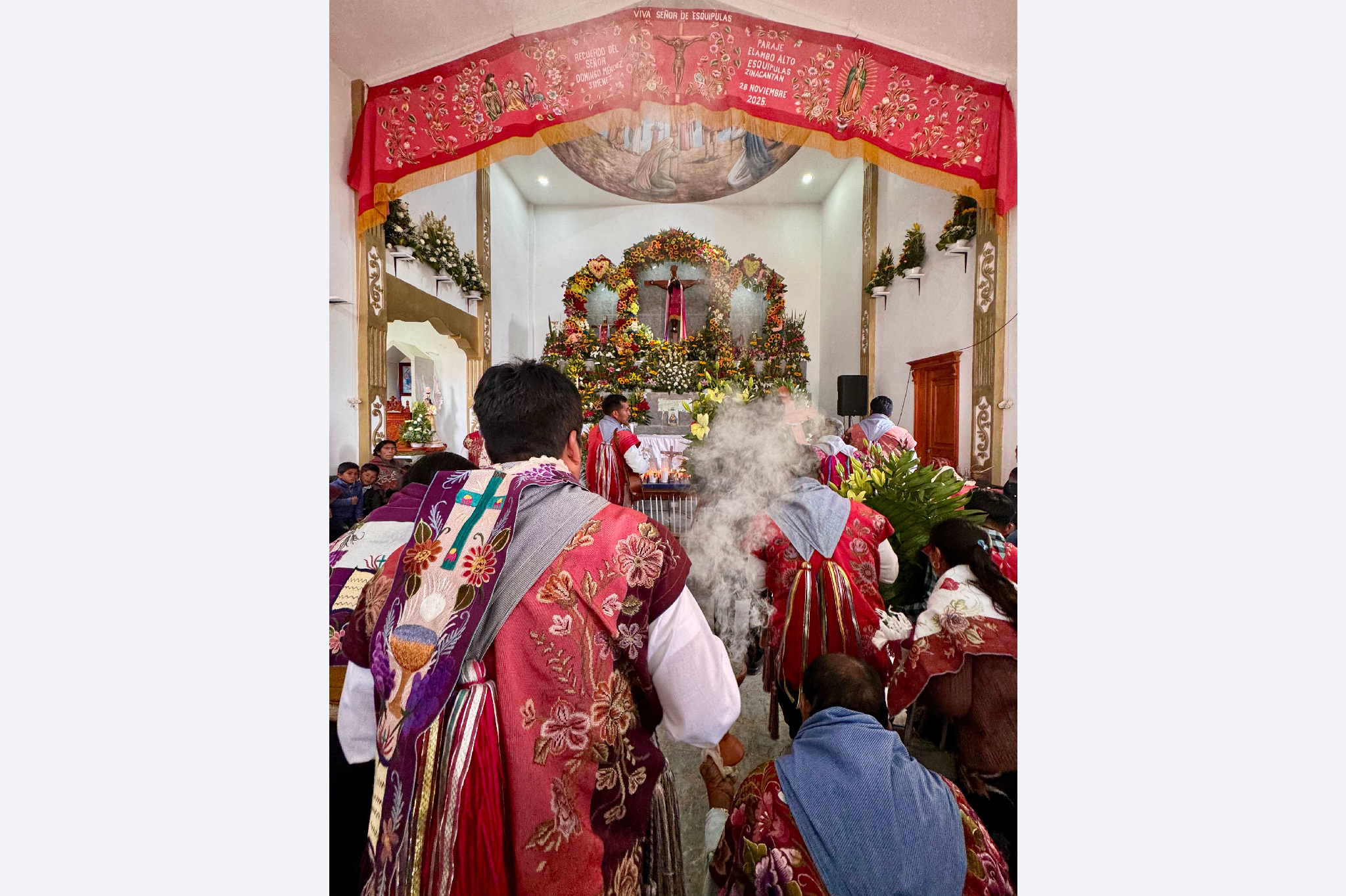
    The patron saint festival of Elambó Esquipulas in the Highlands of Chiapas opens with the resounding music of a band whose cymbals, clarinet, trumpets, and drum enliven the community's procession. We walk from the entrance of the village to the chapel of the Black Christ, draped in a pink mantle embroidered with colorful flowers and adorned with a curly wig of jet-black hair. The darkness of his skin stands out even more against the flowery backdrop and reflects, with a few glimmers in his arms outstretched on the cross, the candles. sown on the floor, burning amidst the incense that fills the altar.

    Once the initial greeting is given, the community kneels to pray the invocation of mercy in the Tsotsil language, under the guidance of Mariano, the catechist in charge, all imploring God for forgiveness for the world, in a murmur that begins like raging waves and then becomes a whisper and caress, like waves brushing against the sand of the beach, a sign of a pacified communal conscience.

    The Mass continues with biblical readings in Tsotsil focusing on the cross of Galilee, followed by a brief meditation that I lead for the community in Spanish. I summarize three key thoughts for the catechist-interpreter to develop with endless eloquence. I center on the biblical meaning of Jesus' cross as a result of his commitment to the excluded of his time. Then, I briefly recount the story of the Lord of Esquipulas in Guatemala, quoting my brother. jTotik Alfonso, though adding my own commentary, points out that its black color symbolizes the sufferings of the people that Christ bears. I see the image adorned with flowers and realize that the Crucified One offers us a loving embrace in the last breath of his life. It comes spontaneously to me to say this to the community, who listen attentively, and I see them receive that embrace with grateful expressions. And I conclude by inviting us all to celebrate the Lord of Esquipulas with our own commitment of love, caring, as he did in life, for those who suffer most in the community, beginning with children whose health is threatened by the soft drink and junk food industries, young people drawn to money, drugs, and alcohol, and women who suffer violence in their own homes and communities.

    The consecration of the bread and wine is experienced with profound devotion by the kneeling community. But this sacred moment of adoration of the body and blood of Jesus, the anointed of God, suddenly becomes an even deeper reverence thanks to the traditional song and dance of the Bolom Chon o jaguar song which expresses the deepest soul of the Tsotsil, Tseltal, and Tojolabal peoples, the Mayan peoples of the Chiapas Highlands. Traditional musicians play the harp, violin, and guitar with a slow, measured rhythm, like a mantra growing in a sonic spiral of infinite tenderness, lulling the incarnate God and Mother Earth, whom our feet touch with their dance. For it is worth remembering that, for the Mayan peoples, in the rites of ancestral tradition—such as those of the Tseltal people studied by the Jesuit— Eugenio Maurer In Bachajón, the dance has a religious meaning, because with the feet one caresses Mother Earth, the primordial gift of the Giver of Life.

    .

    .

    The Christ of Esquipulas, which originated in Guatemala, is a powerful representation of the diverse faces of faith of the ancient Mayan peoples, celebrating Tezcatlipoca under Mexica influence, according to the Dominican chronicler. Friar Diego Durán, to ask for rain:

    […] it was made of a very shiny and jet-black stone [obsidian], the stone from which they make razors and knives for cutting. In the other cities it was made of wood carved in the figure of a man, all black from the temples down, with a white forehead, nose, and mouth, the color of an Indian, dressed in some fine attire in his Indian style. First, he had gold ear ornaments and others of silver. On his lower lip, he had a lip plug of crystalline beryl in which was inserted a green feather, and sometimes a blue one, which from the outside looked like an emerald or ruby. This lip plug was about a gem long, above a ponytail of hair that he had on his head (Durán, II, 1995: 47).

    Centuries later, in that image, the Christianized Mayan people venerate the Nazarene with new meanings. In every corner of Zinacantán I visited this week, I found new and astonishing alterations to the image and the meanings the community gives it. From the story of a charred black Christ who miraculously survived a fire to the icon that darkens because it absorbs the sins of the world, we encounter stories that recount the anxieties and longings of its faithful devotees, giving the Christ increasingly intense shades according to the skin color or the consciousness of the community that venerates him.

    Two scenes remain in my memory from these days exploring the Zinacanteco landscapes. Both hark back to the ancestral rites of the Tsotsil people.

    The first is the prayer of forgiveness when the entire community, in a collective surge, with cries, tears, and sighs, raises its prayer kneeling on the sedge –These are the pine needles laid like a green and fragrant carpet on the floor of the hermitage, chapel, or temple, supporting the feet of the community gathered amidst candles—the incense mingled with the scent of pine from the surrounding forests. A vestige of the people of the mist and the forest, as the poet from Tuxtla sings. Juan Bañuelos:

    .

    Dawn breaks. The humidity is like sleep: motionless. Only
    ascends
    a people with roots in the throats of birds
    whose song stirs the fragrant carpet of the rushes
    The smoke from the huts rises, mimicking Mayan fretwork patterns.
    while the cyclical serum of memory is filtered out

    .

    The second scene that lingers in my heart is the ritual dance of sonic and rhythmic adoration that moves the assembled community, caressing the earth that has borne fruit to the son of Mary, perhaps a jaguar Christ, according to the memory of the Mayan peoples. Bodies transfigured by a radiance of ancestral humanity that opens itself to the loving mystery.

    The Black Christs of Zinacantán continue to luminize in every place, with darker or lighter tones, depending on the land that welcomes and venerates them. Black Christ of Esquipulas during the time of the Captaincy General of Guatemala. Black Christ of Tila during the time of Chiapas' independence. Black Christ of Zinacantán during the time of the indigenous uprising. Black Christ of today's communities facing the mirage of prosperity from the flower and textile trade. Black Christs that will come in the troubled times we live in.

    What laments and what praises will future generations of the Tsotsil people sing when, half a century from now, the cry of wounded humanity makes the Black Christ even darker?

    What laments, praises, and dances do we experience when we realize that time is running out to seek and find solace for a humanity threatened with death by the world of the powerful?

    The black Christs of Zinacantán are a great paradox: an embrace of suffering and a promise of life.

    .

    Ts'ajal Nam, January 17, 2026

    .

    Note: I would like to read your comments in the final section of this page.

  • El clamor de lo (post) humanoAnonymous | Watercolor of the Montesinos monument | Dominican Republic, 2020

    The cry of the (post)human

    By Carlos Mendoza-Álvarez

    .

    In 1511, Friar Antón de Montesinos, along with a handful of Dominican friars who had recently landed in Quisqueya, the Taíno word for the mother of all lands, uttered a cry that still resonates in the Western conscience: “Are these not men?” He was referring to the original inhabitants of that Caribbean island—later known as Hispaniola, where the modern states of Haiti and the Dominican Republic were established—who had been subjected by Spanish soldiers in the name of the Crowns of Castile and Aragon to harsh servitude and slavery. In the sermon for the Fourth Sunday of Advent on December 21 of that year, with the central figure of John the Baptist announcing the urgency of preparing the way for the coming Messiah, Friar Antón became a prophetic voice to counterbalance the nascent coloniality of power. According to this concept of the Peruvian Aníbal Quijano (Coloniality of power, Eurocentrism and Latin AmericaIt is possible to explain from our time the logic of power that led Europe to dominate the modern world, from the Renaissance to the Enlightenment, with its later avatars of American and Russian imperialism that we know today.

    More than five centuries have passed. Now, this enterprise of coloniality is acquiring global dimensions in our time with the extractive capitalist model that is expanding across the world, like a many-headed hydra, according to the Zapatista narrative that emerged in 1994 in southeastern Mexico. Three decades later, new ways of naming the diverse resistances to this lethal force that dominates the world will be heard in the seedbed « Of pyramids, of stories, of love and, of course, heartbreak » which will take place at CIDECI-Unitierra at the end of December.

    The question surrounding humanity may seem rhetorical, but it becomes more urgent when we consider the landscape of exclusion based on class, gender, ethnicity, and cultural identity that entire nations suffer today. The collapse of the international order we knew in modern times leaves us exposed. The foundations of that shared world were laid by the School of Salamanca with the Ius Gentium or the law of nations in the 16th century, with Friar Francisco de Vitoria at the forefront in dialogue with Friar Bartolomé de Las Casas from Chiapas and Guatemala, as analyzed by Enrique Dussel. It was one of the cornerstones of the model of Christendom created to justify the expansion of the earthly city in the image of the City of God under the tutelage of the Spanish Crown. Subsequently, this interpretation was transformed into an internationalist model, beginning with the Enlightenment, with a rationalist foundation of a contractual nature, making international law a pact between sovereign states, without an ultimate foundation in a metaphysical order that had its sustenance in God (Ancient and contemporary law of nations).

    .

    .

    Beyond the theoretical discussions about the transition from the Salamanca model to the Germanic model of international law, what is important to highlight here are the internal contradictions of the modern social contract that is collapsing before our eyes. Today we are witnessing the return of authoritarian regimes based on religious fundamentalisms with messianic pretensions (The United States is a messianic state), as is the case with US imperialism and Israeli Zionism. In the name of what ethical-political principle or source do today's powers justify their mechanisms of domination, neocolonialism, and the elimination of entire peoples? What limits are there to the power deployed by this unbridled new geopolitical “order”?

    But it is necessary to go beyond the catastrophic scenario described so far to recognize the role of peoples and the spiritual traditions of humanity in strengthening communal life among nations. How can we understand and promote the autonomy of individuals, peoples, and territories today in order to preserve what is human How can we cope with the threats of the system that already dominates us, encompassing both traditional and digital territories?

    In this context, Montesinos' sermon acquires remarkable relevance since it expands the question of mutual recognition of the human and the creature to all the victims of systemic violence that is leading humanity and the entire planet to the precipice (International treaties on biodiversity (SCJN)Are the nations and species that inhabit the face of the Earth not creatures with rights? In the post-human world, as it is called today, it is essential to develop a critical way of thinking that affirms the dignity of every creature in the cosmos in its profound dignity linked to the loving mystery of reality.

    It is no longer just about reaffirming the historical strength of indigenous peoples confronting the Eurocentric colonialism of five hundred years ago, but about the subaltern peoples who are disposable in the planetary war economy of the Trump Era, as he comments Leonardo Boff. Latin America and the Caribbean, as evidenced by the US invasion of international waters in the Caribbean Sea, are now a battleground for the war waged by the Southern Command of that neighboring country. Unfortunately, we will soon witness the full extent of this new model of imperial interventionism through the selective occupation of territories, the control of local governments aligned with the interests of the necrostate, and surgical strikes against the “enemies” of US national security.

    Nor is the cry for the dignity of humanity enough if it is dissociated from the cry of the Earth, “the poorest of the poor,” as Leonardo Boff also called it. That “escalation to extremes” conceived by Girard in 2007 based on the phenomenon of terrorism seems like child’s play today in the face of current wars whose objective is the blatant domination of entire populations in order to control their territories as objects of predatory enrichment of ecosystems.

    .

    .

    For this reason, it is more urgent than ever to recognize the new Montesinos who, with their outcry, appeal to the common humanity that unites us as individuals and peoples, with its mystical source that gives strength and opens horizons of life for all, in order to reverse those processes of necropower that claim more and more victims every day.

    But today it is urgent to move beyond the anthropocentric paradigm, transitioning towards an "ecocentric" one (Anthropocentrism and ecocentrism in the jurisprudence of the Inter-American Court of Human Rights) that promotes the dignity of Mother Earth, who is also subjugated by the dominant model of extractive society and economy. «Rethinking as a human species,» according to the proposal of political ecology promoted by Víctor Toledo and a significant network of scientists worldwide (Political ecology is here to stay) is a key step to regain our course as humanity inhabiting the Common Home that has been given to us by the Giver of Life.

    The green martyrs, the searching mothers, and the indigenous peoples in rebellion are some of the voices that have sounded the alarm about the devastating situation that has already reached us. Listening to their denunciations is a beginning of ethical and mystical conversion, but it is not enough. We must join those processes of subjective, territorial, and spiritual autonomy carried out by those who have said enough to necropower.

    .

    .

    Perhaps the most inspiring way for believing communities to celebrate the approaching Christmas is by honoring the memory of Montesinos and all the prophetic voices of yesterday and today.

    Preparing the way for the arrival of the messiah is not, after all, an act of Christmas folklore, but a change of course in our ways of life with ethical-political, practical and mystical decisions, such as recycling garbage, reforesting forests, and including the vulnerable at our tables as gestures of celebrating life amidst the ruins of the present world.

    As I mentioned some years ago (Messianic time and narrative for a theological interpretation of the narrative practices of victims) it is urgent and a priority that we pave the way to messianic times through our acts of resistance to necropower, promoting communities where we learn to spell anew, with imagination and vigor, the humanity and creatureliness that unites us, all drinking from the inexhaustible source of Life.

    .

    Jobel, December 20, 2025

    .

    Note: I would like to read your comments in the final section of this page.

  • Sobre la esperanza en tiempos inciertosSearching Mothers | NTR | Zacatecas, 2025

    On hope in uncertain times

    By Carlos Mendoza-Álvarez

    At dusk this Saturday, the first Advent vigil begins, when Christian communities throughout the world embark on a journey, in the midst of the darkness of time, to receive the human and divine light of dignity and hope that the Messiah brings. The ancient hymn will resonate during the nighttime celebrations, Rorate caeli , whose lyrics and melody are like a lament that rises to heaven from the desolate city, crying out that “the clouds rain down on the Righteous One,” as the prophet Isaiah (45:8) implored during the exile in Babylon.

    Each year, this four-week calendar leading up to Christmas is accompanied by symbols of light, greenery, carols, sweets, tenderness, and community. According to each culture, the waiting period for the Messiah's arrival evokes the awareness that "something is lacking" for the fulfillment of those desires for new times of justice, truth, compassion and peace, not only for a people who arrogantly claim to be the only chosen ones, but for all of humanity and even for the entire cosmos.

    Every generation has seen terrible signs that the world is ending, whether through epidemics that make us feel how vulnerable our bodies and knowledge are; whether through wars waged by empires against emerging powers that threaten their arrogance; whether through the uncertainty of life itself, diminished by age, illness, failure, loneliness, or hopelessness.

    The biblical texts that we, the believing communities, meditate on these days speak of the expectation of the messiah, first with a strong apocalyptic tone that announces the destruction of the corrupt world, reaching the entire cosmos with a catastrophe that will destroy everything because of the human pride that has taken over creation.

    Then, as the date of the celebration of the Nativity of the Messiah Child, a Nazarene, approaches, the tone of the texts becomes more hopeful with the announcement of a God who is near, humanized, small, and fragile. It is the incarnate promise of a divine and human life that begins in complete vulnerability in the story of a migrant family with a newborn baby, trying to survive on the periphery of the empire and fleeing the fury of the local ruler, eventually finding refuge in Egypt, from where a definitive chapter in the history of human redemption will begin to be written.

    However, the collective depression we are experiencing today as humanity due to the escalation of hatred to extremes – which is spreading across the planet in an apocalyptic way “like a lie of Satan,” as René Girard said in an interview he gave me in 2007 in Paris (Hope as apocalypse)– this seems to render any narrative of hope for our uncertain times illusory. The genocide in Gaza continues as the climax of the Nakba or Catastrophe that began in 1947 with the expulsion of nearly a million Palestinians from their lands, paving the way for the creation of the state of Israel in 1948, this systemic violence continues today before our digital screens, met with indifference by social media and the international community. The wars in Ukraine, Congo, and South Sudan have become so “normalized” that they no longer make the front page of newspapers, much less a trending topic in the digital world. In Mexico, public indifference to urgent issues such as the crisis facing corn, lemon, and avocado farmers—caused by the violence in Michoacán—along with the persistent femicides and forced disappearances, speaks to a growing discontent among the population, expressed through strikes, road blockades, and street protests. But the masses seem numb, retreating into bubbles of entertainment and unrestrained holiday shopping, which, among other ills, leaves household finances in ruins for months and years to come.

    Religious consumerism is also part of the overwhelming Christmas marketing, amidst kitschy decorations and echoes of folk crafts used to make piñatas featuring popular characters. It will certainly be present at Mexican posadas, Trump's piñata , which is sold in various markets in Mexico and the United States, will receive blows as a ritual of revenge amid laughter and boos until the cardboard breaks and the blond wicks of the tyrant fly out like shooting stars in some tenement courtyard in Mexico City, Chicago or Los Angeles for the delight of all.

    A few families may perhaps rediscover the “mystical” meaning of the Advent wreath, following the Avatar of Carlo Acutis explaining Advent 2025. This video, which is circulating online, aptly explains the spiritual significance of the ritual of lighting each of the four candles during this season that prepares for Christmas. The light lit each Sunday of Advent symbolizes the "people who walked in darkness and have seen a great light" (Isaiah 9:2), which the prophet foretold to the Hebrew people devastated by the division between the small kingdoms of Israel and Judah, with their leaders corrupted by the idolatry of power, seeking alliances with neighboring Syria to defeat the rival tribe.

    And like a non-place amidst so much noise, creating a void in the midst of the urban clamor, in Mexico the collectives of Searching Mothers (Searching mothers light Christmas tree) will set up Christmas trees covered with ornaments bearing the faces of those we have lost. They are today “the voice crying in the wilderness” (John 1:23) because they speak on behalf of the victims of the narco-state war and the idolatry of the necropower of our time.

    Perhaps this is where the theological core of this season lies: the absence of the Messiah is something that has inspired Hebrew and Christian generations for centuries to mobilize in order to make the messianic times present through acts of remembrance, justice and an (im)possible reconciliation.

    Beyond a folkloric celebration of the coming of God-with-us, what we are about today is going to the other side of history to contemplate there, in the silence of the night, some glimmer of light that announces the arrival of the Messiah. And those who feel in every second of their lives, in every breath—like Vero and Fabiola, mothers searching for their missing children who shared their hope with us in a recent meeting in Guadalajara—the absence that hurts and motivates them to search out of love, are the ones who teach us what hope means in times of uncertainty, the heart of Advent.

    Next Monday, December 1st, the documentary Re-exists 2025 will be presented online (Presentation of the documentary Re-exists 2025), prepared by Uruguayan filmmaker Juan Meza. There, some of the stories of awakening, healing, and embodiment shared by people from seventeen countries and different religious and spiritual traditions from four continents facing diverse forms of violence where it has been possible to spell out hope.

    Advent is a time to continue weaving networks of combative hope , say the social movements on the peripheries of the empire, so that our world does not fall into the abyss. And it is possible to do so by listening to the people who for years and centuries have resisted and now accompany us in re-existing.

    Because there will always be hope as long as there are people and communities who live the end times, so insistently emphasized by Javier Sicilia and Elías González, as the opportunity to enter into another way of existing amidst violence but pregnant with the active expectation of messianic times.

    Happy Advent season!

    Mexico City, November 29, 2025

    Note: I would appreciate your feedback at the end of this page.

English