Category: Chiapas

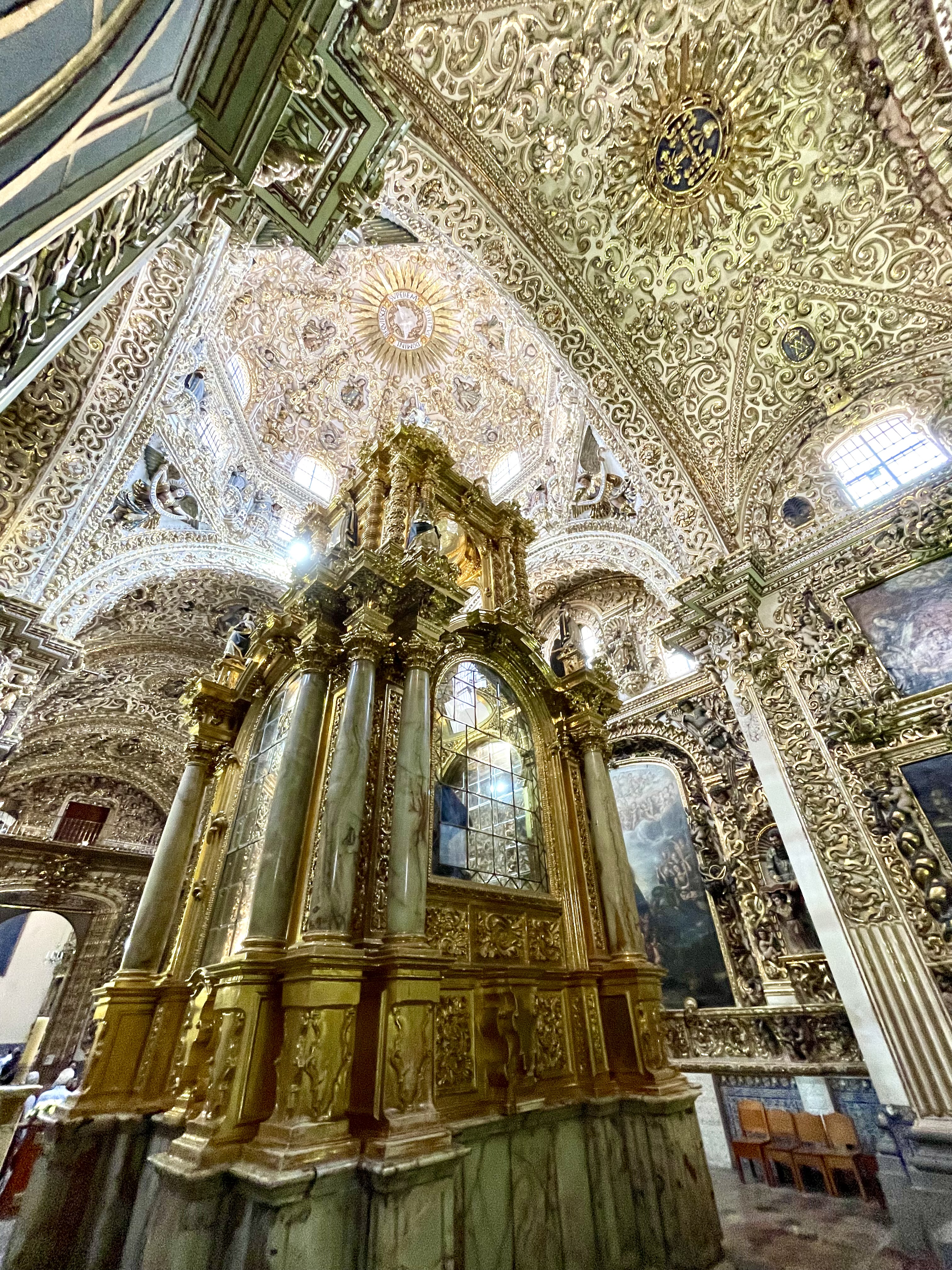
  • Los frutos de la Pascua floridaCarlos Mendoza Álvarez | Chapel of the Rosary, Santo Domingo Church of Puebla | 2026

    The fruits of Easter

    By Carlos Mendoza Álvarez

    Three weeks of silence on this blog have passed amidst a whirlwind of pastoral and personal events that, in retrospect, I see as related fruits of this year's Easter journey. Through brief stories, I will try to recount the glimpses of the world to come that I perceived during these days.

    The religious celebrations of Holy Week suddenly intertwined with a mysterious encounter at the water wells of Yalentay, in the hills of Zinacantán, where I was unexpectedly welcomed by the guardian of the place. These multifaceted religious celebrations unfolded amidst visits from dear colleagues and friends who had traveled from afar—Amirah and Alicia with Adriana—with whom I longed to share the rich fruits of an indigenous Church rooted in and embodied by the Tsotsil people, accompanied by questions about what still needs to be learned about caring for the land as part of the path of resistance.

    Easter in Jobel

    The group of six acolytes was entrusted to me for their training and the preparation of their vestments in the Dominican style. They are six teenagers. pigtails who, with great conviction and emotion, wish to dedicate part of their human and spiritual lives, occupying their free time during middle and high school, to “serving at the altar.” In the context of San Cristóbal de Las Casas, a city of intense religious and devotional practice, connecting with young people to serve Christ at the altar and in the community, especially the poor and the excluded, presents a significant pastoral challenge. Integrating a new generation of young believers faces various forms of resistance from older generations, who seem unwavering in their hierarchical and individualistic religious practices of San Cristóbal's popular piety.

    But after two months of Saturday meetings in a fraternal atmosphere, with simple prayer from the heart and through listening to biblical stories in contemporary audiovisual versions, an incipient community of friendship with Jesus, as shepherd and friend of the sheep of this and other flocks, was formed.

    At the end of this process, which had some tensions with the older generation, I realize the good heart of today's young ponytail holders, eager to serve with beauty and truth at the liturgical altar, while also anxious to translate the symbolism of the altar of Christ—the poor—into acts of service to the most vulnerable in the city.

    65 soles

    And April arrived with its birthday-like emotional force, giving me the opportunity to relive the feast of desire in my own flesh—with mass and a table set with the hallmark of the flavors and style of Puebla—, accompanied by my family and by old and new friends, as thanksgiving for the 65 springs I have been able to live as a man and as a Dominican, most of my life.

    The Chapel of the Rosary, the epicenter of the spiritual life of many families in Puebla, including my own, was the perfect place to offer a prayer of thanksgiving for the gift of life, accompanied by my family and friends throughout so many years of sharing bread and salt, pain and hope, celebration and the work of building other worlds here and now. The Baroque music performed by Julio Saldaña and Suzy Torres, with Magda as soprano and Abraham on keyboard, allowed us to connect with the ancestors of my family and my religious order. This extraordinary space of Baroque art is even more admirable because it tells the stories of women of faith, like Mary, the young woman from Palestine who said yes to the angel, and of many women from the Bible and Dominican sisters from Europe and America, all of them walking, accompanied by the three theological virtues, toward fullness of grace.

    It was a pleasure to host my classmates from the State Normal Institute and the Emiliano Zapata Popular Preparatory School as guests. The years that flew by now seem to bring us closer than we are apart. I had the feeling that we were coming home, after each of us had followed our own path, whether as a lawyer, chemist, engineer, educator, or guerrilla fighter.

    And to my surprise, meeting Polo Sánchez Brito, scout guide of the Antelopes patrol of Group 1 of Puebla, more than half a century later, was to reaffirm those lessons to be self-reliant and in community in the middle of the forest, orienting oneself with the compass and the stars on the initiation walks, learning to light a fire with flint and a little straw, to cook breakfast and prepare coffee with milk at dawn, in addition to recognizing the footprints of the animals that passed by on the paths and recording them in plaster molds.

    Six toasts, one for each decade lived, allowed me to recall small stories of family childhood and as a boy scout, the affective awakening of adolescence, the critical high school youth, the profession chosen from an early age in my case as a Dominican, the faith committed throughout the years according to a spiritual and intellectual tradition of eight centuries, and finally the academic life of three decades inspired by the pastoral accompaniment to vulnerable communities in Mexico.

    And in the end, all this shared memory was crowned by the loving toast in the voices of my sister María Eugenia, my friend Raúl from high school and Amirah, who represented the doctoral students of Boston College from various countries of Our America, from whom I continue to learn so much.

    What a joy to celebrate the gift of life in this way!


    Bavarian dialogues

    And, as a challenging continuation of life, I am now undertaking a brief academic stay in Eichstätt, in Bavaria, thanks to the invitation of my friend, Professor Martin Kirschner, who is allowing me to reconnect with that profession of teaching that I left a year ago when I resigned from Boston College, after three decades of academic life.

    Being the “subject of study” for doctoral students in Bavaria wasn't entirely unfamiliar to me, after Cleusa Caldeira, at the Jesuit Faculty of Theology in Belo Horizonte, Brazil, dedicated her doctoral thesis to exploring my contribution to theological thought. Here, Constantin was tasked with reading my latest book on the resurrection as messianic anticipation, in order to pose incisive questions about the “reality” of Jesus' resurrection, asking what happened to his body and how it affects us today. At its core, there was a metaphysical questioning underlying this foundational event of Christian existence.

    Returning to the rhythm of a European university city—calm, quiet, and orderly in its timing and customs—is a delight. But it's also a challenge not to disconnect from the life and pastoral processes I've been immersed in for the past five months in Chiapas.

    In what way, going forward, will you be able to achieve a balance between action and thought, with enough time for meditation, reflection, and writing?

    The dream of a cabin-home appears on the horizon, a place to socialize with friends in body and spirit, the breath of the divine Ruah to let us be moved by its breeze.

    Perhaps the volcanic environment of my childhood is the fertile humus that will make that dream bloom.

    Eichstätt, April 30, 2026

  • De manglares, esteros y mundos otrosCarlos Mendoza Álvarez | Altar with bat-jaguar-snake face | Old Church, Structure C-3 | Tonalá, Chiapas, 2026

    Of mangroves, estuaries and other worlds

    By Carlos Mendoza Álvarez

    The tide is visible in the distance on the horizon that opens up at the back of the estuary, among the mangroves of Boca del Cielo. The poetic name of this secluded beach in Chiapas is a prelude to the much-desired rest for the small community of friars, exhausted after forty intense days of religious and cultural activities in the Highlands of Chiapas. This period culminated in the climax of Holy Week, experienced with profound devotion by diverse communities throughout these lands.

    The Chiapas coast is still protected by mangroves and estuaries that stretch along its shoreline, from Oaxaca in the northwest to Guatemala in the southeast. Small-scale tourism has not yet disrupted the lives of its inhabitants, mostly Zoque people who have lost their language and customs, but retain a vibrant spirit in their eyes and open smiles. Mariana welcomes us to her palapa with seafood dishes from her coast, such as sea bass, shrimp, and tilapia, accompanied by refreshing drinks of mango, pineapple, melon, and tamarind. She is the heart of the business, along with her teenage son and their pet, Oso, a beautiful white puppy with curly fur and dark circles under his eyes that make him look like a panda in reverse.

    Instead of a swimming pool, the small hotel has direct access via a short flight of steps to the estuary's warm, calm waters, occasionally enlivened by a strong current in the farther area, near the sandbar that protects the channel from the open sea. Further out, a few lizards hide, having fled to sparsely populated areas, where some communities—like the Madresal ecotourism complex—preserve them in breeding centers. It must be said, however, that these initiatives are modest compared to the urgent need to protect the estuaries and their endangered wildlife. The turtle hatchery on Boca del Cielo beach, for example, is only operational for a couple of months each year during the summer, neglected by the local population focused on tourism services, and left to languish due to the indifference of the local government.

    Due to the melting of the polar ice caps caused by climate change, the scientific community predicts the disappearance of many of the planet's low-lying coastlines, such as mangroves and their estuaries, with the sea invading these areas of biodiversity at the boundary between salt and fresh water as tides rise.

    Two millennia ago, in the mountains bordering these beaches, the Mixe-Zoque culture flourished. The archaeological remains of the sacred site—today known as Old Church The crosses carved into some of the stones on the pyramid slopes are of impressive symbolic richness. A central pyramid represents the body of a turtle, its corners mimicking the flippers of the reptile of longevity. The giant head lies at the foot of the stairway, welcoming the pilgrim in a gesture of cosmic sacredness. Stelae of varying sizes, weathered by relentless time and broken in two by ceiba tree roots, are engraved with polymorphic faces that combine the ears of a bat with the snout of a jaguar and the eyes of a monkey and a snake.

    And in the heart of one of the central plazas of the sacred site, which covers more than sixty hectares—located on the plateaus of Tepancuintla Hill, some 700 meters above sea level in what is now the municipality of Tonalá—lies a monumental stone of iconic power similar to the Aztec Sun Stone or the stele of Pakal's tomb in Palenque. The black granite monolith has four faces, each pointing to a cardinal direction: three are human (two men and one woman), and one is zoomorphic, a hallucinatory fusion of sacred animals from the mountains that shelter its inhabitants.

    The local guide told us that this jet-black stone takes on blue hues at certain times of day, convinced that it's like a gateway to the world of the ancestors. To honor his word, I approach it with reverence, walk around it, caress it without touching it, and perceive an ancestral memory that dwells within it and welcomes us with force.

    Two hundred kilometers to the south, the Mokaya culture sowed the seeds of Mesoamerican cultures four thousand years ago, even before the Olmecs, who are recognized as the cultural matrix of Mesoamerica. I already cherish in my heart a future trip to those lands, near the border with Guatemala, to let myself be touched by their wisdom made of stone and pottery, unknown to us today only in their music and oral traditions.

    I began this story by recounting tales of estuaries and mangroves. But upon rereading it, I realize they were merely a gateway to another world, one inhabited by the Mixe-Zoque and Mokaya peoples who lived in these mountains and navigated these waters millennia ago. Their ancestral memory became a cosmogony carved in stone, pyramids constructed with enormous monoliths of granite and volcanic rock, marked with cosmic and human symbols, such as the sun, the knot, the face, and the hand.

    What memory will we leave for future generations two thousand years from now, when someone visits the ruins of our neighborhoods and cities, now dominated by steel and cement? Will they find technological ruins of algorithms and avatars on the internet that can be rescued from oblivion? Perhaps some holograms will be preserved in the cloud, concentrating the wisdom of humanity, lost today in its pursuit of power and money.

    For now, the door to other worlds remains open.

    Boca del Cielo, April 11, 2026

  • JobeLab Una iniciativa de pensamiento crítico y espiritualidades diversas desde San Cristóbal de Las CasasJobeLab | San Cristóbal de las Casas, Chiapas | 2026

    JobeLab An initiative of critical thinking and diverse spiritualities from San Cristóbal de Las Casas

    By Carlos Mendoza Álvarez

    From the second half of the 20th century, Chiapas became a laboratory of new ways of inhabiting and thinking about the world, with the creative confluence of important social, political, cultural and spiritual processes.

    Among them, dynamism stands out synodal (or shared path by all the believing people with their diversity of ministries) of six decades, implemented by the Diocese of San Cristóbal de Las Casas with jTatik Samuel Ruiz as pastor walker And hundreds of local, regional, and international communities and groups, convened for justice and peace for the Indigenous peoples and other communities of this region of Chiapas. In an astonishing confluence of paths, the Indigenous Congress of 1974 marked the beginning of the public presence of Indigenous peoples with their own voice. Indigenous, mestizo, and international social and cultural movements also emerged, with research projects on the rich Mayan heritage, both ancient and modern, developed by teams of social anthropologists, archaeologists, and linguisticists. Waves of researchers arrived from Latin America, the United States, and Europe, and, with an academic model still largely based on extractive practices, made significant discoveries in the social sciences and humanities. The translation of the Bible into Mayan languages, initially promoted by the Summer School of Bible as part of a U.S. interventionist plan, evolved into intercultural dialogue, continued to this day by various Christian churches, including the Roman Catholic Church. Finally, the Zapatista movement, with its armed and media-driven uprising of 1994, became the watershed moment of a social, political, and cultural insurrection that continues to this day as one of the most radical critiques of the hegemonic system of the multi-headed capitalist hydra, including patriarchy and colonialism.

    The “San Cristóbal School” is a name proposed decades ago by Pablo Romo and others in academia and the arts to evoke the legacy of critical thought, resistance, and spirituality that emerged in Chiapas, as a counterpart to the Cuernavaca School, analyzed by Humberto Beck. In their connections and differences, both represent significant contributions to critical thought that arose in Mexico during the last century.

    In this way, recognizing the individuals, groups, organizations, and initiatives of civil society that have been an active part of these processes, as a collective inspired by them, with JobeLab -apocope of Jobel which is the Tsotsil name of San Cristóbal de Las Casas and laboratory To designate this city as a laboratory, we seek to give continuity to such a legacy in a new context, focusing on critical thinking and the spiritualities that have sustained them, such as those of the native peoples, Catholic Christianity, and more recently Buddhism and Islam.

    Through the initiative JobeLab. Ongoing dialogues and mutual support for re-existences We will continue to cultivate this heritage in the new scenario of the civilizational crisis that humanity faces in the second quarter of the 21st century, where peaceful coexistence between nations and the balance of planet Earth are at risk and call us to promote processes of resistance and re-existence.

    We will nurture this initiative based on two inspiring attitudes that are, at the same time, transversal axes of the talks, meetings and festivals that we will organize in various spaces of the city: hospitality and commensality.

    The hospitality It is one of the human gestures that most powerfully expresses our shared human condition, that is, our way of becoming individuals and communities as beings in relation to one another. This radical attitude of openness to otherness is a fundamental ethical and political act, where the religions and spiritualities of humanity celebrate a glimpse of divinity.

    The commensality, Like the other side of the moon, it is the nourishing soil where we receive the otherness of Mother Earth, of other humans who become our neighbors, and of Divinity, through food and drink created by the unique genius of each people. We celebrate this gift as an inclusive banquet where Divine Sophia prepares a table for all nations and creatures of the cosmos.

    Together with Carmen Reyes and Ricardo Hernández, Angélica Evangelista and Abraham Mena, I am enthusiastically participating in this project, drawing on the Dominican tradition of life and thought. In these exchanges, we seek to discover new expressions of the divine and human Word as a creative fire that redeems, animates, and shelters us in our present circumstances. times of hardship as a human species that puts itself and the Common Home at risk, leading us to the precipice of annihilation.

    This week two events will be the formal presentation of JobeLab, after the first event where the initiative germinated, on January 28, with a presentation on Gaza and Chiapas at the Charity temple in the city of San Cristóbal de Las Casas.

    On Wednesday, March 25th at 5:30 pm, we will hold the discussion “The School of San Cristóbal,” with the participation of Pablo Romo, who was one of the key figures in the diocesan process of promoting human rights, paving the way for the creation of the Fray Bartolomé de Las Casas Human Rights Center. Martha Elena Welsh, choreographer who animates in Xitla House In Mexico City, workshops were held to support people in situations of extreme vulnerability, facing various forms of violence. And Juan Carlos La Puente, a Peruvian with extensive international experience in providing spiritual support to human rights defenders, has been developing a methodology for this purpose from his base in Oregon, USA. permanent discernment as a path of body for people and communities in re-existence.

    And then, on Friday, March 27th at 5 p.m., we will explore another facet of re-existence: forgiveness as a path to reconciliation in contexts of violence. With the Muslim community of San Cristóbal de Las Casas, represented by Shaykh Yahya Rhodus and Shaykh Mudar Abudlghani, we will discuss forgiveness in Christian and Muslim traditions as a common path to peace, at a critical moment of violence in the Middle East. And we will do so accompanied by the extraordinary music and song of Nader Khan, a Canadian Sufi artist.

    We invite you to be a part of JobeLab From wherever we may be, whether attending talks and meetings, or imagining and creating similar spaces where we can come together and flourish as individuals and communities in resistance and re-existence, going beyond the spiral of violence that surrounds us, towards a world another world of hospitality and commensality.

    Jobel, March 23, 2026

English