Category: Chiapas

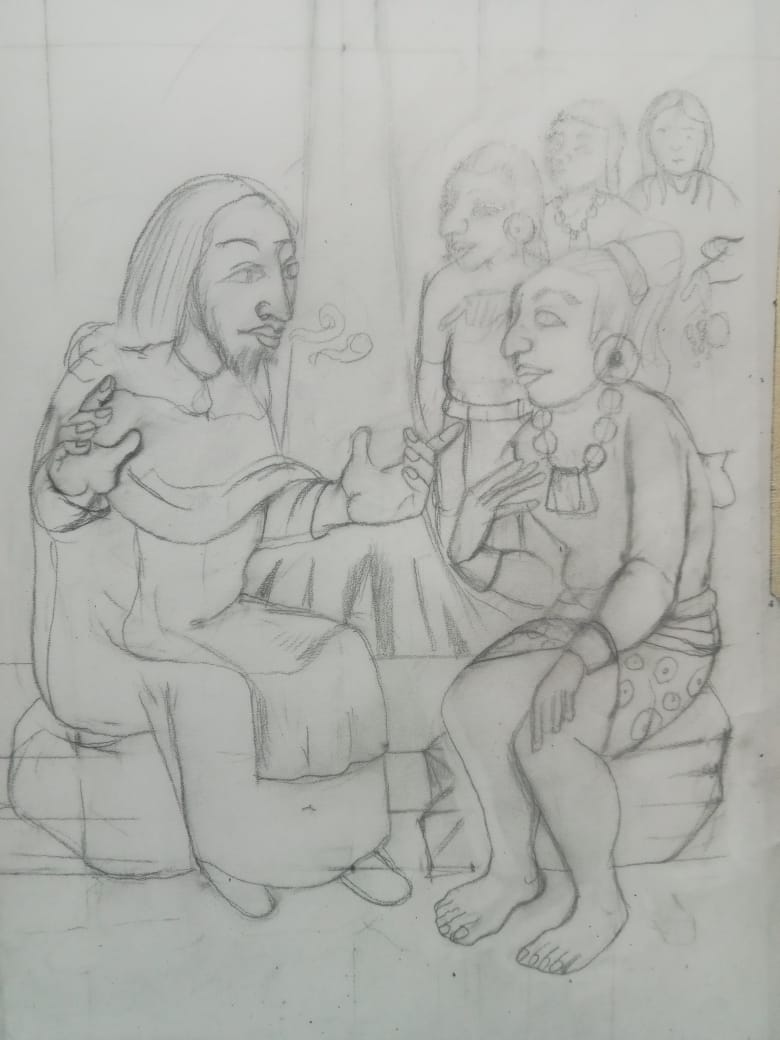
  • La fiesta de la Ruah divina Reflexiones sobre la memoria viva de los pueblos en movimientoAntún Kojtom | Mural 500 OP Chiapas | Detail: sketch of Friar Pedro Lorenzo de la Nada with Lacandon Sage | Sots´leb, 2026

    The Feast of the Divine Ruah Reflections on the living memory of peoples on the move

    By Carlos Mendoza-Álvarez

    Fifty days after Easter, Christian communities around the world celebrate the overabundance of divine love, reaping the fruits of the messianic age, gathered with joy in the midst of suffering, as the Hebrew poet says: “Those who sow in tears will reap with songs of joy” (Psalm 126:5).

    Two thousand years ago, after mourning the brutal execution of Jesus, the Galilean, by the Roman Empire—in collusion with the Temple authorities of Jerusalem and the enraged mob as part of the infernal mimetic cycle—a period of mourning was necessary for his community of friends and companions to grasp the senselessness of the innocent's death. This question still arises today in the grieving hearts of those who have survived lynchings, both ancient and modern. It is a questioning of the meaning of absence that also beats in the hearts of the Mothers Searching for their disappeared children in Mexico today, a cry that becomes a plea to find their offspring and help them "come home.".

    Celebrate that Love is as strong as death and, even more, that Love conquers hate or that Life resists and re-exists At first glance, it seems like an evasion that ignores the suffering of the victims and the urgency of justice. On the contrary, it seems to me that precisely in that hopeful suffering The heart beats with the ethical, political, and spiritual indignation of survivors of so much violence. A cry that is expressed in the public squares of Gaza and Tehran, Beirut and Mexico, Kakuma and Dadaab in Kenya, by those who dedicate their bodies, hearts, and minds to the service of life in the midst of death.

    The celebration of Pentecost is rooted in the joy of peoples who, after confronting horror, are able to go further in healing from trauma and quietly cultivating hope. Without denying the painful past, nor the undeniable need to hold the perpetrators accountable, what matters to those who survived is to stand up and live again with hope. This is what I have been learning, step by step, from the collectives queer/cuir  who face gender phobias of various kinds, women facing abuse and femicide, as well as indigenous peoples who strengthen their resistance through processes of autonomy of bodies and territories, from the Inuit in Canada to the Mapuche in the far south of our continent.

    How can we celebrate the harvest of the divine Ruah in these times of such profound uncertainty? We are witnessing alarming signs of a return to barbarism at the hands of genocidal governments in the Middle East and Africa, as well as in failed states trapped by the complicity of their rulers with transnational criminal organizations, as is the case in Mexico, El Salvador, and Nicaragua. This spiral of genocidal hatred is being transmitted in real time through the attacks of the Israeli Zionist state, which is committing crimes against humanity with the complicity of the United States and the European Union, and the indifference of the international community, against entire populations that stand in the way of its geopolitical power.

    Strengthening resistance movements must also confront fundamental debates to find the path to utopia in times of dystopia. Collective memory, which lies at the heart of these processes, is now a battleground. Who tells the story and how they tell it are questions the Zapatistas in Chiapas, like the Sumud Global Flotilla, are asking themselves, attempting to give visibility to those who always remain in the shadows of the power that kills.

    We Dominicans are not exempt from these debates, especially now that we commemorate 500 years since the arrival of the friars to what we now call Veracruz in Mexico, on July 25, 1526. The great feat of evangelization—which undoubtedly brought missionaries inspired by Renaissance utopia and by the zeal for reform of the religious orders to return to their origins of following Christ—was also marked by the libido dominandi of the conquerors who followed that maxim of Western modernity so forcefully expressed by Enrique Dussel: conquiro, ergo sum, that is, "I conquer, therefore I am".

    When recounting the history of the Dominican presence in this region of the continent—called Tierra Firme by Western navigators and Mesoamerica by later geographers—we cannot forget that a fundamental contradiction marked the evangelizing work of the Dominican friars in the 16th century, as rigorously studied by Friar Daniel Ulloa Herrero in his doctoral dissertation at El Colegio de México: an observant current led by Friar Domingo de Betanzos, and a prophetic tendency championed by Friar Bartolomé de Las Casas. Undoubtedly, there were many nuances between these two tendencies when it came to evangelizing the colonized lands that later gave rise to the golden age of New Spain, the era of the Baroque churches along the Dominican route from Mexico City to Guatemala, traversing the entire central and southern regions of the Viceroyalty of New Spain.

    The splendor of the Baroque art of the convent churches of Puebla, Oaxaca, and Chiapas has shaped a worldview in which Mexico was the axis mundi From that early era of modernity, a meeting point between Asia and Europe, Mexico City was also a laboratory for cosmopolitan culture, as Friar Julián Pablo Fernández liked to say when he was prior of the ruins of the Imperial Convent of Santo Domingo in Mexico City. This era gave birth to a Creole and mestizo culture of universal value, as UNAM historian José Rubén Romero Galván recounts. However, we cannot forget that this Creole culture subjugated and rendered invisible the Indigenous peoples, as contemporary decolonial readings emphasize.

    These reflections come to mind when accompanying a great Tseltal Maya painter, the master Antún Kojtom, who is currently creating a mural commemorating the arrival of the Dominicans in Chiapas, on a wall located in the main square of Sots'leb, between the temple and the market, in the municipal capital of Zinacantán.

    For the past six months we have been discussing the narrative of the emerging mural, emphasizing what we now call a "dialogue of knowledge" between the Mayan peoples of Chiapas and the Dominican friars.

    We chose a tone conversational The mural depicts scenes that highlight the ancestral religion of the Tsotsil people, particularly their religious roles such as grandmothers, seers, and stewards, with their ritual prayers on the hills, ancestral blessings, and community responsibilities. Through this narrative, we seek to underscore the centuries-old legacy that remains alive today in the pastoral life of the parish of San Lorenzo Mártir in Zinacantán.

    In the center of the mural appears the meeting between a Tsotsil steward and a Dominican friar, Fray Bartolomé de Las Casas, both standing with the same dignity, exchanging words, each with his symbol of authority, the staff of command for the first, the Bible for the second.

    On the right, a third scene brings together the prophetic Church that has flourished in the Highlands of Chiapas and the Lacandon Jungle from the 16th century to the present day: a group of friars, with Friar Matías de Córdoba who promoted the independence of Chiapas in the 19th century and Friar Raúl Vera with jTotik Samuel beside him, bishops of the Church of the poor and excluded in the 20th century. Above their heads, like kites moved by the wind of the divine Ruah, are the martyrs of the San Cristóbal Church of recent decades: Ignacio Pérez López, pre-deacon of Chicomuselo, Father Marcelo Pérez, parish priest of Guadalupe in Jobel, Simón Pedro Pérez López, member of Las Abejas de Acteal, and Guadalupe Vázquez Luna, survivor of the Acteal massacre.

    On the far right appears a highly symbolic scene for the recreation of the historical memory of the Dominican friars in Chiapas, recounting stories of creative rebellion: Friar Pedro Lorenzo de la Nada conversing with a Lacandon sage, both seated on rocks in the shade of a large ceiba tree, the sacred tree of the Maya, with the glyphs of the flowery word emerging from their mouths. The friar moves his hands, signifying eloquence, as he listens. The Lacandon sage touches his heart with one hand and points to Mother Earth with the other. One is dressed in his white habit and black cape; the other, adorned with a jade necklace and white loincloth. They are accompanied by a group of Lacandon women, young people, and children, attentive to the dialogue. This scene seeks to represent the apostolic adventure undertaken by a friar who wanted to go beyond the limits of Christian norms, as Jan de Vos masterfully recounts in his biography of Friar Pedro Lorenzo. What we felt was most important to highlight about the founder of modern Palenque was the audacity of the rebellious friar who "went into nowhere," as the prior of the Santo Domingo de San Cristóbal convent told him when Friar Pedro Lorenzo insisted on going into the jungle to find its inhabitants and announce the Good News. Escaping from the convent, he was lost for several years, later reappearing in the land of the Tsendal people, where he founded Palenque. During his apostolic journey, he reached Pochutla and Lake Lacam-Tum, now known as Miramar, a sacred center for the Lacandon people. From that time, some baptismal records are preserved in the diocesan archives, bearing his new name: Friar Pedro Lorenzo de la Nada (Friar Pedro Lorenzo of Nothingness).

    When sharing the sketches of the mural in progress with friends, there has been no shortage of praise for the initiative, especially since it was the result of a long dialogue with civil and religious authorities in Zinacantán. Others have appreciated that the invited artist is a renowned master of contemporary Mayan art. Some critical voices have pointed out the underrepresentation of women, or the prominence of the friars in the images. For my part, once I had agreed with Maestro Antún on the tone From the narrative with the importance of the symbols of the two traditions to be represented in the mural, I received with respect and great admiration the visual proposal of the artist who, with his own genius, will undoubtedly leave us a pictorial legacy that is the gift of the Dominican friars to the people of Zinacantán in this commemoration.

    In a couple of weeks we will be celebrating this event in San Cristóbal de Las Casas and Zinacantán.

    I'll tell you about the new seeds being sown on this path of living memory.

    Jobel, May 22, 2026

  • Los frutos de la Pascua floridaCarlos Mendoza Álvarez | Chapel of the Rosary, Santo Domingo Church of Puebla | 2026

    The fruits of Easter

    By Carlos Mendoza Álvarez

    Three weeks of silence on this blog have passed amidst a whirlwind of pastoral and personal events that, in retrospect, I see as related fruits of this year's Easter journey. Through brief stories, I will try to recount the glimpses of the world to come that I perceived during these days.

    The religious celebrations of Holy Week suddenly intertwined with a mysterious encounter at the water wells of Yalentay, in the hills of Zinacantán, where I was unexpectedly welcomed by the guardian of the place. These multifaceted religious celebrations unfolded amidst visits from dear colleagues and friends who had traveled from afar—Amirah and Alicia with Adriana—with whom I longed to share the rich fruits of an indigenous Church rooted in and embodied by the Tsotsil people, accompanied by questions about what still needs to be learned about caring for the land as part of the path of resistance.

    Easter in Jobel

    The group of six acolytes was entrusted to me for their training and the preparation of their vestments in the Dominican style. They are six teenagers. pigtails who, with great conviction and emotion, wish to dedicate part of their human and spiritual lives, occupying their free time during middle and high school, to “serving at the altar.” In the context of San Cristóbal de Las Casas, a city of intense religious and devotional practice, connecting with young people to serve Christ at the altar and in the community, especially the poor and the excluded, presents a significant pastoral challenge. Integrating a new generation of young believers faces various forms of resistance from older generations, who seem unwavering in their hierarchical and individualistic religious practices of San Cristóbal's popular piety.

    But after two months of Saturday meetings in a fraternal atmosphere, with simple prayer from the heart and through listening to biblical stories in contemporary audiovisual versions, an incipient community of friendship with Jesus, as shepherd and friend of the sheep of this and other flocks, was formed.

    At the end of this process, which had some tensions with the older generation, I realize the good heart of today's young ponytail holders, eager to serve with beauty and truth at the liturgical altar, while also anxious to translate the symbolism of the altar of Christ—the poor—into acts of service to the most vulnerable in the city.

    65 soles

    And April arrived with its birthday-like emotional force, giving me the opportunity to relive the feast of desire in my own flesh—with mass and a table set with the hallmark of the flavors and style of Puebla—, accompanied by my family and by old and new friends, as thanksgiving for the 65 springs I have been able to live as a man and as a Dominican, most of my life.

    The Chapel of the Rosary, the epicenter of the spiritual life of many families in Puebla, including my own, was the perfect place to offer a prayer of thanksgiving for the gift of life, accompanied by my family and friends throughout so many years of sharing bread and salt, pain and hope, celebration and the work of building other worlds here and now. The Baroque music performed by Julio Saldaña and Suzy Torres, with Magda as soprano and Abraham on keyboard, allowed us to connect with the ancestors of my family and my religious order. This extraordinary space of Baroque art is even more admirable because it tells the stories of women of faith, like Mary, the young woman from Palestine who said yes to the angel, and of many women from the Bible and Dominican sisters from Europe and America, all of them walking, accompanied by the three theological virtues, toward fullness of grace.

    It was a pleasure to host my classmates from the State Normal Institute and the Emiliano Zapata Popular Preparatory School as guests. The years that flew by now seem to bring us closer than we are apart. I had the feeling that we were coming home, after each of us had followed our own path, whether as a lawyer, chemist, engineer, educator, or guerrilla fighter.

    And to my surprise, meeting Polo Sánchez Brito, scout guide of the Antelopes patrol of Group 1 of Puebla, more than half a century later, was to reaffirm those lessons to be self-reliant and in community in the middle of the forest, orienting oneself with the compass and the stars on the initiation walks, learning to light a fire with flint and a little straw, to cook breakfast and prepare coffee with milk at dawn, in addition to recognizing the footprints of the animals that passed by on the paths and recording them in plaster molds.

    Six toasts, one for each decade lived, allowed me to recall small stories of family childhood and as a boy scout, the affective awakening of adolescence, the critical high school youth, the profession chosen from an early age in my case as a Dominican, the faith committed throughout the years according to a spiritual and intellectual tradition of eight centuries, and finally the academic life of three decades inspired by the pastoral accompaniment to vulnerable communities in Mexico.

    And in the end, all this shared memory was crowned by the loving toast in the voices of my sister María Eugenia, my friend Raúl from high school and Amirah, who represented the doctoral students of Boston College from various countries of Our America, from whom I continue to learn so much.

    What a joy to celebrate the gift of life in this way!


    Bavarian dialogues

    And, as a challenging continuation of life, I am now undertaking a brief academic stay in Eichstätt, in Bavaria, thanks to the invitation of my friend, Professor Martin Kirschner, who is allowing me to reconnect with that profession of teaching that I left a year ago when I resigned from Boston College, after three decades of academic life.

    Being the “subject of study” for doctoral students in Bavaria wasn't entirely unfamiliar to me, after Cleusa Caldeira, at the Jesuit Faculty of Theology in Belo Horizonte, Brazil, dedicated her doctoral thesis to exploring my contribution to theological thought. Here, Constantin was tasked with reading my latest book on the resurrection as messianic anticipation, in order to pose incisive questions about the “reality” of Jesus' resurrection, asking what happened to his body and how it affects us today. At its core, there was a metaphysical questioning underlying this foundational event of Christian existence.

    Returning to the rhythm of a European university city—calm, quiet, and orderly in its timing and customs—is a delight. But it's also a challenge not to disconnect from the life and pastoral processes I've been immersed in for the past five months in Chiapas.

    In what way, going forward, will you be able to achieve a balance between action and thought, with enough time for meditation, reflection, and writing?

    The dream of a cabin-home appears on the horizon, a place to socialize with friends in body and spirit, the breath of the divine Ruah to let us be moved by its breeze.

    Perhaps the volcanic environment of my childhood is the fertile humus that will make that dream bloom.

    Eichstätt, April 30, 2026

  • De manglares, esteros y mundos otrosCarlos Mendoza Álvarez | Altar with bat-jaguar-snake face | Old Church, Structure C-3 | Tonalá, Chiapas, 2026

    Of mangroves, estuaries and other worlds

    By Carlos Mendoza Álvarez

    The tide is visible in the distance on the horizon that opens up at the back of the estuary, among the mangroves of Boca del Cielo. The poetic name of this secluded beach in Chiapas is a prelude to the much-desired rest for the small community of friars, exhausted after forty intense days of religious and cultural activities in the Highlands of Chiapas. This period culminated in the climax of Holy Week, experienced with profound devotion by diverse communities throughout these lands.

    The Chiapas coast is still protected by mangroves and estuaries that stretch along its shoreline, from Oaxaca in the northwest to Guatemala in the southeast. Small-scale tourism has not yet disrupted the lives of its inhabitants, mostly Zoque people who have lost their language and customs, but retain a vibrant spirit in their eyes and open smiles. Mariana welcomes us to her palapa with seafood dishes from her coast, such as sea bass, shrimp, and tilapia, accompanied by refreshing drinks of mango, pineapple, melon, and tamarind. She is the heart of the business, along with her teenage son and their pet, Oso, a beautiful white puppy with curly fur and dark circles under his eyes that make him look like a panda in reverse.

    Instead of a swimming pool, the small hotel has direct access via a short flight of steps to the estuary's warm, calm waters, occasionally enlivened by a strong current in the farther area, near the sandbar that protects the channel from the open sea. Further out, a few lizards hide, having fled to sparsely populated areas, where some communities—like the Madresal ecotourism complex—preserve them in breeding centers. It must be said, however, that these initiatives are modest compared to the urgent need to protect the estuaries and their endangered wildlife. The turtle hatchery on Boca del Cielo beach, for example, is only operational for a couple of months each year during the summer, neglected by the local population focused on tourism services, and left to languish due to the indifference of the local government.

    Due to the melting of the polar ice caps caused by climate change, the scientific community predicts the disappearance of many of the planet's low-lying coastlines, such as mangroves and their estuaries, with the sea invading these areas of biodiversity at the boundary between salt and fresh water as tides rise.

    Two millennia ago, in the mountains bordering these beaches, the Mixe-Zoque culture flourished. The archaeological remains of the sacred site—today known as Old Church The crosses carved into some of the stones on the pyramid slopes are of impressive symbolic richness. A central pyramid represents the body of a turtle, its corners mimicking the flippers of the reptile of longevity. The giant head lies at the foot of the stairway, welcoming the pilgrim in a gesture of cosmic sacredness. Stelae of varying sizes, weathered by relentless time and broken in two by ceiba tree roots, are engraved with polymorphic faces that combine the ears of a bat with the snout of a jaguar and the eyes of a monkey and a snake.

    And in the heart of one of the central plazas of the sacred site, which covers more than sixty hectares—located on the plateaus of Tepancuintla Hill, some 700 meters above sea level in what is now the municipality of Tonalá—lies a monumental stone of iconic power similar to the Aztec Sun Stone or the stele of Pakal's tomb in Palenque. The black granite monolith has four faces, each pointing to a cardinal direction: three are human (two men and one woman), and one is zoomorphic, a hallucinatory fusion of sacred animals from the mountains that shelter its inhabitants.

    The local guide told us that this jet-black stone takes on blue hues at certain times of day, convinced that it's like a gateway to the world of the ancestors. To honor his word, I approach it with reverence, walk around it, caress it without touching it, and perceive an ancestral memory that dwells within it and welcomes us with force.

    Two hundred kilometers to the south, the Mokaya culture sowed the seeds of Mesoamerican cultures four thousand years ago, even before the Olmecs, who are recognized as the cultural matrix of Mesoamerica. I already cherish in my heart a future trip to those lands, near the border with Guatemala, to let myself be touched by their wisdom made of stone and pottery, unknown to us today only in their music and oral traditions.

    I began this story by recounting tales of estuaries and mangroves. But upon rereading it, I realize they were merely a gateway to another world, one inhabited by the Mixe-Zoque and Mokaya peoples who lived in these mountains and navigated these waters millennia ago. Their ancestral memory became a cosmogony carved in stone, pyramids constructed with enormous monoliths of granite and volcanic rock, marked with cosmic and human symbols, such as the sun, the knot, the face, and the hand.

    What memory will we leave for future generations two thousand years from now, when someone visits the ruins of our neighborhoods and cities, now dominated by steel and cement? Will they find technological ruins of algorithms and avatars on the internet that can be rescued from oblivion? Perhaps some holograms will be preserved in the cloud, concentrating the wisdom of humanity, lost today in its pursuit of power and money.

    For now, the door to other worlds remains open.

    Boca del Cielo, April 11, 2026

English