Tag: Christian Zionism

  • Los sionismos que nos acechan Sobre el (ab)uso de la Biblia en tiempos de la Gran NakbaJuan Fuentes | Critical Zionism Studies | 2025

    The Zionisms that threaten us On the (ab)use of the Bible in times of the Great Nakba

    By Carlos Mendoza Álvarez

    In recent weeks, an alert was raised in Chiapas due to the presence of the Israeli group "Heroes for Life" in primary schools in Zinacantán. This group, comprised of young Israelis, offers activities such as English courses and school facility renovations, presenting itself as an "Israeli youth volunteer" experience with a smiling and friendly "humanitarian work" for vulnerable populations around the world. Apparently, many of them and their advisors are active or retired members of the Israeli army who have participated in various Zionist wars, as Herman Bellinghausen recently commented.

    A few weeks earlier, the Israeli consul in Mexico, Hilla Burk, accompanied by Israeli security advisors, was received by the Secretary of "People's Security," Óscar Aparicio Avendaño, at his offices in the state government building in Tuxtla Gutiérrez. To this day, the public has not been fully informed about the agenda of that meeting, nor about the agreements reached. According to news reports, in other states such as Chihuahua and Querétaro, Israeli advisory contracts already exist with the current governments regarding strategic security, which include contracts for the sale of "state-of-the-art" technology and weaponry from the growing transnational military industry.

    Adding to this Israeli activism in Mexico are the “healing retreats” organized by the Israeli organization Chabat in Cozumel and other Mexican Caribbean beaches, aimed at active and reserve members of the Israeli army who have participated in “the war to defend the State of Israel,” as reported by journalist Georgina Zerega. This is a euphemism to conceal their participation in the ongoing genocide against the Palestinian people in Gaza and the West Bank, as well as the invasion of southern Lebanon with the Greater Israel project, which, as analyzed by thinker Silvana Rabinovich, includes the construction of the Third Temple in Jerusalem as the supreme symbol of this religious war narrative. In some countries, such as Chile, Ireland, and Spain, campaigns have been launched to denounce crimes against humanity committed by Israeli soldiers who are identified passing through these countries, and whom organized civil society and some governments are seeking to bring before national and international courts.

    There is a plan for Israeli territorial expansion in Latin America beyond the Middle East, as investigative journalists have documented in Patagonia and Yucatán, strategic locations due to their natural resources such as water, minerals, and rare earth elements.

    Behind that humanitarian and tourism facade, Zionism deploys a perverse religious ideology based on a misnamed political theology of election and the promise of the land, making the Bible a weapon of war.

    Given this scenario, Christianity faces one of its greatest challenges amidst the civilizational crisis we are experiencing today: discerning the idolatries that supplant the name of God to bring about the death of peoples and the control of strategic territories. Judaism and Islam—in the critical expressions of their own spiritual traditions—will also have to discern the challenge of the Great Nakba, or Great Catastrophe of our time, as the Puerto Rican philosopher Nelson Maldonado-Torres calls the civilizational crisis of the coloniality of techno-fascism.

    Pope Leo XIV, for his part, has drawn attention to the “warlords” who control the war economy marked, from now on, by the abusive use of artificial intelligence for the benefit of an oligarchy of digital technocrats, among whom are the owners of the mega-companies of Silicon Valley in California.

    But as pastor and teacher in the See of Peter, the transcultural Pope has also denounced the blasphemy of those who use God's name to wage war, without explicitly mentioning Zionism or Trumpism. Indeed, in his first Encyclical Letter, "Magnifica Humanitas," Leo XIV denounces "the ideologies of death" that cause suffering and wars due to the greed of the modern world in its "posthumanist" version, which prepares the way for a species superior to humankind, generated by algorithms, and "transhumanist" because it subordinates humanity to the system controlled by biotechnological devices. This is an apocalypse of humanity that Ivan Illich had already predicted six decades earlier.

    In this context, Christian communities throughout the world—in their diversity of traditions as collectives of believers, academics, and artists, together with social movements of prophetic and liberation inspiration—are called to understand and deactivate Zionism, both Jewish and evangelical, which lies at the root of Israeli territorial expansionism today, particularly in Latin America and the Caribbean, with the complicity of the extreme right that haunts political life in Argentina, Chile, Ecuador, El Salvador, Guatemala, Mexico, and the United States.

    First and foremost, it is about honoring the name of God as divine Wisdom that guides our steps toward justice, peace, and mercy in a world at global war, or, as Silvana Rabinovich calls it, an ongoing “omnicide.” The name of God denotes both the unfathomable divine mystery and the inalienable dignity of creation as the work of His love, which no power in this world can supplant or control. Neither ancient demonology nor the hierarchies of today's necropower lords can replace the divine Glory that always transcends political power, as the Italian thinker Giorgio Agamben has so astutely analyzed.

    Secondly, it is important to dismantle the political-religious ideology (not political theology in the strict sense) that today turns the Bible into a weapon of war, especially against the Palestinian people and the Semitic peoples of Palestine, both Christian and of other religious traditions. In this regard, Mitri Raheb and Munther Isaac—Palestinian Lutheran theologians resisting the genocide of their people—constantly emphasize the importance of dismantling the Zionist ideology that has manipulated the theology of the land promise and divine election for the exclusive benefit of the Jewish people.

    It is important to remember, as the Mexican-Lebanese intellectual Alfredo Jalife-Rahme points out, that the Zionist lobby in the United States and Great Britain created the Zionist ideology in the 19th century as an expression of the colonialism of the Jews of the Diaspora, who are not Semites but descendants of the Jewish presence in the countries of Central and Eastern Europe in the 19th century. Zionism originated as a political ideology for the control of the territory of Palestine for the exclusive benefit of the Jewish people.

    And third, we must remember that the Zionist expansionism that has reached Mexico, specifically Chiapas, requires critical monitoring by civil society, churches, and governments regarding its plans to control territories. This expansion is justified by the ideological narrative disseminated by the Israeli state under Netanyahu and his Minister of National Security, Itamar Ben-Gvir, with its brazenly promoted genocidal and expansionist logic of Greater Israel. The Zionist project is rooted in a powerful war industry that makes Jewish and Christian Zionism a threat to humanity and our common home.

    Following the threads of decolonial theology, both Jewish and Christian, it is necessary to reread the Bible as the book of faith of the Semitic peoples in the promise of the living God, who is progressively opening himself to all nations of humanity as recipients of the messianic times that overcome fratricidal violence and establish a new humanity. This is a theology of “the meek who will inherit the earth” (Matthew 5:5), according to the poetic imagination of Jesus of Galilee, as Mitri Raheb reminds us, stemming from the God of life's preferential option for the poor and excluded of all times. It is a theology of the promise fulfilled in the event of the resurrection of Jesus, the Christ of God, which brings to its most radical expression the manifestation “not of a God of the dead, but of the living” (Matthew 22:32). Promise and choice that the Abba of Jesus always fulfills from those excluded from hegemonic systems of domination to summon all the peoples of the earth to the feast of desire, as proposed by the Mexican queer theologian Ángel Méndez.

    Once the civil society of Chiapas and Mexico discovers the threads woven today by Jewish and Christian Zionism, which is expanding throughout the world in complicity with techno-fascist companies and governments that promote discrimination against peoples and religions, it will be necessary to promote communities of encounter between diverse spiritual traditions, in mutual support, nurturing the resistance to evil with such diverse faces.

    Caring for the children and youth of Chiapas in the face of the threat of Zionism today, together with the accountability of authorities at different levels of government in the financing and management of public security, will allow the creation of environments of unrestricted respect for human dignity, with special attention to the most marginalized and vulnerable people and communities.

    Then we must promote the celebration of divine blessing for all nations, not only for the Jewish people who in their Zionist version are betraying their vocation to be witnesses of the Eternal, as described by André Neher, the great French Jewish thinker of the 20th century.

    Let us not forget that messianic times come to all peoples - in the midst of the history of humanity threatened with death, but promised fullness by the God of Life - thanks to the righteous people of history who give their lives for the world that came from God, not from the powerful of this world.

    San Cristóbal de Las Casas, June 20, 2026
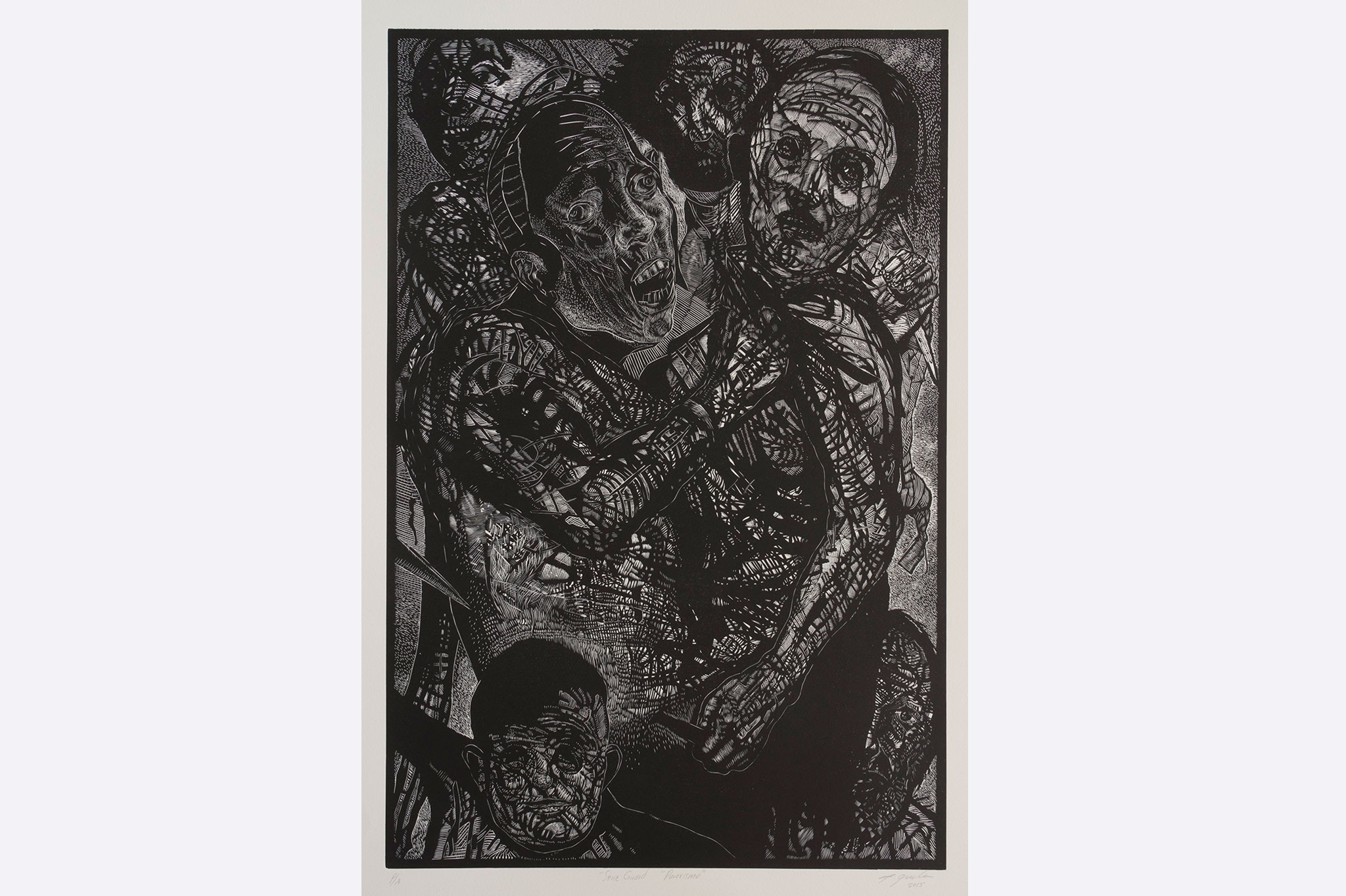
  • La monstruosidad de la religión Sobre un debate moderno en curso“Paroxysm,” Iván Gardea, etching, Cuernavaca, 2019

    The monstrosity of religion On an ongoing modern debate

    By Carlos Mendoza-Álvarez


    This week I was invited to the presentation in Cuernavaca of a book that contains a failed conversation between John Milbank, a British Anglican theologian, and Slavo Žižek, a Slovenian atheist philosopher, about the monstrosity of Christ (The monstrosity of Christ: paradox or dialectic?). The Spanish translation was published by the Universidad Iberoamericana in Mexico City, at the initiative of Ángel Méndez Montoya, as part of an innovative publishing program to offer readers in Mexico and the Spanish-speaking world current theological debates surrounding God as an ontological problem, as a source of ethical meaning in a modern civilization shaken to its foundations, and as a political problem.


    Before attending the presentation at the Miguel Salinas Gallery Library of the Autonomous University of the State of Morelos, located in the historic center of the city in an old house restored as a cultural center, I had the fortune of talking with the Juarez artist Iván Gardea, when visiting his exhibition at the Borda Garden which is open to the public until the end of September.

    Maestro Gardea, in addition to being an impressive engraver in the most rigorous Mexican tradition of printmaking that dates back to Posadas and the Taller de Gráfica Colectiva a century ago, is a born thinker, well-versed in literature, music, philosophy, and theology. We met in his studio six years ago to prepare for the exhibition of his series of prints on violence inspired by the thought of René Girard. We held this exhibition at the Andrea Pozzo Gallery of the Universidad Iberoamericana in Mexico City in 2019, on the occasion of the international conference "Resist! Violence, Resistance, and Spiritualities," organized jointly by the Jesuit university and the International Journal of Theology Concilium, where I had the opportunity to serve on the board of directors and editorial board for eight years.

    During our conversation in the bright colonial courtyard of the Jardín Borda, Iván told me stories about his ongoing artwork, a series of prints specifically about the monstrosity of the sacred in today's society, lost between Western liberalism, "devoid of any belief," and the materialistic atheisms that abound in both academic and social circles. In Iván's opinion, although I correctly interpret it, this monstrosity has many facets, among them nihilism as a way of life without hope. I was greatly surprised to hear his reflections, since that same afternoon we were to discuss the "monstrosity" of Christ in the Žižek-Milbank debate.

    So I briefly summarized the ideas I would later express regarding that book, alternating with my beloved colleagues Sylvia Marcos, a renowned gender anthropologist in Mesoamerica who met Žižek in Slovenia; Ángel Méndez, a queer theologian who worked on his doctoral thesis on the theology of food under Milbank's supervision; and Nicolás Panotto, an Argentine Protestant theologian with whom I share projects in the "Theology After Gaza" group convened two years ago by Mitri Raheb to rethink political theology.

    In the cloister of the Borda Garden, I commented to Iván that, in my opinion, the monstrosity that was important to discern today was that of the religion that perverts the sacred, expressed as Jewish and Christian Zionism, associated with far-right movements around the world that, in the name of God, not only pervert the Bible in their theology of election and promise, but also incite genocidal violence by manipulating the religious sentiment of entire communities. Another example is the case of televangelist Paula White in the White House advising Trump, his vice president Vince, and Secretary of State Rubio in a crusade to bring their country "back to Christian values."

    Another emblematic example of the monstrosity of religion within religious institutions are the criminal cases of manipulation of religion by corrupt leaders, creating financial empires based on boundless ambition and controlling the dormant masses. This phenomenon has produced corruption among political, social, and religious elites in various parts of the world, accompanied by sexual and spiritual abuse, and the trafficking of political and financial privileges by perverse religious figures such as Marcial Maciel and Naasón García in Mexico, Fernando Karadima in Chile, and the leaders of the Sodalicio in Peru.

    This monstrosity of religion is what matters most to analyze from a critical perspective in order to contribute to dismantling its power networks in society. It is urgent to do so through investigative journalism like that of Emiliano Ruiz Parra (Emiliano Ruiz Parra: HBO series, massive vehicle for the demystification of Marcial Maciel), of truth commissions such as the one proposed by then-candidate Borič in Chile (which, incidentally, was never implemented), to ensure accountability to society as an obligation of the secular state and, above all, to guarantee restorative justice for victims.

    Ivan called these religious groups of today a parody of religion and, at the same time, another version of modernity that is collapsing in our times.


    Inspired by this fascinating conversation, I decided to share my thoughts at the book launch at the event organized by the UAEM School of Psychology, in conjunction with the Jean Robert and Sylvia Marcos Double Legacy Chair. I summarize what I presented at that discussion.

    The first thing was to underline the importance of approaching the book as a theological provocation from our Latin American and Caribbean context, so that it is possible to make a critical reading of the European authors of the book, closely following their argumentation and highlighting other intercultural perspectives of approaching the mysterion of the real that religions call God.

    Then, it is worth remembering that the meaning of Christ for humanity in times of civilizational collapse that we are experiencing today seems an irrelevant issue in the face of the exponential increase in violence under a new figure that some call, following René Girard, the "escalation to the extremes of the annihilation of the other." It does not seem relevant to discuss a religious figure who was trapped by a religion that domesticated his universal love. It seems even less important to get lost in the debate between a Slovenian philosopher and a British theologian when we find ourselves in the midst of the desolation of wars of genocide in Gaza, of extermination in Congo and South Sudan, of forced disappearances in Mexico, where the urgent thing is to stop the spiral of hatred if we wish to speak of the ethos political and spiritual possible for humanity in this uncertain hour.

    And it is precisely here that the question of the experience of Jesus of Nazareth in the first century CE, facing hatred in his own body, may be relevant to us today.

    Academic debates often stray into the realm of ideas, no matter how grounded they may be. Defending or accusing Hegel of various solutions to the dialectic of history to justify theological materialism, as Žižek does, or promoting Milbank's radical orthodoxy as a guardian of the City of God, seem secondary when it comes to confronting another monstrosity, one that has many heads, like the one of hatred and death produced by the capitalist, patriarchal, and white, Western hegemonic hydra.

    Even defending or accusing Meister Eckhart - or better yet the former Dominican friar Rainer Schürmann (The Principle of Anarchy: Heidegger and the Question of Action), one of its modern interpreters, often cited by Žižek, for his interpretation of the negativity of divine being as the antecedent of the moment of negativity of the Hegelian dialectic seems like straw when the priority is to think about the negativity of those who inhabit “the region of non-being,” as Fanon said, and are being reduced to nothing.

    I then proposed a decolonial approach to the book The Monstrosity of Christ: Paradox or DialecticA scholarly book that will generate much ink in the academic world, whether to validate Žižek's theological agnosticism or to confirm Milbank's theological philosophy. The crucial question the book poses lies in the impasse of reason in the face of the mystery of being. However, what is worth exploring is a different ontological approach, one that conceives of "being that ages and dies," as Levinas said.

    To do so, it is necessary to turn to the Bible as the original source of this understanding of the paradox of being, and then to apophatic philosophy to spell out the intelligibility of the absurd when Christianity announces a "crucified Messiah" as the meaning of history. Following this route, it will be possible to cross the abyss to think about the monstrosity of being, but as the radiance of the messianic moment in which history seems to open like a recess of "hope against all hope" through "the wounds that heal."

    Thus, another way of speaking about the critical link between philosophy, theology and politics emerges, not as an idea or as potestas politics, but as a messianic knot, that is, resistance to violence woven by those who live in “the shadows of the shadows of the shadows.”


    "By his wounds we shall be healed," says the oxymoron from the book of Isaiah (53:5), written by a disciple of the prophet during his people's exile in Babylon. This is perhaps the pinnacle of Old Testament revelation and one of the most radical truths about the human condition, politics, and hope. It is in this light, of course, that the torture and execution of Jesus of Nazareth by the Roman authorities, in complicity with the authorities of the Temple of Jerusalem and the enraged mob, will be read centuries later.


    Exile was a spiritual and theological place for the disciple of the prophet, as it was for John the Baptist and so many prophets throughout history, "whose voice cries in the wilderness" (John 1:23). Until we reach the voice of Munther Isaac in the 2021 Christmas sermon in Bethlehem, Palestine. The Babylonian exile signified a contradiction for the expatriated people: on the one hand, the pain of being torn from their homeland; on the other, the recognition that they have only been able to live off the crumbs of Nebuchadnezzar II, the Babylonian king. And yet, in the four poems preserved in the Book of Isaiah, the true source of life will be the disciple-people. Babylonian power crushed Davidic power. But the people survived by virtue of their fidelity to the first covenant, if not all, at least a few. Tzadikkim or just people in history. And so, that suffering people is the source of "another way of being," beyond the essence of Babylonian power, in the power of those who resist. They are the servant of Yhwh.


    Following this spark from the anonymous disciple of Isaiah, we can then reread the history of "the cursed of the earth," yesterday and today. In particular, the history of the Palestinian people, who, in the depths of their pain from the genocide they suffered, allow us all to heal from their wounds if we open our lives and actions to this cry. A slogan of the Global Sumud Flotilla says precisely this: "They wanted to erase Palestine, and now Palestine sails all the seas."


    Faced with the monstrosity of the exile in Babylon, the Hebrew people of the anawin, from the poor of God, brings forth the beauty of Sumud or resistance to the catastrophe that has befallen them.


    What dialectic of history in the Hegelian reading recreated by Žižek governs history? That of opposites that annihilate each other in search of a supposed synthesis of Aufhebung or overcoming this rivalry that only prolongs the death throes of humanity with the triumph of the executioners.

    Nor is the philosophy of the City of God, yearned for by John Milbank as a return to theocracy, overcoming the narrow limits of modern autonomy that became a nightmare, capable of crossing the abysmal line that separates privilege from desolation.

    Are both authors in this fictitious dialogue right in raising the alternative between the dialectic of Holy Saturday that annihilates the weak in the Sheol and the paradox of Easter Sunday, which is announced as the triumph of the victims over the executioners?


    Neither paradox nor dialectic, but messianic contraction of the being that ages and dies.

    Eckhart warned us about figures and idols (deitas) that replace the ineffable God (diuinitas). They can be religious or political idols. What is crucial in the life of the Spirit is, therefore, for the German Dominican, detachment (Gellasenheit) as a form of apophatic or negative, non-dialectical negation of the impersonations of Divinity.

    Pseudo-Dionysius had previously explored this path of overcoming the ego, giving rise to the experience of the Mothers and Fathers of the desert in their confrontation with the demons before arriving at the contemplation of the mysterion of the living God.

    Therefore, today, apophatic theology is a companion to the political theory of the commons, proposed by collectives and subjectivities located on the peripheries of the hegemonic world, but rooted in the world of the vital connection between the human, the cosmic, and the divine.

    By listening to the outcry, indignation, and hope of today's most vulnerable, we can then access the apparent monstrosity of Christ, which then becomes the beauty of the forgotten who re-exist when they say enough to the violence of the imperial being that kills.


    Puebla, September 14, 2025

English