Tag: Divine Ruah

  • Somos tierra, somos viento Las enseñanzas del Jilol PedroCarlos Mendoza Álvarez | Prayer in the hills with Jilol Pedro | Sot's Leb, 2026

    We are earth, we are wind The teachings of Jilol Pedro

    By Carlos Mendoza Álvarez

    The rocky base of the mountain - through which the Ts'ajalsul or river of salt water - is the center of the world during the prayer of Peter, the young man Jilol or the healer of the Tsotsil people. Dressed in his black wool poncho, with two red crosses embroidered on the shoulders like the dalmatic of Saint Lawrence the Martyr, patron saint of Sots'leb -land of bats in Tsotsil, or Zinacantán- Pedro plants the candles and places the flowers already blessed before dawn.

    In a long ceremony held in the parish hall, on the eve of Ash Wednesday, the six gathered Jiloletic With dozens of catechists and some of the friars who walk with them, we were preparing to accompany them to six sacred sites in the Zinacanteco region to bring offerings to the hills that protect us from wars and evils, invoking God and the saints at every spring, rock at the bottom of the ravine, or hilltop where we would stop to pray after an exhausting sacred walk.

    Three times a year, according to ancestral tradition, prayers rise to the heavens from the hills of this region in the Chiapas Highlands, inhabited by the Tsotsil people of Zinacantán, to venerate Mother Earth in her sacred places and acknowledge the God of Life, who ceaselessly shelters all creatures that live here with the forests and springs. Jiloletic They are the ones who hold sacred power in these ceremonies. They have received the mandate—in dreams and through extraordinary signs throughout their lives, sometimes since childhood—to heal the community of its many ailments, illnesses, and the violence inflicted upon their bodies and crops. Healers of ancestral tradition, their spiritual authority is revered by the communities at pivotal moments, such as prayers on the hills to ask for bountiful harvests, abundant rains, and protection from war and other evils that threaten the people and creatures who inhabit these lands.

    Pedro is a young man from Jilol who led one of the six pilgrimage routes through the hills of Zinacantán earlier this year. His gentle nature, with a deep gaze and kind smile, becomes powerful when he begins to pray in Tsotsil, his voice strong and mantra-like, chanting invocations to the hills, the saints, and the... Ch'ul Spirit, with Jesus Christ and Mary as guides of protection and divine strength. We all kneel behind him, on the rushes carefully scattered by the catechists, to "plant the candles," already blessed, before the three Zinacanteco green crosses that mark this place as a sacred space, visited by other pilgrims throughout the year. The crosses are also venerated with white and yellow flowers that were also blessed and incensed before dawn.

    At some of the Stations of the Cross, Peter tells us a story about the holy place. Like that one about Lachikin, On the rocky hill beside the river, a group of soldiers are summoned who remained there after a past attempt to attack a woman bathing in the river, a criminal impulse that led them to the current where they drowned. But the hills rescued them and transformed them into guardians of these lands, protecting their inhabitants from war. That is why every year we must come to remind them of this duty, because they still dwell here. Many creatures inhabit the hills, and Jiloletic They have received the gift of seeing them and communicating with them in order to ask for protection for the communities.

    After hearing that brief story, the group continues along the path, advancing single file along a steep, rocky trail to climb the hillside and reach another ravine where another prayer will take place. But before setting off, the walkers each receive a small cup of soda, passed from mouth to mouth, like a ritual act of shared strength. Alejandro, the catechist coordinator, invites us to pick up the trash left behind by other careless pilgrims, especially bottles and plastic wrappers, as a sign of caring for the sacred place we have just venerated. A small symbol of the work of caring for Mother Earth that the diocese is painstakingly promoting as part of its spirituality and ecotheology.

    For several decades now, the Parish of Zinacantán—re-entrusted to the Dominican friars in 1975 after an absence of more than a century, in harmony with the Diocese of San Cristóbal de Las Casas in its commitment to the poor and indigenous peoples, along with the hundreds of catechists and lay ministers who support the communities—has been fostering the encounter between the ancestral spirituality of the Zinacantán people and the Christian spirituality of the Gospel of Christ, embodied in the life and culture of the Zinacantán communities. The prayer on the hills, for example, which they continue to practice, is a testament to this tradition. Jiloletic While celebrated independently, it is also an integral part of the parish's activities. Each of these key moments of the year culminates in a Eucharist where both traditions converge in a shared intention to care for the life of the community and venerate Mother Earth as the primordial gift of the God of Life, who nourishes us with his body that is earth and wind, water and fire, and in the height of love becomes the body of Christ to nourish the praying community.

    “We are earth, we are wind” was the mantra that arose in my heart as I silently accompanied the prayers of Jilol Pedro in each of the sacred sites we visited one cold morning with radiant sunshine in the hills of Zinacantán.

    Land that is nourished by springs, streams and rivers that flow between its rocky canyons.

    Wind that sways the treetops and carries in its chariot the birds that live there. Wind that fans the fire that humanized the ancestors.

    “We are earth, we are wind,” according to the wisdom of the prayer of the hills. That full awareness, embodied in breath, prayer, and shared words these days with the Jiloletic of Zinacantán, will endure in my memory like a spark of life that other traditions also receive in their own language.

    Perhaps not by chance, this week we received ashes on our heads, according to the symbolism of the Hebrew and later Christian people: we are earth prepared by God like an ancient potter. This gesture is accompanied by a call to conversion. But we are also the wind of God who breathes his own spirit into us. Ruah divine to make us living beings.

    Sots'leb, February 22, 2026

    Note: How do we connect today with our earth and wind selves?

  • Desaprendiendo la eficacia para habitar la incertidumbreDiedrick Brackens | The Cup is a Cloud | Los Angeles, 2018

    Unlearning efficiency to inhabit uncertainty

    By Carlos Mendoza-Álvarez

    It has been seven months since I left Boston, after five years of academic life in the frenetic gears of American efficiency, with a special challenge in the background that consisted of translating the master ideas of modern Latin American and European theology to multicultural groups of white students from the United States, and others who came mostly from Korea, China and Japan, plus some from Turkey, El Salvador, Colombia and Chile.

    The initial courtesy of colleagues, both students and professors, gradually gave way with a few of them to a genuine conversation, always with respect for individual work prevailing and few exchanges about the meaning of our work as an academic community.

    I cherish the best moments of those encounters, such as the colloquiums to which we gave the decolonial tone of “conversations” (Beyond Global Violence Initiative), where we were able to open windows so that colleagues from the north and south could listen to each other, with certain difficulties in moving between both worlds, not only because of the differences in language but also because of the diverse experiences that sustain the body, thought and the word.

    What we all enjoyed most were the gatherings in the warmth of Valentina and Domingo's Chilean-Bostonian home, exceptional hosts to both our hearts and our palates. There, we could share, with greater intimacy and freedom, the ideas and intuitions that had lingered in the auditoriums of the Chestnut Hill campus. Sometimes, with Francis's Italian flair, assisted by Martín, and in the warmth of Neto's affability in his home, always ready to welcome us like a true Salvadoran, each of us found our place in the ebb and flow of conversation, wine, and song. In those welcoming homes, we received friends from Brazil, Mexico, El Salvador, Colombia, Puerto Rico, Spain, Ohio, Illinois, New York, Indiana, and California, passing through Massachusetts. And there, new projects for colloquiums, books, and trips were born, projects that continue to surprise and inspire us all to this day.

    But everything was interrupted by my sudden departure from US territory in the Trump era, leaving that seed of cordial intelligence sown in living memory.

    In the following months, back home and with interwoven journeys between South Africa, Turkey, Brazil, and Chile, I faced the challenge of seeing diverse worlds with new eyes, paying special attention to "those who dwell in the shadows of the shadows of the shadows." Thus, I was led—by the pure gift of my hosts during those travels—to experience moments of devastating and beautiful simplicity, such as accompanying Lance from the University of Pretoria to the Congolese refugee farm on the outskirts of the city. There, the pain of being homeless for more than five years was evident in his eyes, but within them also shone a glimmer of dignity that I still carry in my heart and spirit as a call to closeness.

    I vividly remember the walk along the cliffs of Cape Town with Grant and his team, where on a sunny but cold South African winter morning we contemplated how the two great oceans, the Atlantic and the Indian, meet, sometimes with fury and other times with tenderness. A metaphor for intertwined worlds.

    I also recall with emotion the ecumenical Taizé-style prayer led by my Dominican brother Claudio, along with Eda, a resident of Istanbul, and a group of African and Ukrainian students living there. Interspersing mantras for peace in various languages, they gathered in the dim light of the Church of the Preachers, located near the Galata Tower. It was a glimpse of what Pentecost means, albeit only as a bastion of spirituality amidst a vibrant, modern Muslim culture that looks with curiosity at what happens within these Christian enclaves.

    I treasure in my memory the simple and brief Eucharist in the small wooden chapel of the Jesuits in Tirúa, on a small altar covered with a Mapuche textile and adorned with an oriental-style oil lamp that created a luminous twilight, on a spring morning in Wallmapu, in the far south of Chile. I had the grace to share with them for a few days their joyful dispossession, as travelers accompanying the Mapuche people in defense of their territory, their language, and their ancestral spirituality.

    In each of those experiences, the question of how to build bridges to share spiritual intimacy between people and communities of diverse traditions lingered for me. And I remembered the rituals we have explored at Re-existe, precisely seeking new languages to celebrate together our precarious lives, open to hope, according to diverse ancestral traditions, from indigenous peoples to Abrahamic religions and the secular inner lives of those who are individuals or groups without religion.

    Back in the land of my ancestors, now free from the daily pressure of the classroom and the unbearable academic meetings, I'm beginning to understand what it means to unlearn efficiency. To enjoy the free time of otium, beyond the negotium, as I told you here a few weeks ago.

    But it's about more than just slowing down. Something compels me today to live in the moment. otherwise as a renewed inner life and the place as my homeland. I seek an external rhythm between morning walks, religious duties, attentive reading of books piled on my desk for years, and more creative writing, loosening my pen and exploring new literary genres. But it's not enough. There's something more I sense on the horizon, the search for a "place" to put down roots, grow slowly, and blossom, following that creative intuition of Ivan Illich and Jean Robert (The place in the space age). The place and time where inspiration flows will gradually become clearer in the coming months.

    Now that I have time to “do nothing,” I feel invited to reinvent myself every day. I am certainly working in the present on wonderful intellectual projects, such as the collaborative book on political theology—with the introduction I am writing, inviting fifteen contributors from eight different countries to the table of words to reflect on “the common good” in times of great catastrophe—whose manuscript I am revising with the support of Francis and Nathan, dear colleagues I met at Boston College, and which will be published next year by a prestigious publisher in the United States.

    I am delighted to review the scripts for the documentary and the comic book – by Juan and Katsumi respectively – which will commemorate the past meeting Re-exists 2025. The Spirit connecting the peripheries which we will soon share in the digital world to continue strengthening our resistance against the evil that surrounds us today as systemic violence. This initiative has been creating a multifaceted space-time where we learn to re-exist, reinventing ourselves alongside other survivors.

    And with excitement, I also imagine—along with some Dominicans who are seeking new expressions of the charism of preaching in our unprecedented context—what will emerge from our meeting on Nicaea last October in Istanbul. Situated in today's cities and villages, which are like laboratories, we seek how to communicate to humanity the joy of being inhabited by the divine and human Word that redeems us, whether rooted in the secularized world or amidst diverse spiritual traditions.

    Encouraged by these vivid memories and by the ongoing work that connects with my deepest desire, I now face the challenge of "stopping" the whirlwind of efficiency, unlearning to live and think only in terms of production. It is a journey in reverse, but above all, an implosion of a dizzying desire, to return to the still center of body, desire, thought, and spirit from which it flows another mode of existence.

    And then I will learn to let myself be inhabited and moved – as I discussed with my friend Juan Carlos La Puente in the heart of the pandemic (Mutual accompaniment in the divine Ruah)– because of the uncertainty as a gift and surprise of the fluttering of Life that encourages us all.

    Mexico City, November 15, 2025

    Note: I would appreciate your feedback at the end of this page.

  • El Espíritu conectando las periferias

    The Spirit connecting the peripheries

    By Carlos Mendoza-Álvarez


    Since the end of the last century, humanity's religions have updated their mission, realizing the growing poverty and injustice in the world, accompanied by wars promoted by corrupt leaders, where religion was used as a weapon of exclusion and violence.

    The Parliament of the World's Religions with the project of a global ethic (Toward a Global Ethic: An Initial Declaration) where the contribution of the Swiss theologian Hans Küng stood out, or the Earth Charter  Promoted by, among others, the Brazilian Leonardo Boff, along with several spiritual leaders, they sounded the alarm to mobilize religions to stop the spiral of hatred that is spreading across the planet, turning to the sources of human interiority that religions have cultivated for millennia as a source of peace.

    However, many of these initiatives, while they managed to raise awareness among their leaders and communities as well as in the media of the urgent task of building peace with justice and truth, did not always listen to the knowledge and spirituality of people and communities in their daily struggles to defend human life, rivers, forests and mineral, plant and animal species that inhabit the face of the earth but are threatened by the sixth mass extinction underway (What is the sixth mass extinction and what can we do about it?).

    Second and third generation liberation theologies, as we have already analyzed in the Mexican context (Liberation Theology in Mexico: Creative Reception of the Second Vatican Council), have shifted the perspective by placing the victims of global violence themselves at the center as "knowers," that is, experts in humanity thanks to the resilience that has transformed into resistance. Above all, it must be emphasized that, from this experience of vulnerability, these survivors have recognized themselves as privileged interlocutors of Divinity. Indeed, the victims seek to re-exist with new modes of communal organization, agroecological work, and diverse spiritualities. These practices emerge precisely from the people and communities themselves who are threatened by systems of domination.

    Feminist ecotheology, developed by Ivonne Gebara (Ecofeminism: A Latin American Perspective) in Brazil and Marilú Rojas (The relevance of ecofeminist theology and its political impact on current femicide and ecocide) in Mexico, took a radical turn in thinking about the interconnections between the faith of excluded women, their violated bodies and territories, as well as their ancestral knowledge of care and resistance as the beginning of a world change where a new face of divine Sophia is revealed.

    Thus, an increasingly clear awareness emerged among religions and social movements to listen to those who live on the peripheries of the world of wealth and privilege, to explore how "another world is possible" from those social and religious margins.


    Since 2015, a group of university students, along with artists and social movements in defense of the territory in Mexico – with the advice of Gustavo Esteva (Center for Intercultural Meetings and Dialogues) and Boaventura de Sousa Santos with his Conversations of the World With several authors from the epistemic South such as Silvia Rivera Cusicanqui – we began to explore ways to decolonize the university and learn to “weave voices for the common home” (Weaving voices). Thus, we learned the demands of attentive listening to those living on the peripheries, who are not only victims but individuals and collectives who create processes of awakening, healing, and embodying together, and thus weave together knowledge that expresses their ways of life, community organization, and their profound spirituality of life.

    In 2019, we continued this path by analyzing various voices of decolonial theology at a conference (Congress on resistance and spiritualities) organized jointly by the Universidad Iberoamericana, Mexico City, the international journal of theology Concilium, and the Dominican University Cultural Center of Mexico to explore together the common features of resistance to systemic violence and the spiritualities that arise from it.

    In 2023, a group of university colleagues, with the support of Mexican civil society organizations and ITESO, the Jesuit University of Guadalajara in Mexico, managed to bring together more than thirty groups from Latin America (Re-Exists! The spirit crossing peripheries) with the aim of understanding the new forms of life, subjectivity, and communality that individuals and communities of survivors are weaving together. We sought a way to glimpse hope amidst the horror of clandestine graves in Mexico, discrimination based on gender, race, and social status, the devastation of Mother Earth, as well as to explore the rituals that emerge from these practices of resistance. graphic memory of that congress, with his documentary that includes some interviews, can give an idea of what we experienced at that meeting.


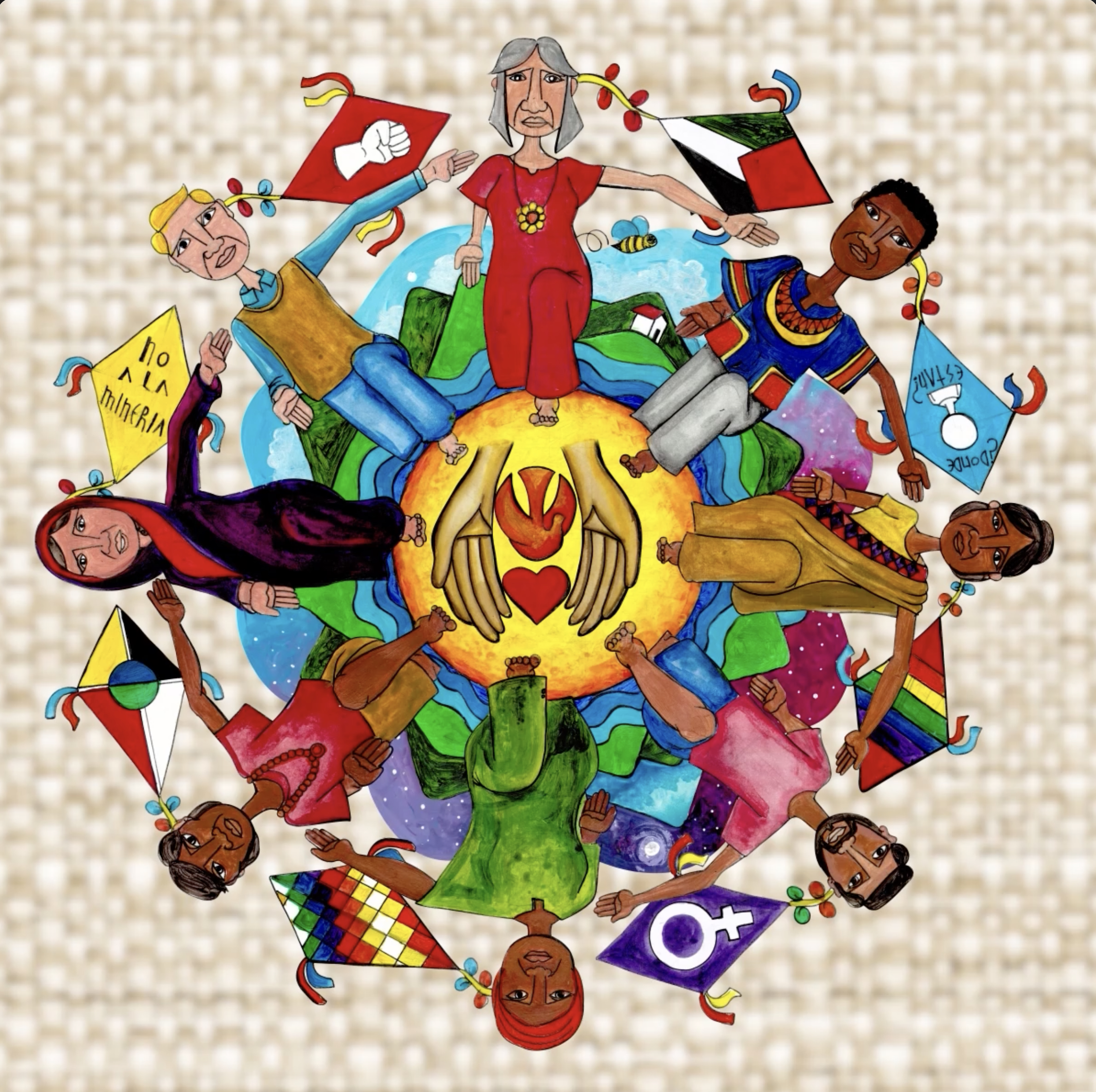
    Now comes the time for the next phase of Re-exist that will emphasize the connections survivors make and the strength that animates them.

    This time, it is a meeting-festival with two novel and challenging features: interculturality as a way of existence and thought, to "rethink as a species," according to the call of the scientific community, closely linked to interreligious dialogue as the only viable way to approach the sacred.

    We propose to explore together the paths of re-existence in this hour of collapse of the modern civilizational model, where the genocide in Gaza has put humanity in jeopardy and becomes a touchstone for human civilization.

    Through three steps we will explore the wake up in the face of the horror that each collective has faced. We will continue analyzing the heal as personal and collective actions of memory, truth and justice that allow victims to rebuild their lives. Then we will be able to access the moment of support each other with new forms of communality.

    Collectives of women from India facing patriarchal violence in the Hindu, Buddhist, and Christian religions will enter into mutual accompaniment with mothers of the disappeared in Mexico. Caretakers of Mother Earth from the Jesuit mission of Bachajón in Chiapas will dialogue with leaders of the Lakota people who work on collective memory to heal from the colonial past, while recovering their ancestral forms of agriculture through traditional diets, the cultivation of local plants, and the rediscovery of rituals such as the Inipi or ritual bathing which is a creation of communality, or the buffalo dance as one of the main symbols of the sacredness of earth and sky.

    Stay tuned on social media Re-exists 2025 where brief informative capsules, interviews, and graphic memories of these moments will be published, which we hope will be like glimpses of life that resists and re-exists, because the strength of the survivors is animated by the divine Ruah that flutters over chaos to bring forth life in the midst of death.


    Guadalajara, September 20, 2025

English