Tag: spirituality

  • Sobre la esperanza en tiempos inciertosSearching Mothers | NTR | Zacatecas, 2025

    On hope in uncertain times

    By Carlos Mendoza-Álvarez

    At dusk this Saturday, the first Advent vigil begins, when Christian communities throughout the world embark on a journey, in the midst of the darkness of time, to receive the human and divine light of dignity and hope that the Messiah brings. The ancient hymn will resonate during the nighttime celebrations, Rorate caeli , whose lyrics and melody are like a lament that rises to heaven from the desolate city, crying out that “the clouds rain down on the Righteous One,” as the prophet Isaiah (45:8) implored during the exile in Babylon.

    Each year, this four-week calendar leading up to Christmas is accompanied by symbols of light, greenery, carols, sweets, tenderness, and community. According to each culture, the waiting period for the Messiah's arrival evokes the awareness that "something is lacking" for the fulfillment of those desires for new times of justice, truth, compassion and peace, not only for a people who arrogantly claim to be the only chosen ones, but for all of humanity and even for the entire cosmos.

    Every generation has seen terrible signs that the world is ending, whether through epidemics that make us feel how vulnerable our bodies and knowledge are; whether through wars waged by empires against emerging powers that threaten their arrogance; whether through the uncertainty of life itself, diminished by age, illness, failure, loneliness, or hopelessness.

    The biblical texts that we, the believing communities, meditate on these days speak of the expectation of the messiah, first with a strong apocalyptic tone that announces the destruction of the corrupt world, reaching the entire cosmos with a catastrophe that will destroy everything because of the human pride that has taken over creation.

    Then, as the date of the celebration of the Nativity of the Messiah Child, a Nazarene, approaches, the tone of the texts becomes more hopeful with the announcement of a God who is near, humanized, small, and fragile. It is the incarnate promise of a divine and human life that begins in complete vulnerability in the story of a migrant family with a newborn baby, trying to survive on the periphery of the empire and fleeing the fury of the local ruler, eventually finding refuge in Egypt, from where a definitive chapter in the history of human redemption will begin to be written.

    However, the collective depression we are experiencing today as humanity due to the escalation of hatred to extremes – which is spreading across the planet in an apocalyptic way “like a lie of Satan,” as René Girard said in an interview he gave me in 2007 in Paris (Hope as apocalypse)– this seems to render any narrative of hope for our uncertain times illusory. The genocide in Gaza continues as the climax of the Nakba or Catastrophe that began in 1947 with the expulsion of nearly a million Palestinians from their lands, paving the way for the creation of the state of Israel in 1948, this systemic violence continues today before our digital screens, met with indifference by social media and the international community. The wars in Ukraine, Congo, and South Sudan have become so “normalized” that they no longer make the front page of newspapers, much less a trending topic in the digital world. In Mexico, public indifference to urgent issues such as the crisis facing corn, lemon, and avocado farmers—caused by the violence in Michoacán—along with the persistent femicides and forced disappearances, speaks to a growing discontent among the population, expressed through strikes, road blockades, and street protests. But the masses seem numb, retreating into bubbles of entertainment and unrestrained holiday shopping, which, among other ills, leaves household finances in ruins for months and years to come.

    Religious consumerism is also part of the overwhelming Christmas marketing, amidst kitschy decorations and echoes of folk crafts used to make piñatas featuring popular characters. It will certainly be present at Mexican posadas, Trump's piñata , which is sold in various markets in Mexico and the United States, will receive blows as a ritual of revenge amid laughter and boos until the cardboard breaks and the blond wicks of the tyrant fly out like shooting stars in some tenement courtyard in Mexico City, Chicago or Los Angeles for the delight of all.

    A few families may perhaps rediscover the “mystical” meaning of the Advent wreath, following the Avatar of Carlo Acutis explaining Advent 2025. This video, which is circulating online, aptly explains the spiritual significance of the ritual of lighting each of the four candles during this season that prepares for Christmas. The light lit each Sunday of Advent symbolizes the "people who walked in darkness and have seen a great light" (Isaiah 9:2), which the prophet foretold to the Hebrew people devastated by the division between the small kingdoms of Israel and Judah, with their leaders corrupted by the idolatry of power, seeking alliances with neighboring Syria to defeat the rival tribe.

    And like a non-place amidst so much noise, creating a void in the midst of the urban clamor, in Mexico the collectives of Searching Mothers (Searching mothers light Christmas tree) will set up Christmas trees covered with ornaments bearing the faces of those we have lost. They are today “the voice crying in the wilderness” (John 1:23) because they speak on behalf of the victims of the narco-state war and the idolatry of the necropower of our time.

    Perhaps this is where the theological core of this season lies: the absence of the Messiah is something that has inspired Hebrew and Christian generations for centuries to mobilize in order to make the messianic times present through acts of remembrance, justice and an (im)possible reconciliation.

    Beyond a folkloric celebration of the coming of God-with-us, what we are about today is going to the other side of history to contemplate there, in the silence of the night, some glimmer of light that announces the arrival of the Messiah. And those who feel in every second of their lives, in every breath—like Vero and Fabiola, mothers searching for their missing children who shared their hope with us in a recent meeting in Guadalajara—the absence that hurts and motivates them to search out of love, are the ones who teach us what hope means in times of uncertainty, the heart of Advent.

    Next Monday, December 1st, the documentary Re-exists 2025 will be presented online (Presentation of the documentary Re-exists 2025), prepared by Uruguayan filmmaker Juan Meza. There, some of the stories of awakening, healing, and embodiment shared by people from seventeen countries and different religious and spiritual traditions from four continents facing diverse forms of violence where it has been possible to spell out hope.

    Advent is a time to continue weaving networks of combative hope , say the social movements on the peripheries of the empire, so that our world does not fall into the abyss. And it is possible to do so by listening to the people who for years and centuries have resisted and now accompany us in re-existing.

    Because there will always be hope as long as there are people and communities who live the end times, so insistently emphasized by Javier Sicilia and Elías González, as the opportunity to enter into another way of existing amidst violence but pregnant with the active expectation of messianic times.

    Happy Advent season!

    Mexico City, November 29, 2025

    Note: I would appreciate your feedback at the end of this page.
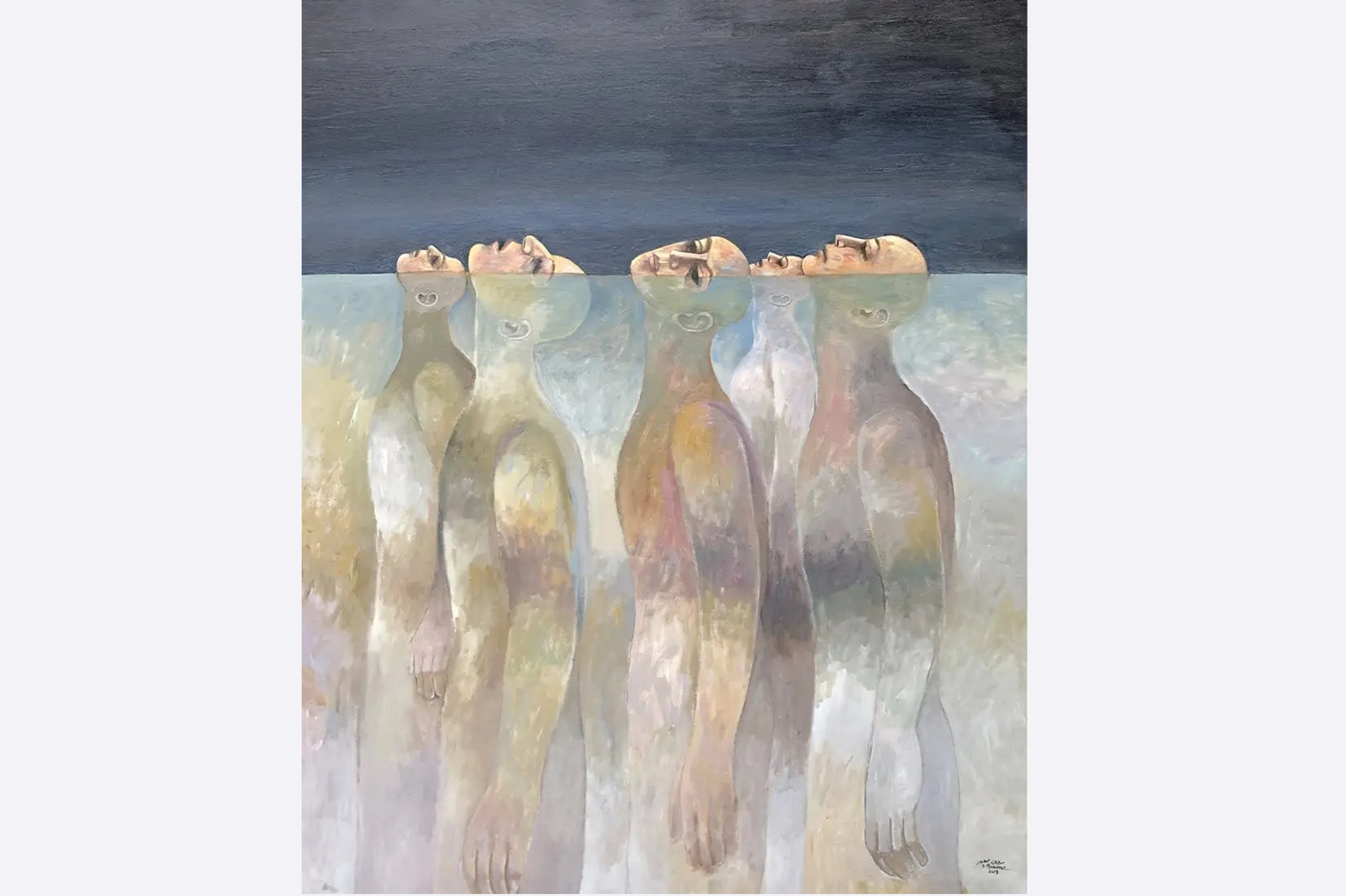
  • Sobre el ocio y el silencio en tiempos reciosSliman Mansour, Temporary escape, 2018

    On leisure and silence in difficult times

    By Carlos Mendoza-Álvarez


    One of the advantages of being retired from academic life now is having free time that flows by day, like a trickle of water that runs down the mountain and becomes a stream until one day it becomes a river.

    The uncertainty of seeing time pass at the beginning of a new stage in life can be uncomfortable because it is accompanied by questions about the purpose of life, especially of each day. I no longer have to prepare the night before to have the next day's course updated, with the necessary teaching materials and the attire to wear for the classroom ritual. Time is measured in advance, minute by minute, in the time that will later pass in the classroom to ensure efficiency and the success of the program, as happened in my last years of teaching in Boston.

    Now I finally have time to think, read, and write. However, the ideas flow with astonishing slowness at times, suddenly untimely in the early morning.

    I no longer have to worry about having my PowerPoint presentation ready with clear ideas, essential quotes, and suggestive images to literally “capture” the attention of students, who were increasingly distracted by the virtual world and demanding the services of the “instructor.” Although they called me “teacher” when addressing me ceremoniously, they were actually demanding duties worthy of a gym instructor. It's no coincidence that this is what the experts in school education called us: “instructors.” This teaching service was an expectation that made itself felt with all its weight in the hundreds of emails each month that had to be answered to clarify questions about classes, authors, and assignments; or to send reports to school services requesting information on how we were handling students with mental illnesses, depression, syndromes I had never heard of, as well as special attention to people with motor, visual, or hearing disabilities. As never before in my thirty years of teaching, the most recurring problem to address in Boston College, It was depression, associated with anxiety, particularly during periods of midterm exams and especially finals.

    And now that I no longer have to live with the urge to jump between the classroom and the cubicle, time stretches out and deflates, with the impression of not moving anymore.


    There are other new activities in this "retirement" stage. Not because I'm always filled with joy, although there are certainly moments of great joy, but because I have to relearn how to live with time. I usually wake up early in the morning as before, but now without rushing, leisurely enjoying the time to meditate in silence and set off for my morning walk. I continue the day with the ritual of espresso and the latest news on the internet, checking a diary while I savor my coffee, which fortunately is no longer filled with appointments one after another. Now there's enough space and time to "do nothing." Which means I have to get down to the task of taste those hours of the day in the leisure.

    I fondly remember the classes of Father Ángel Melcón, a noted Thomist philosopher who was our formator during the Dominican novitiate in Agua Viva at the foot of the volcanoes. He insisted, following the Desert Fathers like Evagrius Ponticus, on the importance of re-educating ourselves during this time of initiation to move from "negotium" to "otium," as a countercultural act because business denies leisure. Thus, he invited us to discover, as novices, the time of pause in life, of silence, of learning to do nothing.

    Today we value similar teachings from the “desert mothers and fathers” (The Apophthegms of the Mothers and Fathers of the Desert), as the spiritual sources of early Christian monastic life in North Africa and the Middle East are known in theology, with its aphorisms or sayings of spiritual wisdom that express the ancient practice of leisure. Business is the worldly hustle and bustle that prevents the silence and contemplation that are precisely the substance of leisure, allowing us to live in inner freedom, confront evil and practice good.

    But how difficult it is to practice this art again, after decades of academic and religious activity. This "second novitiate" will be useful to me as a watershed to enter a new stage of life in the leisure of contemplation, now located in the silence of being and its shadows.


    Sara del Carmen, a dear reader friend from Coyoacán, gave me the novel a few days ago The Spinoza enigma Written by Irvin D. Yalom, the Stanford psychiatrist. I placed it on my desk for when I finished reading another novel which is the third part of the saga that began with The cathedral of the sea, written by the famous Spanish lawyer Ildefonso Falcones, following the story of an Aragonese soldier and aristocrat in Naples in the 14th century (In Love and War. The Cathedral of the Sea 3). While this novel fascinated me for the way it recounted the wars and loves that gave rise to Latin Europe, which later undertook the conquest of the New World, moving on to the other novel connecting the life of a philosopher excommunicated by the Jewish community of Amsterdam in the 17th century with the traumas of Hitler's ideologue and his aversion to Jews in the midst of the Nazi regime, brought me to the heart of a question that today lacerates my conscience about the perversion of the Jewish and Christian religion turned into a weapon of war.

    In recent years, the Palestinian question It has been deepening in my mind and heart like a cry of today's victims where questions about God, the world and myself arise with greater radicality that I cannot answer. Obviously the Jewish religion perverted by Zionism, both Christian and Jewish in our days, provokes in me a frank rejection because a century after the Shoah The Israeli state reproduces the same monstrosity, in the name of God and with the complicity of far-right Christian Zionism, to annihilate a brother Semitic people.

    The leisure time I enjoy now allows me to tie up the loose ends of the emotions, ideas, and stories that have surfaced in my life over recent years, revealing their intimate connection. Spinoza suffered excommunication from his Jewish community in Amsterdam with an Epicurean ataraxia that helps me understand the vocation that other free thinkers have followed, with its reverberations in my own life and in those of us who live on the peripheries of systems.

    The famous expression Deus sive Natura, God or Nature, proposed by Spinoza perhaps summarizes the daemon or modern genius that we urgently need to recover today. Boaventura de Sousa Santos told me this in a personal exchange, when I invited him to write an article on God as a critique of the Cartesian idea, which unfortunately could not be published in the issue of the magazine Concilium Divine Providence: Beyond the Paradigm of Omnipotence  because it had already been shared on the network (The end of the confinement of the Cartesian God). The excesses of religion have made God a transcendent being, as an omnipotent imperial substance associated with the powers of this world, when in reality he is immanent to the world, Spinoza argued. Pantheism in the eyes of the inquisitors of yesterday and today. “Pan-en-theism” as a philosophical current that runs through the history of the West, as described by the Stanford Encyclopedia of Philosophy. But according to the most daring theologians and mystics of the Christian tradition, such as Meister Eckhart, Teilhard and Panikkar, what we call today “pan-en-theism” is in reality what they perceived and thought as the unity of reality that arises because everything real is theological core. That is to say, all reality is imbued with “the improvident divine providence,” as the French philosopher Emmanuel Falque says in the aforementioned issue of the magazine Concilium that I had to prepare.

    What does Spinoza's God have to do with the ongoing genocide of the Palestinian people? Perhaps this catastrophe, unpunished to this day, is supposed to be justified precisely by the idea of a God. religious who chooses a people, to give it a land and becomes his Warrior defender. Nothing could be further from reason, the excommunicated Jew would say. An idol that is not God, the apophatic mystics would say. And nothing could be further from the faith in the Messiah who comes as a gift to redeem the world from hatred, according to the radical vision of Jesus in Galilee and his itinerant community.


    Leisure in this new stage of life opens up a new perspective for exploring my own faith as a silence amidst the rubble of modernity. And thus, I learn to distinguish true religion, which is the contemplation of superabundant Love, which is not a being as an object, but the source of being that animates and sustains everything, and, in extreme cases, those who live in the shadows of non-being.

    However, to access this world of mysterion divine, cosmic and human, it is necessary to dismantle the pseudo-divine avatars that with destructive force control minds, institutions and ritual practices full of arrogance, fear and violent segregation of what is different.

    I cannot forget the main lesson I learned from my stay in South Africa last summer, which will serve as a beacon for years to come: the invitation to cultivate the ability to listen to the cries, whispers, and screams of those who dwell in the shadows of non-being, which is like an anticipated death. And even less do I wish to forget the most unexpected and hopeful thing that emerges in this desert of desolation: the knowledge of the peoples who resist violence as provocations of those lives that return from death, summoning us all. Ancestors. Remnants. Survivors. Their silence is the most eloquent language of the human, the cosmic, and the divine, to contemplate in leisure time and walk with them.

    Making room for leisure requires silence. An experience of the suspension of the senses, like an implosion of appearances that gives way to the appearance of true faces. And with that silence emerges the eloquence of the gaze, the power of the caress, the rebellion of the liberated body, the hope of those who have left us but live on in divine memory.

    In the “tough times” to come, as Teresa of Avila said, I am preparing to go beyond the business from life in the university and in the temple, even in the public square and social networks.

    Inhabiting everyday reality differently, in the cracks and silences, mine and others', some murmur of life will rise to heaven. From the cracked earth and from the rubble of the collapsing world and from my shattered ego, a radiance of being appears.


    Mexico City, August 30, 2025

  • Voces del extremo sur de ÁfricaJane Tully Heath, Still Life. National Gallery of South Africa, 1998

    Voices from the southern tip of Africa

    By Carlos Mendoza Álvarez


    Nora is a migrant woman from eSwatini, the former kingdom of Swaziland, which was a British protectorate until 1968 for the "legalized" exploitation of minerals, and later became a post-colonial kingdom. She had to flee her homeland after leaving her husband, who humiliated her. Due to the tradition of the Swazi people, once she separated, her family abandoned her to her fate, and she would be unable to remarry if she ever wanted to return to her homeland. Her only option would be to return to her husband and ask for his forgiveness. Nora represents hundreds of thousands of refugees in South Africa fleeing a variety of forms of violence; in her case, it wasn't war or famine, but what they call "domestic violence" here. In our brief but intense conversation, I told her something I learned from the African-American poet and musician Mykki Blanco (Queer black french dance empowerment feat. poetry by Mykki Blanco) about how queer communities live vulnerability with dignity and hope, beginning each day singing: “I am strong because I have no choice, but I am fragile.” Nora cries inconsolably because, in addition to the pain of having lost her baby a few months ago, her sorrow is even deeper because she hasn't been able to bury her in her homeland, as is the custom of the Suasi people. In the middle of our conversation, I share some bread with her, and she sobs in thanks. I tell her to take it on behalf of the people of Mexico, who also know about this and other forms of violence. And I say goodbye with a hug, telling her that something good will come from that open wound in her heart, especially if it opens to the wounds of other women, who for thousands of years have woven networks of mutual care.

    A different story in today's world, coming from refugees who, in the shadows of the shadows of the shadows, reinvent their lives.


    During that same visit to the Suasi kingdom, ruled by a king with many wives and numerous children, a custom persisted that left me speechless. Women must serve food by kneeling before their husbands while serving at the table. A middle-aged woman I met during a meal, a spiritual leader in the community that hosted us, told us that sometimes she herself has to play this role when visiting her husband's family, because if she betrayed this custom, it would be perceived as contempt and would exclude her from the family. During our conversation, I noticed that another younger woman remained silent, smiling skeptically, but without saying a word. And then another diner commented that there is a social movement in the Suasi nation seeking to transition to a republic, to overcome these and other customs that denigrate people, but it has suffered repression. At that same table, I perceived three different perspectives on domestic traditions. Perspectives that are also political and spiritual. Everyone survives as best they can, and there are some forms of resistance that persist without changing the age-old patriarchy, while others resist by overcoming fear and dreaming of other "possible worlds." I then think of our America and its resistances of yesterday and today.

    The next day, when I presented my talk on collective healing and possible hope in times of catastrophe to a large and diverse audience, I carried the stories I had heard the day before in my mind and heart. But, in order to avoid passing judgment on a reality I don't understand and only grasped in glimpses, I mentioned the importance of listening to those who live in the shadows today to discover their power, moving from being victims to survivors, as a key criterion for collective healing.

    The silence I perceived in the audience regarding the public naming of these acts of violence revealed to me a degree of fear, perhaps prudence and ancient wisdom to resist, but creating paths to freedom in secret. The public comments were general. Then, in private, some attendees pointed out to me that the Suasi people know what they face and what they want for their nation. Others came forward at the end to share personal stories of grievance due to sexual discrimination, like micro-stories of vulnerability and resistance.

    Some seeds of hope planted in a small kingdom in the far south of Africa.


    After a month-long stay in South Africa and Swaziland, visiting six cities in both countries, I gradually discovered another face of Mother Africa. Many years earlier, I had visited countries in the north of the continent, with a different demographic profile and social challenges more closely linked to religious violence than interethnic violence. A couple of years ago in Kenya, I met for the first time Black Africans with a living memory of the burden of modern slavery created by European colonial metropolises that built wealthy and powerful empires through genocide and cultural plunder, such as that carried out by the Belgian empire in the Congo.

    But these subjugated peoples fought to free themselves in the 20th century until they achieved political independence, but not autonomy from the coloniality of power-knowledge-being that the great Peruvian Aníbal Quijano analyzed (Coloniality of power, Eurocentrism and Latin America). Unfortunately, many post-colonial states remain subject, as is the case with the rest of the countries in the Global South, to the economic colonialism of the powers in power in their extractive capitalist form.

    Thus, in the far south of the African continent, listening to and conversing with heterogeneous groups of people of various ages, made up of Black, white, and "people of color"—as they call what we in Mexico call mestizos, who are a minority in these lands—I have many stories to continue telling in my travel notes. These are communities that still suffer the scourge of segregation, even after their independence. In South Africa, for example, the communities I visited are aware of the challenge of moving from the process that overthrew apartheid to one day achieving nations of coexistence with an independent and pluralistic state.

    Internal migration within the subcontinent today is massive, driven by wars, famine, and social, ideological, and religious repression, not to mention gender-based violence against queer people, whose lives remain criminalized. As Achille Mbembe recalled a few years ago in Cologne (Bodies and Borders) when talking about deglobalizationThe challenge of the Africanization of the world lies, among other factors, in helping the planet's youngest population transition to democratic, just, and egalitarian societies.

    In my opinion, one of the long-range challenges that Mother Africa gives us today lies in exploring new ways to unite the spiritual tradition of the ancestors and the wisdom of Ubuntu as proposed by Professor Jacob Mokhutso (Ubuntu is under siege: a reflection on the challenges of South Africa then and now) with the predominant Western world. It is about creating other modernities that make room for a ecology of knowledge, according to Boaventura de Sousa Santos's classic decolonial expression. In the midst of these resistances, new forms of Christianity and Islam, Judaism and Hinduism, ancestral religions and queer spiritualities will emerge, beyond their current ideological avatars that produce the annihilation of the different other, such as the Zionism we discussed earlier.


    Following a similar route, next August the Zapatista communities (Call for the meeting of resistances and rebellions "Some parts of the whole") from Chiapas, in southeastern Mexico, call us together to tell each other stories of rebellion against the crumbling hegemonic world system. But above all, to think together about how to build the pyramid of resistance that has homeland, heart, dignified rage, and the imagination of new katuns or cosmic temporality of the Mayan world.

    There I will undoubtedly find a challenging moment to continue “weaving voices for the common home”, as we dreamed of with Pablo Reyna, inspired by the vibrant thought of Gustavo Esteva (Weaving voices). Since then, we began to explore the process of decolonizing the university, thanks to the action promoted in those years by David Fernández at the Universidad Iberoamericana in Mexico City.

    And next September, I'll tell you other stories from an intercultural and interreligious meeting to be held in Guadalajara. This time, it was organized by a group of colleagues from Africa, Asia, Europe, and the Americas who are working with collectives in resistance and hope amidst contexts of systemic violence against women, people in forced migration, families of missing persons, and indigenous peoples in defense of Mother Earth. The name of the event, “Re-exists: The Spirit connecting peripheries”, summarizes our way of contributing to sowing seeds and reaping fruits of resistance that have been nourished by a powerful spiritual and political background as spiritualities of the peoples.

    As I conclude this series on the South African journey, I once again thank you, Mother Africa, for continuing to give birth to new worlds.


    Mexico City, July 19, 2025


English