Tag: Dominicans

  • La fiesta de la Ruah divina Reflexiones sobre la memoria viva de los pueblos en movimientoAntún Kojtom | Mural 500 OP Chiapas | Detail: sketch of Friar Pedro Lorenzo de la Nada with Lacandon Sage | Sots´leb, 2026

    The Feast of the Divine Ruah Reflections on the living memory of peoples on the move

    By Carlos Mendoza-Álvarez

    Fifty days after Easter, Christian communities around the world celebrate the overabundance of divine love, reaping the fruits of the messianic age, gathered with joy in the midst of suffering, as the Hebrew poet says: “Those who sow in tears will reap with songs of joy” (Psalm 126:5).

    Two thousand years ago, after mourning the brutal execution of Jesus, the Galilean, by the Roman Empire—in collusion with the Temple authorities of Jerusalem and the enraged mob as part of the infernal mimetic cycle—a period of mourning was necessary for his community of friends and companions to grasp the senselessness of the innocent's death. This question still arises today in the grieving hearts of those who have survived lynchings, both ancient and modern. It is a questioning of the meaning of absence that also beats in the hearts of the Mothers Searching for their disappeared children in Mexico today, a cry that becomes a plea to find their offspring and help them "come home.".

    Celebrate that Love is as strong as death and, even more, that Love conquers hate or that Life resists and re-exists At first glance, it seems like an evasion that ignores the suffering of the victims and the urgency of justice. On the contrary, it seems to me that precisely in that hopeful suffering The heart beats with the ethical, political, and spiritual indignation of survivors of so much violence. A cry that is expressed in the public squares of Gaza and Tehran, Beirut and Mexico, Kakuma and Dadaab in Kenya, by those who dedicate their bodies, hearts, and minds to the service of life in the midst of death.

    The celebration of Pentecost is rooted in the joy of peoples who, after confronting horror, are able to go further in healing from trauma and quietly cultivating hope. Without denying the painful past, nor the undeniable need to hold the perpetrators accountable, what matters to those who survived is to stand up and live again with hope. This is what I have been learning, step by step, from the collectives queer/cuir  who face gender phobias of various kinds, women facing abuse and femicide, as well as indigenous peoples who strengthen their resistance through processes of autonomy of bodies and territories, from the Inuit in Canada to the Mapuche in the far south of our continent.

    How can we celebrate the harvest of the divine Ruah in these times of such profound uncertainty? We are witnessing alarming signs of a return to barbarism at the hands of genocidal governments in the Middle East and Africa, as well as in failed states trapped by the complicity of their rulers with transnational criminal organizations, as is the case in Mexico, El Salvador, and Nicaragua. This spiral of genocidal hatred is being transmitted in real time through the attacks of the Israeli Zionist state, which is committing crimes against humanity with the complicity of the United States and the European Union, and the indifference of the international community, against entire populations that stand in the way of its geopolitical power.

    Strengthening resistance movements must also confront fundamental debates to find the path to utopia in times of dystopia. Collective memory, which lies at the heart of these processes, is now a battleground. Who tells the story and how they tell it are questions the Zapatistas in Chiapas, like the Sumud Global Flotilla, are asking themselves, attempting to give visibility to those who always remain in the shadows of the power that kills.

    We Dominicans are not exempt from these debates, especially now that we commemorate 500 years since the arrival of the friars to what we now call Veracruz in Mexico, on July 25, 1526. The great feat of evangelization—which undoubtedly brought missionaries inspired by Renaissance utopia and by the zeal for reform of the religious orders to return to their origins of following Christ—was also marked by the libido dominandi of the conquerors who followed that maxim of Western modernity so forcefully expressed by Enrique Dussel: conquiro, ergo sum, that is, "I conquer, therefore I am".

    When recounting the history of the Dominican presence in this region of the continent—called Tierra Firme by Western navigators and Mesoamerica by later geographers—we cannot forget that a fundamental contradiction marked the evangelizing work of the Dominican friars in the 16th century, as rigorously studied by Friar Daniel Ulloa Herrero in his doctoral dissertation at El Colegio de México: an observant current led by Friar Domingo de Betanzos, and a prophetic tendency championed by Friar Bartolomé de Las Casas. Undoubtedly, there were many nuances between these two tendencies when it came to evangelizing the colonized lands that later gave rise to the golden age of New Spain, the era of the Baroque churches along the Dominican route from Mexico City to Guatemala, traversing the entire central and southern regions of the Viceroyalty of New Spain.

    The splendor of the Baroque art of the convent churches of Puebla, Oaxaca, and Chiapas has shaped a worldview in which Mexico was the axis mundi From that early era of modernity, a meeting point between Asia and Europe, Mexico City was also a laboratory for cosmopolitan culture, as Friar Julián Pablo Fernández liked to say when he was prior of the ruins of the Imperial Convent of Santo Domingo in Mexico City. This era gave birth to a Creole and mestizo culture of universal value, as UNAM historian José Rubén Romero Galván recounts. However, we cannot forget that this Creole culture subjugated and rendered invisible the Indigenous peoples, as contemporary decolonial readings emphasize.

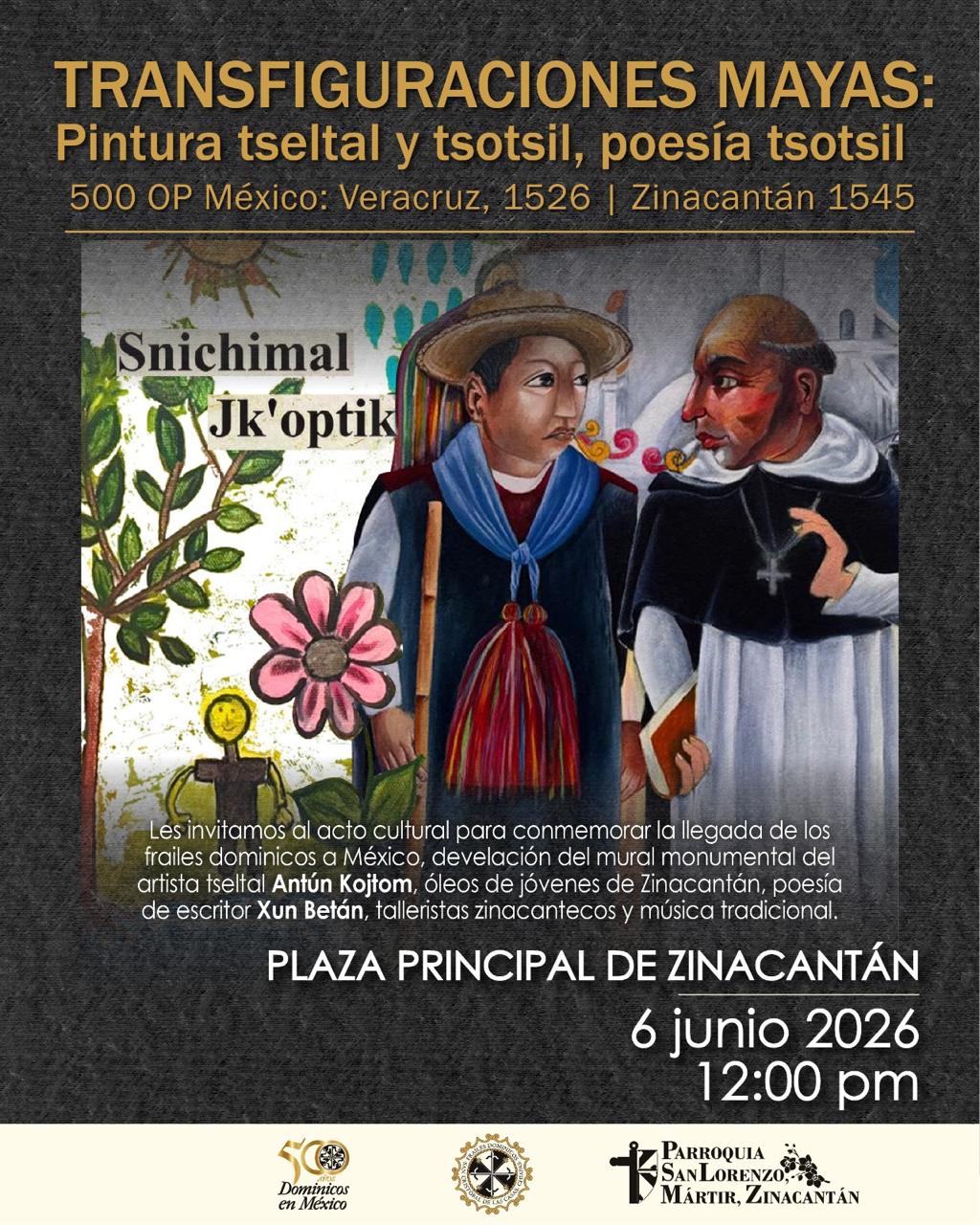
    These reflections come to mind when accompanying a great Tseltal Maya painter, the master Antún Kojtom, who is currently creating a mural commemorating the arrival of the Dominicans in Chiapas, on a wall located in the main square of Sots'leb, between the temple and the market, in the municipal capital of Zinacantán.

    For the past six months we have been discussing the narrative of the emerging mural, emphasizing what we now call a "dialogue of knowledge" between the Mayan peoples of Chiapas and the Dominican friars.

    We chose a tone conversational The mural depicts scenes that highlight the ancestral religion of the Tsotsil people, particularly their religious roles such as grandmothers, seers, and stewards, with their ritual prayers on the hills, ancestral blessings, and community responsibilities. Through this narrative, we seek to underscore the centuries-old legacy that remains alive today in the pastoral life of the parish of San Lorenzo Mártir in Zinacantán.

    In the center of the mural appears the meeting between a Tsotsil steward and a Dominican friar, Fray Bartolomé de Las Casas, both standing with the same dignity, exchanging words, each with his symbol of authority, the staff of command for the first, the Bible for the second.

    On the right, a third scene brings together the prophetic Church that has flourished in the Highlands of Chiapas and the Lacandon Jungle from the 16th century to the present day: a group of friars, with Friar Matías de Córdoba who promoted the independence of Chiapas in the 19th century and Friar Raúl Vera with jTotik Samuel beside him, bishops of the Church of the poor and excluded in the 20th century. Above their heads, like kites moved by the wind of the divine Ruah, are the martyrs of the San Cristóbal Church of recent decades: Ignacio Pérez López, pre-deacon of Chicomuselo, Father Marcelo Pérez, parish priest of Guadalupe in Jobel, Simón Pedro Pérez López, member of Las Abejas de Acteal, and Guadalupe Vázquez Luna, survivor of the Acteal massacre.

    On the far right appears a highly symbolic scene for the recreation of the historical memory of the Dominican friars in Chiapas, recounting stories of creative rebellion: Friar Pedro Lorenzo de la Nada conversing with a Lacandon sage, both seated on rocks in the shade of a large ceiba tree, the sacred tree of the Maya, with the glyphs of the flowery word emerging from their mouths. The friar moves his hands, signifying eloquence, as he listens. The Lacandon sage touches his heart with one hand and points to Mother Earth with the other. One is dressed in his white habit and black cape; the other, adorned with a jade necklace and white loincloth. They are accompanied by a group of Lacandon women, young people, and children, attentive to the dialogue. This scene seeks to represent the apostolic adventure undertaken by a friar who wanted to go beyond the limits of Christian norms, as Jan de Vos masterfully recounts in his biography of Friar Pedro Lorenzo. What we felt was most important to highlight about the founder of modern Palenque was the audacity of the rebellious friar who "went into nowhere," as the prior of the Santo Domingo de San Cristóbal convent told him when Friar Pedro Lorenzo insisted on going into the jungle to find its inhabitants and announce the Good News. Escaping from the convent, he was lost for several years, later reappearing in the land of the Tsendal people, where he founded Palenque. During his apostolic journey, he reached Pochutla and Lake Lacam-Tum, now known as Miramar, a sacred center for the Lacandon people. From that time, some baptismal records are preserved in the diocesan archives, bearing his new name: Friar Pedro Lorenzo de la Nada (Friar Pedro Lorenzo of Nothingness).

    When sharing the sketches of the mural in progress with friends, there has been no shortage of praise for the initiative, especially since it was the result of a long dialogue with civil and religious authorities in Zinacantán. Others have appreciated that the invited artist is a renowned master of contemporary Mayan art. Some critical voices have pointed out the underrepresentation of women, or the prominence of the friars in the images. For my part, once I had agreed with Maestro Antún on the tone From the narrative with the importance of the symbols of the two traditions to be represented in the mural, I received with respect and great admiration the visual proposal of the artist who, with his own genius, will undoubtedly leave us a pictorial legacy that is the gift of the Dominican friars to the people of Zinacantán in this commemoration.

    In a couple of weeks we will be celebrating this event in San Cristóbal de Las Casas and Zinacantán.

    I'll tell you about the new seeds being sown on this path of living memory.

    Jobel, May 22, 2026

  • Dominicos en las fronteras En memoria dichosa de fray Daniel Ulloa Herrero OP (+), 1946-2026David Alfaro Siqueiros | Portrait of Saint Dominic | CUC, 1970

    Dominicans on the frontiers In blessed memory of Friar Daniel Ulloa Herrero OP (+), 1946-2026

    By Carlos Mendoza Álvarez

    Hospitality and commensality are two vital attitudes that, over the years, I have cultivated with the Dominicans since my first encounter in 1979 with Daniel Ulloa and Raúl Vera, then formators of postulants and novices respectively, on the path of initiation to charism of preaching, which has been in dialogue with diverse cultures for eight centuries, with the chiaroscuro of every century-old institution, its shadows and its great lights.

    Even during my childhood in Puebla, both virtues were present in the life of the family, around the figure of my maternal grandmother, my great-aunt, my mother and aunts, along with the uncles who made each family meeting a true celebration of flavors and dances.

    Daniel Ulloa Herrero passed away a few days ago in Cuernavaca, and today the ashes of his mortal body will be deposited in the Columbarium of the Temple of Santa María de la Anunciación, known as the University Parish, next to the National Autonomous University of Mexico in Copilco, which was founded by the Dominicans in 1963, with the spirit of the ongoing conciliar renewal, to cultivate dialogue with intellectuals, students, athletes and workers of the country's top university.

    Friar Daniel received priestly ordination there, along with Friar Miguel Concha and Friar Antonio Ramos, on July 25, 1970, from Bishop Don Sergio Méndez Arceo, who was a council father and an eminent witness of the liberating Latin American Church, against the current of the prominent groups of the Catholic hierarchy and conservative lay people of the time.

    The CUC - as the University Cultural Center Founded by the Dominicans, the university was famous in its golden age for its University Mass and its Film Club, which showcased the latest art films by unknown and even banned directors such as Pasolini, Tarkovsky, Kurosawa, Fellini, and Buñuel. The presence of the Dominicans in every faculty of the UNAM—whether as professors, students, or guest lecturers—extended beyond the university campus, fostering dialogue between faith and reason with students and professors alike.

    In that impetus, Daniel Ulloa, Raúl Vera, and Miguel Concha were trained as preaching friars by figures of the stature of Friar Alberto Escurdia, professor at the Faculty of Philosophy and Letters; Friar Agustín Desobry, who arrived from France with a great project for a cultural center as a space to promote dialogue with university students; Friar Jaime Gurza, an exquisite and cultured man, knowledgeable about the mystical and aesthetic tradition of the medieval and modern Dominicans; and Friar Julián Pablo Fernández, filmmaker and painter, friend of Don Luis Buñuel, David Alfaro Siqueiros, Juan Rulfo, Octavio Paz, Guillermina Bravo, and so many other creators of Mexican culture of the time.

    Daniel Ulloa stood out for his brilliant intelligence, which he would later cultivate as a historian, graduating from El Colegio de México with a thesis on the conflicting currents of the Dominicans upon their arrival in Tierra Firme in 1526: on the one hand, Friar Domingo de Betanzos, with a rigorous reformist spirit in convent life and doctrine, as part of the evangelization and colonization undertaken by the Spanish Crown; on the other hand, Friar Bartolomé de Las Casas, with a bold emphasis in his criticism of the ongoing coloniality, confronting the Encomienda system through the promotion of the Laws of the Indies and a method of peaceful evangelization that he had already tested for years on the coast of Venezuela and later in Verapaz in Guatemala.

    Daniel Ulloa's vibrant personality was marked by a creative sense of humor and exquisite irony that allowed him to connect immediately with young people, both in universities and in working-class neighborhoods. A notable chapter in his history as a young priest was the rock Mass that, along with a band of young people from the alleyway of Leandro Valle, a neighbor of La Lagunilla and Tepito, the "tough" neighborhoods of Mexico City's Historic Center, he enlivened on Sunday nights at the Santo Domingo church.

    Later, both of these intense experiences—his intellectual life as a historian and his pastoral accompaniment of young people from diverse urban cultures—allowed Daniel, as prior of the CUC, to propose a renewed vision of university ministry in the 1980s that emphasized the intellectual life and pastoral accompaniment of university students with their multiple identities. During his years as prior, for example, he welcomed Brothers Roberto and Benjamín Cuéllar, from the Christian Legal Aid organization founded by Archbishop Romero, who became our mentors in human rights work. This experience paved the way for the creation of the Fray Francisco de Vitoria OP Human Rights Center, the oldest civil society organization in Mexico among those that now comprise the network. All rights for all.

    The General Chapter of the Order of Preachers, held in Mexico in 1992, where I had the blessing of serving as Secretary General, elected Friar Timothy Radcliffe as Master of the Order. In his first month in office, he convened a remarkable group of friars as his close collaborators: Jean-Jacques Perennès of the Province of France as Assistant for the Apostolic Life, Guido Vergauwen of the Province of Flanders as Assistant for the Intellectual Life, and Daniel Ulloa of the Province of Mexico as Secretary of the Order. Together with other friars of this vigorous caliber—as enlightened preachers with a profound sense of thought and spirituality dedicated to justice, peace, and beauty—Friar Timothy encouraged the entire Dominican family for nine years to reclaim the prophetic spirit of “holy preaching.” This was the name of the work started by Dominic of Guzman, Bishop Diego de Osma, the sisters of Prulla and the layman Peter Ceila in Languedoc, in turbulent times of return to the radicalism of the gospel, which was shared by the mendicant movements of the time.

    Years later, Friar Daniel emigrated to the United States to continue his university ministry, first in New York, then in Brooklyn, and later in New Jersey. We Dominicans of Mexico owe him a debt of gratitude: to reclaim his legacy and renew the charism of preaching in these new theological spaces where God encounters wounded humanity seeking life, dignity, beauty, justice, and peace around the common table of divine compassion.

    More recently, on December 7, 2024, when Friar Timothy received the cardinalate from Pope Francis, many of his companions from that time gathered in Rome to celebrate this momentous occasion. In a video recorded on that day, Friar Daniel recalled that the main purpose of the gathering was to reaffirm the urgent need for the charism of preaching to proclaim the Good News amidst the turbulent times humanity is experiencing.

    To honor the legacy of that generation of preaching friars who have marked my life as a person, as a Christian, and as a Dominican, my theological work and pastoral service of several decades has sought to listen to each community and culture where I have lived: Mexico City with its disparate and diverse neighborhoods; university students in Fribourg, Switzerland, Paraná in Brazil, Paris, Mexico City, New York, Rio de Janeiro, and Boston; as well as the indigenous peoples of Oaxaca and Chiapas, from decades ago to the present day, to the Lakota and Mapuche peoples at the extreme North and South of the continent.

    Inspired by this Dominican spirit, at the confluence of faith and reason, I now participate in the development of this initiative JobeLab In San Cristóbal de Las Casas, along with friends from this city. I'll tell you more soon about this exciting network of friendship, hospitality, and budding culinary experiences.

    In the coming days, we will be holding two events here in Jobel: on Wednesday, March 25th at 5:50 pm at Belil Restaurant, a presentation about the San Cristóbal School as a breeding ground for critical thinking that emerged in Chiapas in the second half of the 20th century, with the participation of Pablo Romo, Martha Elena Welsh, and Juan Carlos L. Puente. And on Friday, March 27th, at 5 pm at the Charity Temple, we will host the event “Music for Interreligious Encounter,” together with Shaykh Yahya Rhodus and Shaykh Mudar Abdulghani from the city's Muslim community, focusing on the Sufi music and chants of Nader Khan, a Canadian believer and artist, as expressions of encountering the sacred in times of extreme violence.

    We look forward to welcoming you for an experience of hospitality and dining.

    Jobel, March 21, 2026

  • La llamada a la itinerancia De Boston a la Condesa y JovelAntún Kojtom | Drop of water in the navel of the earth | Tenejapa, Chiapas | 2020

    The Call to Itinerancy From Boston to La Condesa and Jovel

    By Carlos Mendoza-Álvarez

    .

    It has been seven months since I left Boston, following the unfortunate episode of academic censorship and the growing risk of criminalizing university research in the Trump era.

    Upon returning to my homeland, I had the good fortune to stay for several months at the Dominican house located in a hipster neighborhood of Mexico City. The liturgical atmosphere of Holy Week deepened the process of mourning and resurrection that such a loss entailed, creating a pause to allow my emotions to settle and prepare me for the next stage of life. The Easter Triduum helped me feel how divine Life flows in the depths of my heart. This perception grew in the following months, thanks to the company of extraordinary people and communities I was able to visit during the summer in various parts of the world as part of my theological service.

    Extraordinary scenes from that journey come to mind, like the gaze of a refugee pleading for empathy, or the sound of the waves crashing against the South African cliffs. I carry in my heart the image of the modest altar—true in its prayerful simplicity and closeness to others—of the Jesuit community in Mapuche territory. The conversations in Turkey with a handful of friars and sisters of the Dominican Order still resonate in my ears, as we searched for signs where today we might recognize the messianic times that are slow in coming. Each morning, the rituals of women healers from Malaysia, Dakota, India, and Kenya, gathered in Guadalajara, rise powerfully from the depths of my heart, with scenes that remain etched in the documentary Re-Existing 2025, lingering like flashes in the middle of the night.

    During several months spent in Mexico City, I was able to glimpse the changes taking place due to gentrification in an urban neighborhood, brought about by mobile populations—in this case, the “digital nomads” from the Global North who displace impoverished inhabitants in the South, while simultaneously enriching the local culture with new flavors and knowledge. In religious terms, as I mentioned earlier, I became aware of the fragmentation of the world of human interiority, which some call spirituality, but which designates a wellspring of transcendence that flows in every person as it evokes Lanza del Vasto in his poetry A Holy Source often desiccated by the vulgar marketing of religion. I was surprised to find in the temples a revival of popular Catholicism of devotions among young people who cling to piety without much interest in the prophetic spirit of Christianity of the conciliar renewal of more than half a century ago that placed justice linked to the experience of faith at the center of Latin American Christianity.

    .

    .

    And finally, after a wait filled with days and nights of uncertainty, I was able to travel to Chiapas to put down roots and build connections in those Mayan lands in the years to come. I was looking for a “place” to inhabit, or, as the beloved master of the Dominican order, Friar Timothy, now Cardinal Radcliffe, said in his book The fountain of hope, an “ecological niche where we can flourish”, amidst the diversity of flora and fauna of the human condition, another way of describing our similarities and oddities when it comes to living in community.

    Jovel, either land of wetlands and pastures, the valley where the colonial city of San Cristóbal de Las Casas was established, as the indigenous peoples called it, had received the Dominican novices in 1980 when we visited these lands, accompanied by our teacher, Friar Raúl Vera, who even then showed a pastoral zeal for the peasants in Amecameca and for the mayan villages from Chiapas and Guatemala. Since then, a little piece of my heart has remained here, revived by the annual visits to San Cristóbal and Ocosingo with my university classmates from Servandus Missions of the University Parish animated by the Dominicans in Mexico City.

    My several-month stay in Ocosingo in 1994, following the EZLN uprising, is an experience that has left an indelible mark on my connection to the indigenous liberation movement and the mystique that sustains it. This insurrectionary movement had found fertile ground in the work of jTatik Samuel Ruiz, the Wanderer, accompanying the indigenous and mestizo peoples of the Diocese of San Cristóbal de Las Casas since 1961. His conversion to the poor, inspired by the The Pact of the Catacombs. During the Second Vatican Council, his commitment was further solidified by his active participation in the Latin American episcopal conferences in Medellín, Puebla, Santo Domingo, and Aparecida. The Indigenous Congress of 1974 —where the Dominican friar Enrique Ruiz Maldonado actively collaborated on the occasion of the fourth centenary of the death of Friar Bartolomé de Las Casas, the first diocesan bishop of San Cristóbal— a watershed moment would be marked in the adoption of the indigenous cause as the backbone of the preferential option for the poor made by the diocese located in the Highlands of Chiapas and the Cañadas of the Lacandon Jungle. As a corollary to this path, the Third Diocesan Synod which concluded in 1999, as one of its participants, Sister Celia Rojas recounts, would ratify four decades of opting for the poor and promoting an Indian Mayan theology as the most complete expression of the inculturation of the Gospel according to the conciliar spirit.

    Returning to these lands permanently, forty-five years later, now means being prepared to face new challenges that were unforeseen in the last century. One of these is perhaps the situation of migrant Indigenous children and youth in symbiosis with urban culture and digital media, which is generating new Indigenous subjectivities caught between tradition and modernity. Thanks to dear friends like Geovanni Nájera of Semillero 259 Yara and Sebsor of Psicolexia,For example, I'm beginning to enjoy and understand a little more those other expressions of contemporary indigenous urban tribes. Through urban gardens, hip hop and rap, street art and graffiti, among other aesthetic and social expressions, the initiatives they promote are the seeds of something new.

    .

    .

    An immersion bath in the Tsotsil ecclesial community took place these days in the Parish of Saint Lawrence the Martyr, Founded by Dominican friars in 1545, this community, nearly five centuries later, boasts forty-five villages with sixty churches and chapels, a testament to the vitality of the faithful in these highlands of Chiapas. Here, catechists, extraordinary ministers of Holy Communion, and traditional authorities coexist with youth choirs and women's groups, accompanied by Dominican friars and sisters. This presence was renewed in 1961 when the Dominicans returned to this community after a long hiatus following the Reform Laws of 1857, the Revolution, and its aftermath in the first half of the 20th century, as vividly recounted by Friar Pablo Iribarren..

    A couple of days were enough to immerse myself in another world, with its vibrant symbolic and linguistic tradition. Although I had already glimpsed it as a visitor, a new horizon now opened before me, a chance to learn how to be present as part of the community of friars accompanying these communities. I felt it was a call to continue my journey in diverse ways. It is about embarking on a new path alongside these peoples, with their own unique character, their intergenerational tensions, their expressions of Catholic religious tradition, yet also ancestral, all of it shaped by the tensions between capitalist modernity and visions of other ways of life, governance, and spirituality.

    A major challenge for me will be learning the Tsotsil language and navigating amidst the powerful traditional symbols of the Zinacanteca culture, while listening with empathy to those generations of young people who are transforming the tradition of their ancestors with new ways of life.

    Another significant challenge will be the cultural life in the city of San Cristóbal, cosmopolitan and provincial at the same time, with centers of critical thought of international stature such as the Colegio de la Frontera Sur, the Universidad de la Tierra-Cideci, the Fray Bartolomé de Las Casas Chair in the Faculty of Law of the Autonomous University of Chiapas, and several centers of culture and arts.

    Some novel ideas are emerging, like sparks, to begin a dialogue with the cultures present in Jovel and Zinacantán. The traditional radio program run by the friars in recent decades reached a specific, more religiously oriented audience. But an online portal with podcasts and video clips featuring content on the mysticism of religions, their similarities and differences, or on political theology in today's world that abuses religion to justify genocide, would reach a younger and more diverse segment of the population.

    For now, the content is yet to be defined within the community to achieve the right tone and approach for a theology that is grounded in the street and born from the street,developed through dialogue with people both inside and outside of churches who are willing to discuss their deepest concerns and intuitions regarding the meaning of life, social justice, beauty in so many traditions, cultural pluralism, and the survival of our common home. I hope to soon share some of the first steps on this new path here.

    What will give strength to these dreams is undoubtedly the vitality of today's Mayan communities, in their interaction with other urban and digital cultures. Therein lies the fertile ground for them to flourish in these lands.

    The calls of itinerancy will always be uncertain, but from here I travel them confident in the knowledge of ancestral and modern peoples who will be a light on the path.

    .

    Jovel, December 6, 2025

    .

    Note: I would like to read your comments in the final section of this page.

English