By Carlos Mendoza-Álvarez
I return to the story of the river of waters of life and thought that has been formed thanks to shared learning experiences with friends with whom I discover an inspiring way to live spirituality and to weave a theological and philosophical thought that is meaningful and mobilizing for the times we live in our era of global uncertainty.
Mutual Spiritual and Theological Accompaniment was the first stream that began to flow, irrigating the lands of my theological work, which I cultivated with people on the margins of society. I sought a spirituality of life that flourishes amidst the cracks of power, first in Mexico and the United States, then throughout the continent, and now reaching Europe and Africa. Thus, little by little, I explored spaces of great vitality, diverse spiritualities with their own theological knowledge outside the university, such as the public square, pastoral service, and social activism. These were spiritualities I had sensed since my youth, but which I now listened to with greater attention, both heart and mind.
∂
The other tributary of the valley of decolonial practices and knowledge was one I began to navigate with Pablo Reyna, Araceli Téllez, Eduardo Velasco, and several colleagues from the Ibero-American University of Mexico City more than a decade ago. It was during the time of the #YoSoy132 student movement, which rose up against the corruption of the Mexican political system; also during the protests over the forced disappearance of the Ayotzinapa students; and, later, during the #MeToo movement, ignited by feminist comrades in public squares around the world to dismantle the age-old patriarchy.
I joined the learning process to “decolonize the university,” to which David Fernández—who began his rectorship at the Ibero-American University in Mexico City inspired by the thought and martyrdom of his Jesuit colleague Ignacio Ellacuría of the Central American University of El Salvador, and advised by the sharp intellect of the great Mexican thinker Gustavo Esteva—had called us, from my position as an academic and administrator. In my capacity as Divisional Director of Humanities and Communication at Ibero Mexico City, I proposed holding a colloquium in 2016 called “For a Change of World,” where we invited students, faculty, researchers, administrative staff, and university service personnel to raise the most urgent social problems of our time and discuss ways to address them, considering their root causes as part of our university vocation, and making the crucial “epistemological” shift to learn from the knowledge of the peoples and social movements that creatively and hopefully confronted these forms of violence. The keynote address given by Leonardo Boff on the challenges of our time was memorable at that colloquium.
From that auspicious moment, a series of talks, workshops, and academic colloquia followed, each bringing together three diverse and complementary perspectives and analyses: social movements resisting various forms of violence; academics learning and researching alongside these movements; and artists' collectives creating performances, choreographies, music, paintings, sculptures, plays, and literature to tell and recreate the life stories emerging from the cracks of a violent world. Over time, it proved to be a fascinating formula, full of cognitive, social, cultural, and spiritual challenges, revealing itself as a specific path to "decolonizing" the university, thus opening it to other processes of knowledge and transformation of reality arising from the peripheries of the hegemonic world.
The 2017 colloquium “At the Crossroads of North and South” on the poetic and academic work of Boaventura de Sousa Santos was another memorable moment. Rappers, singing and dancing to the poetry of the Portuguese author's INKZ (Incapable) writing, interacted with Searching Mothers from Mexico and Argentina, with young women from the Community Guards of Cherán in Michoacán, and with healers from Bojayá in Colombia, healing the trauma of the massacre perpetrated by paramilitaries and the army, among many other experiences of victims turned survivors. In this way, we explored new paths of the “ecology of knowledges”—a barely explored territory that we will have to traverse in the years to come.
Later, the conference on decolonial theologies organized in 2019 by the international theology journal Concilium in Mexico City—a publishing initiative I was part of as an editorial advisor and later as a director, which kept the flame of the Second Vatican Council alive—in collaboration with the Ibero-American University and the Dominican Catholic University Center (CUC) at the National Autonomous University of Mexico (UNAM), brought together several of these threads into a master knot. An ecumenical prayer service in the Santo Domingo Church in Mexico City, co-led by a Dominican Catholic bishop and an Afro-Puerto Rican queer bishop, opened the event, which then brought together social movements from Mexico, Guatemala, El Salvador, Colombia, Brazil, and Argentina on the Santa Fe campus of the university. There, they engaged in inspiring conversations with investigative journalists, anthropologists, philosophers, and theologians in roundtables of mutual listening. Each day was accompanied by three-way discussions, following the format that had revealed to us a new model of university in its infancy. Other times we organize round tables with renowned figures, such as that extraordinary conversation between Rita Segato, Raúl Zibechi and Amador Fernández Savater about the spiritualities that animate resistances, a topic for the three figures outside of their usual reflections on critical theory that they agreed to explore, carried out at the CUC of the University Parish of the Dominicans, to close the event with provocative intuitions about “political hope”.
∂
Up until then, we called these conversations “Resist” until, in dialogue with Nelson Maldonado-Torres during a colloquium in Boston in the spring of 2022, I realized the need to name this deeper phase of the decolonization of life and thought with a new expression. It was crucial to focus on the “re-existences” created by Afro-diasporic peoples, women in their struggle against patriarchy, queer collectives, mothers searching for their missing children in Argentina and Mexico, collectives of people in forced migration, people with disabilities (or different abilities, depending on the desired emphasis) creating living spaces, and so many other communities in resistance that invent, day after day, new ways of life, communal organization, and spiritualities of Buen Vivir (Good Living).
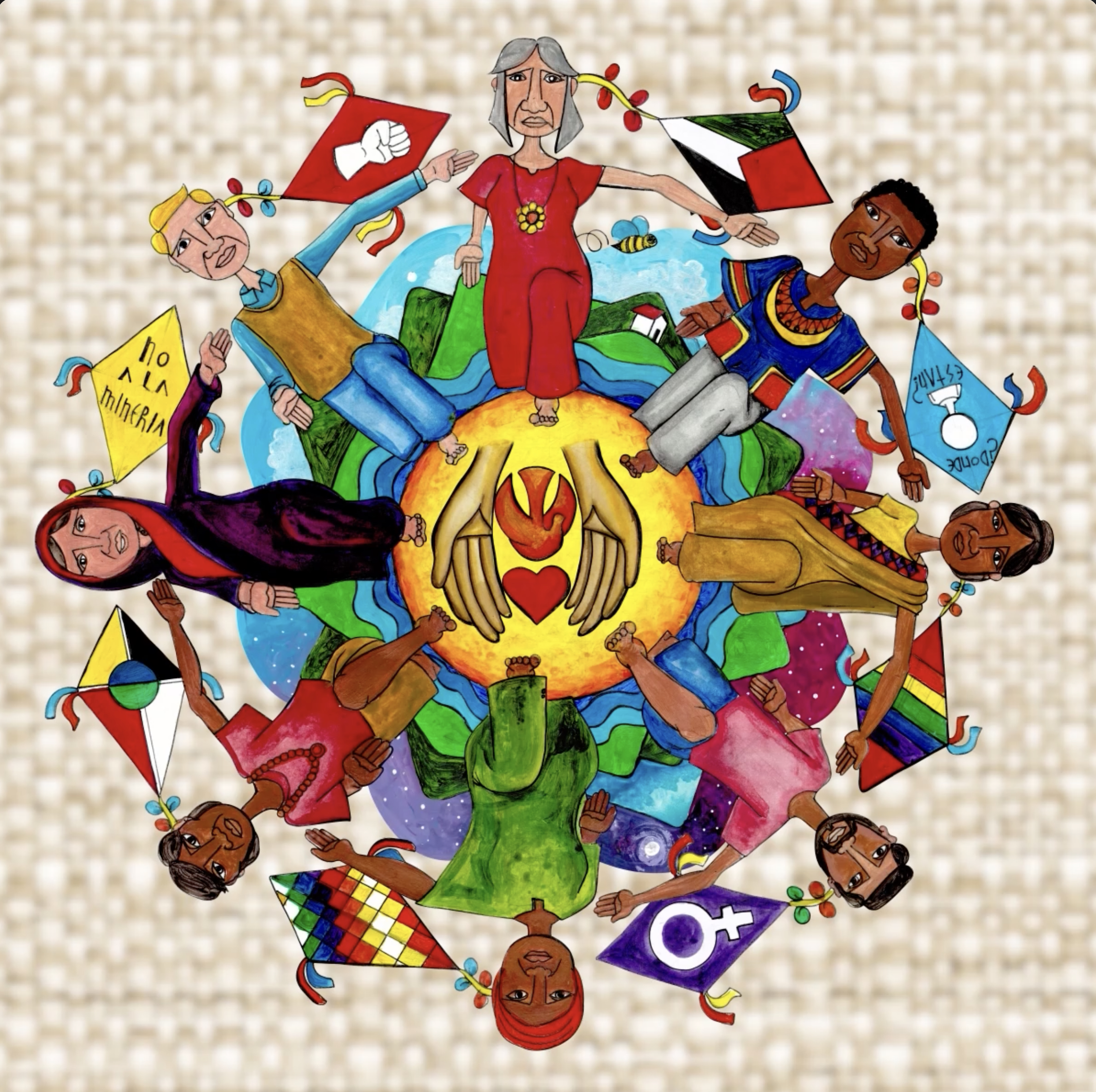
Inspired by this intuition, together with Elías González and Juan Carlos La Puente, we organized two festival-meetings at ITESO in Guadalajara, both titled “Re-existe” (Re-exists), the first in 2023 and the second in 2025. Thanks to the vision of its rector, Alexander Zatyrka, and the creative imagination of a handful of theologians from Peru, Kenya, Nigeria, Catalonia, India, and Mexico, we were able to bring together eighty invited guests and hundreds of students and faculty at both events. The heart of both discussions and festivals beat with a focus on the spiritualities that sustain, with “combative hope,” the people and communities located on the fringes of the hegemonic world. Mining extractivism was analyzed in its connections to white supremacist racism and xenophobic immigration policies, with their strategies of ethnic cleansing and extermination focused on controlling territories and subjectivities through new settler colonialisms, such as those that gave rise to countries like the United States, South Africa, and Israel. There, we sought to unravel the processes of awakening, healing, and self-empowerment deployed by communities in resistance. Histories that, little by little, transform into re-existences.
The harvest of these wonderful encounters was also expressed as a celebratory ritual thanks to the support of Fran, Diego, Glenda, and Lau, popular educators from the Bendita Mezcla collective, formed by the younger generations of the Base Ecclesial Communities of Our America. And so, these conversations reached their aesthetic climax with the comic book talent of Katsumi Lemus, the rap and hip hop of the comrades from Psicolexia and Semillero 259 from Chiapas, the performances of the Portland, Oregon, artists' collective, the dancers of Jauja in the Andean highlands, and so many other people who create glimmers of beauty in the cracks of necropower.
We now dream of reuniting in Mother Africa in 2028, where we can honor the living memory of those peoples who teach us so much today about the power of their recovered ancestral heritage. Peoples who are living testaments to the creativity of the diaspora and the profound thought that arises from centuries-old wounds transformed into bodies and territories of dignity and hope, as in South Africa and Kenya, South Sudan and the Congo.
In the context of the great catastrophe (Nakba) that we face today—whether as “war against humanity” according to the Zapatistas in Chiapas, as genocide in Palestine denounced in its ideological apparatuses of Jewish and evangelical Zionism by Silvana Rabinovich and Mitri Raheb, or as technofascism throughout the world according to decolonial thought—these encounters are more urgent than ever to weave networks of mutual recognition and political hope, promoting a sharp analysis of the complexity of the catastrophe.
But perhaps the greatest challenge lies in sharing the initiatives for caring for territories and the processes of autonomy cultivated by many groups located in the cracks of the hegemonic world, where the life of the peoples is preserved and enhanced as a seed of hope for humanity and for the Common Home that welcomes us into its bosom.
∂
On this urgent topic, a book on decolonial political theology has been in the works for a year. It is a decolonial analysis because it arises from the cracks in necropower during the great catastrophe. But such an approach is insufficient if it is not enriched by the anthropological analysis of mimetic desire, which explains the violence within subjectivity in relation to the otherness of one's neighbor and the other God. This decolonial political theology remains open to ongoing critique thanks to the horizon of apophatic thought, which warns us against any usurpation of the divine. It is a collective work that I gradually developed, together with colleagues who participated in the colloquia I organized with the support of Martin, Matthew, and Francis, enthusiastic doctoral students at Boston College, during the five years I lived in Massachusetts. The New York-based publisher Orbis Books is the home that welcomes us for the publication of this work, where we will give an account of our feelings and thoughts of re-existence in times of necropower.
I will share more details about this book, which is in the final stage of the publishing process, in future posts.
Jobel, September 12, 2026