Tag: Antún Kojtom

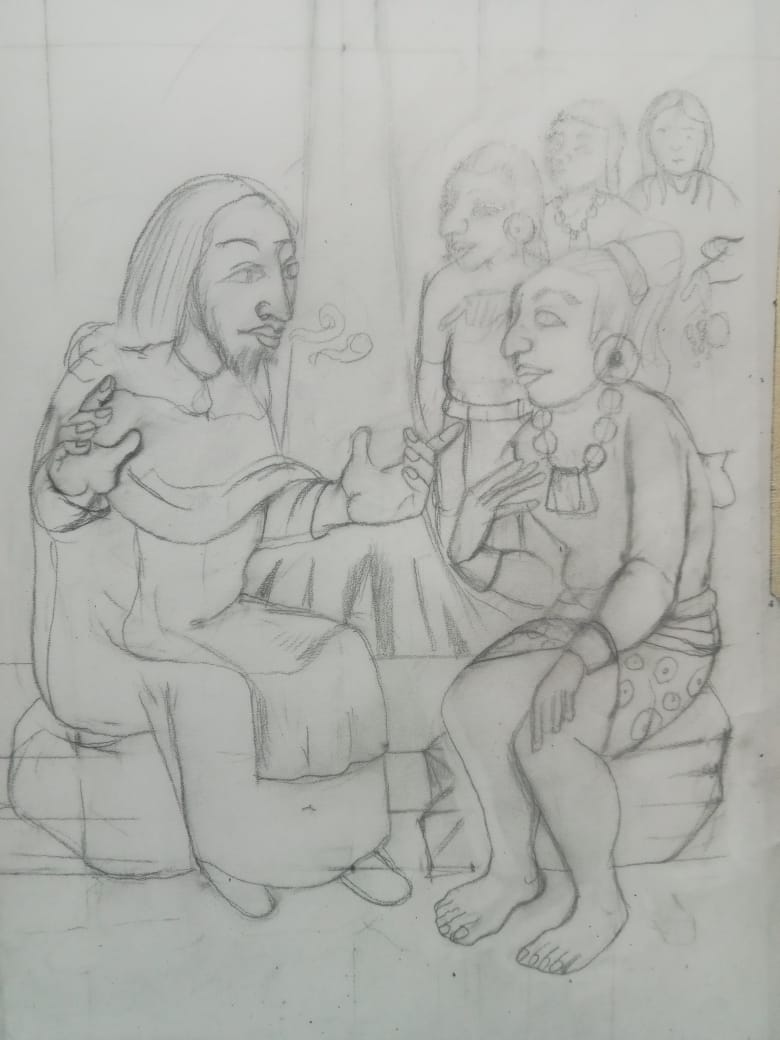
  • La fiesta de la Ruah divina Reflexiones sobre la memoria viva de los pueblos en movimientoAntún Kojtom | Mural 500 OP Chiapas | Detail: sketch of Friar Pedro Lorenzo de la Nada with Lacandon Sage | Sots´leb, 2026

    The Feast of the Divine Ruah Reflections on the living memory of peoples on the move

    By Carlos Mendoza-Álvarez

    Fifty days after Easter, Christian communities around the world celebrate the overabundance of divine love, reaping the fruits of the messianic age, gathered with joy in the midst of suffering, as the Hebrew poet says: “Those who sow in tears will reap with songs of joy” (Psalm 126:5).

    Two thousand years ago, after mourning the brutal execution of Jesus, the Galilean, by the Roman Empire—in collusion with the Temple authorities of Jerusalem and the enraged mob as part of the infernal mimetic cycle—a period of mourning was necessary for his community of friends and companions to grasp the senselessness of the innocent's death. This question still arises today in the grieving hearts of those who have survived lynchings, both ancient and modern. It is a questioning of the meaning of absence that also beats in the hearts of the Mothers Searching for their disappeared children in Mexico today, a cry that becomes a plea to find their offspring and help them "come home.".

    Celebrate that Love is as strong as death and, even more, that Love conquers hate or that Life resists and re-exists At first glance, it seems like an evasion that ignores the suffering of the victims and the urgency of justice. On the contrary, it seems to me that precisely in that hopeful suffering The heart beats with the ethical, political, and spiritual indignation of survivors of so much violence. A cry that is expressed in the public squares of Gaza and Tehran, Beirut and Mexico, Kakuma and Dadaab in Kenya, by those who dedicate their bodies, hearts, and minds to the service of life in the midst of death.

    The celebration of Pentecost is rooted in the joy of peoples who, after confronting horror, are able to go further in healing from trauma and quietly cultivating hope. Without denying the painful past, nor the undeniable need to hold the perpetrators accountable, what matters to those who survived is to stand up and live again with hope. This is what I have been learning, step by step, from the collectives queer/cuir  who face gender phobias of various kinds, women facing abuse and femicide, as well as indigenous peoples who strengthen their resistance through processes of autonomy of bodies and territories, from the Inuit in Canada to the Mapuche in the far south of our continent.

    How can we celebrate the harvest of the divine Ruah in these times of such profound uncertainty? We are witnessing alarming signs of a return to barbarism at the hands of genocidal governments in the Middle East and Africa, as well as in failed states trapped by the complicity of their rulers with transnational criminal organizations, as is the case in Mexico, El Salvador, and Nicaragua. This spiral of genocidal hatred is being transmitted in real time through the attacks of the Israeli Zionist state, which is committing crimes against humanity with the complicity of the United States and the European Union, and the indifference of the international community, against entire populations that stand in the way of its geopolitical power.

    Strengthening resistance movements must also confront fundamental debates to find the path to utopia in times of dystopia. Collective memory, which lies at the heart of these processes, is now a battleground. Who tells the story and how they tell it are questions the Zapatistas in Chiapas, like the Sumud Global Flotilla, are asking themselves, attempting to give visibility to those who always remain in the shadows of the power that kills.

    We Dominicans are not exempt from these debates, especially now that we commemorate 500 years since the arrival of the friars to what we now call Veracruz in Mexico, on July 25, 1526. The great feat of evangelization—which undoubtedly brought missionaries inspired by Renaissance utopia and by the zeal for reform of the religious orders to return to their origins of following Christ—was also marked by the libido dominandi of the conquerors who followed that maxim of Western modernity so forcefully expressed by Enrique Dussel: conquiro, ergo sum, that is, "I conquer, therefore I am".

    When recounting the history of the Dominican presence in this region of the continent—called Tierra Firme by Western navigators and Mesoamerica by later geographers—we cannot forget that a fundamental contradiction marked the evangelizing work of the Dominican friars in the 16th century, as rigorously studied by Friar Daniel Ulloa Herrero in his doctoral dissertation at El Colegio de México: an observant current led by Friar Domingo de Betanzos, and a prophetic tendency championed by Friar Bartolomé de Las Casas. Undoubtedly, there were many nuances between these two tendencies when it came to evangelizing the colonized lands that later gave rise to the golden age of New Spain, the era of the Baroque churches along the Dominican route from Mexico City to Guatemala, traversing the entire central and southern regions of the Viceroyalty of New Spain.

    The splendor of the Baroque art of the convent churches of Puebla, Oaxaca, and Chiapas has shaped a worldview in which Mexico was the axis mundi From that early era of modernity, a meeting point between Asia and Europe, Mexico City was also a laboratory for cosmopolitan culture, as Friar Julián Pablo Fernández liked to say when he was prior of the ruins of the Imperial Convent of Santo Domingo in Mexico City. This era gave birth to a Creole and mestizo culture of universal value, as UNAM historian José Rubén Romero Galván recounts. However, we cannot forget that this Creole culture subjugated and rendered invisible the Indigenous peoples, as contemporary decolonial readings emphasize.

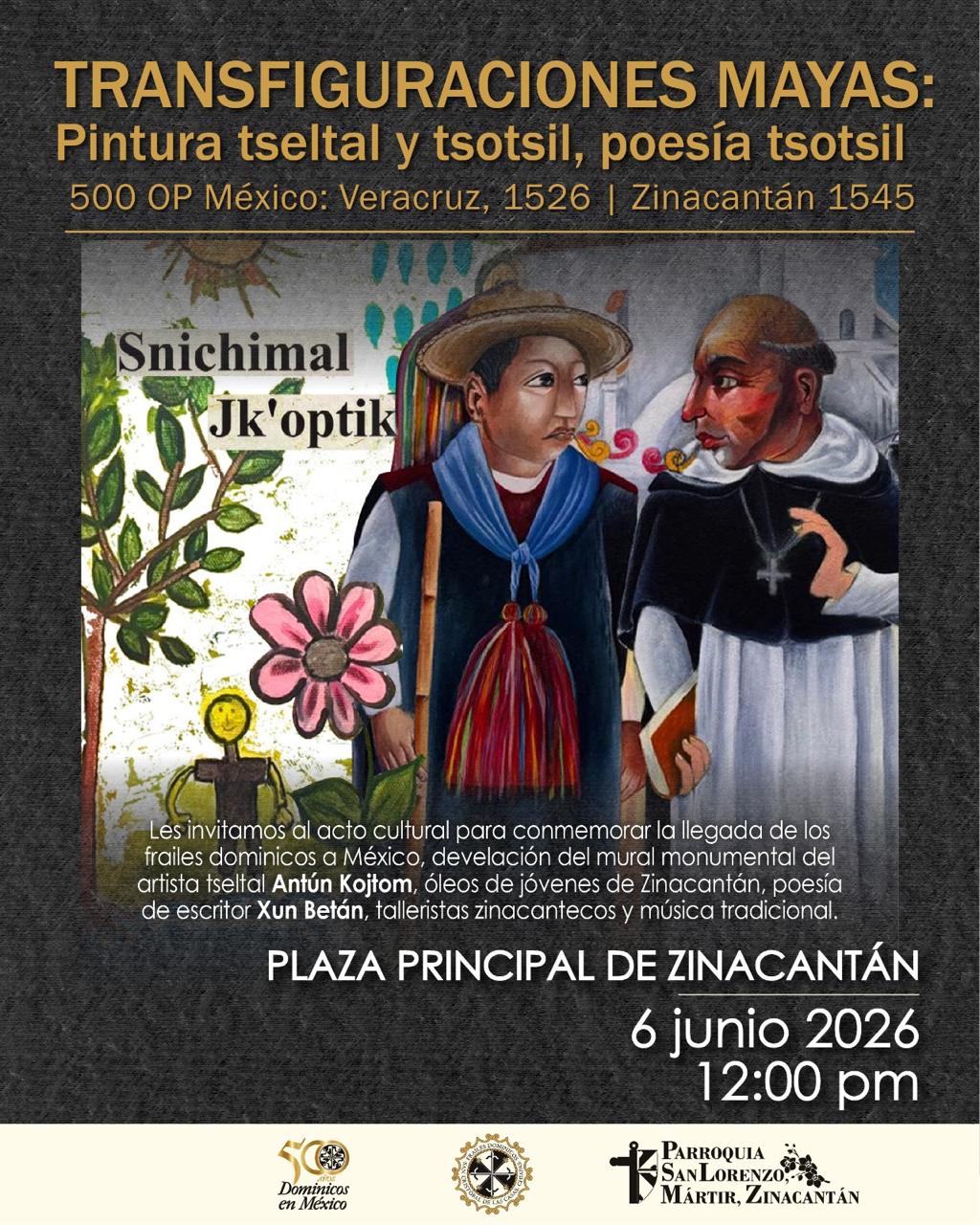
    These reflections come to mind when accompanying a great Tseltal Maya painter, the master Antún Kojtom, who is currently creating a mural commemorating the arrival of the Dominicans in Chiapas, on a wall located in the main square of Sots'leb, between the temple and the market, in the municipal capital of Zinacantán.

    For the past six months we have been discussing the narrative of the emerging mural, emphasizing what we now call a "dialogue of knowledge" between the Mayan peoples of Chiapas and the Dominican friars.

    We chose a tone conversational The mural depicts scenes that highlight the ancestral religion of the Tsotsil people, particularly their religious roles such as grandmothers, seers, and stewards, with their ritual prayers on the hills, ancestral blessings, and community responsibilities. Through this narrative, we seek to underscore the centuries-old legacy that remains alive today in the pastoral life of the parish of San Lorenzo Mártir in Zinacantán.

    In the center of the mural appears the meeting between a Tsotsil steward and a Dominican friar, Fray Bartolomé de Las Casas, both standing with the same dignity, exchanging words, each with his symbol of authority, the staff of command for the first, the Bible for the second.

    On the right, a third scene brings together the prophetic Church that has flourished in the Highlands of Chiapas and the Lacandon Jungle from the 16th century to the present day: a group of friars, with Friar Matías de Córdoba who promoted the independence of Chiapas in the 19th century and Friar Raúl Vera with jTotik Samuel beside him, bishops of the Church of the poor and excluded in the 20th century. Above their heads, like kites moved by the wind of the divine Ruah, are the martyrs of the San Cristóbal Church of recent decades: Ignacio Pérez López, pre-deacon of Chicomuselo, Father Marcelo Pérez, parish priest of Guadalupe in Jobel, Simón Pedro Pérez López, member of Las Abejas de Acteal, and Guadalupe Vázquez Luna, survivor of the Acteal massacre.

    On the far right appears a highly symbolic scene for the recreation of the historical memory of the Dominican friars in Chiapas, recounting stories of creative rebellion: Friar Pedro Lorenzo de la Nada conversing with a Lacandon sage, both seated on rocks in the shade of a large ceiba tree, the sacred tree of the Maya, with the glyphs of the flowery word emerging from their mouths. The friar moves his hands, signifying eloquence, as he listens. The Lacandon sage touches his heart with one hand and points to Mother Earth with the other. One is dressed in his white habit and black cape; the other, adorned with a jade necklace and white loincloth. They are accompanied by a group of Lacandon women, young people, and children, attentive to the dialogue. This scene seeks to represent the apostolic adventure undertaken by a friar who wanted to go beyond the limits of Christian norms, as Jan de Vos masterfully recounts in his biography of Friar Pedro Lorenzo. What we felt was most important to highlight about the founder of modern Palenque was the audacity of the rebellious friar who "went into nowhere," as the prior of the Santo Domingo de San Cristóbal convent told him when Friar Pedro Lorenzo insisted on going into the jungle to find its inhabitants and announce the Good News. Escaping from the convent, he was lost for several years, later reappearing in the land of the Tsendal people, where he founded Palenque. During his apostolic journey, he reached Pochutla and Lake Lacam-Tum, now known as Miramar, a sacred center for the Lacandon people. From that time, some baptismal records are preserved in the diocesan archives, bearing his new name: Friar Pedro Lorenzo de la Nada (Friar Pedro Lorenzo of Nothingness).

    When sharing the sketches of the mural in progress with friends, there has been no shortage of praise for the initiative, especially since it was the result of a long dialogue with civil and religious authorities in Zinacantán. Others have appreciated that the invited artist is a renowned master of contemporary Mayan art. Some critical voices have pointed out the underrepresentation of women, or the prominence of the friars in the images. For my part, once I had agreed with Maestro Antún on the tone From the narrative with the importance of the symbols of the two traditions to be represented in the mural, I received with respect and great admiration the visual proposal of the artist who, with his own genius, will undoubtedly leave us a pictorial legacy that is the gift of the Dominican friars to the people of Zinacantán in this commemoration.

    In a couple of weeks we will be celebrating this event in San Cristóbal de Las Casas and Zinacantán.

    I'll tell you about the new seeds being sown on this path of living memory.

    Jobel, May 22, 2026

  • De mundos alternos que se tocan Conmemorando el primer centenario del nacimiento de Ivan IllichStreet Art | In Praise of the Bicycle | Buenos Aires, 2015

    Of alternate worlds that touch Commemorating the centenary of Ivan Illich's birth

    By Carlos Mendoza-Álvarez

    Between postwar Europe and the Latin America and Caribbean of the modern mirage, there were flows of life and thought that went back and forth between both shores of the Atlantic. What was once the frontier of conquest, colonization, and evangelization—with the Creole and mestizo creations that reinvented the West during the colonial period—became in modern times an ocean of whispers of new worlds, sailing against the current of progress and industrialization.

    The 1960s saw the emergence in Cuernavaca, Mexico, of a river of thought flowing "north of the future," as Ivan Illich liked to describe the future arriving to us here and now, quoting the poem by Paul Celan, that Romanian-Jewish author who fascinated him so much:

    In the rivers, to the north of the future,
    I lay the net that you
    hesitant loads
    writing on stones,
    shades.

    In my hand autumn eats its leaf: we are friends.
    We extract time from nuts and teach it to walk:
    time returns to the nut.

    It's Sunday in the mirror,
    In sleep one sleeps,
    The mouth speaks the truth.

    My eye ascends to the sex of my beloved:
    We looked at each other,
    We say dark words to each other,
    We love each other as poppies and memory love each other,
    we fell asleep like wine in bowls,
    like the sea in the bloody ray of the moon.

    We stand embraced at the window, they can see us from the street:
    It's time this was known.,
    It is time for the stone to bloom,
    that a heart beats in the restlessness.
    It's time for it to be time.

    It's time.

    Austrian researcher Isabella Bruckner, a young professor at the Benedictine Athenaeum of Saint Anselm in Rome, who is now moving to Freiburg im Breisgau, organized a European colloquium to delve into the theological legacy of Ivan Illich, tracing the genealogy of his deepest intuitions about the crisis of instrumental modernity, which arose from what he called the perversion of Christianity.

    Together with Professor Martin Kirschner of the Catholic University of Eichstätt in Bavaria, I was invited to give a joint presentation comparing the political theology emerging in certain parts of Germany and Mexico, inspired by Illich's intuitions and ideas. The challenge was twofold: to find common ground and an appropriate language to account for experiences of proximity  and conviviality in countries so disparate in their political cultures: the German people currently grappling with the European Union's complicity as an ally of Israel and the United States in their geopolitical war in the Middle East, and the Mexican people seduced by the siren song of the Fourth Transformation and the roar of the World Cup, which silences the tragedy of the disappeared and the corruption of the narco-government in a large part of the country's territory.

    When I was invited to participate, I suggested to the organizer that she invite people who for years have been inspired by Illich's thought, particularly Javier Sicilia, Sylvia Marcos, Roberto Ochoa, and Rafael Mondragón, who are little known in European academia. So I undertook the task of presenting in my paper the central ideas of this critical dialogue on what Humberto Beck called the Cuernavaca School, with the Hebrew and Christian thinker of proximity and conviviality. I emphasized the new paths emerging in Mexico and other parts of the world. world below and of the peripheries From the centers of hegemonic power, where resistances flow as other ways of eating, healing and educating —as the late Gustavo Esteva said speaking of revolutionary verbs— to promote territorial, epistemic and spiritual autonomies that sustain communities and peoples who face the many-headed hydra that devours the world.

    One of the Illichan themes that most impacted colleagues in Germany during the COVID-19 pandemic was his critique of the pharmaceutical industry, promoted by Western democratic governments that imposed public health policies without considering the autonomy of individuals and communities in choosing the most appropriate ways to confront the pandemic. My German colleagues, Martin Kirschner and Markus Riedenauer, emphasized the continued relevance of this critique of the state's power to impose mandatory vaccination programs, disregarding the serious scientific objections to the indiscriminate use of vaccines and the effects they caused in the population.

    Another recurring theme in the Rome debates was that of the territorial, epistemic, and cultural autonomies that arise from placing face-to-face proximity at the center of life, or, in Illich's words, the conviviality as a mode of existence and the place which is inhabited with the strength of the vernacular. Both in Europe and in Latin America and the Caribbean, these autonomies have been gaining ground in recent decades, with the conquest of bodies and territories by women, indigenous peoples and collectives queer/cuir /queir, among other resistance groups.

    European colleagues were surprised by the diverse approaches to the ethical, political, and spiritual implications of the work of the migrant thinker Ivan Illich. From his diaspora from the clerical Church to his return to medieval classics like Hugh of Saint Victor—and through his time living with Puerto Rican communities in New York and later with peasant communities in Cuernavaca—Illich bore witness to these other worlds that intersect. Fabio Milana, editor, along with Giorgio Agamben, of Illich's work in Italian, presented a gem of archival research from the Illich family to recount Ivan's "vocation," as the young son of a Jewish mother and a Christian father, who cultivated from childhood and adolescence a passion for the thought that arose from Christianity as the event of the Incarnation of the Word of God. This core would later remain as an ember in the work of the migrant thinker to this day, in which we now recover Illich's pristine vision of a powerless church.

    The proposal to continue exploring Illich's thought from its various perspectives, both European and Latin American, remains open. We hope to organize a meeting in Cuernavaca that will foster these dialogues and new ways of living together in the conviviality of those who resist the era of the system, reclaiming place and vernacular culture as cornerstones of another possible modernity.

    This week, cultural writing and painting workshops begin in Sots'leb, as part of the preparations for the commemoration of the 500th anniversary of the Chiapas Revolution, which will take place on Saturday, June 6th in Zinacantán.

    I have been fortunate to contribute to the organization of these events, led by Antún Kojtom, a Tseltal painter from Tenejapa, and Xun Betán, a Tsotsil anthropologist and poet from Venustiano Carranza. These acts of collective memory seek to explore the enduring presence of the cultures of the Chiapas Highlands and their encounter with the Dominican friars in a dialogue that began five hundred years ago.

    A mural on the esplanade outside the San Lorenzo Mártir temple in Zinacantán will depict scenes from the ancestral religion of the Tsotsil people, such as prayers on the hills led by the Jiloletic, The blessing of the grandmothers and the importance of traditional roles as a bond within the community are also depicted. As part of this ancestral history, the mural's center features a scene of an imagined encounter between a Tsotsil steward and Friar Bartolomé de Las Casas, accompanied behind him by other friars who safeguarded the legacy of the Gospel linked to the defense of the people's rights, such as Friar Matías de Córdoba, who contributed to the independence of Chiapas, and, more recently, Friar Raúl Vera. jTatic Samuel Ruiz walking with the Mayan people. And at the far right of the mural, the master Antún created a beautiful scene of the dialogue between a Lacandon sage and Friar Pedro Lorenzo de la Nada, both sitting under a ceiba tree listening to each other: the friar speaking with eloquence and respect, the Mayan sage pointing to the earth and touching his heart.

    Those who can attend on Saturday, June 6th in Zinacantán will be able to participate in the unveiling of the mural, accompanied by Tsotsil poetry and traditional music, thus reaffirming the dialogue of knowledge that we seek to continue promoting between friars and Tsotsil communities, and strengthening the life of the people with the vital sap of their ancestral traditions and the prophetic force of the Gospel.

    Rome, May 17, 2026

English