Tag: Aníbal Quijano

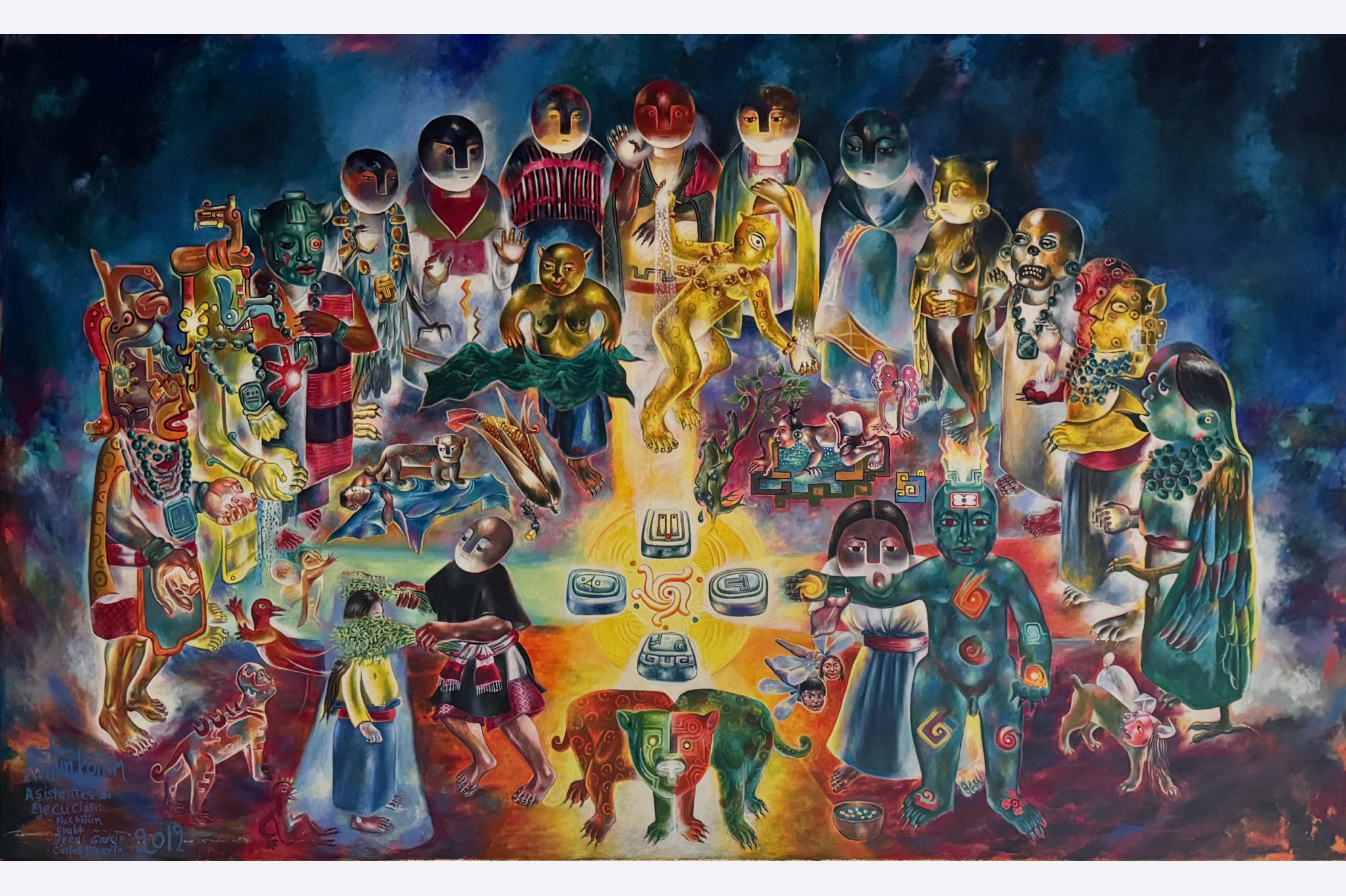
  • El clamor de lo (post) humanoAnonymous | Watercolor of the Montesinos monument | Dominican Republic, 2020

    The cry of the (post)human

    By Carlos Mendoza-Álvarez

    .

    In 1511, Friar Antón de Montesinos, along with a handful of Dominican friars who had recently landed in Quisqueya, the Taíno word for the mother of all lands, uttered a cry that still resonates in the Western conscience: “Are these not men?” He was referring to the original inhabitants of that Caribbean island—later known as Hispaniola, where the modern states of Haiti and the Dominican Republic were established—who had been subjected by Spanish soldiers in the name of the Crowns of Castile and Aragon to harsh servitude and slavery. In the sermon for the Fourth Sunday of Advent on December 21 of that year, with the central figure of John the Baptist announcing the urgency of preparing the way for the coming Messiah, Friar Antón became a prophetic voice to counterbalance the nascent coloniality of power. According to this concept of the Peruvian Aníbal Quijano (Coloniality of power, Eurocentrism and Latin AmericaIt is possible to explain from our time the logic of power that led Europe to dominate the modern world, from the Renaissance to the Enlightenment, with its later avatars of American and Russian imperialism that we know today.

    More than five centuries have passed. Now, this enterprise of coloniality is acquiring global dimensions in our time with the extractive capitalist model that is expanding across the world, like a many-headed hydra, according to the Zapatista narrative that emerged in 1994 in southeastern Mexico. Three decades later, new ways of naming the diverse resistances to this lethal force that dominates the world will be heard in the seedbed « Of pyramids, of stories, of love and, of course, heartbreak » which will take place at CIDECI-Unitierra at the end of December.

    The question surrounding humanity may seem rhetorical, but it becomes more urgent when we consider the landscape of exclusion based on class, gender, ethnicity, and cultural identity that entire nations suffer today. The collapse of the international order we knew in modern times leaves us exposed. The foundations of that shared world were laid by the School of Salamanca with the Ius Gentium or the law of nations in the 16th century, with Friar Francisco de Vitoria at the forefront in dialogue with Friar Bartolomé de Las Casas from Chiapas and Guatemala, as analyzed by Enrique Dussel. It was one of the cornerstones of the model of Christendom created to justify the expansion of the earthly city in the image of the City of God under the tutelage of the Spanish Crown. Subsequently, this interpretation was transformed into an internationalist model, beginning with the Enlightenment, with a rationalist foundation of a contractual nature, making international law a pact between sovereign states, without an ultimate foundation in a metaphysical order that had its sustenance in God (Ancient and contemporary law of nations).

    .

    .

    Beyond the theoretical discussions about the transition from the Salamanca model to the Germanic model of international law, what is important to highlight here are the internal contradictions of the modern social contract that is collapsing before our eyes. Today we are witnessing the return of authoritarian regimes based on religious fundamentalisms with messianic pretensions (The United States is a messianic state), as is the case with US imperialism and Israeli Zionism. In the name of what ethical-political principle or source do today's powers justify their mechanisms of domination, neocolonialism, and the elimination of entire peoples? What limits are there to the power deployed by this unbridled new geopolitical “order”?

    But it is necessary to go beyond the catastrophic scenario described so far to recognize the role of peoples and the spiritual traditions of humanity in strengthening communal life among nations. How can we understand and promote the autonomy of individuals, peoples, and territories today in order to preserve what is human How can we cope with the threats of the system that already dominates us, encompassing both traditional and digital territories?

    In this context, Montesinos' sermon acquires remarkable relevance since it expands the question of mutual recognition of the human and the creature to all the victims of systemic violence that is leading humanity and the entire planet to the precipice (International treaties on biodiversity (SCJN)Are the nations and species that inhabit the face of the Earth not creatures with rights? In the post-human world, as it is called today, it is essential to develop a critical way of thinking that affirms the dignity of every creature in the cosmos in its profound dignity linked to the loving mystery of reality.

    It is no longer just about reaffirming the historical strength of indigenous peoples confronting the Eurocentric colonialism of five hundred years ago, but about the subaltern peoples who are disposable in the planetary war economy of the Trump Era, as he comments Leonardo Boff. Latin America and the Caribbean, as evidenced by the US invasion of international waters in the Caribbean Sea, are now a battleground for the war waged by the Southern Command of that neighboring country. Unfortunately, we will soon witness the full extent of this new model of imperial interventionism through the selective occupation of territories, the control of local governments aligned with the interests of the necrostate, and surgical strikes against the “enemies” of US national security.

    Nor is the cry for the dignity of humanity enough if it is dissociated from the cry of the Earth, “the poorest of the poor,” as Leonardo Boff also called it. That “escalation to extremes” conceived by Girard in 2007 based on the phenomenon of terrorism seems like child’s play today in the face of current wars whose objective is the blatant domination of entire populations in order to control their territories as objects of predatory enrichment of ecosystems.

    .

    .

    For this reason, it is more urgent than ever to recognize the new Montesinos who, with their outcry, appeal to the common humanity that unites us as individuals and peoples, with its mystical source that gives strength and opens horizons of life for all, in order to reverse those processes of necropower that claim more and more victims every day.

    But today it is urgent to move beyond the anthropocentric paradigm, transitioning towards an "ecocentric" one (Anthropocentrism and ecocentrism in the jurisprudence of the Inter-American Court of Human Rights) that promotes the dignity of Mother Earth, who is also subjugated by the dominant model of extractive society and economy. «Rethinking as a human species,» according to the proposal of political ecology promoted by Víctor Toledo and a significant network of scientists worldwide (Political ecology is here to stay) is a key step to regain our course as humanity inhabiting the Common Home that has been given to us by the Giver of Life.

    The green martyrs, the searching mothers, and the indigenous peoples in rebellion are some of the voices that have sounded the alarm about the devastating situation that has already reached us. Listening to their denunciations is a beginning of ethical and mystical conversion, but it is not enough. We must join those processes of subjective, territorial, and spiritual autonomy carried out by those who have said enough to necropower.

    .

    .

    Perhaps the most inspiring way for believing communities to celebrate the approaching Christmas is by honoring the memory of Montesinos and all the prophetic voices of yesterday and today.

    Preparing the way for the arrival of the messiah is not, after all, an act of Christmas folklore, but a change of course in our ways of life with ethical-political, practical and mystical decisions, such as recycling garbage, reforesting forests, and including the vulnerable at our tables as gestures of celebrating life amidst the ruins of the present world.

    As I mentioned some years ago (Messianic time and narrative for a theological interpretation of the narrative practices of victims) it is urgent and a priority that we pave the way to messianic times through our acts of resistance to necropower, promoting communities where we learn to spell anew, with imagination and vigor, the humanity and creatureliness that unites us, all drinking from the inexhaustible source of Life.

    .

    Jobel, December 20, 2025

    .

    Note: I would like to read your comments in the final section of this page.

  • Noticias de WallmapuGabriel Pozo Menares | Mapuche Calendar | Wallmapu, 2011

    Wallmapu News

    By Carlos Mendoza Álvarez

    p

    The light of dusk reaches Tirúa, in Mapuche lands, while Carlos, my Jesuit host who has been here for more than fifteen years (HistoriActiva Jesuit community of Tirúa), drives along the dirt road to visit friends who have opened their homes to share life in the area for years. We arrive and are greeted by the oldest daughter, along with her cats and dogs. She briefly interrupts the work she's preparing for her last semester of high school, as after graduation she plans to enroll in university to study teaching. Life goes on simply among the families who live here. Her father spent the day growing potatoes and then dedicated the afternoon to laying the floor of a new room in the house. They offer us mate as a ritual to accompany their conversation. Before leaving, the friends exchange bird food and make plans to recycle an old wooden door that will be installed in a budding eco-spirituality center.

    Wallmapu (Declaration of the Department of History on the term Wallmapu) is the term that refers to the ancestral lands of the Mapuche people (The Indigenous World 2025: Chile). Today, they are dominated by the forestry industry, which has contaminated the territory with invasive species such as eucalyptus and pine to mass-produce cellulose for export to the global packaging market.

    The Mapuche people today are divided between the frantic integration into the modern world of consumption on the one hand and, on the other, the defense of their territory, language, and traditional medicine under the leadership of Machi women, healers and spiritual ancestors.

    On both sides of the mountain range, divided between Chile and Argentina, the Mapuche people fight for their territorial and cultural survival, in the face of the overwhelming inertia of the modern world (Chile: Resistance to the forestry model in Wallmapu, Mapuche territory). For communities assimilated into today's modern model, it seems better to eat processed foods than seaweed and shellfish as the ancients did; or to drink Coca-Cola instead of herbal teas because it gives them greater status; they prefer to be evangelical Christians or Roman Catholics rather than follow the spirituality and language of their ancestors. Ultimately, it is a matter of "integration" into the modern world, even at the price of cultural assimilation and environmental depredation, which, in its symbolic undertone, is violence against the ancestors and against Mother Earth.

    Civil society networks such as “Churches and Mining”, or the initiatives for intercultural dialogue on ancient and modern astronomy promoted by some universities in the region, are modest attempts to accompany a people torn apart by internal contradictions between modernity and tradition.

    Perhaps eco-spirituality is being an "articulation," among others of a more social and political nature, that allows for these intersections. Carlos told me the anecdote of a grandmother who, attending a workshop on traditional medicine and eco-spirituality, said she didn't understand anything about the intersections of the three bodies (personal, communal, and territorial) that the workshop presented, because she had been thinking throughout the entire meeting about the meaning of that strange word written on the invitation: "articulation." A term that the grandmother kept thinking about until she finally realized that it surely referred to the articulations of bones, when she felt something in her body was out of alignment, impeding her mobility and causing pain. So she concluded that the workshop was a path to healing her joints. And ultimately, that was the objective of the workshop! That grandmother had followed it in her own way, even though she was absent from the rest of the talks.

    p

    p

    Before arriving in Mapuche lands, I was able to speak with university students at two forums in Santiago, Chile. The first was about the work of Gustavo Gutiérrez, one of the fathers of liberation theology, on the occasion of the first anniversary of his death (Gustavo Gutiérrez International Congress). In a traditional academic format with keynote lectures and presentations, over the course of a couple of days a clearer awareness emerged among attendees about the importance of style Latin American to speak of God, intimately connected to the experience of the poor and oppressed. A wisdom that is already part of the way some Roman Catholic and Protestant Christian communities understand their faith in a liberating God and promote the transformative role of victims in their own liberation processes, leaving behind lands of slavery and embarking on paths of new life.

    But we also began to see, not without some attendees' surprise, that it is necessary to open our hearts and our eyes to other exclusions, such as those experienced by women, queer/cuir people, undocumented migrants, relatives of missing persons, Afro-diasporic peoples, and indigenous peoples, to mention those who represent today's resistance to the violence that afflicts us in so many ways, with the Palestinian people today facing the genocide perpetrated by the Israeli government and its accomplices at heart.

    During the colloquium, several initiatives emerged to keep the memory of the great Peruvian theologian's work alive, through the work of the archives that house the recordings of the summer courses Gutiérrez offered in Lima for several years, a valuable resource that will reveal another angle of the author's thinking. Likewise, some of us proposed to investigate the relationship between Gustavo's thought and the work of Aníbal Quijano, his compatriot, who represents one of the most important sources of decolonial thought today, along with Frantz Fanon. The confluence of both thought styles, along with Black, feminist, queer/cuir and Palestinian liberation theology, will provide us with a more pertinent theoretical framework for understanding the intersectionality of violence and ongoing resistance in order to create alternative ways of life, governance, and spirituality that inspire communities located at the fractures of humanity.

    p

    p

    The other meeting, held with colleagues from the Chilean Society of Theology (UCSC hosted the Annual Conference of the Chilean Theological Society), was an opportunity to think together about possible paths to hope for communities facing systemic violence.

    My contribution to that annual event brought to the table the question of thinking about hope from a perspective of "combative decoloniality," like the dignified rage practiced by the Zapatista communities, or the indignation of women who face sexual or spiritual abuse in their respective religions. Because, from my perspective, it's about dismantling a vision of hope as a flight from the world in anticipation of consolation in the afterlife of eternal life.

    Rather, it's about discovering and strengthening the hope that "emerges" from the fractures of humanity. It's where survivors paddle against the current of the history of oppression and privilege, inhabiting the world with practices of mutual care, in the pedagogy of embodiment, and collective healing with memory, truth, and justice, as we explored at the recent Re-existe 2025 gathering.

    p

    p

    The sky of Wallmapu, with the crescent moon shining brightly, is today a living metaphor for the hope that surrounds us when we hear the heartbeat of the lands and stars of the South.

    p

    Tirúa, October 25, 2025

  • Voces del extremo sur de ÁfricaJane Tully Heath, Still Life. National Gallery of South Africa, 1998

    Voices from the southern tip of Africa

    By Carlos Mendoza Álvarez


    Nora is a migrant woman from eSwatini, the former kingdom of Swaziland, which was a British protectorate until 1968 for the "legalized" exploitation of minerals, and later became a post-colonial kingdom. She had to flee her homeland after leaving her husband, who humiliated her. Due to the tradition of the Swazi people, once she separated, her family abandoned her to her fate, and she would be unable to remarry if she ever wanted to return to her homeland. Her only option would be to return to her husband and ask for his forgiveness. Nora represents hundreds of thousands of refugees in South Africa fleeing a variety of forms of violence; in her case, it wasn't war or famine, but what they call "domestic violence" here. In our brief but intense conversation, I told her something I learned from the African-American poet and musician Mykki Blanco (Queer black french dance empowerment feat. poetry by Mykki Blanco) about how queer communities live vulnerability with dignity and hope, beginning each day singing: “I am strong because I have no choice, but I am fragile.” Nora cries inconsolably because, in addition to the pain of having lost her baby a few months ago, her sorrow is even deeper because she hasn't been able to bury her in her homeland, as is the custom of the Suasi people. In the middle of our conversation, I share some bread with her, and she sobs in thanks. I tell her to take it on behalf of the people of Mexico, who also know about this and other forms of violence. And I say goodbye with a hug, telling her that something good will come from that open wound in her heart, especially if it opens to the wounds of other women, who for thousands of years have woven networks of mutual care.

    A different story in today's world, coming from refugees who, in the shadows of the shadows of the shadows, reinvent their lives.


    During that same visit to the Suasi kingdom, ruled by a king with many wives and numerous children, a custom persisted that left me speechless. Women must serve food by kneeling before their husbands while serving at the table. A middle-aged woman I met during a meal, a spiritual leader in the community that hosted us, told us that sometimes she herself has to play this role when visiting her husband's family, because if she betrayed this custom, it would be perceived as contempt and would exclude her from the family. During our conversation, I noticed that another younger woman remained silent, smiling skeptically, but without saying a word. And then another diner commented that there is a social movement in the Suasi nation seeking to transition to a republic, to overcome these and other customs that denigrate people, but it has suffered repression. At that same table, I perceived three different perspectives on domestic traditions. Perspectives that are also political and spiritual. Everyone survives as best they can, and there are some forms of resistance that persist without changing the age-old patriarchy, while others resist by overcoming fear and dreaming of other "possible worlds." I then think of our America and its resistances of yesterday and today.

    The next day, when I presented my talk on collective healing and possible hope in times of catastrophe to a large and diverse audience, I carried the stories I had heard the day before in my mind and heart. But, in order to avoid passing judgment on a reality I don't understand and only grasped in glimpses, I mentioned the importance of listening to those who live in the shadows today to discover their power, moving from being victims to survivors, as a key criterion for collective healing.

    The silence I perceived in the audience regarding the public naming of these acts of violence revealed to me a degree of fear, perhaps prudence and ancient wisdom to resist, but creating paths to freedom in secret. The public comments were general. Then, in private, some attendees pointed out to me that the Suasi people know what they face and what they want for their nation. Others came forward at the end to share personal stories of grievance due to sexual discrimination, like micro-stories of vulnerability and resistance.

    Some seeds of hope planted in a small kingdom in the far south of Africa.


    After a month-long stay in South Africa and Swaziland, visiting six cities in both countries, I gradually discovered another face of Mother Africa. Many years earlier, I had visited countries in the north of the continent, with a different demographic profile and social challenges more closely linked to religious violence than interethnic violence. A couple of years ago in Kenya, I met for the first time Black Africans with a living memory of the burden of modern slavery created by European colonial metropolises that built wealthy and powerful empires through genocide and cultural plunder, such as that carried out by the Belgian empire in the Congo.

    But these subjugated peoples fought to free themselves in the 20th century until they achieved political independence, but not autonomy from the coloniality of power-knowledge-being that the great Peruvian Aníbal Quijano analyzed (Coloniality of power, Eurocentrism and Latin America). Unfortunately, many post-colonial states remain subject, as is the case with the rest of the countries in the Global South, to the economic colonialism of the powers in power in their extractive capitalist form.

    Thus, in the far south of the African continent, listening to and conversing with heterogeneous groups of people of various ages, made up of Black, white, and "people of color"—as they call what we in Mexico call mestizos, who are a minority in these lands—I have many stories to continue telling in my travel notes. These are communities that still suffer the scourge of segregation, even after their independence. In South Africa, for example, the communities I visited are aware of the challenge of moving from the process that overthrew apartheid to one day achieving nations of coexistence with an independent and pluralistic state.

    Internal migration within the subcontinent today is massive, driven by wars, famine, and social, ideological, and religious repression, not to mention gender-based violence against queer people, whose lives remain criminalized. As Achille Mbembe recalled a few years ago in Cologne (Bodies and Borders) when talking about deglobalizationThe challenge of the Africanization of the world lies, among other factors, in helping the planet's youngest population transition to democratic, just, and egalitarian societies.

    In my opinion, one of the long-range challenges that Mother Africa gives us today lies in exploring new ways to unite the spiritual tradition of the ancestors and the wisdom of Ubuntu as proposed by Professor Jacob Mokhutso (Ubuntu is under siege: a reflection on the challenges of South Africa then and now) with the predominant Western world. It is about creating other modernities that make room for a ecology of knowledge, according to Boaventura de Sousa Santos's classic decolonial expression. In the midst of these resistances, new forms of Christianity and Islam, Judaism and Hinduism, ancestral religions and queer spiritualities will emerge, beyond their current ideological avatars that produce the annihilation of the different other, such as the Zionism we discussed earlier.


    Following a similar route, next August the Zapatista communities (Call for the meeting of resistances and rebellions "Some parts of the whole") from Chiapas, in southeastern Mexico, call us together to tell each other stories of rebellion against the crumbling hegemonic world system. But above all, to think together about how to build the pyramid of resistance that has homeland, heart, dignified rage, and the imagination of new katuns or cosmic temporality of the Mayan world.

    There I will undoubtedly find a challenging moment to continue “weaving voices for the common home”, as we dreamed of with Pablo Reyna, inspired by the vibrant thought of Gustavo Esteva (Weaving voices). Since then, we began to explore the process of decolonizing the university, thanks to the action promoted in those years by David Fernández at the Universidad Iberoamericana in Mexico City.

    And next September, I'll tell you other stories from an intercultural and interreligious meeting to be held in Guadalajara. This time, it was organized by a group of colleagues from Africa, Asia, Europe, and the Americas who are working with collectives in resistance and hope amidst contexts of systemic violence against women, people in forced migration, families of missing persons, and indigenous peoples in defense of Mother Earth. The name of the event, “Re-exists: The Spirit connecting peripheries”, summarizes our way of contributing to sowing seeds and reaping fruits of resistance that have been nourished by a powerful spiritual and political background as spiritualities of the peoples.

    As I conclude this series on the South African journey, I once again thank you, Mother Africa, for continuing to give birth to new worlds.


    Mexico City, July 19, 2025


English