Category: Contemporary violence

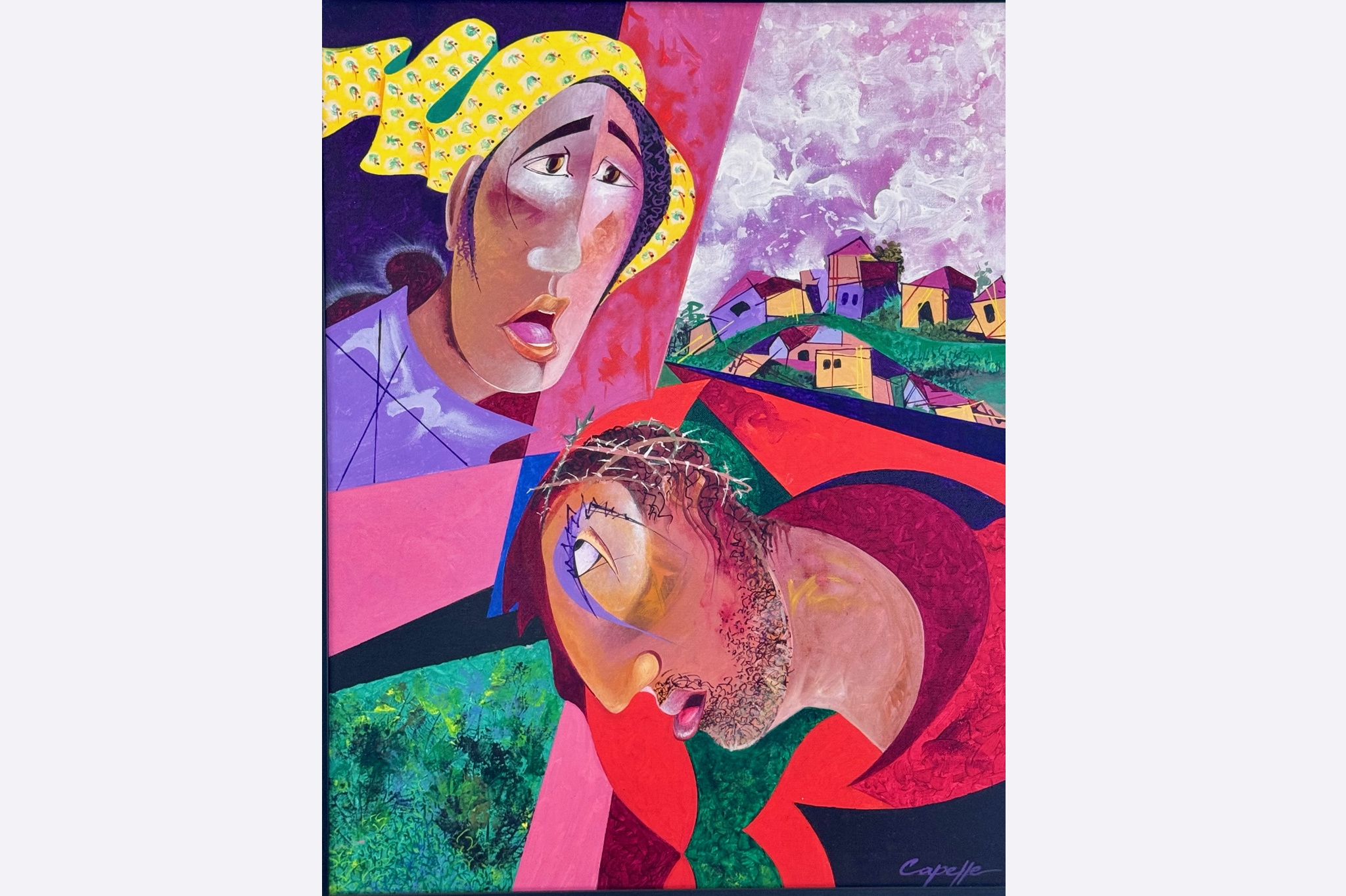
  • Sudáfrica, treinta y un años después del fin de ApartheidCapelle, Joseph. Stations of the Cross, IV: Jesus meets his mother, St. Martin de Porres Parish, Soweto, 2015

    South Africa, thirty-one years after the end of Apartheid

    By Carlos Mendoza Álvarez


    A Congolese refugee camp on the outskirts of Pretoria welcomes a small group of people from universities and churches interested in learning about their lives and stories. Ten families, each with four or five young children and some elders, greet us on the esplanade on a cold South African winter afternoon. Our guide is Lance Thomas, a colleague from the Centre for Faith and Community at the University of Pretoria (UP), who told us about his decolonial vision of accompanying vulnerable groups of houseless people and refugees. This is a splendid project that the university has been developing for more than ten years.

    During my visit to the UP a few days ago, I was struck by the creativity of this university community in connecting, among other ongoing projects, the world of unhoused people with different academic departments such as architecture, sociology, and theology, promoting a practical theology “on the street.” The recent inaugural lecture of the academic year by Prof. Stephan de Beer, discussing ways of building community and its spiritual dimension, while accompanying houseless families in creating projects to recover living spaces, is a prime example of this decolonial way of doing theology.

    Along the way, Lance warns us of the importance of not falling into the trap of victimization and the spontaneous desire to provide financial aid to the community we are about to visit. The aim is to see the conditions of that community up close to seek support strategies that address, as far as possible, the systemic causes that subject more than 250,000 refugees in South Africa from Burundi, the Democratic Republic of Congo, Rwanda, South Sudan, Somalia, and Zimbabwe, according to UNHCR.

    As I listen to Lance, I am strongly reminded of Ivan Illich’s warning never to lose sight of the importance of conviviality with others, as well as the friendship with the poor that was at the heart of Gustavo Gutiérrez’s liberation theology. Without falling into the trap of emotional manipulation, I resolved to be alerted to connect both poles: to think systemically and act compassionately.

    During spontaneous conversations with those who approached us at the camp to chat, I was struck by the deep gaze, as if open to painful memories, of two elderly people who told us stories of the seven years that had passed since they fled the war in the Democratic Republic of Congo. They have been jumping from one United Nations refugee camp to another in South Africa. Some were imprisoned for two years. The children who flit around with generous smiles and wide eyes “don't know what school is,” one of the community leaders tells me.

    A woman with an emphatic voice insists again and again on the discrimination they suffer as families from “their own South African brothers.” She shows me the document that UNHCR gave her seven years ago. Her only identity document, almost destroyed by the passage of time and dampened by her nervous hands, is not accepted by any South African authority. Another man approaches, full of anger and pain, saying that they can’t take it anymore and that if they don’t receive humanitarian aid, they will soon die. The woman returns, her voice desperate, to say that their neighbors threaten them at night and tell them to leave, to go back to their country. “But we have nowhere to go back to,” she says, heartbroken.

    One of our group members spent the entire time talking to one of the young women who is pregnant. The risk of inadequate medical care for her and her baby is real, due to the growing refusal of clinics in the country to accept refugees without valid permits. They immediately form a network of sisterhood.

    The impact of this visit, which I shared with a close group of friends and family in Mexico, sparked a desire to do something together with that refugee community. I will soon let you know here what we can do together.


    ∂


    I told this story a few days later to those who attend my talks on “Collective Healing and Community Hope.” It is a mixed group of South Africans, white and “of color,” elders and young people, some of them documented immigrants. They are part of a pastoral network in Cape Town and neighboring cities. We talk about the abyssal line that separates the world of privilege from that of exclusion. I emphasize the intersectionality that must be discovered between the various narratives of “coming out” of those who live in the shadows of poverty, gender violence, racism, ableism, and so many other stories of domination in our unequal societies. The audience immediately connects with the narrative that makes people with disabilities visible, but they are reluctant to recognize the connections with the narratives of queer/cuir Social justice concerns them, but even gender equality makes them uncomfortable. I take my talks a step further, talking about refugees in South Africa and my recent visit to a community in that country, describing them as those who live “in the shadows of the shadows of the shadows,” evoking Frantz Fanon’s powerful metaphor of “the zone of no-being" (Black skin, white masks). And the audience begins to open their minds and hearts, little by little, to discover the power, beauty, and spirituality in those who call us to cross into the “zone of no-being,” to dare to name the systemic violence that concerns us all, and to begin processes of mutual recognition, listening, and personal and communal transformation.


    ∂


    I realized then that when we talk about reconciliation with the South African people, we touch on a wound that is still open, even after decades of post-apartheid. “We are still segregated,” writes a colleague in a “silent conversation” we have as part of the afternoon workshop, commenting on flipcharts about violence in today's world. Thirty-one years after the collective trauma of apartheid for the peoples who inhabit these lands, no effective agrarian reform has yet been implemented, as 60% of the land belongs to white Afrikaners, contrary to the lies spread by Trump, who recently welcomed fifty Afrikaners as refugees fleeing “black persecution”. Another cynical deception by the dictator in office on land stolen from the indigenous peoples of North America. The distribution of wealth in the country of diamonds and tanzanite remains stalled by the corruption of the black elites who govern the country today. Many post-apartheid youths admire Elon Musk and Trevor Noah, hoping to one day migrate like them to the Big Apple or Los Angeles. Their dream is now reflected in the artificial world of the Netflix series “The Kings of Jo'burg", which is perceived by critical South African youth as a crude “Americanization” of life in this country.

    The wound of national reconciliation in the rainbow nation of Mandela and Desmond Tutu's time remains open. There is certainly skepticism in the country about its corrupt political class, as in my beloved Mexico. There is a certain resignation in the face of the failure of democracy, although small pockets of critical communities resist. The "3rd Black Power Pan-Afrikanist Decoloniality Winter School”, which will take place in Soweto at the end of July as a festival of combative decoloniality, will present another face of South Africa. One that emerges from the ancestral knowledge of African peoples.

    There is hope that South Africa, as the elder sister of the resistance movements of our times, will awaken from its slumber.


    Cape Town, July 5, 2025
  • En búsqueda de la unidad perdidaEmbroidery for the "Maternar" exhibition at the MUAC-UNAM, as a tribute to the mothers who track and search. Embroidery by Pau Cuarón

    In search of the lost unity

    By Carlos Mendoza-Álvarez


    The military repression of protests in support of immigrants in Los Angeles, the Israeli bombing of Gaza, and the murder of mothers and fathers searching for their families by criminal gangs in Mexico are lacerating wounds to the lost unity of humanity today.

    While violence is as old as human memory, what has left us astonished in recent days is the rampant cynicism of the US government, which "justifies" police raids against undocumented migrants on the grounds of national security, when in reality it is a typical strategy of any dictatorship to control the population and militarize the country. The passivity of the masses subjected to the digital dictatorship of fake news disseminated by traditional media such as newspapers and television, which goes viral on social media in concentrated doses, strengthens the populist power that spreads across the world, crossing ideologies. From far-right fundamentalist groups in the United States, Israel, El Salvador, Argentina, and Italy promoting the "free world," to India, Russia, and Venezuela with identity-based nationalist ideologies, or even Brazil and Mexico with a supposedly leftist government that disregards indigenous peoples.

    We are at the mercy of those media powers in the era of post-truth, which should better be called the age of unpunished liesWe are no longer surprised by the disqualification of victims by the powerful, nor by the abusive use of words to denigrate others that is spreading like a pandemic in public and private forums. Language has been perverted from its original purpose: instead of reflecting reality with creative imagination, it distorts, manipulates, and accommodates it to the petty interests of those who wield economic, social, or religious power.

    Today, promoting the unity of humanity is irrelevant, as populist leaders emphasize the separation between "free citizens" and the surplus population, between "democratic" peoples and corrupt nations. This madness is now leading to the escalation of violence by Israel and its allies against Lebanon, Syria, and Iran.

    It doesn't matter that modern science has confirmed the unity of the human race through DNA, providing genetic support for that intimate conviction of the unity of the human species that diverse cultures had expressed in the past through myths, stories, and powerful symbols to celebrate the beauty of the human condition in its ethnic and cultural diversity.

    The search for the lost unit It has been the roadmap for humanity's wisdom and religious traditions. Through myths and rituals, these forms of knowledge have since ancient times explored the paths that guide peoples on their journey to build the communion that persists as a collective human desire. Sometimes we see this unity as a lost past, other times as a longed-for future that, in both cases, seems to slip through our fingers.

    Religions were born to connect people with that source of unity The primordial faith that connects the human, the cosmic, and the divine. Faith in a single God was the challenge of monotheistic traditions to interpret the shared belonging of peoples and cultures to a transcendent source of life from which the unity of the cosmos and of humankind flows. More than a revelation from on high, this faith monotheistic expressed in its historical genesis a desire to recover lost unity.


    *


    In this context of global mourning over the violence of the new empire of white supremacy and extractive capitalism, which is devastating everything in its path, it is worth reflecting on the unity of God, according to various religious grammars, for its impact on our way of recovering the longed-for lost unity.

    Christian communities commemorate this weekend, the Sunday after Pentecost, the feast of the tri-unity of God. A belief that is a source of scandal for Hebrew and Islamic monotheisms, which confess the original unity of Yhwh or Allah as the sole merciful father of the universe. For two thousand years, the heart of the Christian faith has been confronted by these monotheistic traditions, considering it a heresy. It has also been a source of mutual interpellation among the three Abrahamic religions for failing to jointly bear witness to this unity of God, creation, and the human race. However, during brief periods of peaceful coexistence, such as during the Umayyad Caliphate of Córdoba in the 10th and 11th centuries of the Common Era, these differences were mediated by a mutual understanding of the root belief in a single living God and the diversity of interpretations of that divine unity as the source of the common union between the divine, human, and cosmic worlds.

    Two thousand years later, Christianity continues to provocatively claim that God is both one and triune, triune Some theologians have said since Christian antiquity, highlighting the intimate communion of divine being. Communion in diversity is what theologies of today will say. queer/cuir  to emphasize the communion of mutual hospitality in difference.

    1700 years ago, in the year 325 of the common era, the first Council of Nicaea began to explore the mutuality of the loving being between Jesus of Nazareth and his Abba which opened up space for a third. Years later, the First Council of Constantinople in 381 included the Holy Spirit in this dynamic communion that is like a “divine circularity.” The famous perijoresis Trinitarian of the Cappadocian Fathers.

    Following this legacy, Saint Augustine and Saint Thomas Aquinas, as classics of ancient and medieval Christianity, sought to harmonize faith in one God with the Christian confession of the communion of divine persons. who share the same being in a loving relationshipWhat seemed in the letter a far-fetched theoretical debate, in reality put on the table the importance of considering divinity, not in an isolated celestial perfection, but in her intimate radical vulnerability which puts it in relation to itself as a mystery of communion and to the cosmos as a mystery of synergy.

    Meister Eckhart, a Dominican of the Rhine in the 14th century, used to describe that divine circularity intimately affecting the human soul like a spiral of annihilation: “The Holy Spirit takes the soul and drags it to the purest and highest, to its origin which is the Son, and the Son continues dragging it to his origin, which is the Father, to the Depth, to the First, in which the Son has his being” “Adolescens, tibi dico: Surge”, Sermon 18, in Treatises and sermons, p. 236)

    Recovering the lost unity of the human species in its communion with the cosmos and with God in times of rivalry and hatred is perhaps the best way to honor the ancient Trinitarian monotheism that Christianity offers as a glimmer of redemption to humanity, today fragmented by the violent spiral that repels all intimacy of life.

    From the depths of Los Angeles raids, the ruins of Gaza, and the clandestine graves of Mexico—a cruel trinity of our times—emerges a cry for unity from today's victims and their survivors, calling us to delve into the bottomless depths of life that endures.

    Perhaps there lies our compass to recover lost unity.


    Mexico City and Johannesburg

    June 14, 2025

English