Category: Sacred sites

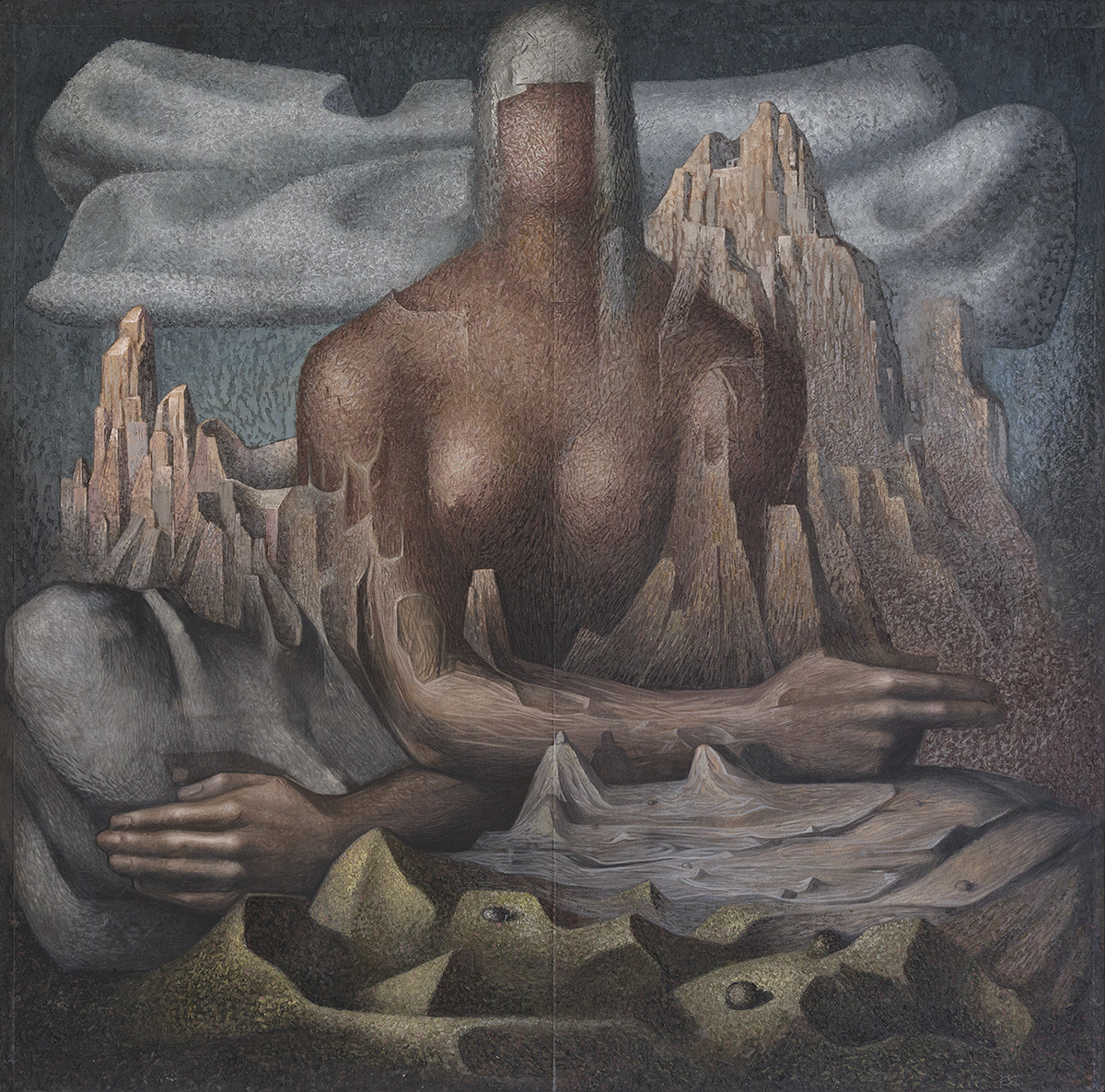
  • En las laderas volcánicas del altiplano mexicano Sobre la vida que resiste y florece en las grietas del mundoJorge González Camarena | The Mountain | Encaustic on Masonite | BBVA Mexico Collection | ca. 1980

    On the volcanic slopes of the Mexican plateau About life that endures and flourishes in the cracks of the world

    By Carlos Mendoza Álvarez

    The fumarole of the Popocatépetl volcano is perceived from afar as a powerful sign of sacred land, venerated by the ancient Mexicans and later by the "graniceros" of today, who preserve the prayer with offerings to the ancestral mountains of the Cholula valley, heart of the volcanic axis of the Mexican highlands.

    Returning to the landscape of childhood, scanning for signs to sow dreams of words and true encounters, brought to my memory surprising episodes of life.

    The first was the campsite on the slopes of Iztaccíhuatl, or the Sleeping Woman, which we, the colleagues from the Emiliano Zapata Preparatory School, organized fifty years ago. The camaraderie of Raúl, Arturo, Adrián, Juan, and Alfredo, among other dear friends, forged a sacred friendship in that place that endures to this day. The youthful rituals of student camping were enlivened by periods of silence, games, cooking, and celebration, listening in the heart of the forest to the progressive rock music of our generation, from Pink Floyd and Queen to Emerson, Lake & Palmer and other British bands that populated our collective imagination.

    Another memorable moment in volcanic lands was the ascent to the Popocatépetl crater, with Friar Raúl Vera as our novice master, guided by Güero, a young, expert mountaineer from Amecameca, in the State of Mexico, one early morning in the spring of 1980. After a great effort in the final part of the climb, well-equipped with ice axes, mountain boots, and goggles for the glare of the snow, the group of ten novices and their master reached the crater. We found the volcano's chimney exhaling sulfurous vapors, still silent, as Don Goyo—as Popocatépetl is called because of March 12, the day of Saint Gregory, on which, since ancient times, its feast day has been celebrated with offerings to ask for rain—would not reactivate its active cycle until December 21, 1994, after seventy years of volcanic inactivity. Peering towards the inner cone from the crater's ridge, amidst an astonishing silence, we celebrated "the Mass on the world," according to that phrase by Teilhard de Chardin, that remarkable scientist and Jesuit mystic of the cosmic Christ, Alpha and Omega of the evolution of the cosmos.

    As a sacred place, this land of volcanoes has also suffered the siege of evil, but with the triumph of life, leaving scars on the wounded social body.

    I remember the harrowing experience of four friars who volunteered to mediate, for humanitarian and evangelical reasons, the ransom payment for a kidnapping victim. It happened in 1994, that fateful year for Mexico, when disparate worlds collided like tectonic plates: the modernity of President Salinas, marked by the greed and corruption of the Mexican political system, clashed head-on with the guerrilla movements that still survived in the country after their persecution by the Mexican state since the Dirty War of the 1970s. Living through the experience of mediating the ransom payment for a kidnapped person was a profound experience, bringing me face to face with the fragility of human life in the face of the abyss of evil. The cursed money of that thirty-million-dollar ransom symbolized, on the one hand, the perversion of the powerful members of the Mexican elite who amassed such wealth, and on the other, the wickedness of those who used human life as a banner of justice for dubious social causes. As part of the ransom delivery route, the kidnappers, who were guiding us by satellite phones—very rare even then—made us cross the Paso de Cortés, right between the two sacred volcanoes, to reach Puebla and deliver the cursed briefcases there. This wasn't possible because, according to those manipulating us, we were being followed by the government. After a few days of uncertainty, we were able to deliver the ransom in a working-class neighborhood of Mexico City, and the person was released hours later. The four friars who volunteered to be mediators will never forget that experience of humanitarian assistance amidst a wave of criminal violence, with perpetrators on both sides. Violence that, unfortunately, persists to this day in new forms of necropower.

    Years later, I returned to that area through Tlamacas, a mountain refuge also located in Paso de Cortés, during a dramatic moment for a community there on a spiritual retreat led by Friar Ricardo Villarreal at the Hermitage of Silence. In the middle of the night, after a day of meditation, the community was attacked by bandits. Their collective trauma did not prevent this contemplative meditation community from continuing on its path of inner healing and strengthening of its communal life, uniting body, mind, and spirit in a journey of spirituality in motion, through sacred walks, Christian and Buddhist mantras, and service to the community. The silence of the forest, with its human and other inhabitants, had been desecrated by criminal gangs.

    In recent decades, the plume of Don Goyo (Goyo's volcano) has persisted, sometimes exhaling sulfurous vapors and volcanic ash accompanied by lava. Thus, it presides over the dawns of the Puebla-Tlaxcala valley, with its history of earthquakes and social movements of indigenous peoples, of youth demanding democracy, and of collectives dedicated to the spirituality of the land.

    Popocatépetl is the guardian of Iztaccíhuatl, also called "La Volcana" (The Volcano) by the farming communities that live on its slopes, or Rosita because its August festival gratefully celebrates the rains and the fertility of the crops. She is the beloved Sleeping Woman of Mexica mythology, reimagined in recent times as the guardian of the planet's chakras, according to the mythology of Regina created by Antonio Velasco Piña.

    A few days ago, I had the good fortune to visit the territory of San Juan Tianguismanalco and Santiago Xalitzintla, accompanied by Víctor and Carolina, with their young son Emik, who live there and lovingly care for it. For me, this short trip was a reunion with sacred land. I experienced that day as a ritual within the spiral of time, to once again tread that sacred ground of my youth, now with dreams in my heart of returning to the land of my ancestors.

    I met a young and talented witness to the communities organized in defense of their land, connected by family ties and choice to the villages, forests and springs, birds and insects, reptiles and rodents, cornfields and greenhouses that inhabit it. A land of volcanoes with lush avocado, apple, peach, and pear trees. A territory of flowers and aromatic plants with healing essences used in traditional therapies. Ancestry and agroecology find in this land a strength deeply rooted in the land, a promise of life in a present lived with hope amidst so many global uncertainties.

    The dream of Tabor - another holy mountain that has always accompanied me as a symbolic place of ancient and new transfigurations, from that of Jesus of Galilee to that of the peoples in resistance and re-existence - is now revived with impetuous force in these parts, now in these sacred mountains.

    The volcano evokes the virtuous triangle I've been discovering with friends like Juan Carlos from Peru, Kochurani from India, and Laurel from the United States and El Salvador, as well as with collectives from diverse latitudes, to represent our learning process of sowing combative hope where life is threatened. One vertex of the triangle is the practice of mutual support among individuals and collectives resisting systemic violence as a source of life. The other vertex is the creative experiences where we learn to re-exist, reinventing ourselves from the ruins amidst the Great Catastrophe we are experiencing. And the third vertex is the spiritual and theological seedbeds, with ethical and mystical depth, that we can cultivate collectively to learn to care for ourselves and flourish as individuals and creatures of the cosmos. Soon, in this land of volcanoes, we will create a virtual and in-person seedbed on the decolonial theology we are developing in community.

    We will see how the breath of the divine Ruah makes us discover, with exquisite respect for the territory and its inhabitants, new calls to inhabit together the sacred land of the Puebla highlands.

    And speaking of resistance to necropower in the territories, we must now also consider the digital realm where artificial intelligence, manipulated by transnational corporations and authoritarian governments, is designing techno-fascism. For this reason, next Thursday, July 9th, the JobeLab collective, formed by friends from San Cristóbal de Las Casas, will hold the discussion “Disarming Power and Rescuing the Human: Readings on Leo XIV’s Encyclical 'Magnifica Humanitas'‘ at La Madriguera bookstore in San Cristóbal de Las Casas. We will have the participation of experts in computer science, communication, anthropology, philosophy, and theology. Chiapas is a prize for its natural resources, coveted by the industry behind AI, so it is crucial to understand what we are facing. We hope to see you there.

    San Juan Tianguismanalco, July 2, 2026

  • De manglares, esteros y mundos otrosCarlos Mendoza Álvarez | Altar with bat-jaguar-snake face | Old Church, Structure C-3 | Tonalá, Chiapas, 2026

    Of mangroves, estuaries and other worlds

    By Carlos Mendoza Álvarez

    The tide is visible in the distance on the horizon that opens up at the back of the estuary, among the mangroves of Boca del Cielo. The poetic name of this secluded beach in Chiapas is a prelude to the much-desired rest for the small community of friars, exhausted after forty intense days of religious and cultural activities in the Highlands of Chiapas. This period culminated in the climax of Holy Week, experienced with profound devotion by diverse communities throughout these lands.

    The Chiapas coast is still protected by mangroves and estuaries that stretch along its shoreline, from Oaxaca in the northwest to Guatemala in the southeast. Small-scale tourism has not yet disrupted the lives of its inhabitants, mostly Zoque people who have lost their language and customs, but retain a vibrant spirit in their eyes and open smiles. Mariana welcomes us to her palapa with seafood dishes from her coast, such as sea bass, shrimp, and tilapia, accompanied by refreshing drinks of mango, pineapple, melon, and tamarind. She is the heart of the business, along with her teenage son and their pet, Oso, a beautiful white puppy with curly fur and dark circles under his eyes that make him look like a panda in reverse.

    Instead of a swimming pool, the small hotel has direct access via a short flight of steps to the estuary's warm, calm waters, occasionally enlivened by a strong current in the farther area, near the sandbar that protects the channel from the open sea. Further out, a few lizards hide, having fled to sparsely populated areas, where some communities—like the Madresal ecotourism complex—preserve them in breeding centers. It must be said, however, that these initiatives are modest compared to the urgent need to protect the estuaries and their endangered wildlife. The turtle hatchery on Boca del Cielo beach, for example, is only operational for a couple of months each year during the summer, neglected by the local population focused on tourism services, and left to languish due to the indifference of the local government.

    Due to the melting of the polar ice caps caused by climate change, the scientific community predicts the disappearance of many of the planet's low-lying coastlines, such as mangroves and their estuaries, with the sea invading these areas of biodiversity at the boundary between salt and fresh water as tides rise.

    Two millennia ago, in the mountains bordering these beaches, the Mixe-Zoque culture flourished. The archaeological remains of the sacred site—today known as Old Church The crosses carved into some of the stones on the pyramid slopes are of impressive symbolic richness. A central pyramid represents the body of a turtle, its corners mimicking the flippers of the reptile of longevity. The giant head lies at the foot of the stairway, welcoming the pilgrim in a gesture of cosmic sacredness. Stelae of varying sizes, weathered by relentless time and broken in two by ceiba tree roots, are engraved with polymorphic faces that combine the ears of a bat with the snout of a jaguar and the eyes of a monkey and a snake.

    And in the heart of one of the central plazas of the sacred site, which covers more than sixty hectares—located on the plateaus of Tepancuintla Hill, some 700 meters above sea level in what is now the municipality of Tonalá—lies a monumental stone of iconic power similar to the Aztec Sun Stone or the stele of Pakal's tomb in Palenque. The black granite monolith has four faces, each pointing to a cardinal direction: three are human (two men and one woman), and one is zoomorphic, a hallucinatory fusion of sacred animals from the mountains that shelter its inhabitants.

    The local guide told us that this jet-black stone takes on blue hues at certain times of day, convinced that it's like a gateway to the world of the ancestors. To honor his word, I approach it with reverence, walk around it, caress it without touching it, and perceive an ancestral memory that dwells within it and welcomes us with force.

    Two hundred kilometers to the south, the Mokaya culture sowed the seeds of Mesoamerican cultures four thousand years ago, even before the Olmecs, who are recognized as the cultural matrix of Mesoamerica. I already cherish in my heart a future trip to those lands, near the border with Guatemala, to let myself be touched by their wisdom made of stone and pottery, unknown to us today only in their music and oral traditions.

    I began this story by recounting tales of estuaries and mangroves. But upon rereading it, I realize they were merely a gateway to another world, one inhabited by the Mixe-Zoque and Mokaya peoples who lived in these mountains and navigated these waters millennia ago. Their ancestral memory became a cosmogony carved in stone, pyramids constructed with enormous monoliths of granite and volcanic rock, marked with cosmic and human symbols, such as the sun, the knot, the face, and the hand.

    What memory will we leave for future generations two thousand years from now, when someone visits the ruins of our neighborhoods and cities, now dominated by steel and cement? Will they find technological ruins of algorithms and avatars on the internet that can be rescued from oblivion? Perhaps some holograms will be preserved in the cloud, concentrating the wisdom of humanity, lost today in its pursuit of power and money.

    For now, the door to other worlds remains open.

    Boca del Cielo, April 11, 2026

English