Category: Proximity

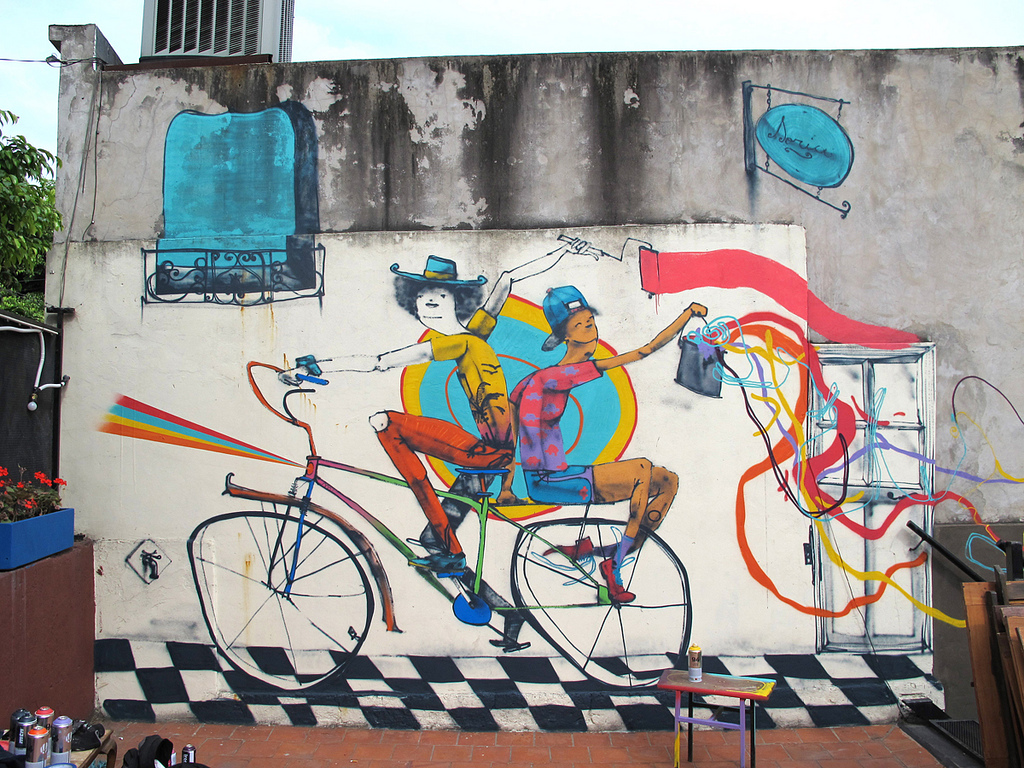
  • De mundos alternos que se tocan Conmemorando el primer centenario del nacimiento de Ivan IllichStreet Art | In Praise of the Bicycle | Buenos Aires, 2015

    Of alternate worlds that touch Commemorating the centenary of Ivan Illich's birth

    By Carlos Mendoza-Álvarez

    Between postwar Europe and the Latin America and Caribbean of the modern mirage, there were flows of life and thought that went back and forth between both shores of the Atlantic. What was once the frontier of conquest, colonization, and evangelization—with the Creole and mestizo creations that reinvented the West during the colonial period—became in modern times an ocean of whispers of new worlds, sailing against the current of progress and industrialization.

    The 1960s saw the emergence in Cuernavaca, Mexico, of a river of thought flowing "north of the future," as Ivan Illich liked to describe the future arriving to us here and now, quoting the poem by Paul Celan, that Romanian-Jewish author who fascinated him so much:

    In the rivers, to the north of the future,
    I lay the net that you
    hesitant loads
    writing on stones,
    shades.

    In my hand autumn eats its leaf: we are friends.
    We extract time from nuts and teach it to walk:
    time returns to the nut.

    It's Sunday in the mirror,
    In sleep one sleeps,
    The mouth speaks the truth.

    My eye ascends to the sex of my beloved:
    We looked at each other,
    We say dark words to each other,
    We love each other as poppies and memory love each other,
    we fell asleep like wine in bowls,
    like the sea in the bloody ray of the moon.

    We stand embraced at the window, they can see us from the street:
    It's time this was known.,
    It is time for the stone to bloom,
    that a heart beats in the restlessness.
    It's time for it to be time.

    It's time.

    Austrian researcher Isabella Bruckner, a young professor at the Benedictine Athenaeum of Saint Anselm in Rome, who is now moving to Freiburg im Breisgau, organized a European colloquium to delve into the theological legacy of Ivan Illich, tracing the genealogy of his deepest intuitions about the crisis of instrumental modernity, which arose from what he called the perversion of Christianity.

    Together with Professor Martin Kirschner of the Catholic University of Eichstätt in Bavaria, I was invited to give a joint presentation comparing the political theology emerging in certain parts of Germany and Mexico, inspired by Illich's intuitions and ideas. The challenge was twofold: to find common ground and an appropriate language to account for experiences of proximity  and conviviality in countries so disparate in their political cultures: the German people currently grappling with the European Union's complicity as an ally of Israel and the United States in their geopolitical war in the Middle East, and the Mexican people seduced by the siren song of the Fourth Transformation and the roar of the World Cup, which silences the tragedy of the disappeared and the corruption of the narco-government in a large part of the country's territory.

    When I was invited to participate, I suggested to the organizer that she invite people who for years have been inspired by Illich's thought, particularly Javier Sicilia, Sylvia Marcos, Roberto Ochoa, and Rafael Mondragón, who are little known in European academia. So I undertook the task of presenting in my paper the central ideas of this critical dialogue on what Humberto Beck called the Cuernavaca School, with the Hebrew and Christian thinker of proximity and conviviality. I emphasized the new paths emerging in Mexico and other parts of the world. world below and of the peripheries From the centers of hegemonic power, where resistances flow as other ways of eating, healing and educating —as the late Gustavo Esteva said speaking of revolutionary verbs— to promote territorial, epistemic and spiritual autonomies that sustain communities and peoples who face the many-headed hydra that devours the world.

    One of the Illichan themes that most impacted colleagues in Germany during the COVID-19 pandemic was his critique of the pharmaceutical industry, promoted by Western democratic governments that imposed public health policies without considering the autonomy of individuals and communities in choosing the most appropriate ways to confront the pandemic. My German colleagues, Martin Kirschner and Markus Riedenauer, emphasized the continued relevance of this critique of the state's power to impose mandatory vaccination programs, disregarding the serious scientific objections to the indiscriminate use of vaccines and the effects they caused in the population.

    Another recurring theme in the Rome debates was that of the territorial, epistemic, and cultural autonomies that arise from placing face-to-face proximity at the center of life, or, in Illich's words, the conviviality as a mode of existence and the place which is inhabited with the strength of the vernacular. Both in Europe and in Latin America and the Caribbean, these autonomies have been gaining ground in recent decades, with the conquest of bodies and territories by women, indigenous peoples and collectives queer/cuir /queir, among other resistance groups.

    European colleagues were surprised by the diverse approaches to the ethical, political, and spiritual implications of the work of the migrant thinker Ivan Illich. From his diaspora from the clerical Church to his return to medieval classics like Hugh of Saint Victor—and through his time living with Puerto Rican communities in New York and later with peasant communities in Cuernavaca—Illich bore witness to these other worlds that intersect. Fabio Milana, editor, along with Giorgio Agamben, of Illich's work in Italian, presented a gem of archival research from the Illich family to recount Ivan's "vocation," as the young son of a Jewish mother and a Christian father, who cultivated from childhood and adolescence a passion for the thought that arose from Christianity as the event of the Incarnation of the Word of God. This core would later remain as an ember in the work of the migrant thinker to this day, in which we now recover Illich's pristine vision of a powerless church.

    The proposal to continue exploring Illich's thought from its various perspectives, both European and Latin American, remains open. We hope to organize a meeting in Cuernavaca that will foster these dialogues and new ways of living together in the conviviality of those who resist the era of the system, reclaiming place and vernacular culture as cornerstones of another possible modernity.

    This week, cultural writing and painting workshops begin in Sots'leb, as part of the preparations for the commemoration of the 500th anniversary of the Chiapas Revolution, which will take place on Saturday, June 6th in Zinacantán.

    I have been fortunate to contribute to the organization of these events, led by Antún Kojtom, a Tseltal painter from Tenejapa, and Xun Betán, a Tsotsil anthropologist and poet from Venustiano Carranza. These acts of collective memory seek to explore the enduring presence of the cultures of the Chiapas Highlands and their encounter with the Dominican friars in a dialogue that began five hundred years ago.

    A mural on the esplanade outside the San Lorenzo Mártir temple in Zinacantán will depict scenes from the ancestral religion of the Tsotsil people, such as prayers on the hills led by the Jiloletic, The blessing of the grandmothers and the importance of traditional roles as a bond within the community are also depicted. As part of this ancestral history, the mural's center features a scene of an imagined encounter between a Tsotsil steward and Friar Bartolomé de Las Casas, accompanied behind him by other friars who safeguarded the legacy of the Gospel linked to the defense of the people's rights, such as Friar Matías de Córdoba, who contributed to the independence of Chiapas, and, more recently, Friar Raúl Vera. jTatic Samuel Ruiz walking with the Mayan people. And at the far right of the mural, the master Antún created a beautiful scene of the dialogue between a Lacandon sage and Friar Pedro Lorenzo de la Nada, both sitting under a ceiba tree listening to each other: the friar speaking with eloquence and respect, the Mayan sage pointing to the earth and touching his heart.

    Those who can attend on Saturday, June 6th in Zinacantán will be able to participate in the unveiling of the mural, accompanied by Tsotsil poetry and traditional music, thus reaffirming the dialogue of knowledge that we seek to continue promoting between friars and Tsotsil communities, and strengthening the life of the people with the vital sap of their ancestral traditions and the prophetic force of the Gospel.

    Rome, May 17, 2026

  • Amores no patriarcalesComet Ludo | The struggle doesn't continue, it's ongoing | 2014

    Non-patriarchal loves

    By Carlos Mendoza Álvarez

    “The patriarchy is a judge that judges us for being born | and our punishment is the violence you see […] And it wasn’t my fault, not how I walked, not how I dressed | and it wasn’t my fault, not how I walked, not how I dressed…” Thus began the performance by the Chilean collective Las Tesis at the height of the #MeToo movement, shortly before the Covid-19 pandemic that would later ravage humanity. I remember how, in 2020, protests spread across the world like a rising tide: gatherings in public squares, clotheslines denouncing sexual harassment in universities, companies, government offices, and public parks. A green-and-black wave of women’s collective action confronting patriarchy.

    At that time, colleagues at Universidad Iberoamericana Mexico City denounced fellow students, professors, and administrators through the clothesline for acts of sexual harassment. Thanks to these protests, a formal institutional protocol for reporting harassment was later established at the university, managed by various institutional committees and commissions. A human rights culture was also promoted to combat gender violence, integrating this issue into the curriculum and establishing the Center for Critical Gender Studies and Feminisms. Years earlier, a doctoral program had been created to investigate this phenomenon in contemporary society from an interdisciplinary perspective, thus contributing to the strengthening of feminist and LGBTQ+ collectives, while also designing proposals for the establishment of public policies on gender equality. I was tasked, along with feminist and queer colleagues, with exploring the best ways to support this initiative from the Division of Humanities and Communication, where I worked as a divisional coordinator at that time with a formidable team of young colleagues, experts in philosophy, communication, graphic arts, administration, and academic management.

    During those years, there was also a surge in denunciations from public figures emerging in diverse cultural spheres, such as the artistic, academic, and religious communities, expressing the outcry of more than half the world's population, fed up with gender-based violence, primarily against women, but also against queer individuals and groups. Thanks to this collective awakening, I discovered the admirable work of the Indian theologian Kochurani Abraham with women victims of gender-based violence inflicted against them by male leaders of three traditional Indian religions: Hinduism, Islam, and Christianity. Their work consisted of making this age-old violence visible and accompanying women on their path to liberation from the patriarchal burden by inventing new forms of belonging to their spiritual tradition, nurtured by mutual care and creativity in their commitment to intertwining spirituality with social justice and gender equality.

    But there were also excesses, such as cancel culture, which destroyed, with a click, the lives and careers of people accused without evidence, sometimes as a settling of scores, other times as the rotten fruit of rivalry, and still others with sufficient grounds for an anonymous denunciation out of fear of the corruption networks that kept the patriarchal pact intact, a political phenomenon analyzed by Rita Segato as a mandate of masculinity in her work Counter-pedagogies of cruelty.

    The case of Boaventura de Sousa Santos touched me very personally because years earlier I had organized, together with my dear colleague and friend Pablo Reyna, a colloquium on his scientific and poetic work, to frame the Honorary Doctorate through which he was awarded five degrees from universities within the Jesuit University System of Mexico for his notable contributions to epistemologies of the South, the World Social Forum, and the ecology of knowledges. A group of colleagues from the Center for Social Studies (CES) at the University of Coimbra accused him of sexual harassment in a British publication, which was later retracted. The accusation abruptly ended his career. This crisis, at the same time, brought to light a hidden problem of rivalry within Portuguese academia and its global connections. Now, five years later, we know that the accusations have not been proven, although the damage has already been done, according to the recent account of the Brazilian philosopher Marilena Chaui. As part of this sad story, Maria Paula Meneses, the Mozambican academic, who was one of the people accused of covering up for the Portuguese author, has just passed away, and a farewell message she made public last July before her death can be read.

    How to maintain the relevance of a colossal work like that of Boaventura, Maria Paula and Marilena, with their network of conversations about the world with decolonial and anticolonial colleagues such as Silvia Rivera-Cusicanqui   and  Gladys Tzul Tzul struggling from below, honoring first the memory of the victims of patriarchy, as well as those trapped in the spiral of resentment and hatred that expands in diverse human collectives, while continuing to call for the necessary accountability and the challenge of the communal discovery of truth?

    This week I participated in the Seminar on non-patriarchal practices led by our dear friend and fellow anthropologist Abraham Mena at Ecosur. It was a virtual session that allowed us to include critical theology in the academic conversation in this intercultural and Indigenous city, as an interlocutor with other social sciences and the humanities, in order to reflect on paths for overcoming patriarchy and its toxic masculinities.

    In my presentation I emphasized the need for intersectionality as a method to connect the diverse forms of violence suffered by "the wretched of the earth," starting with women, but including people rendered disposable by a hegemonic, patriarchal, capitalist, classist, and white supremacist society.

    I was surprised by the online questions that focused on best practices for dismantling patriarchy. My guiding thread in the dialogue was non-patriarchal loves like a compass to escape the entanglement of hegemonic power with its many heads, like the capitalist hydra the Zapatistas warned us about some years ago.

    These non-patriarchal loves are dissident loves that dismantle the toxic way of affirming the human condition as power, control, and the mandate of masculinity. Diasporic loves of queer people, but also the love of cisgender people who embrace diversity in their own bodies, minds, and spirits. And as an expression of that love, I also emphasized the importance of ritual that collectives create in their diversity to celebrate life as survivors: the mothers of disappeared persons, the migrants facing the train of horror, not by chance named La Bestia, and the native peoples intertwining ancestral tradition with Christianities of diverse confessional tones.

    I recounted, as a reference point for these new forms, the history of feminist liturgies that recreate their own sacramentality from the passage of divinity through lives, the bodies and the struggles of women, as she has explored Marilú Rojas in her research on the feminist ecotheology of liberation. She also brought to heart the queer/cuir liturgies of LGBTQ+ collectives, which never cease to celebrate the queer God as an incarnate divinity. As Ángel Méndez points out, there is nothing more queer than a humanized God.

    Non-patriarchal loves are, ultimately, diasporic loves, that is to say, going out towards others in all their diversity. Gender-fluid loves that are constantly being reconceptualized, as analyzed by Sylvia Marcos in the case of Zapatista women. What matters are the people who risk living each human relationship and creature in the context of love that does not control, impose, or kill, but celebrates life in its amazing diversity.

    Non-patriarchal loves that must be discovered in each story of those who dare to go out and encounter others (across differences and beyond them) as gift, offering, call, caress, cry, and communion.

    San Cristóbal de Las Casas, February 14, 2026

    Note: How do you weave together non-patriarchal loves?

  • Tiempo de guerra y tiempo de pazRutger van der Tas | Absolution | 2023

    Time of war and time of peace

    By Carlos Mendoza-Álvarez

    We began the new year 2026 with the deployment of US military might very close to us in the Caribbean Sea. This was the setup for the extraction in Caracas of the illegitimate president Nicolás Maduro and his wife, kidnapped in the name of foreign justice to be taken to a court in New York where they are accused of criminal conspiracy related to drug trafficking.

    This new expression of warfare in today's tripolar world, created after the pandemic by the United States, China, and Russia, was already foreseeable. Russia's invasion of Ukraine, China's threat to Taiwan, and the genocide of the Palestinian people by the state of Israel with the tactical support of the United States are all part of this new geopolitical strategy.

    But we ignored these signs in the Western Hemisphere. We thought that Latin America and the Caribbean would be safe from Uncle Sam's neocolonialism because they had overcome his political and military interventionism during the era of the military dictatorships of the last century. We believed in party-based democracies, which took the reins of left-wing and right-wing governments throughout the region. Under the illusion of these party-based systems, we were unable to see how networks of corruption were being woven between political parties, business groups, governments in power, increasingly sophisticated criminal organizations, and transnational corporations, forming the very fabric of the extractive society of which we are part as unrestrained consumers of superfluous goods, indifferent to "the political" as everyone's task.

    Today it is necessary to recognize that we are also part of the problem of this neocolonial war with various fronts that has already reached our territories and entered our homes.

    On social media, hateful phrases are increasingly circulating, used to criticize anyone who comments on the corruption occurring in Mexico under the Fourth Transformation, or in Venezuela denouncing Chavismo, or in the United States pointing out the ICE executions in Minneapolis and Chicago as a mercenary power serving the ideology of [the regime/the regime]. Make America Great Again (Maga). It seems that it's all the same to insult someone with a single phrase on Facebook, Instagram, and TikTok, and then justify a deranged mercenary shooting a woman point-blank in the head for driving a car that failed to stop despite police threats on a street in her neighborhood, which was being raided by immigration police. Even in our closest digital conversations, this practice of resolving differences with a single phrase and a click, blocking those who disagree with us as if it were a virtual gunshot, is growing.

    Differences worth confronting in a face-to-face dialogue, which we avoid as much as possible because it makes us uncomfortable. Why does this proximity frighten us so much? It seems as if the world of war has been encapsulated within the screens of our cell phones, tablets, or computers, only to then spill out onto the streets with the same necrophilic clinical precision, using pepper spray or an AK-47 rifle. The time of war has already entered those "black mirrors" that devour us mercilessly, shifting from praise to insult with the same speed with which our thumb swipes wildly across the screen. scrolling or swiping on the cell phone screen.

    Time of territorial and digital warfare.

    “Everything has its time,” says the book of Ecclesiastes. This beautiful biblical wisdom text is a contemplative meditation on war and peace, addressed to a people seeking their place in the Hellenistic world of their time. “A time to throw stones into the river, and a time to gather them up.” Thus the Qohelet, or Hebrew sage, expresses the inexorable law of life, lived in the ebb and flow of love and hate, a law celebrated by poets of so many cultures. “A time to embrace and a time to refrain from embracing,” he continues, in a more personal tone, speaking of love and heartbreak. And to complete this realism, bordering on self-denial in the face of the inevitable, he concludes with a laconic ending: “A time for war and a time for peace.”.

    Will we have to resign ourselves to the imperial military violence that stunned us a few days ago, and at the same time be trapped in the solitude of social media, which exalts and lynches with a click those who dare to dissent in a chat with friends, family, or a digital community? Times of war.

    The realism of face-to-face confrontation is perhaps the opportunity to “stop the virtual and territorial war” by recovering the intimate space from the encounter of vulnerable body with vulnerable body, as masterfully presented Emmanuel Levinas. This vital opening immediately places us in a different perspective: the range of the voice with its intonations and accents, movements and pauses, emphasis and irony, glances and silences. It opens another door for us. Perhaps the refuge of peace lies precisely there. In that realm of pause, silence, shadow, the waiting period. A time of peace.

    Could that be the narrow gate through which the messiah passes?

    These past few weeks I've been discovering new facets of the urban indigenous culture of the Chiapas Highlands, very different from what I knew in past decades. I've had to learn to pause, for example, to interpret a look when a woman addresses me in Tsotsil, a Mayan language I don't understand, during a prayer and reconciliation meeting. But she and I managed to connect by looking into each other's eyes: hers bathed in tears that flowed accompanied by the whisper of her voice, imploring a heavenly blessing to ease her pain. Mine, responding to her gaze with tears that mirrored hers. Even though we don't "understand" each other in terms of phonemes and the signifiers of language, a communication of sense Through gestures and symbols, when we both bow our heads and my hands brush against her hair to communicate human and divine energy, and her hands embrace mine in gratitude and bless me. In that silence that gives way to the wordless embrace, a spark of eternity arises, enveloping us both.

    Is that the peace he speaks of? Qohelet in the times of the dominant Hellenism of his era?

    Times of peace in the face-to-face experience.

    The first week of the year leaves me with a very clear challenge: to learn to break free from the times of war in a world driven mad by threatening empires, as a gift of times of peace lived in face-to-face encounters. proximity, so dear to Jesus of Nazareth, recovered by Gustavo Gutiérrez e Ivan Illich in our time.

    In this way we can move from resignation to the overwhelming military power of our times, reinforced by self-denial in the face of the digital lynchings we experience in a frenzied way, towards the peace of face-to-face encounters, in the discreet but real meeting with the face, body, and soul of the other, however different they may be, when we experience them as a gift.

    There is always the possibility of a haven of peace that arises like a spark when we allow our vulnerable condition to touch and be touched by the other person, with their own ways of life.

    And indeed, our violent world is in need of that peace more than ever.

    Jobel, January 10, 2026

English