
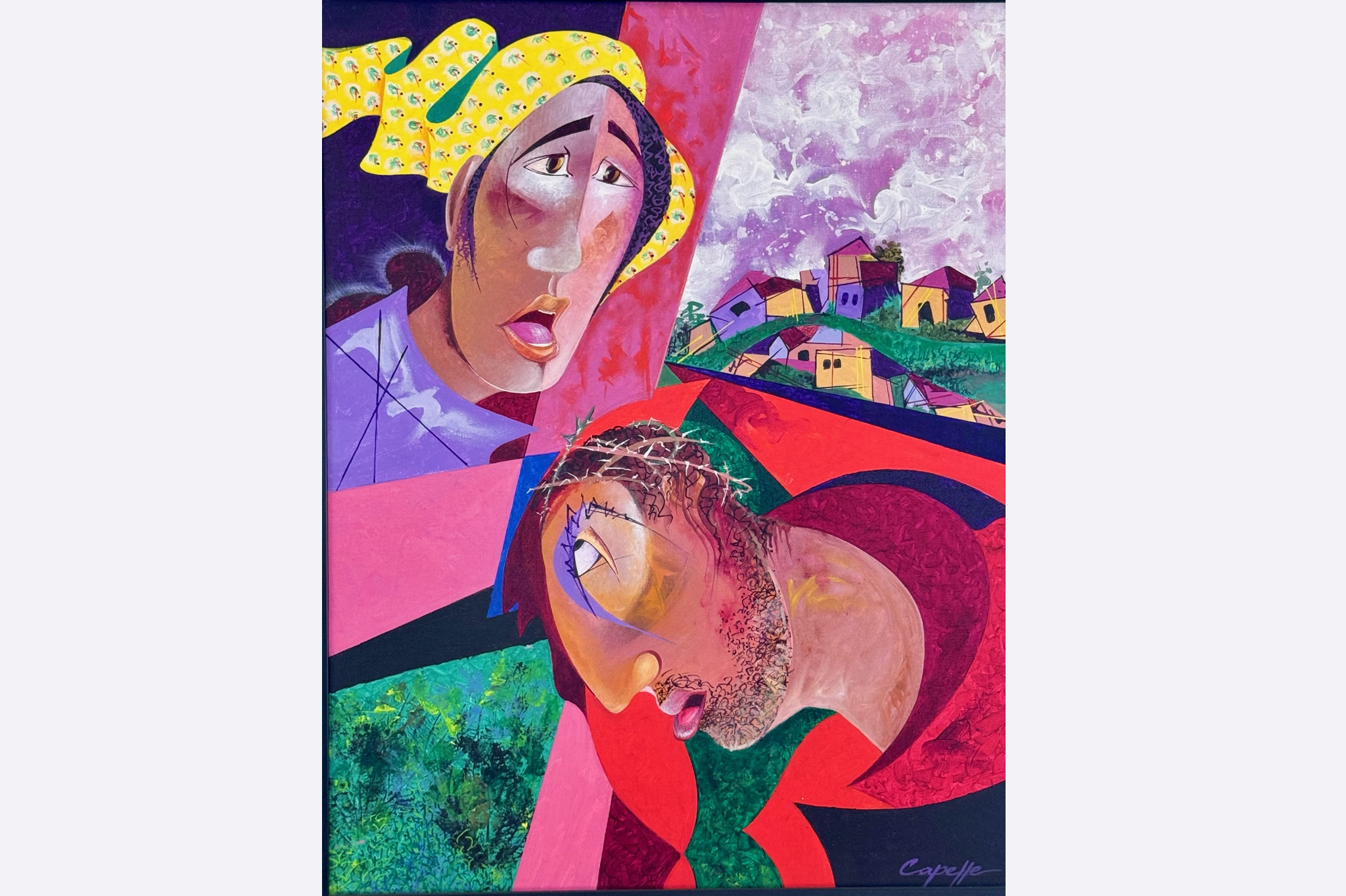
By Carlos Mendoza Álvarez
A Congolese refugee camp on the outskirts of Pretoria welcomes a small group of people from universities and churches interested in learning about their lives and stories. Ten families, each with four or five young children and some elders, greet us on the esplanade on a cold South African winter afternoon. Our guide is Lance Thomas, a colleague from the Centre for Faith and Community at the University of Pretoria (UP), who told us about his decolonial vision of accompanying vulnerable groups of houseless people and refugees. This is a splendid project that the university has been developing for more than ten years.
During my visit to the UP a few days ago, I was struck by the creativity of this university community in connecting, among other ongoing projects, the world of unhoused people with different academic departments such as architecture, sociology, and theology, promoting a practical theology “on the street.” The recent inaugural lecture of the academic year by Prof. Stephan de Beer, discussing ways of building community and its spiritual dimension, while accompanying houseless families in creating projects to recover living spaces, is a prime example of this decolonial way of doing theology.
Along the way, Lance warns us of the importance of not falling into the trap of victimization and the spontaneous desire to provide financial aid to the community we are about to visit. The aim is to see the conditions of that community up close to seek support strategies that address, as far as possible, the systemic causes that subject more than 250,000 refugees in South Africa from Burundi, the Democratic Republic of Congo, Rwanda, South Sudan, Somalia, and Zimbabwe, according to UNHCR.
As I listen to Lance, I am strongly reminded of Ivan Illich’s warning never to lose sight of the importance of conviviality with others, as well as the friendship with the poor that was at the heart of Gustavo Gutiérrez’s liberation theology. Without falling into the trap of emotional manipulation, I resolved to be alerted to connect both poles: to think systemically and act compassionately.
During spontaneous conversations with those who approached us at the camp to chat, I was struck by the deep gaze, as if open to painful memories, of two elderly people who told us stories of the seven years that had passed since they fled the war in the Democratic Republic of Congo. They have been jumping from one United Nations refugee camp to another in South Africa. Some were imprisoned for two years. The children who flit around with generous smiles and wide eyes “don't know what school is,” one of the community leaders tells me.
A woman with an emphatic voice insists again and again on the discrimination they suffer as families from “their own South African brothers.” She shows me the document that UNHCR gave her seven years ago. Her only identity document, almost destroyed by the passage of time and dampened by her nervous hands, is not accepted by any South African authority. Another man approaches, full of anger and pain, saying that they can’t take it anymore and that if they don’t receive humanitarian aid, they will soon die. The woman returns, her voice desperate, to say that their neighbors threaten them at night and tell them to leave, to go back to their country. “But we have nowhere to go back to,” she says, heartbroken.
One of our group members spent the entire time talking to one of the young women who is pregnant. The risk of inadequate medical care for her and her baby is real, due to the growing refusal of clinics in the country to accept refugees without valid permits. They immediately form a network of sisterhood.
The impact of this visit, which I shared with a close group of friends and family in Mexico, sparked a desire to do something together with that refugee community. I will soon let you know here what we can do together.
∂
I told this story a few days later to those who attend my talks on “Collective Healing and Community Hope.” It is a mixed group of South Africans, white and “of color,” elders and young people, some of them documented immigrants. They are part of a pastoral network in Cape Town and neighboring cities. We talk about the abyssal line that separates the world of privilege from that of exclusion. I emphasize the intersectionality that must be discovered between the various narratives of “coming out” of those who live in the shadows of poverty, gender violence, racism, ableism, and so many other stories of domination in our unequal societies. The audience immediately connects with the narrative that makes people with disabilities visible, but they are reluctant to recognize the connections with the narratives of queer/cuir Social justice concerns them, but even gender equality makes them uncomfortable. I take my talks a step further, talking about refugees in South Africa and my recent visit to a community in that country, describing them as those who live “in the shadows of the shadows of the shadows,” evoking Frantz Fanon’s powerful metaphor of “the zone of no-being" (Black skin, white masks). And the audience begins to open their minds and hearts, little by little, to discover the power, beauty, and spirituality in those who call us to cross into the “zone of no-being,” to dare to name the systemic violence that concerns us all, and to begin processes of mutual recognition, listening, and personal and communal transformation.
∂
I realized then that when we talk about reconciliation with the South African people, we touch on a wound that is still open, even after decades of post-apartheid. “We are still segregated,” writes a colleague in a “silent conversation” we have as part of the afternoon workshop, commenting on flipcharts about violence in today's world. Thirty-one years after the collective trauma of apartheid for the peoples who inhabit these lands, no effective agrarian reform has yet been implemented, as 60% of the land belongs to white Afrikaners, contrary to the lies spread by Trump, who recently welcomed fifty Afrikaners as refugees fleeing “black persecution”. Another cynical deception by the dictator in office on land stolen from the indigenous peoples of North America. The distribution of wealth in the country of diamonds and tanzanite remains stalled by the corruption of the black elites who govern the country today. Many post-apartheid youths admire Elon Musk and Trevor Noah, hoping to one day migrate like them to the Big Apple or Los Angeles. Their dream is now reflected in the artificial world of the Netflix series “The Kings of Jo'burg", which is perceived by critical South African youth as a crude “Americanization” of life in this country.
The wound of national reconciliation in the rainbow nation of Mandela and Desmond Tutu's time remains open. There is certainly skepticism in the country about its corrupt political class, as in my beloved Mexico. There is a certain resignation in the face of the failure of democracy, although small pockets of critical communities resist. The "3rd Black Power Pan-Afrikanist Decoloniality Winter School”, which will take place in Soweto at the end of July as a festival of combative decoloniality, will present another face of South Africa. One that emerges from the ancestral knowledge of African peoples.
There is hope that South Africa, as the elder sister of the resistance movements of our times, will awaken from its slumber.
Cape Town, July 5, 2025