Tag: political theology

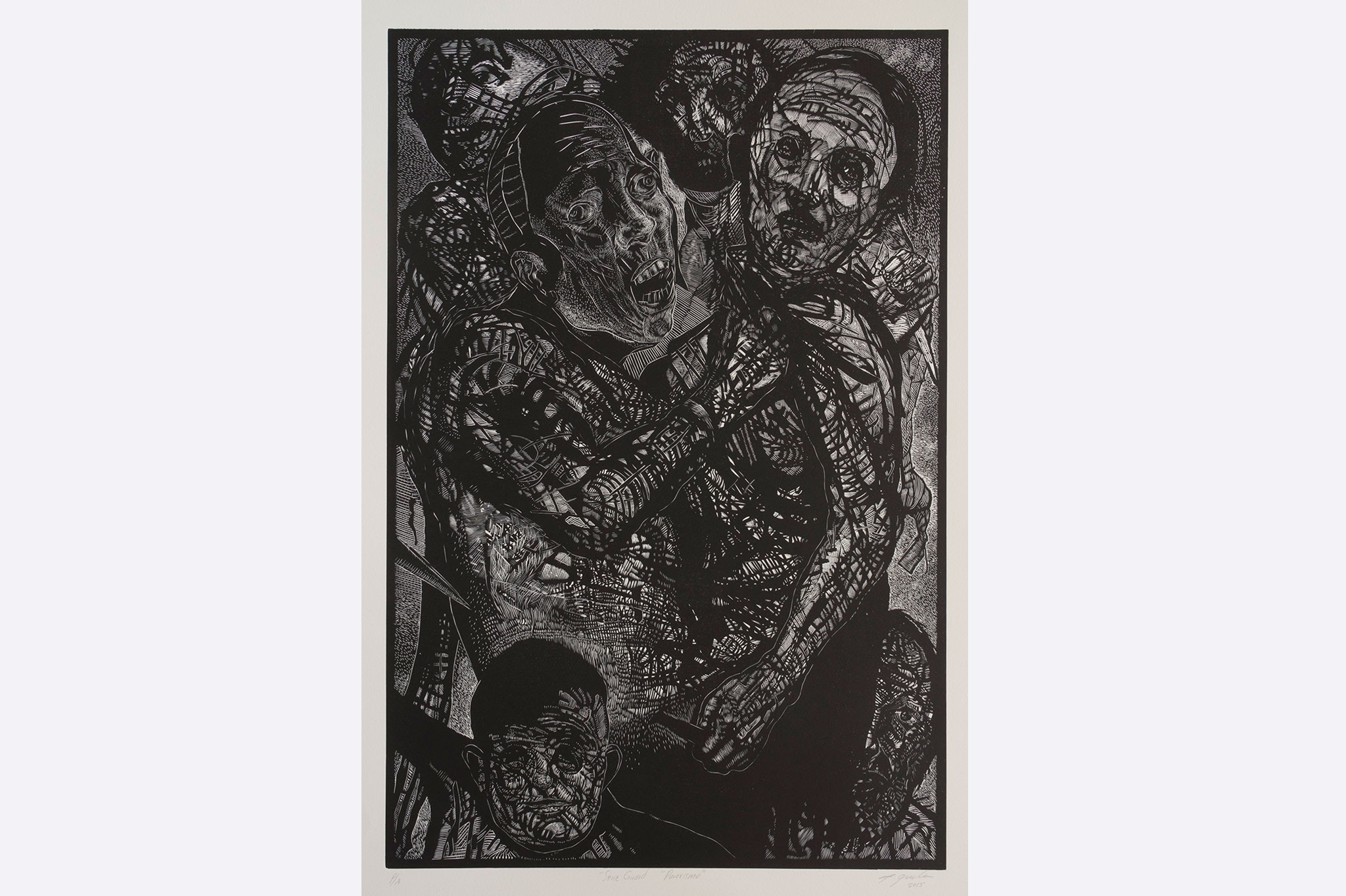
  • La monstruosidad de la religión Sobre un debate moderno en curso“Paroxysm,” Iván Gardea, etching, Cuernavaca, 2019

    The monstrosity of religion On an ongoing modern debate

    By Carlos Mendoza-Álvarez


    This week I was invited to the presentation in Cuernavaca of a book that contains a failed conversation between John Milbank, a British Anglican theologian, and Slavo Žižek, a Slovenian atheist philosopher, about the monstrosity of Christ (The monstrosity of Christ: paradox or dialectic?). The Spanish translation was published by the Universidad Iberoamericana in Mexico City, at the initiative of Ángel Méndez Montoya, as part of an innovative publishing program to offer readers in Mexico and the Spanish-speaking world current theological debates surrounding God as an ontological problem, as a source of ethical meaning in a modern civilization shaken to its foundations, and as a political problem.


    Before attending the presentation at the Miguel Salinas Gallery Library of the Autonomous University of the State of Morelos, located in the historic center of the city in an old house restored as a cultural center, I had the fortune of talking with the Juarez artist Iván Gardea, when visiting his exhibition at the Borda Garden which is open to the public until the end of September.

    Maestro Gardea, in addition to being an impressive engraver in the most rigorous Mexican tradition of printmaking that dates back to Posadas and the Taller de Gráfica Colectiva a century ago, is a born thinker, well-versed in literature, music, philosophy, and theology. We met in his studio six years ago to prepare for the exhibition of his series of prints on violence inspired by the thought of René Girard. We held this exhibition at the Andrea Pozzo Gallery of the Universidad Iberoamericana in Mexico City in 2019, on the occasion of the international conference "Resist! Violence, Resistance, and Spiritualities," organized jointly by the Jesuit university and the International Journal of Theology Concilium, where I had the opportunity to serve on the board of directors and editorial board for eight years.

    During our conversation in the bright colonial courtyard of the Jardín Borda, Iván told me stories about his ongoing artwork, a series of prints specifically about the monstrosity of the sacred in today's society, lost between Western liberalism, "devoid of any belief," and the materialistic atheisms that abound in both academic and social circles. In Iván's opinion, although I correctly interpret it, this monstrosity has many facets, among them nihilism as a way of life without hope. I was greatly surprised to hear his reflections, since that same afternoon we were to discuss the "monstrosity" of Christ in the Žižek-Milbank debate.

    So I briefly summarized the ideas I would later express regarding that book, alternating with my beloved colleagues Sylvia Marcos, a renowned gender anthropologist in Mesoamerica who met Žižek in Slovenia; Ángel Méndez, a queer theologian who worked on his doctoral thesis on the theology of food under Milbank's supervision; and Nicolás Panotto, an Argentine Protestant theologian with whom I share projects in the "Theology After Gaza" group convened two years ago by Mitri Raheb to rethink political theology.

    In the cloister of the Borda Garden, I commented to Iván that, in my opinion, the monstrosity that was important to discern today was that of the religion that perverts the sacred, expressed as Jewish and Christian Zionism, associated with far-right movements around the world that, in the name of God, not only pervert the Bible in their theology of election and promise, but also incite genocidal violence by manipulating the religious sentiment of entire communities. Another example is the case of televangelist Paula White in the White House advising Trump, his vice president Vince, and Secretary of State Rubio in a crusade to bring their country "back to Christian values."

    Another emblematic example of the monstrosity of religion within religious institutions are the criminal cases of manipulation of religion by corrupt leaders, creating financial empires based on boundless ambition and controlling the dormant masses. This phenomenon has produced corruption among political, social, and religious elites in various parts of the world, accompanied by sexual and spiritual abuse, and the trafficking of political and financial privileges by perverse religious figures such as Marcial Maciel and Naasón García in Mexico, Fernando Karadima in Chile, and the leaders of the Sodalicio in Peru.

    This monstrosity of religion is what matters most to analyze from a critical perspective in order to contribute to dismantling its power networks in society. It is urgent to do so through investigative journalism like that of Emiliano Ruiz Parra (Emiliano Ruiz Parra: HBO series, massive vehicle for the demystification of Marcial Maciel), of truth commissions such as the one proposed by then-candidate Borič in Chile (which, incidentally, was never implemented), to ensure accountability to society as an obligation of the secular state and, above all, to guarantee restorative justice for victims.

    Ivan called these religious groups of today a parody of religion and, at the same time, another version of modernity that is collapsing in our times.


    Inspired by this fascinating conversation, I decided to share my thoughts at the book launch at the event organized by the UAEM School of Psychology, in conjunction with the Jean Robert and Sylvia Marcos Double Legacy Chair. I summarize what I presented at that discussion.

    The first thing was to underline the importance of approaching the book as a theological provocation from our Latin American and Caribbean context, so that it is possible to make a critical reading of the European authors of the book, closely following their argumentation and highlighting other intercultural perspectives of approaching the mysterion of the real that religions call God.

    Then, it is worth remembering that the meaning of Christ for humanity in times of civilizational collapse that we are experiencing today seems an irrelevant issue in the face of the exponential increase in violence under a new figure that some call, following René Girard, the "escalation to the extremes of the annihilation of the other." It does not seem relevant to discuss a religious figure who was trapped by a religion that domesticated his universal love. It seems even less important to get lost in the debate between a Slovenian philosopher and a British theologian when we find ourselves in the midst of the desolation of wars of genocide in Gaza, of extermination in Congo and South Sudan, of forced disappearances in Mexico, where the urgent thing is to stop the spiral of hatred if we wish to speak of the ethos political and spiritual possible for humanity in this uncertain hour.

    And it is precisely here that the question of the experience of Jesus of Nazareth in the first century CE, facing hatred in his own body, may be relevant to us today.

    Academic debates often stray into the realm of ideas, no matter how grounded they may be. Defending or accusing Hegel of various solutions to the dialectic of history to justify theological materialism, as Žižek does, or promoting Milbank's radical orthodoxy as a guardian of the City of God, seem secondary when it comes to confronting another monstrosity, one that has many heads, like the one of hatred and death produced by the capitalist, patriarchal, and white, Western hegemonic hydra.

    Even defending or accusing Meister Eckhart - or better yet the former Dominican friar Rainer Schürmann (The Principle of Anarchy: Heidegger and the Question of Action), one of its modern interpreters, often cited by Žižek, for his interpretation of the negativity of divine being as the antecedent of the moment of negativity of the Hegelian dialectic seems like straw when the priority is to think about the negativity of those who inhabit “the region of non-being,” as Fanon said, and are being reduced to nothing.

    I then proposed a decolonial approach to the book The Monstrosity of Christ: Paradox or DialecticA scholarly book that will generate much ink in the academic world, whether to validate Žižek's theological agnosticism or to confirm Milbank's theological philosophy. The crucial question the book poses lies in the impasse of reason in the face of the mystery of being. However, what is worth exploring is a different ontological approach, one that conceives of "being that ages and dies," as Levinas said.

    To do so, it is necessary to turn to the Bible as the original source of this understanding of the paradox of being, and then to apophatic philosophy to spell out the intelligibility of the absurd when Christianity announces a "crucified Messiah" as the meaning of history. Following this route, it will be possible to cross the abyss to think about the monstrosity of being, but as the radiance of the messianic moment in which history seems to open like a recess of "hope against all hope" through "the wounds that heal."

    Thus, another way of speaking about the critical link between philosophy, theology and politics emerges, not as an idea or as potestas politics, but as a messianic knot, that is, resistance to violence woven by those who live in “the shadows of the shadows of the shadows.”


    "By his wounds we shall be healed," says the oxymoron from the book of Isaiah (53:5), written by a disciple of the prophet during his people's exile in Babylon. This is perhaps the pinnacle of Old Testament revelation and one of the most radical truths about the human condition, politics, and hope. It is in this light, of course, that the torture and execution of Jesus of Nazareth by the Roman authorities, in complicity with the authorities of the Temple of Jerusalem and the enraged mob, will be read centuries later.


    Exile was a spiritual and theological place for the disciple of the prophet, as it was for John the Baptist and so many prophets throughout history, "whose voice cries in the wilderness" (John 1:23). Until we reach the voice of Munther Isaac in the 2021 Christmas sermon in Bethlehem, Palestine. The Babylonian exile signified a contradiction for the expatriated people: on the one hand, the pain of being torn from their homeland; on the other, the recognition that they have only been able to live off the crumbs of Nebuchadnezzar II, the Babylonian king. And yet, in the four poems preserved in the Book of Isaiah, the true source of life will be the disciple-people. Babylonian power crushed Davidic power. But the people survived by virtue of their fidelity to the first covenant, if not all, at least a few. Tzadikkim or just people in history. And so, that suffering people is the source of "another way of being," beyond the essence of Babylonian power, in the power of those who resist. They are the servant of Yhwh.


    Following this spark from the anonymous disciple of Isaiah, we can then reread the history of "the cursed of the earth," yesterday and today. In particular, the history of the Palestinian people, who, in the depths of their pain from the genocide they suffered, allow us all to heal from their wounds if we open our lives and actions to this cry. A slogan of the Global Sumud Flotilla says precisely this: "They wanted to erase Palestine, and now Palestine sails all the seas."


    Faced with the monstrosity of the exile in Babylon, the Hebrew people of the anawin, from the poor of God, brings forth the beauty of Sumud or resistance to the catastrophe that has befallen them.


    What dialectic of history in the Hegelian reading recreated by Žižek governs history? That of opposites that annihilate each other in search of a supposed synthesis of Aufhebung or overcoming this rivalry that only prolongs the death throes of humanity with the triumph of the executioners.

    Nor is the philosophy of the City of God, yearned for by John Milbank as a return to theocracy, overcoming the narrow limits of modern autonomy that became a nightmare, capable of crossing the abysmal line that separates privilege from desolation.

    Are both authors in this fictitious dialogue right in raising the alternative between the dialectic of Holy Saturday that annihilates the weak in the Sheol and the paradox of Easter Sunday, which is announced as the triumph of the victims over the executioners?


    Neither paradox nor dialectic, but messianic contraction of the being that ages and dies.

    Eckhart warned us about figures and idols (deitas) that replace the ineffable God (diuinitas). They can be religious or political idols. What is crucial in the life of the Spirit is, therefore, for the German Dominican, detachment (Gellasenheit) as a form of apophatic or negative, non-dialectical negation of the impersonations of Divinity.

    Pseudo-Dionysius had previously explored this path of overcoming the ego, giving rise to the experience of the Mothers and Fathers of the desert in their confrontation with the demons before arriving at the contemplation of the mysterion of the living God.

    Therefore, today, apophatic theology is a companion to the political theory of the commons, proposed by collectives and subjectivities located on the peripheries of the hegemonic world, but rooted in the world of the vital connection between the human, the cosmic, and the divine.

    By listening to the outcry, indignation, and hope of today's most vulnerable, we can then access the apparent monstrosity of Christ, which then becomes the beauty of the forgotten who re-exist when they say enough to the violence of the imperial being that kills.


    Puebla, September 14, 2025
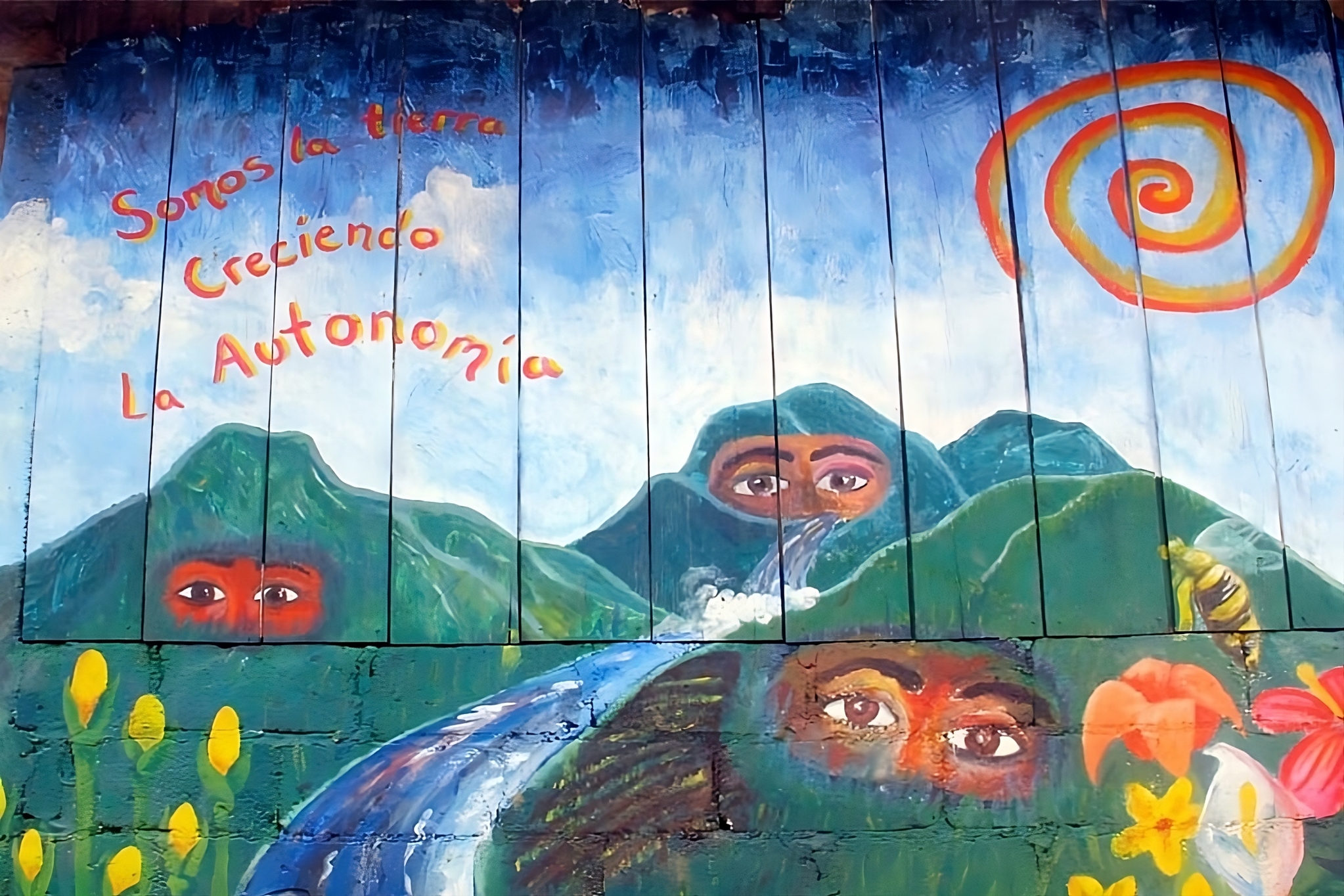
  • Entre aguas y tierra: de Soweto al Caracol MoreliaDetail of a mural, Caracol de Oventic. Sosa, J., Rivero, E., and Wolkovicz, P. (2015)

    Between water and land: from Soweto to Caracol Morelia

    By Carlos Mendoza-Álvarez


    This weekend concludes in Chiapas the International meeting of resistance and rebellions "Some parts of the whole" Organized by the Zapatista bases of young EZLN militia members and their leadership, a new generation has expressed—through plays, concerts, workshops, and dance—the self-criticism of their decades-old movement to reaffirm their worldview and their struggle to build other possible worlds.

    This new generation was born in autonomous territories, after the armed and media uprising of 1994, where their perspective on life and understanding of the world below has enabled them to develop a creative imagination about the human and the cosmic. As Raúl Zibechi astutely points out (Zapatista self-criticism), the meeting represents a valuable innovation in the Latin American left of the last half-century due to its capacity for self-criticism and its persistence over more than three decades in defending its territory, its ways of life, and learning a mode of governance where one “commands by obeying.”


    After my stay in South Africa this summer, I returned to Mexico with a clearer awareness of the connections that exist between the resistances of “those below,” from the refugees on the outskirts of Pretoria and the artists of “combative decolonality” in Soweto, to the Palestinian resistance of the Sumud in Gaza, the West Bank, and everywhere else the clamor to stop the genocide of the Palestinian people emerges from public squares and digital campaigns.

    Driven by this awareness of the urgency of continuing to learn from these social movements and build bridges, I was preparing to participate in the meeting of resistance groups at the Caracol Morelia, when the chaos generated by the storm that hit Mexico City a week ago prevented me from doing so. A massive urban sludge—created by the amount of rain that fell with a force unseen in 73 years, exacerbated by the garbage accumulated in the streets by an indolent citizenry that clogged urban drainage systems, and worsened by the appalling water policy of governments in modern times of chaotic growth in ancient Tenochtitlan—paralyzed the lives of millions of people. I was stranded for hours at the airport, unable to reach southeastern Mexico due to the chaos that lasted into the following days.

    So I had to settle for attending the event virtually, thanks to the online broadcasts made by the organizers (Live broadcast from the Meeting of Resistances and Rebellions "Some Parts of the Whole") and various civil society organizations were present at the Caracol Morelia, near Altamirano, for workshops, plays, and concerts. Among the presentations of resistance to the pyramid of privilege, it is worth highlighting the presence of women's collectives dismantling patriarchy, students creating alternative education networks, farmers resisting extractivism, and settlers confronting gentrification, among many other local, regional, and "intergalactic" initiatives resisting the capitalist and patriarchal hydra.


    However, in my opinion, it remains to be explored in these anti-systemic meetings spiritual resistances of these collectives and peoples. Because it's not enough to expose the strategies of resistance to the many-headed hydra. Nor is it enough to organize networks of solidarity and support between collectives and peoples to dismantle the pyramid of privileges. Rowing against the current often leads to desolation. That's why it's necessary to go to the source from which the fighting hope who does not cease his creative imagination in the midst of catastrophe.

    What inner and collective strength enables surviving individuals and communities living amidst increasing systemic violence to resist? How do they experience an awakening from the destiny imposed by the hegemony that kept them subjugated and made them declare that the world had to change? What processes of personal and collective healing have they developed to strengthen their resistance? How do survivors support, accompany, and care for one another? Because we cannot forget that resistance is a way of life that also involves symbols, rituals, and celebrations, as profound expressions of collective memory that allow for a connection with ancestors, with Mother Earth, and with divinity celebrated in so many ways. This dimension has been cultivated for millennia by the religions and spiritualities of humanity, from shamanism in Mongolia to monotheistic religions and their diverse ways of nurturing peoples to live with dignity and hope.

    As we mentioned a few weeks ago here, in order to explore this spiritual and political source of resistance, a meeting called “Re-exists: The Spirit connecting the peripheries”. A group of sixty people from social and religious movements in Asia, Africa, Europe and our America, together with university people and artists located in the interstices of hegemonic power, will meet to share these and other questions, analyzing the reality we face and nourishing ourselves with ethical-political ideals and ancestral knowledge. We will seek to listen to individuals and collectives of survivors, through words, rituals and workshops, to “heart” what we have learned, crowning each day with an urban performance that will tie up loose ends to recognize the Ruah divine that gives life to the people.

    In every neighborhood and city, in every network of people and communities, the urgency to do something concrete to dismantle the systemic violence that plagues us has awakened. There we can open our imaginations, our hearts, and our intelligence to propose collaborative projects. Community gardens, soup kitchens, meditation groups, performances in public squares, interactive classrooms, research projects in a dialogue of knowledge, and so many other ways of weaving networks of shared care flourish today in the cracks in the walls of the world-system of privilege and greed.

    The storms that create floods and ecological chaos in the city represent a world crumbling. The water that flows down from the mountains to irrigate the land, on the other hand, is like the web of care woven by the survivors of yesterday and today. Let us listen to those who say, "We are the earth growing autonomy," as the Caracol de Oventic mural that accompanies these lines tells us.

    Let us trust in our imaginative capacity to navigate the living waters with their underground rivers that connect Soweto with Gaza, with the Caracol Morelia, and with so many other places of survival, resistance, and re-existence.


    Mexico City, August 16, 2025

  • ¿Quiénes heredarán la tierra robada y gentrificada?Lucky Madlo Sibiya (South Africa, 1942), Untitled

    Who will inherit the stolen and gentrified land?

    By Carlos Mendoza-Álvarez OP


    The wars of yesterday and today are brutal rituals of territorial control as a space of privilege for a powerful group over the rest of the beings that inhabit it.

    Modern expansionism, which began in the late 15th century with interoceanic voyages financed by European kingdoms that became nascent empires, was an enterprise of control of routes and territories that expanded throughout the world in a brutal manner as an unprecedented colonization project. libido dominandi The conquistador found in this "civilizing" enterprise his perfect justification in the religious armor that accompanied the wars of conquest: those lands had to be conquered in the name of God.

    This is happening today in Palestine because of the greed of the Israeli state and the powers that support it to seize the territory of the Palestinian people, both Muslim and Christian. Such colonizing libido fuels the unbridled fury of Jewish settlers eager to seize more and more land in the West Bank and Gaza. This perverse logic leads a people who were victims of Nazism to now commit genocide against a brother nation.

    A similar, but even more perverse, greed fuels the transnational war industry for the benefit of corporations that enrich themselves exponentially by creating armed conflicts to fuel the war machine that generates trillions of dollars in profits each year around the world. In this case, it involves the control of financial and industrial territories to feed the arms industry in every corner of the planet.

    Israeli Zionism and Christian Zionism are two sides of the same coin. They write another disastrous page in the history of the greed for land as property, cynically manipulating the biblical promise of the land. Since the 19th century, this Zionism born in the United Kingdom was the one that paved the way for the later creation of the State of Israel, under the pretext of the Shoah. That same Zionism, in its version of perverse political messianism represented by the State of Israel, has now invented a criminal scenario with a Muslim enemy to be defeated in order to impose its military power in the Middle East, annihilating the Palestinian people and humiliating neighboring peoples, through the blatant manipulation of the Bible, as Mitri Raheb has shown in his essential book Decolonizing Palestine. The Bible, the land, the peopleThe Israeli machinery of drones, tons of missiles and millions of bots or automated accounts flooding social networks, has been spreading fake news throughout the virtual world that has left the entire world stunned, producing a “collective cognitive dissonance,” as analyzed in Brazil by João Cezar de Castro Rocha based on Leon Festinger's theory.


    And, strange as it may seem, the ongoing gentrification in many cities around the world, from Barcelona to Mexico City, is another expression of that same colonizer's will to dominate, now in its gentle version. hipster. Only this time, it's not about conquering territories to govern them through military occupation armies with the aura of an imperialist religious flag. I'm referring to the digital nomadic colonizers who take advantage of the power of their currencies, emboldened by their dreams of white and technological primacy, to inhabit residential neighborhoods in vibrant cities at a much lower cost than they would have in their countries of origin. Thus, these hipster herds nurture their cosmopolitan illusions enclosed in their urban bubbles, without coming into close contact with the population of the place they inhabit, but rather displacing them or subordinating them to their tastes and interests. This phenomenon represents the most recent and perverse version of settler colonialism that displaces previous inhabitants from their land.

    For the past five years, I've spent a period of time each year in Mexico City's Hipódromo Condesa neighborhood, where the Dominicans have for almost a hundred years animated a parish that was a religious center for the Mexican middle class with aspirations for urban modernity, though not so much religious ones. Every year I return, I'm surprised to see that the former residents have left, selling their homes, converting them into Airbnbs, or outright opening hipster-trendy businesses, ranging from vegan restaurants and light ice cream shops to bistros with Mexican fusion menus. But what has surprised me most is the proliferation of businesses specializing in angels, candles, Tarot readings, physical therapy, Bikram yoga, and other types of yoga, as well as countless spas with massage menus ranging from reflexology to tantric, not to mention, of course, Reiki mixed with "ancestral" techniques from the heart of Mexico.

    On the other hand, the Catholic parishes in that area of the city collapsed financially due to the lack of alms, but above all, their traditional religious population was aging. To the surprise of many religious ministers, in recent decades, La Condesa has become a laboratory for new religious expressions, as Hugo Suárez has documented (Images of Faith. Audiovisual Sociology of the Condesa neighborhood), a sociologist from Guadalajara, in a recent comparative study of the religious practices of residents of Condesa and Ajusco in Mexico City, one a hipster neighborhood and the other a working-class one. To complete this quick overview, it's important to note that in recent years, there has been an upswing in the number of believers in Catholic churches, especially in South America, characterized by a traditional Catholicism of intense and highly moralizing individual piety. This is an unexpected effect of gentrification in those parts.


    What criteria could help us understand the meaning spiritual From these old and new territorial control processes? Could humanity's religions pull from the vault of their memories some precious talisman that sheds light on us?

    The second beatitude of Matthew's Sermon on the Mount captures the poetic message of Christ as He preached in Galilee in a provocative way. This beatitude literally says: "Blessed are the meek, for they shall inherit the earth" (Matthew 5:5). The Greek word for the meek is πραΰς (praus). This term is associated with those who resist the powers that want to push them aside because they are considered redundant in the community. In Galilee in Jesus' time, these meek They were those who resisted the Roman power of taxes or military occupation.

    It is not, first and foremost, a question of understanding the meek as peaceful people according to the traditional reading of this text. Rather, it refers to those who resist violence without making a fuss, appearing invisible to the eyes of the world, because they deploy what today we might call strategies of resistance as survivors of many forms of violence.

    On the streets of our cities, we see some of these people out of the corner of our eyes, passing by us like shadows lying on a sidewalk, or living in cardboard houses under a bridge, or even lurking in the garbage looking for a piece of bread, a cigarette butt, or a can of beer with a drink to take. They are the disposables of consumer society, the ones surplus to requirements in a shopping mall, and whom we might bump into by chance or carelessness when entering the subway or when rolling down our car window at a stoplight at any urban intersection. When we approach these peripheries very close to us, we discover that, despite the subhumanization that surrounds them, these people organize, care for, and support one another.

    The promise of the land that Jesus announces to the meek It is subversive because it does not refer to the people of Israel, as imperial Davidic theology had previously intended and repeats today with its genocidal narrative. It is not about “possessing the land,” much less exploiting it, but about inherit it, that is, to receive it as a gift from the Abba who “makes his sun rise on the evil and the good, and sends rain on the righteous and the unrighteous” (Matthew 5:45). Jesus thus subverts the dominant narrative of his time, which consisted of distributing land according to religious strata that marked the economic and social scale, with the Temple playing a central role in Jerusalem as the religious capital of Judea.

    Therefore, the Galilean's greatest audacity lay in saying that the "meek" will inherit the earth, thus opening the promise of the earth to the most vulnerable in society. A world reversed from that produced by gentrification.

    To conclude these reflections, let us allow the Colombian poet José Eustasio Rivera to whisper that uncertain hope of those who resist colonization because they sense that, at the heart of their resistance, they are beginning to inherit the land:


    XIV


    I am a son of the mountain! For its coolest place
    I search, always singing, for the resounding hive;
    and in the silent caves my throat fills
    of nectarean honeycombs and of stone almonds.

    As I leave the waves, I fall asleep with pleasure
    on the dead leaves that my dog gleans;
    and through the branches, on my brown face
    the afternoon sun sets its moving arabesque.

    Inspired by a dream of distant tenderness,
    I caress the flowers; I crown myself with vines,
    and I embrace the trunks with deep emotion;

    that later, when I concentrate my thoughts alone,
    I seek the prize of the mountain, and in my spirit I find,
    the flowering shoot of a sweet illusion.


    Promised land, Bogotá, 1921.


    eSwatini, July 12, 2025

English