
By Carlos Mendoza Álvarez
Three weeks of silence on this blog have passed amidst a whirlwind of pastoral and personal events that, in retrospect, I see as related fruits of this year's Easter journey. Through brief stories, I will try to recount the glimpses of the world to come that I perceived during these days.
The religious celebrations of Holy Week suddenly intertwined with a mysterious encounter at the water wells of Yalentay, in the hills of Zinacantán, where I was unexpectedly welcomed by the guardian of the place. These multifaceted religious celebrations unfolded amidst visits from dear colleagues and friends who had traveled from afar—Amirah and Alicia with Adriana—with whom I longed to share the rich fruits of an indigenous Church rooted in and embodied by the Tsotsil people, accompanied by questions about what still needs to be learned about caring for the land as part of the path of resistance.
Easter in Jobel
The group of six acolytes was entrusted to me for their training and the preparation of their vestments in the Dominican style. They are six teenagers. pigtails who, with great conviction and emotion, wish to dedicate part of their human and spiritual lives, occupying their free time during middle and high school, to “serving at the altar.” In the context of San Cristóbal de Las Casas, a city of intense religious and devotional practice, connecting with young people to serve Christ at the altar and in the community, especially the poor and the excluded, presents a significant pastoral challenge. Integrating a new generation of young believers faces various forms of resistance from older generations, who seem unwavering in their hierarchical and individualistic religious practices of San Cristóbal's popular piety.
But after two months of Saturday meetings in a fraternal atmosphere, with simple prayer from the heart and through listening to biblical stories in contemporary audiovisual versions, an incipient community of friendship with Jesus, as shepherd and friend of the sheep of this and other flocks, was formed.
At the end of this process, which had some tensions with the older generation, I realize the good heart of today's young ponytail holders, eager to serve with beauty and truth at the liturgical altar, while also anxious to translate the symbolism of the altar of Christ—the poor—into acts of service to the most vulnerable in the city.
65 soles
And April arrived with its birthday-like emotional force, giving me the opportunity to relive the feast of desire in my own flesh—with mass and a table set with the hallmark of the flavors and style of Puebla—, accompanied by my family and by old and new friends, as thanksgiving for the 65 springs I have been able to live as a man and as a Dominican, most of my life.
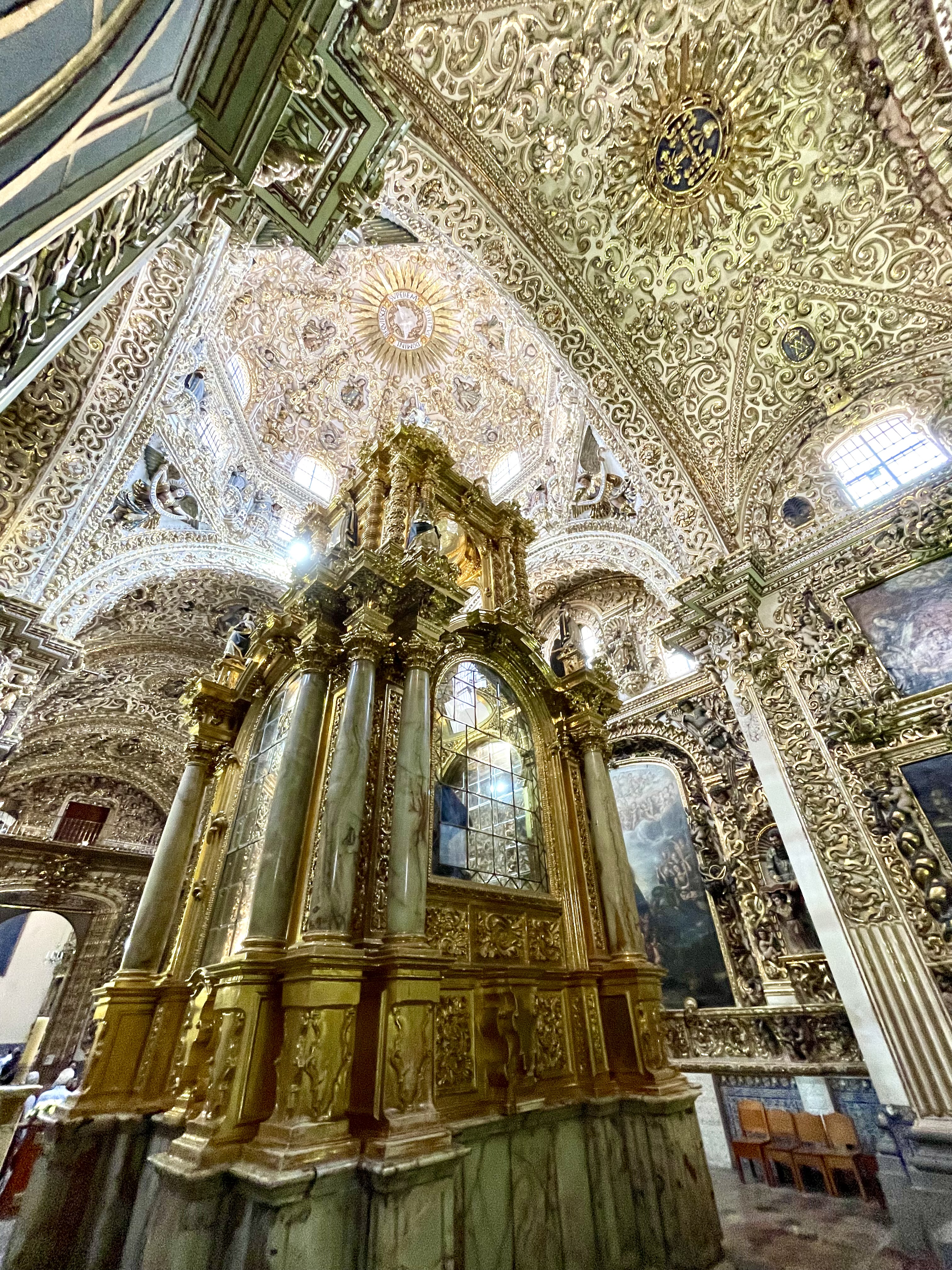
The Chapel of the Rosary, the epicenter of the spiritual life of many families in Puebla, including my own, was the perfect place to offer a prayer of thanksgiving for the gift of life, accompanied by my family and friends throughout so many years of sharing bread and salt, pain and hope, celebration and the work of building other worlds here and now. The Baroque music performed by Julio Saldaña and Suzy Torres, with Magda as soprano and Abraham on keyboard, allowed us to connect with the ancestors of my family and my religious order. This extraordinary space of Baroque art is even more admirable because it tells the stories of women of faith, like Mary, the young woman from Palestine who said yes to the angel, and of many women from the Bible and Dominican sisters from Europe and America, all of them walking, accompanied by the three theological virtues, toward fullness of grace.
It was a pleasure to host my classmates from the State Normal Institute and the Emiliano Zapata Popular Preparatory School as guests. The years that flew by now seem to bring us closer than we are apart. I had the feeling that we were coming home, after each of us had followed our own path, whether as a lawyer, chemist, engineer, educator, or guerrilla fighter.
And to my surprise, meeting Polo Sánchez Brito, scout guide of the Antelopes patrol of Group 1 of Puebla, more than half a century later, was to reaffirm those lessons to be self-reliant and in community in the middle of the forest, orienting oneself with the compass and the stars on the initiation walks, learning to light a fire with flint and a little straw, to cook breakfast and prepare coffee with milk at dawn, in addition to recognizing the footprints of the animals that passed by on the paths and recording them in plaster molds.
Six toasts, one for each decade lived, allowed me to recall small stories of family childhood and as a boy scout, the affective awakening of adolescence, the critical high school youth, the profession chosen from an early age in my case as a Dominican, the faith committed throughout the years according to a spiritual and intellectual tradition of eight centuries, and finally the academic life of three decades inspired by the pastoral accompaniment to vulnerable communities in Mexico.
And in the end, all this shared memory was crowned by the loving toast in the voices of my sister María Eugenia, my friend Raúl from high school and Amirah, who represented the doctoral students of Boston College from various countries of Our America, from whom I continue to learn so much.
What a joy to celebrate the gift of life in this way!
Bavarian dialogues
And, as a challenging continuation of life, I am now undertaking a brief academic stay in Eichstätt, in Bavaria, thanks to the invitation of my friend, Professor Martin Kirschner, who is allowing me to reconnect with that profession of teaching that I left a year ago when I resigned from Boston College, after three decades of academic life.
Being the “subject of study” for doctoral students in Bavaria wasn't entirely unfamiliar to me, after Cleusa Caldeira, at the Jesuit Faculty of Theology in Belo Horizonte, Brazil, dedicated her doctoral thesis to exploring my contribution to theological thought. Here, Constantin was tasked with reading my latest book on the resurrection as messianic anticipation, in order to pose incisive questions about the “reality” of Jesus' resurrection, asking what happened to his body and how it affects us today. At its core, there was a metaphysical questioning underlying this foundational event of Christian existence.
Returning to the rhythm of a European university city—calm, quiet, and orderly in its timing and customs—is a delight. But it's also a challenge not to disconnect from the life and pastoral processes I've been immersed in for the past five months in Chiapas.
In what way, going forward, will you be able to achieve a balance between action and thought, with enough time for meditation, reflection, and writing?
The dream of a cabin-home appears on the horizon, a place to socialize with friends in body and spirit, the breath of the divine Ruah to let us be moved by its breeze.
Perhaps the volcanic environment of my childhood is the fertile humus that will make that dream bloom.
Eichstätt, April 30, 2026