Tag: Sylvia Marcos

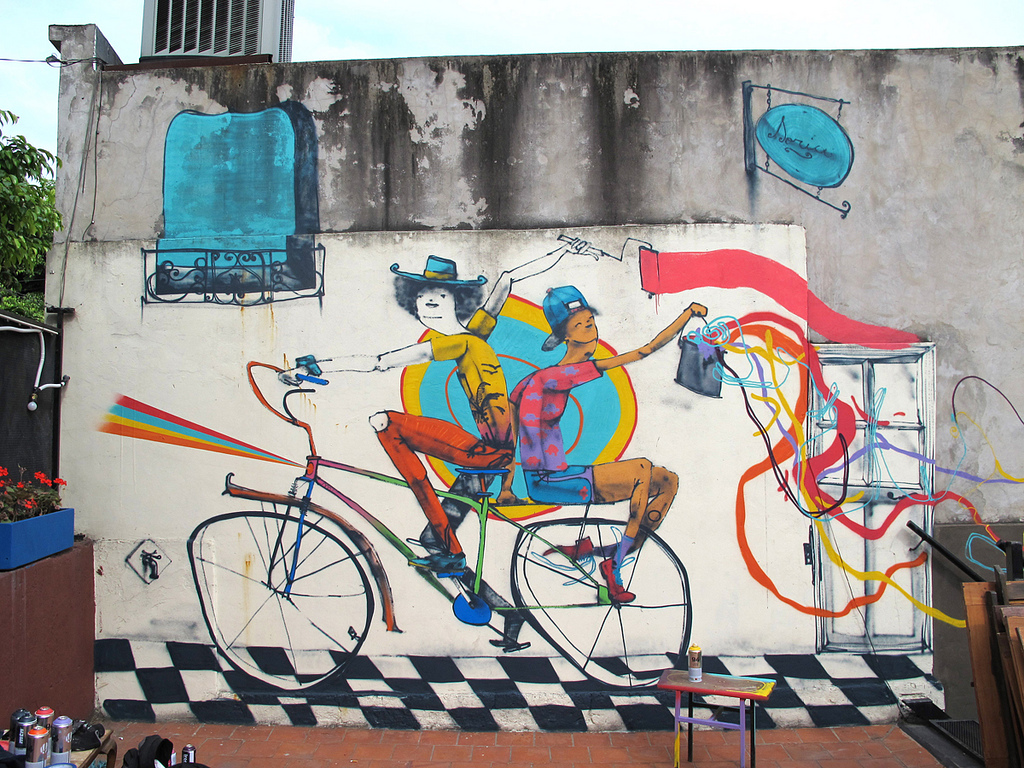
  • De mundos alternos que se tocan Conmemorando el primer centenario del nacimiento de Ivan IllichStreet Art | In Praise of the Bicycle | Buenos Aires, 2015

    Of alternate worlds that touch Commemorating the centenary of Ivan Illich's birth

    By Carlos Mendoza-Álvarez

    Between postwar Europe and the Latin America and Caribbean of the modern mirage, there were flows of life and thought that went back and forth between both shores of the Atlantic. What was once the frontier of conquest, colonization, and evangelization—with the Creole and mestizo creations that reinvented the West during the colonial period—became in modern times an ocean of whispers of new worlds, sailing against the current of progress and industrialization.

    The 1960s saw the emergence in Cuernavaca, Mexico, of a river of thought flowing "north of the future," as Ivan Illich liked to describe the future arriving to us here and now, quoting the poem by Paul Celan, that Romanian-Jewish author who fascinated him so much:

    In the rivers, to the north of the future,
    I lay the net that you
    hesitant loads
    writing on stones,
    shades.

    In my hand autumn eats its leaf: we are friends.
    We extract time from nuts and teach it to walk:
    time returns to the nut.

    It's Sunday in the mirror,
    In sleep one sleeps,
    The mouth speaks the truth.

    My eye ascends to the sex of my beloved:
    We looked at each other,
    We say dark words to each other,
    We love each other as poppies and memory love each other,
    we fell asleep like wine in bowls,
    like the sea in the bloody ray of the moon.

    We stand embraced at the window, they can see us from the street:
    It's time this was known.,
    It is time for the stone to bloom,
    that a heart beats in the restlessness.
    It's time for it to be time.

    It's time.

    Austrian researcher Isabella Bruckner, a young professor at the Benedictine Athenaeum of Saint Anselm in Rome, who is now moving to Freiburg im Breisgau, organized a European colloquium to delve into the theological legacy of Ivan Illich, tracing the genealogy of his deepest intuitions about the crisis of instrumental modernity, which arose from what he called the perversion of Christianity.

    Together with Professor Martin Kirschner of the Catholic University of Eichstätt in Bavaria, I was invited to give a joint presentation comparing the political theology emerging in certain parts of Germany and Mexico, inspired by Illich's intuitions and ideas. The challenge was twofold: to find common ground and an appropriate language to account for experiences of proximity  and conviviality in countries so disparate in their political cultures: the German people currently grappling with the European Union's complicity as an ally of Israel and the United States in their geopolitical war in the Middle East, and the Mexican people seduced by the siren song of the Fourth Transformation and the roar of the World Cup, which silences the tragedy of the disappeared and the corruption of the narco-government in a large part of the country's territory.

    When I was invited to participate, I suggested to the organizer that she invite people who for years have been inspired by Illich's thought, particularly Javier Sicilia, Sylvia Marcos, Roberto Ochoa, and Rafael Mondragón, who are little known in European academia. So I undertook the task of presenting in my paper the central ideas of this critical dialogue on what Humberto Beck called the Cuernavaca School, with the Hebrew and Christian thinker of proximity and conviviality. I emphasized the new paths emerging in Mexico and other parts of the world. world below and of the peripheries From the centers of hegemonic power, where resistances flow as other ways of eating, healing and educating —as the late Gustavo Esteva said speaking of revolutionary verbs— to promote territorial, epistemic and spiritual autonomies that sustain communities and peoples who face the many-headed hydra that devours the world.

    One of the Illichan themes that most impacted colleagues in Germany during the COVID-19 pandemic was his critique of the pharmaceutical industry, promoted by Western democratic governments that imposed public health policies without considering the autonomy of individuals and communities in choosing the most appropriate ways to confront the pandemic. My German colleagues, Martin Kirschner and Markus Riedenauer, emphasized the continued relevance of this critique of the state's power to impose mandatory vaccination programs, disregarding the serious scientific objections to the indiscriminate use of vaccines and the effects they caused in the population.

    Another recurring theme in the Rome debates was that of the territorial, epistemic, and cultural autonomies that arise from placing face-to-face proximity at the center of life, or, in Illich's words, the conviviality as a mode of existence and the place which is inhabited with the strength of the vernacular. Both in Europe and in Latin America and the Caribbean, these autonomies have been gaining ground in recent decades, with the conquest of bodies and territories by women, indigenous peoples and collectives queer/cuir /queir, among other resistance groups.

    European colleagues were surprised by the diverse approaches to the ethical, political, and spiritual implications of the work of the migrant thinker Ivan Illich. From his diaspora from the clerical Church to his return to medieval classics like Hugh of Saint Victor—and through his time living with Puerto Rican communities in New York and later with peasant communities in Cuernavaca—Illich bore witness to these other worlds that intersect. Fabio Milana, editor, along with Giorgio Agamben, of Illich's work in Italian, presented a gem of archival research from the Illich family to recount Ivan's "vocation," as the young son of a Jewish mother and a Christian father, who cultivated from childhood and adolescence a passion for the thought that arose from Christianity as the event of the Incarnation of the Word of God. This core would later remain as an ember in the work of the migrant thinker to this day, in which we now recover Illich's pristine vision of a powerless church.

    The proposal to continue exploring Illich's thought from its various perspectives, both European and Latin American, remains open. We hope to organize a meeting in Cuernavaca that will foster these dialogues and new ways of living together in the conviviality of those who resist the era of the system, reclaiming place and vernacular culture as cornerstones of another possible modernity.

    This week, cultural writing and painting workshops begin in Sots'leb, as part of the preparations for the commemoration of the 500th anniversary of the Chiapas Revolution, which will take place on Saturday, June 6th in Zinacantán.

    I have been fortunate to contribute to the organization of these events, led by Antún Kojtom, a Tseltal painter from Tenejapa, and Xun Betán, a Tsotsil anthropologist and poet from Venustiano Carranza. These acts of collective memory seek to explore the enduring presence of the cultures of the Chiapas Highlands and their encounter with the Dominican friars in a dialogue that began five hundred years ago.

    A mural on the esplanade outside the San Lorenzo Mártir temple in Zinacantán will depict scenes from the ancestral religion of the Tsotsil people, such as prayers on the hills led by the Jiloletic, The blessing of the grandmothers and the importance of traditional roles as a bond within the community are also depicted. As part of this ancestral history, the mural's center features a scene of an imagined encounter between a Jilol, or Tsotsil seer, and Friar Bartolomé de Las Casas, accompanied behind him by other friars who safeguarded the legacy of the Gospel linked to the defense of the people's rights, such as Friar Matías de Córdoba, who contributed to the independence of Chiapas, and, more recently, Friar Raúl Vera. jTatic Samuel Ruiz walking with the Mayan people. And on the far right of the mural, the master Antún created a beautiful scene of the dialogue between the sage of Pochutla. Chan ak'abal or night serpent, and Friar Pedro Lorenzo de la Nada, both sitting under a ceiba tree, the sacred tree of the Maya of the Lacandon Jungle, listening to each other: the friar speaking with eloquence and respect, the wise Maya pointing to the earth and touching his heart.

    Those who can attend on Saturday, June 6th in Zinacantán will be able to participate in the unveiling of the mural, accompanied by Tsotsil poetry and traditional music, thus reaffirming the dialogue of knowledge that we seek to continue promoting between friars and Tsotsil communities, and strengthening the life of the people with the vital sap of their ancestral traditions and the prophetic force of the Gospel.

    Rome, May 17, 2026

  • Adiós, “America”.Photo by Elizabeth Scholl for The Huntington News

    Goodbye, “America.”

    By Carlos Mendoza-Álvarez


    Since I was a child, I have had an ambivalent relationship with American culture. On the one hand, enjoying its cartoons like every childhood of the 20th century, then its multicultural music, from the jazz we listened to at family parties and the rhythms of the time like Twist  and Rock & Roll, that moved the elders at home to dance. Baseball, “the king of sports,” was the sport we enjoyed most at home, which my dad and my family passionately followed on the radio and later on television. I experienced the Apollo 13 moon landing as a 9-year-old boy in front of the television, admiring the latest marvel of human civilization.

    But I also remember reading the newspapers and watching TV scenes of Uncle Sam's constant military invasions around the world as a teenager, with the sad stories of the wars promoted by US imperialism during the Vietnam era. As a high school student, I became more aware of US interventions in Latin America, from its support for dictatorships in South America to the CIA's funding of paramilitary groups to dismantle guerrilla movements across the continent and in my own country.


    My education in Mexico laid the foundation for critical thinking, first at the Benemerita Autonomous University of Puebla, where I began studying philosophy, and then at National Autonomous University of Mexico (UNAM for its acronym in Spanish), where I completed my bachelor's degree, though I didn't graduate, following the advice of my Dominican superiors. Postgraduate studies in Switzerland and France opened my eyes to new perspectives on the traditions of European phenomenological thought and contemporary Hebrew philosophy.

    I never imagined living for a long time in “the heart of the empire” until an invitation arrived from Boston College, (BC) to join its prestigious Theology Department. I arrived in Massachusetts at the height of my academic career after 25 years of teaching and research in Mexico, Switzerland, France, and Chile, to build bridges between the South and the North through classes in liberation theology and Latin American thought. But my background also included, to the surprise of my Boston colleagues, decolonial thought and queer theory. These are three avenues I explored and connected over the years to reflect on the crisis of modernity and its effects on the experience of subjectivity open to the revelation of another world.

    I was received with great professional attention by the BC authorities and with polite respect for my colleagues, recognized as the best in their disciplines in the international academic world, according to the dominant model of knowledge. I began my work in January 2021, in the middle of winter and during the critical phase of the pandemic. The campus seemed like a ghost town, frozen in time by the frigid cold and the mandated lockdown. I offered my first classes in through a hybrid model, with half the students in the classroom wearing masks and the other half online. I survived the first year of isolation thanks to the invaluable support of Sole, a beloved Chilean doctoral student who served as my teaching assistant, and Neto, a kind-hearted Salvadoran colleague.

    Once established as a Senior Scholar, I threw myself into teaching, discovering to my surprise the tremendous workload entailed in an educational model that prioritizes the undivided attention of the "instructor" over students who follow instructions to the letter, with little creative imagination to independently search for sources, problematize topics, and suggest new interpretations. It was also important to adapt the bibliography to English only texts because the students didn't read other languages. To top it all off, I discovered that Spanish wasn't recognized as a "scientific language." Then the warning signs went off, as I began to perceive the power of white academia, still present on the East Coast of the country, so famous for its liberal thinking, but ultimately with an internalized colonialism yet to be defused.

    I set about immersing myself in this experience of a new educational model, abandoning my initial intention upon accepting this invitation, which was to focus on writing two outstanding books to complete my second theological trilogy, this time on the idea of "tradition" that communicates divine revelation according to the Christian narrative. Those manuscripts are still on my desk. I sensed it was important to pursue the research in another way, so I began a project called Beyond Global Violence Initiative (BGVI) as a platform for promoting academic conversations with colleagues from the South and North on pressing issues facing the humanities today. Thanks to the initial support of academic authorities and, above all, the generosity of colleagues from various latitudes who responded to the invitation, I was able to organize five colloquia to weave collective reflections on modern subjectivity in the face of civilizational catastrophe, following the path of phenomenology, mimetic theory, and apophatic thought. A book in progress on political theology, scheduled to appear in 2026, will be the rich harvest of these gatherings.


    The initial academic project of building bridges between South and North was going well until we welcomed Palestine. Then I began to perceive the strangeness, later transformed into suspicion, and finally into distrust, on the part of some colleagues and academic authorities regarding these investigations with their social and political implications, of openly critiquing the theologies of empire, such as in its form of Israeli or Christian Zionism. With some fellow professors, doctoral students, and a few undergraduate students who shared this concern about the ongoing genocide of the Palestinian people, we organized two academic events to learn about current Palestinian thought. But I began to receive messages of "concern" from academic authorities and outright rejection from some students who, emboldened Trump supporters, openly and at times aggressively expressed themselves against decolonial critique of extractive capitalism, heteronormative patriarchy, and white supremacist racism.

    The fear promoted by the Trump administration since its first term grew massively from the beginning of its second term. It focused on controlling thought in American universities. Its strategy became more aggressive since taking office in January 2025. Through "hate rhetoric"—analyzed through a mimetic lens by the Brazilian colleague João Cezar de Castro Rocha, first in Brazil and then in the United States and other far-right countries in government—the movement Make America Great Again (MAGA) increasingly and viciously controlled minds and universities through social media and censorship policies. The problem wasn't just Trump, but the more than 70 million voters who supported him and who, even amid the US geopolitical military expansionism, continue to subscribe to his imperial dictatorial policies (on immigration, gender, and white supremacist racism), all of which are amalgamated with the "theological" ideology of political messianism.

    American colonialism is closely linked to Israeli Zionism and both are part of the new phase of the coloniality of power, with its replicas in far-right movements around the world, as the Puerto Rican thinker Nelson Maldonado-Torres has put it with the idea of the "principle of coloniality" (The US at 250, Coloniality, and Political Zionism in Perspective).Therefore, theology as critical thought, which emerges from the life and practice of Christian communities in diverse contexts who experience the glimmerings of redemption, is urgently called to dismantle this false political theology. Failure to do so justifies the imperial narrative.

    An event scheduled for last April as part of our BGVI research project sought to reflect, together with Hilari Rantisi (Centering Human Life, Disrupting Injustice Without Replicating It), a Palestinian-American colleague at Harvard, on peacebuilding in times of war, comparing Zionist colonialism in Palestine with British colonialism in Kenya's recent past. We had organized it with a BC colleague, but ultimately decided to cancel it due to institutional pressure and to avoid the real risk of deportation and even criminalization for those of us who are foreign professors and students, since we could have been accused of supporting "terrorist groups" and threatening national security.

    In that tense atmosphere, BC no longer offered me the necessary security to continue my theological work, to the point of offering me private legal assistance in case of emergency, not institutional, but rather a lawyer specializing in immigration matters. So, with the support of my Dominican religious superior in Mexico, I decided to resign from BC at the end of the spring academic semester to return to my homeland and continue my theological work in freedom.

    The climate of self-censorship that spread like a contagion was most evident when I said goodbye in a letter from my colleagues at BC. I received a single, empathetic response that emphasized "the emotional effects" I suffered from this veiled censorship, without commenting on the reasons for my resignation or the call I made in my letter to reconsider what kind of theology we were pursuing at that university.


    Today, as I conclude my institutional collaboration with Boston College,I write these lines to say "Goodbye, America." That name stolen from the entire continent, but which, in Spanish and Portuguese, as Maria Clara Bingemer, my dear Brazilian colleague, says, we write with an accent, "América." I will not use that name again to refer to a country that has based its two-and-a-half-century history on the theft of territories, fueled by a messianic colonialism of the invasions of American and Caribbean lands, planning and financing constant wars of dominion across the planet. I say goodbye to its theology of dominion and prosperity, disguised as democracy and the free world.

    To my US colleagues who remain silent in the face of their government's imperialism, I hope they may soon awaken from the slumber that has lulled them, whether out of fear of censorship or the complicity of white colonial privilege that prevents them from seeing the corruption of the power that shelters and protects them, based on the global war of the Western world system that creates more and more victims crying out to heaven.

    The giant has feet of clay and will one day fall. Meanwhile, those of us who stand in the crevices of power, wherever we are, weave other ways of life, from the inner freedom of thought and solidarity, from the social, political, academic, and religious peripheries.

    Ivan Illich and Gustavo Esteva, walking with Jean Robert, Sylvia Marcos, and peoples in resistance like the Zapatistas in the epistemic South, opened up the path of life for “deprofessionalized intellectuals” as listeners to peoples in resistance.

    On these routes, fruitful dialogues are woven: South-South, South-North, and many other geographical, political, and spiritual directions, sowing the seeds of new worlds.

    Goodbye, “America.” Hello, free world.


    eGoli / Jo'Burg, June 29, 2025

English