
By Carlos Mendoza-Álvarez OP
The story goes that 1,700 years ago, Constantine I, Emperor of the Eastern Roman Empire, tired of the quarrels among his Christian subjects, called them to settle their differences over the identity of the founder of their movement, Jesus the Galilean, executed in the year 30 of the Common Era in a distant province of the Roman Empire.
Three centuries had passed since a group of women disciples testified that they had seen Rabbi Jesus again, after his bloody murder on the outskirts of Jerusalem, returning with his wounded but luminous body, reuniting with them in a garden or on the beach, rereading together the stories of their ancestors with new eyes, their hearts burning as they remembered his sayings and gestures around a bit of bread or fish shared with him.
At least five generations of Christian communities, scattered throughout Asia Minor on the fringes of the Roman Empire, had passed until the moment when the emperor took that initiative. These communities had followed the path opened by some of Jesus' closest friends, such as Peter and James, or those who had only heard of him, such as Paul of Tarsus. Each one told his story of a life change, after having welcomed into his heart the teachings of Rabbi Jesus, so ancient and so new in the lineage of his Hebrew ancestors, about the generous love of his Abba and the strength of his Ruah or Spirit given to those who follow him.
Throughout those years, lived by the first Christian communities in the diaspora, some didn't fully understand who the Galilean was. For all, he was an exceptional person who had marked their lives in unusual ways, sometimes experiencing his extraordinary power through miraculous acts that made him appear as an angel, not a human. Other times, the memory of his words and deeds left them with a new life lesson, like the great rabbi of the one God, whose absence left them orphaned. A good man, a prophet, an angel of God, an extraordinary being. But they couldn't quite work out who Jesus was.
Long ago, second- and third-generation Christians, who kept alive the memory of Jesus' beloved disciple in Ephesus, for example, preserved poems that sang of Jesus' life as the divine Logos who "existed from the beginning with God and was God" (Jn 1:1). Other inspired hymns had been collected by Paul of Tarsus, Priscilla, Lydia, and Phoebe during their time in communities in Asia Minor, later including them in letters, rituals, and Gospels to celebrate Jesus as "the one who did not boast about his status as God," in Paul's letter to the community of Philippi (Phil 2:6), or as "the firstborn from the dead," in his letter to the community of Colossae (Col 1:18). Those early second- and third-generation Christian communities recognized Jesus as the Son of Man, the firstborn of the dead, the Alpha and Omega of the new creation, as well as many other titles that expressed the human and messianic condition of the Nazarene.
Until the time came, at the beginning of the 4th century of the Common Era, when some experts in the Hebrew Scriptures and in the letters and stories of Jesus' friends - most of them monks and bishops from North Africa and Asia Minor, including some from Hispania, that distant Roman province - began to write treatises unleashing a polemic to name the novelty of the Galilean's being. Most of these learned masters in the philosophy of the time chose Greek words to name that intimate communion of Jesus with his heavenly Abba, among which stood out that of homoousious or “of the same being”, to designate that Jesus shares from all eternity the same “substance” or being as his Abba.
And so was born the declaration of the bishops gathered in Nicaea, convened by the Emperor Constantine in 325, which gave rise to the Creed of the Church that we still profess every Sunday at the Eucharist: “I believe in one Lord, Jesus Christ, the only Son of God, born of the Father before all ages: God from God, Light from Light, true God from true God, begotten, not made, in the same way.” substance that the Father, through whom all things were made.”
∂
Although this expression is a treasure in the memory of the primitive community that is already part of the DNA of the Christian faith, over the centuries in the Mediterranean basin this expression was clothed with an imperial aura to designate the divine being as the "power" of God the creator and of his Son. Pantocrator or almighty.
These divine names later justified a model of Eurocentric imperial Christianity that was imposed on other cultures and other ways of approaching the divine mystery that were colonized, most of the time destroyed, in the name of that idea of a God-substance that is the principle and foundation of the civilizing order that expanded throughout the globe, claiming to be the most complete form of human culture.
But today it is necessary to recover those voices denied by imperial Christianity as part of the symphony of the faith of the peoples. How can we express with new words and symbols the faith of the people of God that celebrates the intimacy of the divine Ruah that Jesus shares with his Abba? Returning to the ancient faith of the Church that confesses that Jesus is a true human being and true God, we can reread his humanity through the lens of the desire that constitutes us as beings in relationship, in order to experience and understand that which unites Jesus with his Abba: both share the same loving desire to give life to the other, which is another way of stammering the strength or dynamis divine which is the Holy Spirit.
In this way, confessing that Christ lives the same desire as his Abba, opening space for a third person who is precisely the divine Ruah, also touches us intimately, including every creature in the cosmos, to be wrapped in the loving embrace of Trinitarian life. A dance that is an incessant gift of loving superabundance, accompanying the entire creation.
∂
This same loving desire animates the kenosis or self-emptying of the divine Word that the Christian faith affirms is the heart of redemption. Through the Incarnation, God "migrates" from full being to the realm of non-being to rescue those who live "in darkness and in the shadow of death," as the elderly Zechariah, one of the anawin or poor of Yahweh, celebrating his son John who would precede the steps of the Messiah.
Because Jesus shares in the same desire as his Abba, as the Messiah of God, he crosses the abyss to go from the light to the shadows of the shadows of the shadows. To share in the same being as his Abba means, on the path of cosmic and human redemption, to descend to the Sheol or place of the ancestors, as an act of radical solidarity with the entire creation and with the victims of violent history in order to, from non-being, bring forth life as a messianic insurrection.
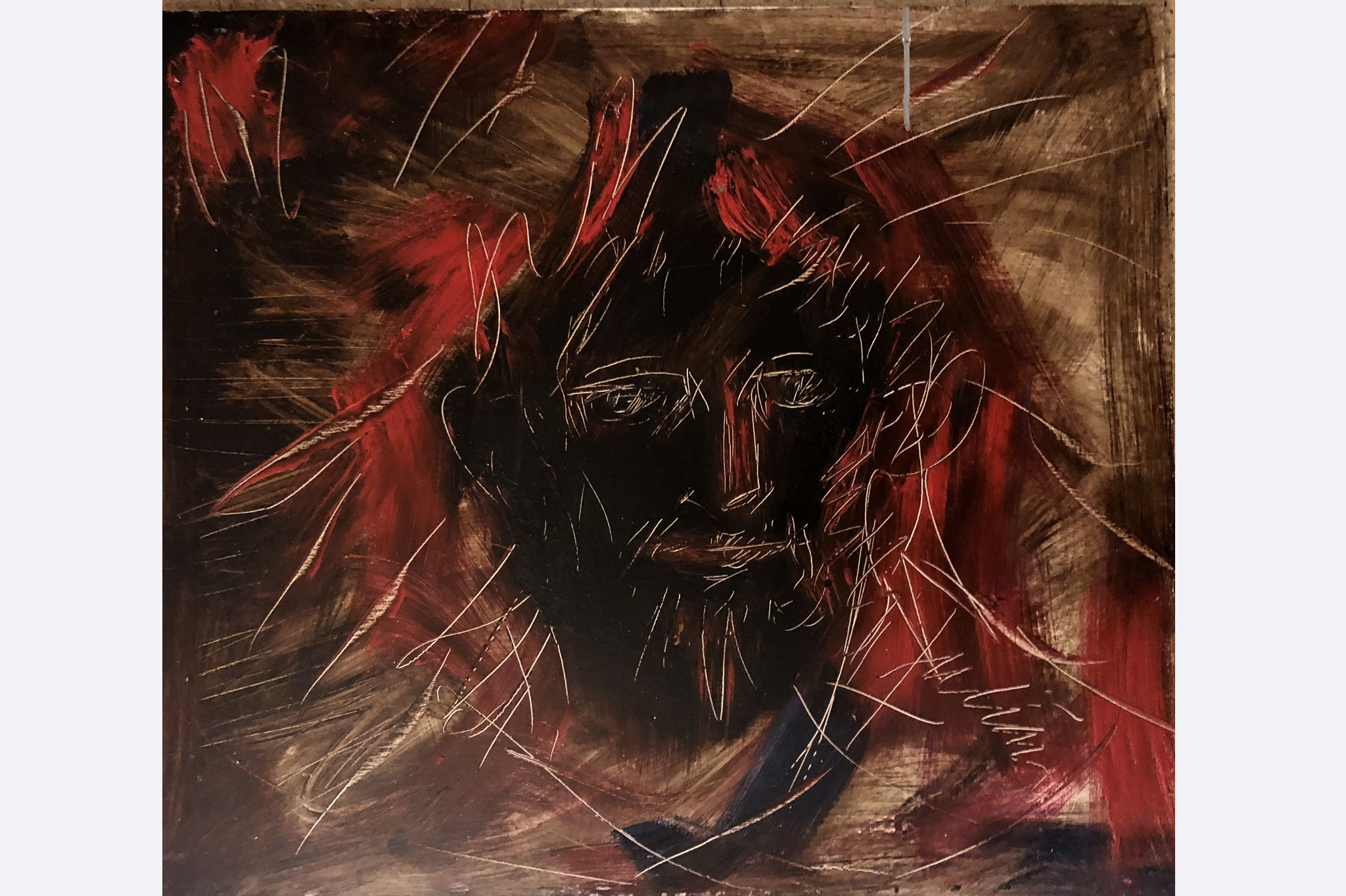
He Apophatic Christ The extraordinary canvas by Julián Pablo, which accompanies today's reflection, painted in his studio at the Santo Domingo Convent in Mexico City a decade ago, emerges like a flash of light amidst the shadows, precisely from the realm of non-being, as an affirmation of life amidst death. This painting is a contemporary visual representation of the mystery of redemption "in the negative," that is, from the reverse side of violent history, where God brings about universal redemption.
May the commemoration of the 1700th anniversary of the Council of Nicaea be a propitious occasion for us to cross the abyss and encounter those who today cry out for life from the realms of non-being produced by systemic violence. These survivors, with dignified rage and eschatological imagination, participate in the divine-human communion as an anticipation of the new world that has come from God, and they call upon the entire human species to celebrate God-with-us.
Puebla de los Ángeles, August 3, 2025