Tag: Re-exists

  • El Espíritu conectando las periferias

    The Spirit connecting the peripheries

    By Carlos Mendoza-Álvarez


    Since the end of the last century, humanity's religions have updated their mission, realizing the growing poverty and injustice in the world, accompanied by wars promoted by corrupt leaders, where religion was used as a weapon of exclusion and violence.

    The Parliament of the World's Religions with the project of a global ethic (Toward a Global Ethic: An Initial Declaration) where the contribution of the Swiss theologian Hans Küng stood out, or the Earth Charter  Promoted by, among others, the Brazilian Leonardo Boff, along with several spiritual leaders, they sounded the alarm to mobilize religions to stop the spiral of hatred that is spreading across the planet, turning to the sources of human interiority that religions have cultivated for millennia as a source of peace.

    However, many of these initiatives, while they managed to raise awareness among their leaders and communities as well as in the media of the urgent task of building peace with justice and truth, did not always listen to the knowledge and spirituality of people and communities in their daily struggles to defend human life, rivers, forests and mineral, plant and animal species that inhabit the face of the earth but are threatened by the sixth mass extinction underway (What is the sixth mass extinction and what can we do about it?).

    Second and third generation liberation theologies, as we have already analyzed in the Mexican context (Liberation Theology in Mexico: Creative Reception of the Second Vatican Council), have shifted the perspective by placing the victims of global violence themselves at the center as "knowers," that is, experts in humanity thanks to the resilience that has transformed into resistance. Above all, it must be emphasized that, from this experience of vulnerability, these survivors have recognized themselves as privileged interlocutors of Divinity. Indeed, the victims seek to re-exist with new modes of communal organization, agroecological work, and diverse spiritualities. These practices emerge precisely from the people and communities themselves who are threatened by systems of domination.

    Feminist ecotheology, developed by Ivonne Gebara (Ecofeminism: A Latin American Perspective) in Brazil and Marilú Rojas (The relevance of ecofeminist theology and its political impact on current femicide and ecocide) in Mexico, took a radical turn in thinking about the interconnections between the faith of excluded women, their violated bodies and territories, as well as their ancestral knowledge of care and resistance as the beginning of a world change where a new face of divine Sophia is revealed.

    Thus, an increasingly clear awareness emerged among religions and social movements to listen to those who live on the peripheries of the world of wealth and privilege, to explore how "another world is possible" from those social and religious margins.


    Since 2015, a group of university students, along with artists and social movements in defense of the territory in Mexico – with the advice of Gustavo Esteva (Center for Intercultural Meetings and Dialogues) and Boaventura de Sousa Santos with his Conversations of the World With several authors from the epistemic South such as Silvia Rivera Cusicanqui – we began to explore ways to decolonize the university and learn to “weave voices for the common home” (Weaving voices). Thus, we learned the demands of attentive listening to those living on the peripheries, who are not only victims but individuals and collectives who create processes of awakening, healing, and embodying together, and thus weave together knowledge that expresses their ways of life, community organization, and their profound spirituality of life.

    In 2019, we continued this path by analyzing various voices of decolonial theology at a conference (Congress on resistance and spiritualities) organized jointly by the Universidad Iberoamericana, Mexico City, the international journal of theology Concilium, and the Dominican University Cultural Center of Mexico to explore together the common features of resistance to systemic violence and the spiritualities that arise from it.

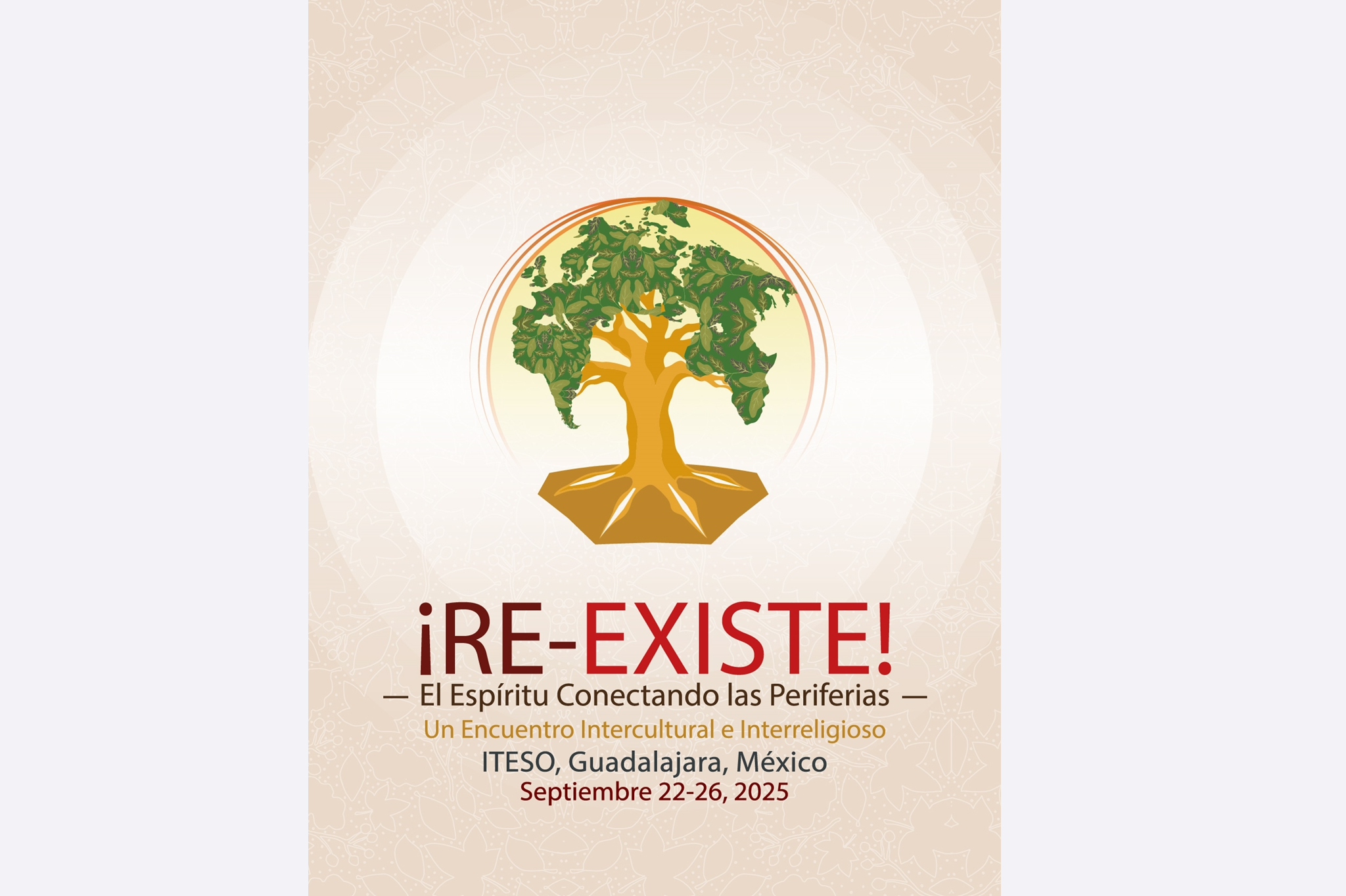
    In 2023, a group of university colleagues, with the support of Mexican civil society organizations and ITESO, the Jesuit University of Guadalajara in Mexico, managed to bring together more than thirty groups from Latin America (Re-Exists! The spirit crossing peripheries) with the aim of understanding the new forms of life, subjectivity, and communality that individuals and communities of survivors are weaving together. We sought a way to glimpse hope amidst the horror of clandestine graves in Mexico, discrimination based on gender, race, and social status, the devastation of Mother Earth, as well as to explore the rituals that emerge from these practices of resistance. graphic memory of that congress, with his documentary that includes some interviews, can give an idea of what we experienced at that meeting.


    Now comes the time for the next phase of Re-exist that will emphasize the connections survivors make and the strength that animates them.

    This time, it is a meeting-festival with two novel and challenging features: interculturality as a way of existence and thought, to "rethink as a species," according to the call of the scientific community, closely linked to interreligious dialogue as the only viable way to approach the sacred.

    We propose to explore together the paths of re-existence in this hour of collapse of the modern civilizational model, where the genocide in Gaza has put humanity in jeopardy and becomes a touchstone for human civilization.

    Through three steps we will explore the wake up in the face of the horror that each collective has faced. We will continue analyzing the heal as personal and collective actions of memory, truth and justice that allow victims to rebuild their lives. Then we will be able to access the moment of support each other with new forms of communality.

    Collectives of women from India facing patriarchal violence in the Hindu, Buddhist, and Christian religions will enter into mutual accompaniment with mothers of the disappeared in Mexico. Caretakers of Mother Earth from the Jesuit mission of Bachajón in Chiapas will dialogue with leaders of the Lakota people who work on collective memory to heal from the colonial past, while recovering their ancestral forms of agriculture through traditional diets, the cultivation of local plants, and the rediscovery of rituals such as the Inipi or ritual bathing which is a creation of communality, or the buffalo dance as one of the main symbols of the sacredness of earth and sky.

    Stay tuned on social media Re-exists 2025 where brief informative capsules, interviews, and graphic memories of these moments will be published, which we hope will be like glimpses of life that resists and re-exists, because the strength of the survivors is animated by the divine Ruah that flutters over chaos to bring forth life in the midst of death.


    Guadalajara, September 20, 2025
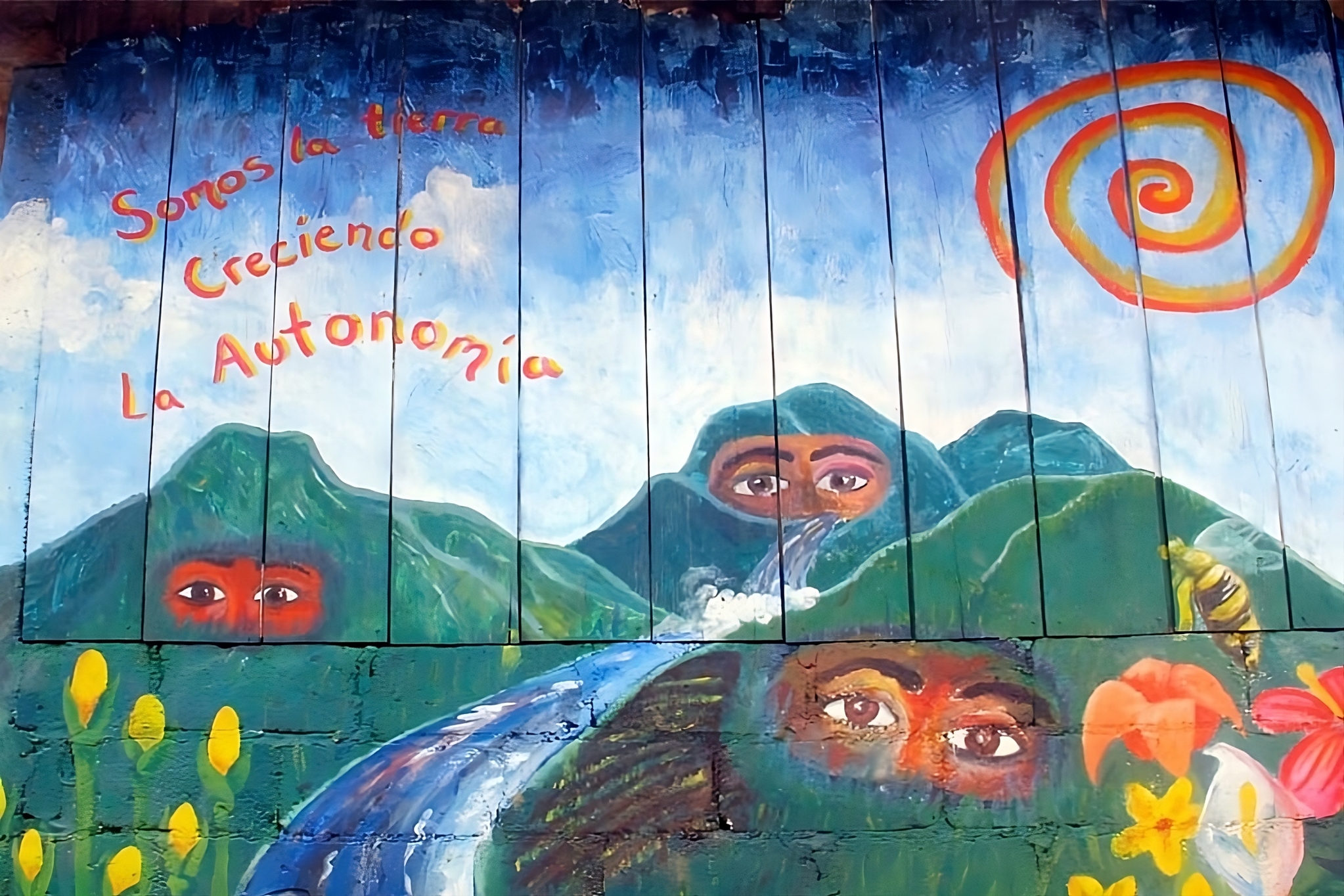
  • Entre aguas y tierra: de Soweto al Caracol MoreliaDetail of a mural, Caracol de Oventic. Sosa, J., Rivero, E., and Wolkovicz, P. (2015)

    Between water and land: from Soweto to Caracol Morelia

    By Carlos Mendoza-Álvarez


    This weekend concludes in Chiapas the International meeting of resistance and rebellions "Some parts of the whole" Organized by the Zapatista bases of young EZLN militia members and their leadership, a new generation has expressed—through plays, concerts, workshops, and dance—the self-criticism of their decades-old movement to reaffirm their worldview and their struggle to build other possible worlds.

    This new generation was born in autonomous territories, after the armed and media uprising of 1994, where their perspective on life and understanding of the world below has enabled them to develop a creative imagination about the human and the cosmic. As Raúl Zibechi astutely points out (Zapatista self-criticism), the meeting represents a valuable innovation in the Latin American left of the last half-century due to its capacity for self-criticism and its persistence over more than three decades in defending its territory, its ways of life, and learning a mode of governance where one “commands by obeying.”


    After my stay in South Africa this summer, I returned to Mexico with a clearer awareness of the connections that exist between the resistances of “those below,” from the refugees on the outskirts of Pretoria and the artists of “combative decolonality” in Soweto, to the Palestinian resistance of the Sumud in Gaza, the West Bank, and everywhere else the clamor to stop the genocide of the Palestinian people emerges from public squares and digital campaigns.

    Driven by this awareness of the urgency of continuing to learn from these social movements and build bridges, I was preparing to participate in the meeting of resistance groups at the Caracol Morelia, when the chaos generated by the storm that hit Mexico City a week ago prevented me from doing so. A massive urban sludge—created by the amount of rain that fell with a force unseen in 73 years, exacerbated by the garbage accumulated in the streets by an indolent citizenry that clogged urban drainage systems, and worsened by the appalling water policy of governments in modern times of chaotic growth in ancient Tenochtitlan—paralyzed the lives of millions of people. I was stranded for hours at the airport, unable to reach southeastern Mexico due to the chaos that lasted into the following days.

    So I had to settle for attending the event virtually, thanks to the online broadcasts made by the organizers (Live broadcast from the Meeting of Resistances and Rebellions "Some Parts of the Whole") and various civil society organizations were present at the Caracol Morelia, near Altamirano, for workshops, plays, and concerts. Among the presentations of resistance to the pyramid of privilege, it is worth highlighting the presence of women's collectives dismantling patriarchy, students creating alternative education networks, farmers resisting extractivism, and settlers confronting gentrification, among many other local, regional, and "intergalactic" initiatives resisting the capitalist and patriarchal hydra.


    However, in my opinion, it remains to be explored in these anti-systemic meetings spiritual resistances of these collectives and peoples. Because it's not enough to expose the strategies of resistance to the many-headed hydra. Nor is it enough to organize networks of solidarity and support between collectives and peoples to dismantle the pyramid of privileges. Rowing against the current often leads to desolation. That's why it's necessary to go to the source from which the fighting hope who does not cease his creative imagination in the midst of catastrophe.

    What inner and collective strength enables surviving individuals and communities living amidst increasing systemic violence to resist? How do they experience an awakening from the destiny imposed by the hegemony that kept them subjugated and made them declare that the world had to change? What processes of personal and collective healing have they developed to strengthen their resistance? How do survivors support, accompany, and care for one another? Because we cannot forget that resistance is a way of life that also involves symbols, rituals, and celebrations, as profound expressions of collective memory that allow for a connection with ancestors, with Mother Earth, and with divinity celebrated in so many ways. This dimension has been cultivated for millennia by the religions and spiritualities of humanity, from shamanism in Mongolia to monotheistic religions and their diverse ways of nurturing peoples to live with dignity and hope.

    As we mentioned a few weeks ago here, in order to explore this spiritual and political source of resistance, a meeting called “Re-exists: The Spirit connecting the peripheries”. A group of sixty people from social and religious movements in Asia, Africa, Europe and our America, together with university people and artists located in the interstices of hegemonic power, will meet to share these and other questions, analyzing the reality we face and nourishing ourselves with ethical-political ideals and ancestral knowledge. We will seek to listen to individuals and collectives of survivors, through words, rituals and workshops, to “heart” what we have learned, crowning each day with an urban performance that will tie up loose ends to recognize the Ruah divine that gives life to the people.

    In every neighborhood and city, in every network of people and communities, the urgency to do something concrete to dismantle the systemic violence that plagues us has awakened. There we can open our imaginations, our hearts, and our intelligence to propose collaborative projects. Community gardens, soup kitchens, meditation groups, performances in public squares, interactive classrooms, research projects in a dialogue of knowledge, and so many other ways of weaving networks of shared care flourish today in the cracks in the walls of the world-system of privilege and greed.

    The storms that create floods and ecological chaos in the city represent a world crumbling. The water that flows down from the mountains to irrigate the land, on the other hand, is like the web of care woven by the survivors of yesterday and today. Let us listen to those who say, "We are the earth growing autonomy," as the Caracol de Oventic mural that accompanies these lines tells us.

    Let us trust in our imaginative capacity to navigate the living waters with their underground rivers that connect Soweto with Gaza, with the Caracol Morelia, and with so many other places of survival, resistance, and re-existence.


    Mexico City, August 16, 2025

  • Voces del extremo sur de ÁfricaJane Tully Heath, Still Life. National Gallery of South Africa, 1998

    Voices from the southern tip of Africa

    By Carlos Mendoza Álvarez


    Nora is a migrant woman from eSwatini, the former kingdom of Swaziland, which was a British protectorate until 1968 for the "legalized" exploitation of minerals, and later became a post-colonial kingdom. She had to flee her homeland after leaving her husband, who humiliated her. Due to the tradition of the Swazi people, once she separated, her family abandoned her to her fate, and she would be unable to remarry if she ever wanted to return to her homeland. Her only option would be to return to her husband and ask for his forgiveness. Nora represents hundreds of thousands of refugees in South Africa fleeing a variety of forms of violence; in her case, it wasn't war or famine, but what they call "domestic violence" here. In our brief but intense conversation, I told her something I learned from the African-American poet and musician Mykki Blanco (Queer black french dance empowerment feat. poetry by Mykki Blanco) about how queer communities live vulnerability with dignity and hope, beginning each day singing: “I am strong because I have no choice, but I am fragile.” Nora cries inconsolably because, in addition to the pain of having lost her baby a few months ago, her sorrow is even deeper because she hasn't been able to bury her in her homeland, as is the custom of the Suasi people. In the middle of our conversation, I share some bread with her, and she sobs in thanks. I tell her to take it on behalf of the people of Mexico, who also know about this and other forms of violence. And I say goodbye with a hug, telling her that something good will come from that open wound in her heart, especially if it opens to the wounds of other women, who for thousands of years have woven networks of mutual care.

    A different story in today's world, coming from refugees who, in the shadows of the shadows of the shadows, reinvent their lives.


    During that same visit to the Suasi kingdom, ruled by a king with many wives and numerous children, a custom persisted that left me speechless. Women must serve food by kneeling before their husbands while serving at the table. A middle-aged woman I met during a meal, a spiritual leader in the community that hosted us, told us that sometimes she herself has to play this role when visiting her husband's family, because if she betrayed this custom, it would be perceived as contempt and would exclude her from the family. During our conversation, I noticed that another younger woman remained silent, smiling skeptically, but without saying a word. And then another diner commented that there is a social movement in the Suasi nation seeking to transition to a republic, to overcome these and other customs that denigrate people, but it has suffered repression. At that same table, I perceived three different perspectives on domestic traditions. Perspectives that are also political and spiritual. Everyone survives as best they can, and there are some forms of resistance that persist without changing the age-old patriarchy, while others resist by overcoming fear and dreaming of other "possible worlds." I then think of our America and its resistances of yesterday and today.

    The next day, when I presented my talk on collective healing and possible hope in times of catastrophe to a large and diverse audience, I carried the stories I had heard the day before in my mind and heart. But, in order to avoid passing judgment on a reality I don't understand and only grasped in glimpses, I mentioned the importance of listening to those who live in the shadows today to discover their power, moving from being victims to survivors, as a key criterion for collective healing.

    The silence I perceived in the audience regarding the public naming of these acts of violence revealed to me a degree of fear, perhaps prudence and ancient wisdom to resist, but creating paths to freedom in secret. The public comments were general. Then, in private, some attendees pointed out to me that the Suasi people know what they face and what they want for their nation. Others came forward at the end to share personal stories of grievance due to sexual discrimination, like micro-stories of vulnerability and resistance.

    Some seeds of hope planted in a small kingdom in the far south of Africa.


    After a month-long stay in South Africa and Swaziland, visiting six cities in both countries, I gradually discovered another face of Mother Africa. Many years earlier, I had visited countries in the north of the continent, with a different demographic profile and social challenges more closely linked to religious violence than interethnic violence. A couple of years ago in Kenya, I met for the first time Black Africans with a living memory of the burden of modern slavery created by European colonial metropolises that built wealthy and powerful empires through genocide and cultural plunder, such as that carried out by the Belgian empire in the Congo.

    But these subjugated peoples fought to free themselves in the 20th century until they achieved political independence, but not autonomy from the coloniality of power-knowledge-being that the great Peruvian Aníbal Quijano analyzed (Coloniality of power, Eurocentrism and Latin America). Unfortunately, many post-colonial states remain subject, as is the case with the rest of the countries in the Global South, to the economic colonialism of the powers in power in their extractive capitalist form.

    Thus, in the far south of the African continent, listening to and conversing with heterogeneous groups of people of various ages, made up of Black, white, and "people of color"—as they call what we in Mexico call mestizos, who are a minority in these lands—I have many stories to continue telling in my travel notes. These are communities that still suffer the scourge of segregation, even after their independence. In South Africa, for example, the communities I visited are aware of the challenge of moving from the process that overthrew apartheid to one day achieving nations of coexistence with an independent and pluralistic state.

    Internal migration within the subcontinent today is massive, driven by wars, famine, and social, ideological, and religious repression, not to mention gender-based violence against queer people, whose lives remain criminalized. As Achille Mbembe recalled a few years ago in Cologne (Bodies and Borders) when talking about deglobalizationThe challenge of the Africanization of the world lies, among other factors, in helping the planet's youngest population transition to democratic, just, and egalitarian societies.

    In my opinion, one of the long-range challenges that Mother Africa gives us today lies in exploring new ways to unite the spiritual tradition of the ancestors and the wisdom of Ubuntu as proposed by Professor Jacob Mokhutso (Ubuntu is under siege: a reflection on the challenges of South Africa then and now) with the predominant Western world. It is about creating other modernities that make room for a ecology of knowledge, according to Boaventura de Sousa Santos's classic decolonial expression. In the midst of these resistances, new forms of Christianity and Islam, Judaism and Hinduism, ancestral religions and queer spiritualities will emerge, beyond their current ideological avatars that produce the annihilation of the different other, such as the Zionism we discussed earlier.


    Following a similar route, next August the Zapatista communities (Call for the meeting of resistances and rebellions "Some parts of the whole") from Chiapas, in southeastern Mexico, call us together to tell each other stories of rebellion against the crumbling hegemonic world system. But above all, to think together about how to build the pyramid of resistance that has homeland, heart, dignified rage, and the imagination of new katuns or cosmic temporality of the Mayan world.

    There I will undoubtedly find a challenging moment to continue “weaving voices for the common home”, as we dreamed of with Pablo Reyna, inspired by the vibrant thought of Gustavo Esteva (Weaving voices). Since then, we began to explore the process of decolonizing the university, thanks to the action promoted in those years by David Fernández at the Universidad Iberoamericana in Mexico City.

    And next September, I'll tell you other stories from an intercultural and interreligious meeting to be held in Guadalajara. This time, it was organized by a group of colleagues from Africa, Asia, Europe, and the Americas who are working with collectives in resistance and hope amidst contexts of systemic violence against women, people in forced migration, families of missing persons, and indigenous peoples in defense of Mother Earth. The name of the event, “Re-exists: The Spirit connecting peripheries”, summarizes our way of contributing to sowing seeds and reaping fruits of resistance that have been nourished by a powerful spiritual and political background as spiritualities of the peoples.

    As I conclude this series on the South African journey, I once again thank you, Mother Africa, for continuing to give birth to new worlds.


    Mexico City, July 19, 2025


English