Tag: structural racism

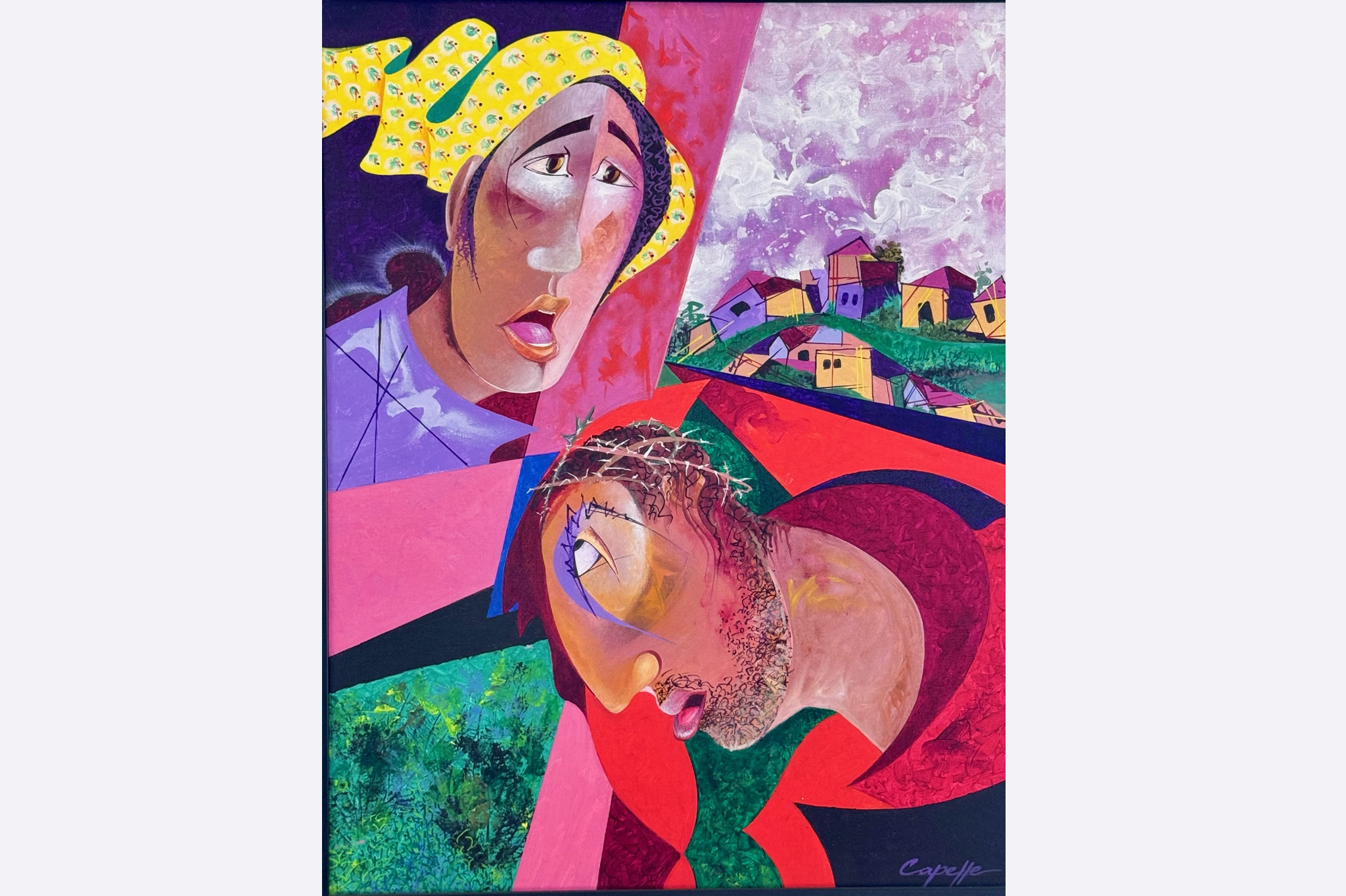
  • Sudáfrica, treinta y un años después del fin de ApartheidCapelle, Joseph. Stations of the Cross, IV: Jesus meets his mother, St. Martin de Porres Parish, Soweto, 2015

    South Africa, thirty-one years after the end of Apartheid

    By Carlos Mendoza Álvarez


    A Congolese refugee camp on the outskirts of Pretoria welcomes a small group of people from universities and churches interested in learning about their lives and stories. Ten families, each with four or five young children and some elders, greet us on the esplanade on a cold South African winter afternoon. Our guide is Lance Thomas, a colleague from the Centre for Faith and Community at the University of Pretoria (UP), who told us about his decolonial vision of accompanying vulnerable groups of houseless people and refugees. This is a splendid project that the university has been developing for more than ten years.

    During my visit to the UP a few days ago, I was struck by the creativity of this university community in connecting, among other ongoing projects, the world of unhoused people with different academic departments such as architecture, sociology, and theology, promoting a practical theology “on the street.” The recent inaugural lecture of the academic year by Prof. Stephan de Beer, discussing ways of building community and its spiritual dimension, while accompanying houseless families in creating projects to recover living spaces, is a prime example of this decolonial way of doing theology.

    Along the way, Lance warns us of the importance of not falling into the trap of victimization and the spontaneous desire to provide financial aid to the community we are about to visit. The aim is to see the conditions of that community up close to seek support strategies that address, as far as possible, the systemic causes that subject more than 250,000 refugees in South Africa from Burundi, the Democratic Republic of Congo, Rwanda, South Sudan, Somalia, and Zimbabwe, according to UNHCR.

    As I listen to Lance, I am strongly reminded of Ivan Illich’s warning never to lose sight of the importance of conviviality with others, as well as the friendship with the poor that was at the heart of Gustavo Gutiérrez’s liberation theology. Without falling into the trap of emotional manipulation, I resolved to be alerted to connect both poles: to think systemically and act compassionately.

    During spontaneous conversations with those who approached us at the camp to chat, I was struck by the deep gaze, as if open to painful memories, of two elderly people who told us stories of the seven years that had passed since they fled the war in the Democratic Republic of Congo. They have been jumping from one United Nations refugee camp to another in South Africa. Some were imprisoned for two years. The children who flit around with generous smiles and wide eyes “don't know what school is,” one of the community leaders tells me.

    A woman with an emphatic voice insists again and again on the discrimination they suffer as families from “their own South African brothers.” She shows me the document that UNHCR gave her seven years ago. Her only identity document, almost destroyed by the passage of time and dampened by her nervous hands, is not accepted by any South African authority. Another man approaches, full of anger and pain, saying that they can’t take it anymore and that if they don’t receive humanitarian aid, they will soon die. The woman returns, her voice desperate, to say that their neighbors threaten them at night and tell them to leave, to go back to their country. “But we have nowhere to go back to,” she says, heartbroken.

    One of our group members spent the entire time talking to one of the young women who is pregnant. The risk of inadequate medical care for her and her baby is real, due to the growing refusal of clinics in the country to accept refugees without valid permits. They immediately form a network of sisterhood.

    The impact of this visit, which I shared with a close group of friends and family in Mexico, sparked a desire to do something together with that refugee community. I will soon let you know here what we can do together.


    I told this story a few days later to those who attend my talks on “Collective Healing and Community Hope.” It is a mixed group of South Africans, white and “of color,” elders and young people, some of them documented immigrants. They are part of a pastoral network in Cape Town and neighboring cities. We talk about the abyssal line that separates the world of privilege from that of exclusion. I emphasize the intersectionality that must be discovered between the various narratives of “coming out” of those who live in the shadows of poverty, gender violence, racism, ableism, and so many other stories of domination in our unequal societies. The audience immediately connects with the narrative that makes people with disabilities visible, but they are reluctant to recognize the connections with the narratives of queer/cuir Social justice concerns them, but even gender equality makes them uncomfortable. I take my talks a step further, talking about refugees in South Africa and my recent visit to a community in that country, describing them as those who live “in the shadows of the shadows of the shadows,” evoking Frantz Fanon’s powerful metaphor of “the zone of no-being" (Black skin, white masks). And the audience begins to open their minds and hearts, little by little, to discover the power, beauty, and spirituality in those who call us to cross into the “zone of no-being,” to dare to name the systemic violence that concerns us all, and to begin processes of mutual recognition, listening, and personal and communal transformation.


    I realized then that when we talk about reconciliation with the South African people, we touch on a wound that is still open, even after decades of post-apartheid. “We are still segregated,” writes a colleague in a “silent conversation” we have as part of the afternoon workshop, commenting on flipcharts about violence in today's world. Thirty-one years after the collective trauma of apartheid for the peoples who inhabit these lands, no effective agrarian reform has yet been implemented, as 60% of the land belongs to white Afrikaners, contrary to the lies spread by Trump, who recently welcomed fifty Afrikaners as refugees fleeing “black persecution”. Another cynical deception by the dictator in office on land stolen from the indigenous peoples of North America. The distribution of wealth in the country of diamonds and tanzanite remains stalled by the corruption of the black elites who govern the country today. Many post-apartheid youths admire Elon Musk and Trevor Noah, hoping to one day migrate like them to the Big Apple or Los Angeles. Their dream is now reflected in the artificial world of the Netflix series “The Kings of Jo'burg", which is perceived by critical South African youth as a crude “Americanization” of life in this country.

    The wound of national reconciliation in the rainbow nation of Mandela and Desmond Tutu's time remains open. There is certainly skepticism in the country about its corrupt political class, as in my beloved Mexico. There is a certain resignation in the face of the failure of democracy, although small pockets of critical communities resist. The "3rd Black Power Pan-Afrikanist Decoloniality Winter School”, which will take place in Soweto at the end of July as a festival of combative decoloniality, will present another face of South Africa. One that emerges from the ancestral knowledge of African peoples.

    There is hope that South Africa, as the elder sister of the resistance movements of our times, will awaken from its slumber.


    Cape Town, July 5, 2025

  • Adiós, “America”.Photo by Elizabeth Scholl for The Huntington News

    Goodbye, “America.”

    By Carlos Mendoza-Álvarez


    Since I was a child, I have had an ambivalent relationship with American culture. On the one hand, enjoying its cartoons like every childhood of the 20th century, then its multicultural music, from the jazz we listened to at family parties and the rhythms of the time like Twist  and Rock & Roll, that moved the elders at home to dance. Baseball, “the king of sports,” was the sport we enjoyed most at home, which my dad and my family passionately followed on the radio and later on television. I experienced the Apollo 13 moon landing as a 9-year-old boy in front of the television, admiring the latest marvel of human civilization.

    But I also remember reading the newspapers and watching TV scenes of Uncle Sam's constant military invasions around the world as a teenager, with the sad stories of the wars promoted by US imperialism during the Vietnam era. As a high school student, I became more aware of US interventions in Latin America, from its support for dictatorships in South America to the CIA's funding of paramilitary groups to dismantle guerrilla movements across the continent and in my own country.


    My education in Mexico laid the foundation for critical thinking, first at the Benemerita Autonomous University of Puebla, where I began studying philosophy, and then at National Autonomous University of Mexico (UNAM for its acronym in Spanish), where I completed my bachelor's degree, though I didn't graduate, following the advice of my Dominican superiors. Postgraduate studies in Switzerland and France opened my eyes to new perspectives on the traditions of European phenomenological thought and contemporary Hebrew philosophy.

    I never imagined living for a long time in “the heart of the empire” until an invitation arrived from Boston College, (BC) to join its prestigious Theology Department. I arrived in Massachusetts at the height of my academic career after 25 years of teaching and research in Mexico, Switzerland, France, and Chile, to build bridges between the South and the North through classes in liberation theology and Latin American thought. But my background also included, to the surprise of my Boston colleagues, decolonial thought and queer theory. These are three avenues I explored and connected over the years to reflect on the crisis of modernity and its effects on the experience of subjectivity open to the revelation of another world.

    I was received with great professional attention by the BC authorities and with polite respect for my colleagues, recognized as the best in their disciplines in the international academic world, according to the dominant model of knowledge. I began my work in January 2021, in the middle of winter and during the critical phase of the pandemic. The campus seemed like a ghost town, frozen in time by the frigid cold and the mandated lockdown. I offered my first classes in through a hybrid model, with half the students in the classroom wearing masks and the other half online. I survived the first year of isolation thanks to the invaluable support of Sole, a beloved Chilean doctoral student who served as my teaching assistant, and Neto, a kind-hearted Salvadoran colleague.

    Once established as a Senior Scholar, I threw myself into teaching, discovering to my surprise the tremendous workload entailed in an educational model that prioritizes the undivided attention of the "instructor" over students who follow instructions to the letter, with little creative imagination to independently search for sources, problematize topics, and suggest new interpretations. It was also important to adapt the bibliography to English only texts because the students didn't read other languages. To top it all off, I discovered that Spanish wasn't recognized as a "scientific language." Then the warning signs went off, as I began to perceive the power of white academia, still present on the East Coast of the country, so famous for its liberal thinking, but ultimately with an internalized colonialism yet to be defused.

    I set about immersing myself in this experience of a new educational model, abandoning my initial intention upon accepting this invitation, which was to focus on writing two outstanding books to complete my second theological trilogy, this time on the idea of "tradition" that communicates divine revelation according to the Christian narrative. Those manuscripts are still on my desk. I sensed it was important to pursue the research in another way, so I began a project called Beyond Global Violence Initiative (BGVI) as a platform for promoting academic conversations with colleagues from the South and North on pressing issues facing the humanities today. Thanks to the initial support of academic authorities and, above all, the generosity of colleagues from various latitudes who responded to the invitation, I was able to organize five colloquia to weave collective reflections on modern subjectivity in the face of civilizational catastrophe, following the path of phenomenology, mimetic theory, and apophatic thought. A book in progress on political theology, scheduled to appear in 2026, will be the rich harvest of these gatherings.


    The initial academic project of building bridges between South and North was going well until we welcomed Palestine. Then I began to perceive the strangeness, later transformed into suspicion, and finally into distrust, on the part of some colleagues and academic authorities regarding these investigations with their social and political implications, of openly critiquing the theologies of empire, such as in its form of Israeli or Christian Zionism. With some fellow professors, doctoral students, and a few undergraduate students who shared this concern about the ongoing genocide of the Palestinian people, we organized two academic events to learn about current Palestinian thought. But I began to receive messages of "concern" from academic authorities and outright rejection from some students who, emboldened Trump supporters, openly and at times aggressively expressed themselves against decolonial critique of extractive capitalism, heteronormative patriarchy, and white supremacist racism.

    The fear promoted by the Trump administration since its first term grew massively from the beginning of its second term. It focused on controlling thought in American universities. Its strategy became more aggressive since taking office in January 2025. Through "hate rhetoric"—analyzed through a mimetic lens by the Brazilian colleague João Cezar de Castro Rocha, first in Brazil and then in the United States and other far-right countries in government—the movement Make America Great Again (MAGA) increasingly and viciously controlled minds and universities through social media and censorship policies. The problem wasn't just Trump, but the more than 70 million voters who supported him and who, even amid the US geopolitical military expansionism, continue to subscribe to his imperial dictatorial policies (on immigration, gender, and white supremacist racism), all of which are amalgamated with the "theological" ideology of political messianism.

    American colonialism is closely linked to Israeli Zionism and both are part of the new phase of the coloniality of power, with its replicas in far-right movements around the world, as the Puerto Rican thinker Nelson Maldonado-Torres has put it with the idea of the "principle of coloniality" (The US at 250, Coloniality, and Political Zionism in Perspective).Therefore, theology as critical thought, which emerges from the life and practice of Christian communities in diverse contexts who experience the glimmerings of redemption, is urgently called to dismantle this false political theology. Failure to do so justifies the imperial narrative.

    An event scheduled for last April as part of our BGVI research project sought to reflect, together with Hilari Rantisi (Centering Human Life, Disrupting Injustice Without Replicating It), a Palestinian-American colleague at Harvard, on peacebuilding in times of war, comparing Zionist colonialism in Palestine with British colonialism in Kenya's recent past. We had organized it with a BC colleague, but ultimately decided to cancel it due to institutional pressure and to avoid the real risk of deportation and even criminalization for those of us who are foreign professors and students, since we could have been accused of supporting "terrorist groups" and threatening national security.

    In that tense atmosphere, BC no longer offered me the necessary security to continue my theological work, to the point of offering me private legal assistance in case of emergency, not institutional, but rather a lawyer specializing in immigration matters. So, with the support of my Dominican religious superior in Mexico, I decided to resign from BC at the end of the spring academic semester to return to my homeland and continue my theological work in freedom.

    The climate of self-censorship that spread like a contagion was most evident when I said goodbye in a letter from my colleagues at BC. I received a single, empathetic response that emphasized "the emotional effects" I suffered from this veiled censorship, without commenting on the reasons for my resignation or the call I made in my letter to reconsider what kind of theology we were pursuing at that university.


    Today, as I conclude my institutional collaboration with Boston College,I write these lines to say "Goodbye, America." That name stolen from the entire continent, but which, in Spanish and Portuguese, as Maria Clara Bingemer, my dear Brazilian colleague, says, we write with an accent, "América." I will not use that name again to refer to a country that has based its two-and-a-half-century history on the theft of territories, fueled by a messianic colonialism of the invasions of American and Caribbean lands, planning and financing constant wars of dominion across the planet. I say goodbye to its theology of dominion and prosperity, disguised as democracy and the free world.

    To my US colleagues who remain silent in the face of their government's imperialism, I hope they may soon awaken from the slumber that has lulled them, whether out of fear of censorship or the complicity of white colonial privilege that prevents them from seeing the corruption of the power that shelters and protects them, based on the global war of the Western world system that creates more and more victims crying out to heaven.

    The giant has feet of clay and will one day fall. Meanwhile, those of us who stand in the crevices of power, wherever we are, weave other ways of life, from the inner freedom of thought and solidarity, from the social, political, academic, and religious peripheries.

    Ivan Illich and Gustavo Esteva, walking with Jean Robert, Sylvia Marcos, and peoples in resistance like the Zapatistas in the epistemic South, opened up the path of life for “deprofessionalized intellectuals” as listeners to peoples in resistance.

    On these routes, fruitful dialogues are woven: South-South, South-North, and many other geographical, political, and spiritual directions, sowing the seeds of new worlds.

    Goodbye, “America.” Hello, free world.


    eGoli / Jo'Burg, June 29, 2025

English