
By Carlos Mendoza-Álvarez
Since the end of the last century, humanity's religions have updated their mission, realizing the growing poverty and injustice in the world, accompanied by wars promoted by corrupt leaders, where religion was used as a weapon of exclusion and violence.
The Parliament of the World's Religions with the project of a global ethic (Toward a Global Ethic: An Initial Declaration) where the contribution of the Swiss theologian Hans Küng stood out, or the Earth Charter Promoted by, among others, the Brazilian Leonardo Boff, along with several spiritual leaders, they sounded the alarm to mobilize religions to stop the spiral of hatred that is spreading across the planet, turning to the sources of human interiority that religions have cultivated for millennia as a source of peace.
However, many of these initiatives, while they managed to raise awareness among their leaders and communities as well as in the media of the urgent task of building peace with justice and truth, did not always listen to the knowledge and spirituality of people and communities in their daily struggles to defend human life, rivers, forests and mineral, plant and animal species that inhabit the face of the earth but are threatened by the sixth mass extinction underway (What is the sixth mass extinction and what can we do about it?).
Second and third generation liberation theologies, as we have already analyzed in the Mexican context (Liberation Theology in Mexico: Creative Reception of the Second Vatican Council), have shifted the perspective by placing the victims of global violence themselves at the center as "knowers," that is, experts in humanity thanks to the resilience that has transformed into resistance. Above all, it must be emphasized that, from this experience of vulnerability, these survivors have recognized themselves as privileged interlocutors of Divinity. Indeed, the victims seek to re-exist with new modes of communal organization, agroecological work, and diverse spiritualities. These practices emerge precisely from the people and communities themselves who are threatened by systems of domination.
Feminist ecotheology, developed by Ivonne Gebara (Ecofeminism: A Latin American Perspective) in Brazil and Marilú Rojas (The relevance of ecofeminist theology and its political impact on current femicide and ecocide) in Mexico, took a radical turn in thinking about the interconnections between the faith of excluded women, their violated bodies and territories, as well as their ancestral knowledge of care and resistance as the beginning of a world change where a new face of divine Sophia is revealed.
Thus, an increasingly clear awareness emerged among religions and social movements to listen to those who live on the peripheries of the world of wealth and privilege, to explore how "another world is possible" from those social and religious margins.
∂
Since 2015, a group of university students, along with artists and social movements in defense of the territory in Mexico – with the advice of Gustavo Esteva (Center for Intercultural Meetings and Dialogues) and Boaventura de Sousa Santos with his Conversations of the World With several authors from the epistemic South such as Silvia Rivera Cusicanqui – we began to explore ways to decolonize the university and learn to “weave voices for the common home” (Weaving voices). Thus, we learned the demands of attentive listening to those living on the peripheries, who are not only victims but individuals and collectives who create processes of awakening, healing, and embodying together, and thus weave together knowledge that expresses their ways of life, community organization, and their profound spirituality of life.
In 2019, we continued this path by analyzing various voices of decolonial theology at a conference (Congress on resistance and spiritualities) organized jointly by the Universidad Iberoamericana, Mexico City, the international journal of theology Concilium, and the Dominican University Cultural Center of Mexico to explore together the common features of resistance to systemic violence and the spiritualities that arise from it.
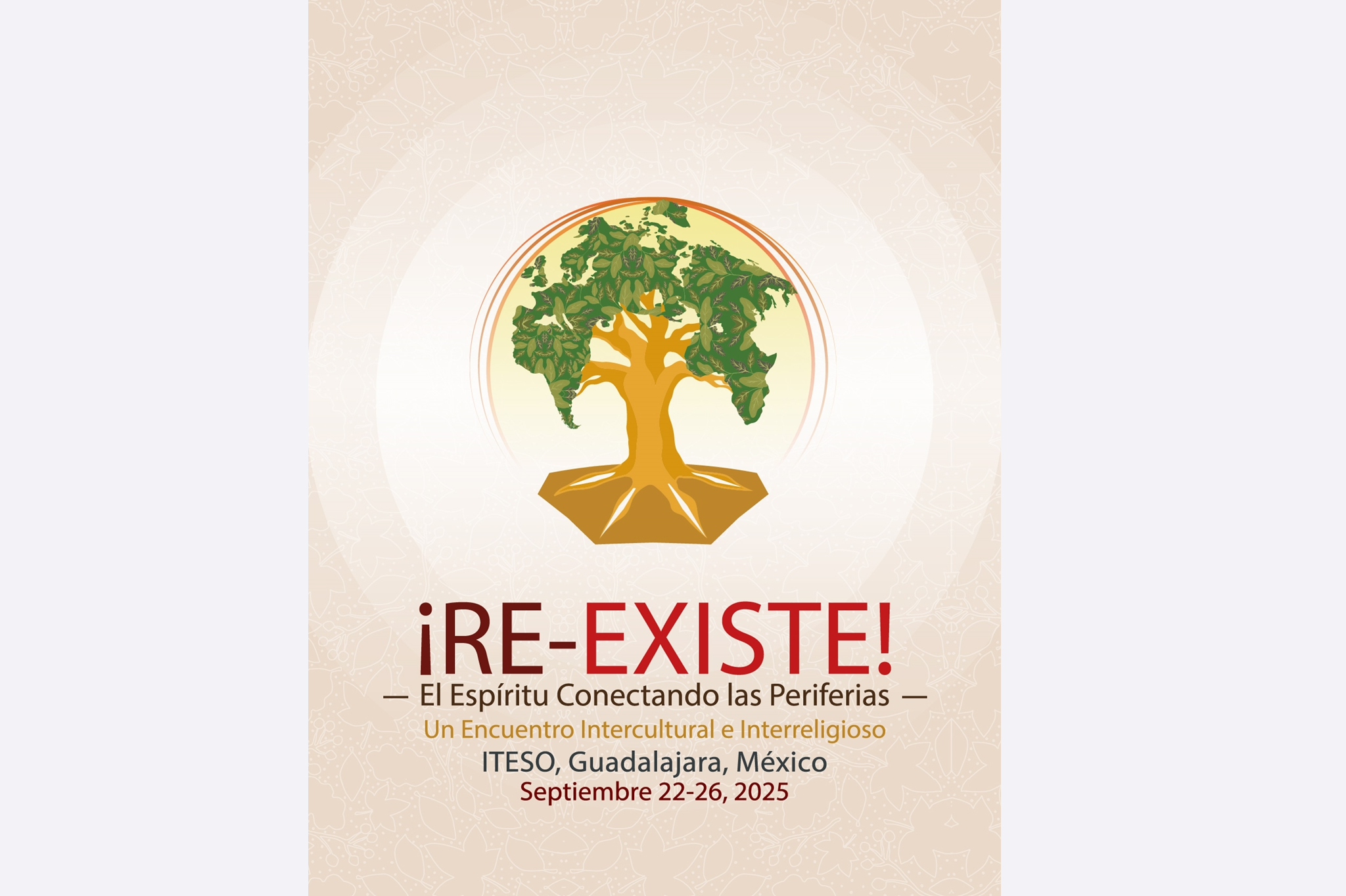
In 2023, a group of university colleagues, with the support of Mexican civil society organizations and ITESO, the Jesuit University of Guadalajara in Mexico, managed to bring together more than thirty groups from Latin America (Re-Exists! The spirit crossing peripheries) with the aim of understanding the new forms of life, subjectivity, and communality that individuals and communities of survivors are weaving together. We sought a way to glimpse hope amidst the horror of clandestine graves in Mexico, discrimination based on gender, race, and social status, the devastation of Mother Earth, as well as to explore the rituals that emerge from these practices of resistance. graphic memory of that congress, with his documentary that includes some interviews, can give an idea of what we experienced at that meeting.
∂
Now comes the time for the next phase of Re-exist that will emphasize the connections survivors make and the strength that animates them.
This time, it is a meeting-festival with two novel and challenging features: interculturality as a way of existence and thought, to "rethink as a species," according to the call of the scientific community, closely linked to interreligious dialogue as the only viable way to approach the sacred.
We propose to explore together the paths of re-existence in this hour of collapse of the modern civilizational model, where the genocide in Gaza has put humanity in jeopardy and becomes a touchstone for human civilization.
Through three steps we will explore the wake up in the face of the horror that each collective has faced. We will continue analyzing the heal as personal and collective actions of memory, truth and justice that allow victims to rebuild their lives. Then we will be able to access the moment of support each other with new forms of communality.
Collectives of women from India facing patriarchal violence in the Hindu, Buddhist, and Christian religions will enter into mutual accompaniment with mothers of the disappeared in Mexico. Caretakers of Mother Earth from the Jesuit mission of Bachajón in Chiapas will dialogue with leaders of the Lakota people who work on collective memory to heal from the colonial past, while recovering their ancestral forms of agriculture through traditional diets, the cultivation of local plants, and the rediscovery of rituals such as the Inipi or ritual bathing which is a creation of communality, or the buffalo dance as one of the main symbols of the sacredness of earth and sky.
Stay tuned on social media Re-exists 2025 where brief informative capsules, interviews, and graphic memories of these moments will be published, which we hope will be like glimpses of life that resists and re-exists, because the strength of the survivors is animated by the divine Ruah that flutters over chaos to bring forth life in the midst of death.
Guadalajara, September 20, 2025