Tag: peace

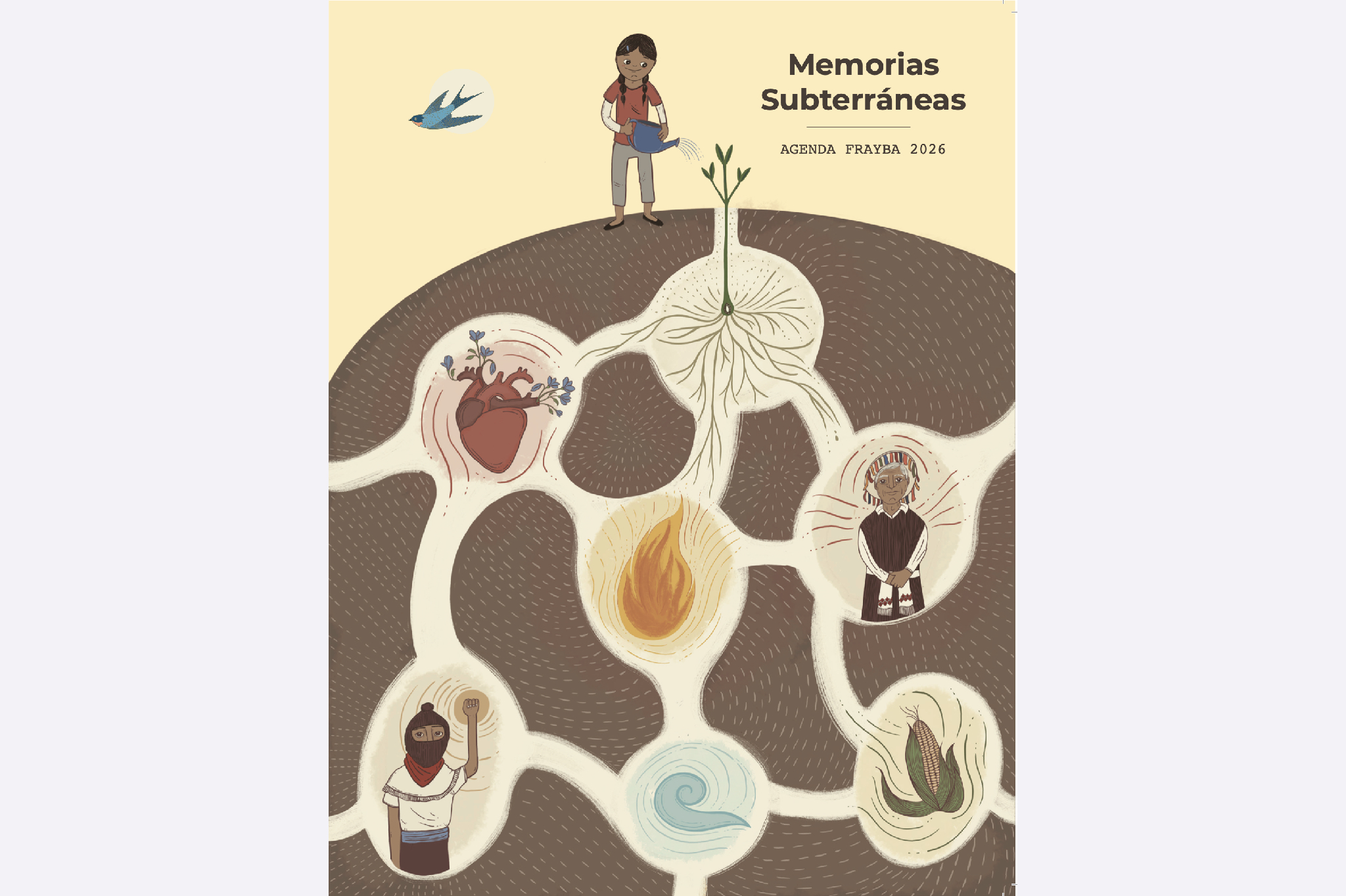
  • La paz como caminos de insurrección mesiánica Sobre la Agenda Frayba 2026 Memorias subterráneasGabriela Soriano | Underground Memories | San Cristóbal de las Casas, Chiapas | 2026

    Peace as a path to messianic insurrection About the Frayba Agenda 2026 Underground Memories

    By Carlos Mendoza Álvarez

    Last Wednesday, the presentation of the fifteenth edition of the Frayba Agenda Titled “Underground Memories,” it was prepared by the Fray Bartolomé de Las Casas Human Rights Center in Chiapas. This annual publication, since 2011, preserves the living memory of the actions carried out in the promotion and defense of the human rights of the indigenous peoples of Chiapas, as well as of people in forced migration and refugees, who have been supported by this civil society organization over several decades. Frayba -as this organization is affectionately called- was born inspired by the winds of conciliar renewal of the diocese of San Cristóbal de Las Casas and the social processes that emerged as an expression of the indigenous movement of the second half of the twentieth century.

    Three articles reflecting on the local, regional, and national context—by Jorge Santiago, founder of several ecclesial and civil organizations, Susana Montes de la Commission for Support of Community Reconciliation (Coreco) and an interview with Carlos González, a member of the Coordination of National Indigenous Congress of Government Created by Pedro Faro, these are accompanied by a valuable graphic record of the key moments of three decades of peacebuilding in Chiapas. The editorial design and illustrations by Gabriela Soriano Segoviano reflect, with beautiful strokes of contemporary folk art, the connections of the underground memories of resistance that inspire the indigenous peoples of today, as well as civil society and the churches that walk with them.

    Below, I transcribe my participation in the round table discussion, on that rainy afternoon in San Cristóbal de Las Casas.

    “There is no path to peace, peace is the path”

    Mahatma Gandhi

    This year we are commemorating three decades of peacebuilding in Chiapas: Frayba, Coreco, Sipaz, the National Indigenous Congress, the Zapatista Movement, the San Andrés Accords, and many other initiatives of civil society, churches, and social movements. These networks emerged from the fertile soil of Chiapas, prepared more than six decades ago by the pastoral plan of the Diocese of San Cristóbal with the arrival of Bishop [name missing]. jTatik Samuel Ruiz, who, after an arduous and patient conversation and journey with the native peoples, led to the birth of an indigenous Church.

    A decade later, the Indigenous Congress of 1974 fostered the emergence of a collective consciousness among Indigenous peoples as historical subjects. And finally, the rise of the Zapatista movement, with its support bases and militias, proposed a different way of living and creating the political sphere as a shared endeavor. All these processes were accompanied by a vibrant and creative current of critical thought, which arose in the Highlands of Chiapas and the canyons of the Lacandon Jungle throughout the second half of the 20th century.

    The San Cristóbal School, so named by Pablo Romo, along with the Cuernavaca School, analyzed by Humberto Bech, have been, in my opinion, the two main Mexican contributions to critical thought in the second half of the 20th century. Both provide us today with a precise direction for confronting with clarity the growing spiral of systemic violence that, with the Puerto Rican decolonial thinker Nelson Maldonado-Torres, we call here the Great Catastropheand.

    Jorge Santiago's reflection on the Frayba Agenda 2026. Underground Memories The work we present today rightly underscores the centrality of the San Andrés Accords as a crucible of decades of struggle for peace with justice and dignity. The thinker from San Cristóbal points out that the historical demands of Indigenous peoples remain relevant, and that the Mexican state still owes a debt for honoring these historic accords.

    Two pastoral letters from jTatik Samuel Ruiz and Don Raúl Vera prepared the celebration of the Third Diocesan Synod, which took place from 1995 to 1999. This process allowed the diocese to reap the harvest of half a century of pastoral life and thus give a clear path of synodality to the life and commitments of this diocese. Both letters arose in a context of uncertainty due to the animosity and conflict on the part of Vatican authorities of that time, fueled by the Club of Rome, or a group of Mexican bishops who were declared enemies of liberation theology in Mexico and Latin America.

    The first pastoral letter So that justice and peace may meet (1996) is an ecclesial response to the armed uprising of 1994. It reflects the struggle for land by indigenous peoples, as well as the commitment to justice and peace made by this diocese, following the impetus of the Second Vatican Council and the Second General Conference of Latin American Bishops in Medellín. The second pastoral letter From pain to hope, The agreement, signed by both bishops in 1998, after the Acteal massacre, is a commitment to hope amid the pain of the survivors and a pledge to continue seeking peace with justice and dignity.

    The Vatican's violence against this pastoral project would later be unleashed against Don Raúl Vera, who was transferred to the Diocese of Saltillo on December 30, 1999, in a failed attempt to dismantle the synodal process. What his detractors never imagined was that this perverse decision would become the opportunity to sow the seeds of a liberating Church, now in lands of mining extraction and gender violence, which Don Raúl would embrace with fidelity to his mission as a pastor in those desert lands of northern Mexico.

    Finally, I would like to make two final comments to continue the conversation.

    The challenges of moving forward, after three decades of peacebuilding, are now unprecedented, as we find ourselves in the uncertain moment of civilizational collapse. A commitment to justice for Indigenous peoples is no longer enough; it is essential to integrate other forms of justice, such as gender justice (sexual diversity) and ecological justice, to understand the rebellions. transmodern that build individuals and collectives of survivors in contexts of global violence. The historical strength of the poor, which the first generation of liberation theology envisioned, is giving way to the unsubmissive reason of social and ecclesial movements that are already weaving networks of mutual support, dignity, resistance and diverse re-existences.

    It is also time to reformulate the theoretical framework for thinking about systemic violence. Liberation theology requires a radicalization that arises from dialogue with decolonial thought and theory. queer/cuir /queer and intersectionality to continue supporting peace processes, transitional justice, and diverse spiritualities of life that face the ongoing Great Catastrophe.

    Let us not forget that it is our task to honor the legacy of the ancestors of the liberating Church, but from the new subjectivities, bodies and territories in resistance, with the fruits of thought, art and spirituality that emerge as messianic insurrections anticipating other worlds, of dignity and life for everyone.

    The spirituality of messianic time is an interruption of the linear time of that Chronos that devours its children on altars of bloody sacrifices. Such a messianic force arises as an insurrection. peaceful In the face of systemic violence, that is, as a break from the vicious cycle of rivalry and violence, to establish processes of mutual recognition, beyond the violence that produces poverty, exclusion, and subjugation to hegemonic powers. It is a spirituality of life in the midst of death. Another time that (in)emerges as an anticipation of other possible worlds from the survivors of yesterday and today.

    Next Wednesday, March 25, at 6 p.m., we will continue our discussion on critical thinking emerging from Chiapas, with reflections by Pablo Romo on the San Cristóbal School and experiences of a spirituality of mutual support amidst violence, presented by our friend and Peruvian colleague Juan Carlos La Puente. Both reflections will be followed by a dance performance by Martha Elena Welsh.

    See you at the restaurant Belil, in the historic center of San Cristóbal de Las Casas, where with Ricardo and Carmen as hosts, along with Angélica and Abraham, we will continue opening dining spaces, where resistances and spiritualities emerge as a commitment to permanent dialogue and mutual support in the care of life.

    San Cristóbal de Las Casas, March 7, 2026

  • Tiempo de guerra y tiempo de pazRutger van der Tas | Absolution | 2023

    Time of war and time of peace

    By Carlos Mendoza-Álvarez

    We began the new year 2026 with the deployment of US military might very close to us in the Caribbean Sea. This was the setup for the extraction in Caracas of the illegitimate president Nicolás Maduro and his wife, kidnapped in the name of foreign justice to be taken to a court in New York where they are accused of criminal conspiracy related to drug trafficking.

    This new expression of warfare in today's tripolar world, created after the pandemic by the United States, China, and Russia, was already foreseeable. Russia's invasion of Ukraine, China's threat to Taiwan, and the genocide of the Palestinian people by the state of Israel with the tactical support of the United States are all part of this new geopolitical strategy.

    But we ignored these signs in the Western Hemisphere. We thought that Latin America and the Caribbean would be safe from Uncle Sam's neocolonialism because they had overcome his political and military interventionism during the era of the military dictatorships of the last century. We believed in party-based democracies, which took the reins of left-wing and right-wing governments throughout the region. Under the illusion of these party-based systems, we were unable to see how networks of corruption were being woven between political parties, business groups, governments in power, increasingly sophisticated criminal organizations, and transnational corporations, forming the very fabric of the extractive society of which we are part as unrestrained consumers of superfluous goods, indifferent to "the political" as everyone's task.

    Today it is necessary to recognize that we are also part of the problem of this neocolonial war with various fronts that has already reached our territories and entered our homes.

    On social media, hateful phrases are increasingly circulating, used to criticize anyone who comments on the corruption occurring in Mexico under the Fourth Transformation, or in Venezuela denouncing Chavismo, or in the United States pointing out the ICE executions in Minneapolis and Chicago as a mercenary power serving the ideology of [the regime/the regime]. Make America Great Again (Maga). It seems that it's all the same to insult someone with a single phrase on Facebook, Instagram, and TikTok, and then justify a deranged mercenary shooting a woman point-blank in the head for driving a car that failed to stop despite police threats on a street in her neighborhood, which was being raided by immigration police. Even in our closest digital conversations, this practice of resolving differences with a single phrase and a click, blocking those who disagree with us as if it were a virtual gunshot, is growing.

    Differences worth confronting in a face-to-face dialogue, which we avoid as much as possible because it makes us uncomfortable. Why does this proximity frighten us so much? It seems as if the world of war has been encapsulated within the screens of our cell phones, tablets, or computers, only to then spill out onto the streets with the same necrophilic clinical precision, using pepper spray or an AK-47 rifle. The time of war has already entered those "black mirrors" that devour us mercilessly, shifting from praise to insult with the same speed with which our thumb swipes wildly across the screen. scrolling or swiping on the cell phone screen.

    Time of territorial and digital warfare.

    “Everything has its time,” says the book of Ecclesiastes. This beautiful biblical wisdom text is a contemplative meditation on war and peace, addressed to a people seeking their place in the Hellenistic world of their time. “A time to throw stones into the river, and a time to gather them up.” Thus the Qohelet, or Hebrew sage, expresses the inexorable law of life, lived in the ebb and flow of love and hate, a law celebrated by poets of so many cultures. “A time to embrace and a time to refrain from embracing,” he continues, in a more personal tone, speaking of love and heartbreak. And to complete this realism, bordering on self-denial in the face of the inevitable, he concludes with a laconic ending: “A time for war and a time for peace.”.

    Will we have to resign ourselves to the imperial military violence that stunned us a few days ago, and at the same time be trapped in the solitude of social media, which exalts and lynches with a click those who dare to dissent in a chat with friends, family, or a digital community? Times of war.

    The realism of face-to-face confrontation is perhaps the opportunity to “stop the virtual and territorial war” by recovering the intimate space from the encounter of vulnerable body with vulnerable body, as masterfully presented Emmanuel Levinas. This vital opening immediately places us in a different perspective: the range of the voice with its intonations and accents, movements and pauses, emphasis and irony, glances and silences. It opens another door for us. Perhaps the refuge of peace lies precisely there. In that realm of pause, silence, shadow, the waiting period. A time of peace.

    Could that be the narrow gate through which the messiah passes?

    These past few weeks I've been discovering new facets of the urban indigenous culture of the Chiapas Highlands, very different from what I knew in past decades. I've had to learn to pause, for example, to interpret a look when a woman addresses me in Tsotsil, a Mayan language I don't understand, during a prayer and reconciliation meeting. But she and I managed to connect by looking into each other's eyes: hers bathed in tears that flowed accompanied by the whisper of her voice, imploring a heavenly blessing to ease her pain. Mine, responding to her gaze with tears that mirrored hers. Even though we don't "understand" each other in terms of phonemes and the signifiers of language, a communication of sense Through gestures and symbols, when we both bow our heads and my hands brush against her hair to communicate human and divine energy, and her hands embrace mine in gratitude and bless me. In that silence that gives way to the wordless embrace, a spark of eternity arises, enveloping us both.

    Is that the peace he speaks of? Qohelet in the times of the dominant Hellenism of his era?

    Times of peace in the face-to-face experience.

    The first week of the year leaves me with a very clear challenge: to learn to break free from the times of war in a world driven mad by threatening empires, as a gift of times of peace lived in face-to-face encounters. proximity, so dear to Jesus of Nazareth, recovered by Gustavo Gutiérrez e Ivan Illich in our time.

    In this way we can move from resignation to the overwhelming military power of our times, reinforced by self-denial in the face of the digital lynchings we experience in a frenzied way, towards the peace of face-to-face encounters, in the discreet but real meeting with the face, body, and soul of the other, however different they may be, when we experience them as a gift.

    There is always the possibility of a haven of peace that arises like a spark when we allow our vulnerable condition to touch and be touched by the other person, with their own ways of life.

    And indeed, our violent world is in need of that peace more than ever.

    Jobel, January 10, 2026

  • El cuerpo del mesías: entre incertidumbre y alertaExocé Kasongo, Last Punk, print on demand, 2021

    The body of the Messiah: between uncertainty and alert

    By Carlos Mendoza-Álvarez


    A collective emotion of panic is sweeping through humanity from all four corners of the globe at the present time due to the war in the Middle East unleashed by Israel and Hamas, which is now spreading from Lebanon and Syria to the ancient land of Iran. This fire is being fanned by the boundless ambition of the United States, a new phase of modern imperialism, with its lackeys in various parts of the world. The recent protests under the slogan "#No King" in that country have only opened a small crack in the wall of white supremacy and Western capitalism, which, as the Zapatistas have been reminding us for a decade (Critical Thinking Against the Capitalist Hydra I) is like a many-headed hydra that reproduces more strongly each time one of its heads is cut off.

    The devastation in Gaza continues in real time, as digital media vividly reproduces scenes of burning buildings in Tehran and a desperate mass of Israelis trying to enter bomb shelters in Tel Aviv.

    Since 2007 René Girard (Clausewitz at the Extremes: Politics, War, and Apocalypse) had seen this "escalation to extremes" coming with a sharp apocalyptic eye, analyzing the logic of war as a final solution to eliminate the rival, from the Treatise on War of a Prussian general named Clausewitz. Girard interpreted this foretold catastrophe by stating that modern society had become the civilization that forgot Christ's invitation to dismantle "the lie of Satan." A path of mimetic violence that consists in believing that by sacrificing a few, the majority will be preserved from destruction. This "ancient path of wicked men," as the Book of Job (22: 15-16) says, commented on by Girard, is false because, despite the scapegoats, evil continues to nest in the human heart, marked by rivalry, contagion, and the sacrifice of others, which will continue to produce new victims until "the righteous people of history" stop this spiral of violence in their own bodies, as Saint Paul evokes in his letter to the Ephesians (2:14) when speaking of Christ on the cross.

    Such a victimizing process is carried out today by the states that perpetrate war. We see it spreading in Russia, the United States, Israel, El Salvador, and so many other countries where elites who govern with the cynicism of privileged minorities are willing to sacrifice "the disposable" for the sake of supposed national security, a prosperous economy, regional peace, or the "free world."

    The fear of the outbreak of nuclear war paralyzes us. We already saw its devastating effects eighty years ago in Hiroshima and Nagasaki, when atomic energy was used as a weapon of war by the United States, which has since controlled global foreign policy, with the complicity of NATO and other states that decide who can or cannot develop this technology. This is a new form of sovereign power which is imposed as a geopolitical strategy of deterrence and control of the planet. We are also familiar with the devastating ecological risks of nuclear accidents following the Chernobyl disaster in Ukraine in 1986 and Fukushima in Japan in 2011, whose human victims and thousands of animal and plant species continue to be affected by the devastating effects of this tiny, out-of-control atomic force.

    And yet, we must not forget that these same victims have struggled to become survivors who recover their own dignity and historical strength in the midst of horror. Jean-Pierre Dupuy reminded us in 2002 in his book For an illustrated catastrophism  and others who followed him the importance of learning from the victims of nuclear energy abuse their ways of resisting.

    We must subvert the logic of the powerful who capture our imagination with their greed for possession. By listening to those who confront evil in their own bodies and territories, thanks to their indignation and creativity, we can move from panic and uncertainty to a state of alert that allows us to change here and now that logic of death into processes of life and mutual care. It is up to us to take charge of our life stories, rooted in he place typical of our communities and towns, as Jean Robert said from Cuernavaca to inhabit the place from the proportion of the walker (Thinking while walking).

    Peace "from below" and from the reverse side of the history of the powerful is what we can build every day. Searching mothers in Argentina and Mexico have done so for decades. Indigenous peoples do so based on their knowledge and forms of communal organization. Women imagine and create it in their networks of care, confronting patriarchy for millennia. Collectives build it against the current. queer/cuir  who face the various phobias of yesterday and today.

    *

    I am writing these lines in Durban, South Africa, on the coast of the Indian Ocean, during a break from the workshop on "Hope and Healing" shared with religious and spiritual leaders of the region. One of them told us yesterday of his concern about the tasks pending in this country, after two decades of national refoundation following the abolition of the Apartheid In 1994, the ethical leadership of the South African people continues to bear fruit, such as the complaint filed by the South African State with the International Supreme Court in The Hague for the Palestinian genocide carried out by the State of Israel. However, within the country, there are serious pending issues, such as agrarian reform that would redistribute land still owned by the Afrikaners in the territory's 60%. The working groups told stories of South African youth blinded by the digital world and its vicissitudes, enveloping the imagination of a people with false hopes that make it impossible to face new challenges. Challenges such as the rejection of migration by the population from neighboring countries like Zimbabwe, Mozambique, and Lesotho, due to the famine or war they suffer, the successive corruption of governments, and the lack of accountability of authorities at all levels. Searching together for criteria to confront this crisis of uncertainty, we have found that spiritualities of humanity, such as the African healing tradition and the churches of various denominations close to the people in the peripheries, with their admirable wealth of ways of life, meditation and healing practices, represent ways of subversive of community in the face of religious monopoly in all traditions. These spiritualities are an oasis for the people who inhabit "the region of non-being" evoked by Frantz Fanon (The Wretched of the Earth).

    But these spiritualities need to be recovered in their inner strength of rebellion against evil and the development of other ways of life. Today more than ever, it is necessary to dismantle the power of religious ideologies that turn spiritualities into instruments for manipulating consciences, bodies, and territories.

    Humanity is called today to move from panic and uncertainty to a state of alert, that is, to creative imagination which mobilizes the forces of each person and community, weaving bonds of life in the midst of death. In the Christian tradition today it is celebrated Corpus Christiyou, the body of the Messiah. This is not a religious mythology that sacralizes objects, but the living memory of humanity and the cosmos as messianic body mortally wounded, fighting for life. In several countries, initiatives by governments and churches to promote peace are emerging. In Mexico, the “National Dialogue for Peace" promoted this weekend by several Catholic organizations is a reflection of this clamor.

    But we must not forget that the call for peace that arises in this context of imminent war in the Middle East and in every region of the planet will be a "flame flash" if that fire is not fanned. inside of each of our bodies and communities with practices of self-care, meditation and mutual accompaniment, new modes of governance and transitional justice that stop the spiral of hatred that is rampant throughout the world.

    In this way, we will be able to move from uncertainty to critical and hopeful vigilance as humanity, which, together with all of creation, resists and re-exists to become the living body of the Messiah.


    Durban, South Africa

    June 21, 2025

English