Tag: Mother Earth

  • Donde comienza el desierto del Pacífico Sobre los cruces del Mutuo Acompañamiento Espiritual y TeológicoRoberto Mamani | Ari Kepay | Tarija, Bolivia, 2020

    Where the Pacific Desert begins On the intersections of Mutual Spiritual and Theological Accompaniment


    By Carlos Mendoza Álvarez

    The “Huaca Mach'ay” is the ancestral sacred cave carved from sillar, the name given to ignimbrite, a volcanic rock found in the highlands of Arequipa, Peru. For thousands of years, pilgrims have venerated these places as the womb of Mother Earth, coming here to experience the birth of new life. As a community of friends, we have traveled from the north and south to Arequipa, the Castilian name for Ari Kepay, which in Quechua means “here we stay.”.

    That cosmic womb welcomes us one sunny morning in the Andean highlands, accompanied by Fiorella as our guide. With her activism in defense of the Chili River and its valley, threatened by the hydroelectric and real estate industries, she listens to our questions and other ways of being visitors in her territory. We are a group of companions from the Mutual Spiritual and Theological Accompaniment who, over the course of eleven years, have shared the emotion of telling our stories of vulnerability, righteous anger, and hope, learning from individuals and collectives resisting diverse forms of violence in Oregon and Chiapas, Arequipa and Barcelona, Monterrey and Lima.

    As the start of our annual in-person gathering, Belissa welcomes us to her hometown, “the white city,” so named for the volcanic stone that adorns its houses with facades sculpted with baroque flourishes, a reminder of its colonial and racist past, as it was a city built for Spanish colonizers. We didn't come for cultural tourism or to kayak the rapids of the Chili River. We arrived here after monthly meetings in “virtual homes” over a four-month cycle, where we shared our stories of vulnerability and resilience, of awakening with diverse commitments to life. Each of us was invited by a loved one who had already experienced the power of a spirituality rooted in our own wounds, open to those of other individuals and groups, with whom it is possible to weave threads of hope. Adrián, as a companion to young day laborers and queer people on the West Coast of the United States; Bosque, as an activist for deliberative democracy on environmental justice issues in Monterrey; Belissa as a doctor walking with health collectives for the care of neurodivergent children in vulnerable situations in Arequipa; Rachel as a pastor exploring new pastoral ministries for queer communities in Oregon.

    ∂

    The Apus are the guardian mountains of the memory of this place where the Pacific Desert begins, stretching from Arequipa in Peru to Atacama in Chile. Misti, Chachani, and Pichu Pichu are the three silent witnesses to the stories of the Inca and mestizo peoples who coexist with the creatures of the ravines: birds, reptiles, and endemic cacti of this remarkable ecological niche. Modern exploitation is causing the glaciers to melt, and the rivers are being turned into irrigation ditches. We witness the socio-environmental devastation accelerated by the impoverishment of the lives of internally migrating peasant communities from remote provinces in the Andes Mountains, drawn by the mirage of the modern city that expels them from the highlands to the outskirts of beautiful Arequipa.

    The river is the lifeblood of the Andean spine, formed by rocks that descend from the volcano, explains Jorge, an anthropologist from Arequipa who calls himself a “Renaissance man” as he recounts his struggle to defend the territory as a member, along with Fiorella, of the citizen initiative “Save the Chilina Valley.” His aspiration as a young ecotourism entrepreneur is centered on protecting the legacy of his ancestors, confronting the mafias that seek to control the territory with their tentacles extended into the real estate industry, local and regional governments, and the indifference of the local population. A coalition of several civil society organizations has so far managed to halt the construction of a sixth hydroelectric plant in the river canyon, a project that lacks environmental planning and is the spearhead of a land-use change across the entire valley to build resorts for extreme sports tourism. The value of this civil society initiative lies in the recovery of the social fabric of the Arequipa community to mobilize it to take charge of the care of its territory, with the tremendous challenge of weaving a common cause amidst perverse private interests.

    At the end of the visit, we perform our traditional ritual of gratitude for what we have learned from our hosts. The veneration of the sacred place and its ancestors is followed by a blessing from everyone gathered in a circle around those who opened their hearts and shared their struggles with us, thus connecting who we are with our hosts and supporting each other in our resistance and new ways of re-existing.

    ∂

    “Mothering” is an intimate act, but also a collective one. It represents a new dimension for me, ever since Kochurani helped me perceive in my own life the reality of giving birth to life. It's a capacity we rarely acknowledge, yet it's a source of life and dignity. It's not an experience exclusive to women when they conceive the offspring of the human species. It's an act of conceiving and giving birth that celibate women also experience through processes and acts of bringing life into the world in any of its forms: caring for our grandparents, for example; or protecting a territory from extractive mining companies; and even giving birth to new forms of communal governance in small pockets of resistance. That's why men are also called to “mother,” thus empowering the feminine dimension of our deepest being.

    Fiorella shuddered when, in the ritual of gratitude, I thanked her for her diverse motherhood, which ranges from caring for her young son to the community care of the threatened river.

    May these encounters where the Pacific desert begins, with the Apus as guardians of our intersecting paths, be a propitious occasion to be reborn wherever we find ourselves, putting down roots to stay wherever we arrive.


    Ari Kepay, October 3, 2026

  • Somos tierra, somos viento Las enseñanzas del Jilol PedroCarlos Mendoza Álvarez | Prayer in the hills with Jilol Pedro | Sot's Leb, 2026

    We are earth, we are wind The teachings of Jilol Pedro

    By Carlos Mendoza Álvarez

    The rocky base of the mountain - through which the Ts'ajalsul or river of salt water - is the center of the world during the prayer of Peter, the young man Jilol or the healer of the Tsotsil people. Dressed in his black wool poncho, with two red crosses embroidered on the shoulders like the dalmatic of Saint Lawrence the Martyr, patron saint of Sots'leb -land of bats in Tsotsil, or Zinacantán- Pedro plants the candles and places the flowers already blessed before dawn.

    In a long ceremony held in the parish hall, on the eve of Ash Wednesday, the six gathered Jiloletic With dozens of catechists and some of the friars who walk with them, we were preparing to accompany them to six sacred sites in the Zinacanteco region to bring offerings to the hills that protect us from wars and evils, invoking God and the saints at every spring, rock at the bottom of the ravine, or hilltop where we would stop to pray after an exhausting sacred walk.

    Three times a year, according to ancestral tradition, prayers rise to the heavens from the hills of this region in the Chiapas Highlands, inhabited by the Tsotsil people of Zinacantán, to venerate Mother Earth in her sacred places and acknowledge the God of Life, who ceaselessly shelters all creatures that live here with the forests and springs. Jiloletic They are the ones who hold sacred power in these ceremonies. They have received the mandate—in dreams and through extraordinary signs throughout their lives, sometimes since childhood—to heal the community of its many ailments, illnesses, and the violence inflicted upon their bodies and crops. Healers of ancestral tradition, their spiritual authority is revered by the communities at pivotal moments, such as prayers on the hills to ask for bountiful harvests, abundant rains, and protection from war and other evils that threaten the people and creatures who inhabit these lands.

    ∂

    Pedro is a young man from Jilol who led one of the six pilgrimage routes through the hills of Zinacantán earlier this year. His gentle nature, with a deep gaze and kind smile, becomes powerful when he begins to pray in Tsotsil, his voice strong and mantra-like, chanting invocations to the hills, the saints, and the... Ch'ul Spirit, with Jesus Christ and Mary as guides of protection and divine strength. We all kneel behind him, on the rushes carefully scattered by the catechists, to "plant the candles," already blessed, before the three Zinacanteco green crosses that mark this place as a sacred space, visited by other pilgrims throughout the year. The crosses are also venerated with white and yellow flowers that were also blessed and incensed before dawn.

    At some of the Stations of the Cross, Peter tells us a story about the holy place. Like that one about Lachikin, On the rocky hill beside the river, a group of soldiers are summoned who remained there after a past attempt to attack a woman bathing in the river, a criminal impulse that led them to the current where they drowned. But the hills rescued them and transformed them into guardians of these lands, protecting their inhabitants from war. That is why every year we must come to remind them of this duty, because they still dwell here. Many creatures inhabit the hills, and Jiloletic They have received the gift of seeing them and communicating with them in order to ask for protection for the communities.

    After hearing that brief story, the group continues along the path, advancing single file along a steep, rocky trail to climb the hillside and reach another ravine where another prayer will take place. But before setting off, the walkers each receive a small cup of soda, passed from mouth to mouth, like a ritual act of shared strength. Alejandro, the catechist coordinator, invites us to pick up the trash left behind by other careless pilgrims, especially bottles and plastic wrappers, as a sign of caring for the sacred place we have just venerated. A small symbol of the work of caring for Mother Earth that the diocese is painstakingly promoting as part of its spirituality and ecotheology.

    ∂

    For several decades now, the Parish of Zinacantán—re-entrusted to the Dominican friars in 1975 after an absence of more than a century, in harmony with the Diocese of San Cristóbal de Las Casas in its commitment to the poor and indigenous peoples, along with the hundreds of catechists and lay ministers who support the communities—has been fostering the encounter between the ancestral spirituality of the Zinacantán people and the Christian spirituality of the Gospel of Christ, embodied in the life and culture of the Zinacantán communities. The prayer on the hills, for example, which they continue to practice, is a testament to this tradition. Jiloletic While celebrated independently, it is also an integral part of the parish's activities. Each of these key moments of the year culminates in a Eucharist where both traditions converge in a shared intention to care for the life of the community and venerate Mother Earth as the primordial gift of the God of Life, who nourishes us with his body that is earth and wind, water and fire, and in the height of love becomes the body of Christ to nourish the praying community.

    ∂

    “We are earth, we are wind” was the mantra that arose in my heart as I silently accompanied the prayers of Jilol Pedro in each of the sacred sites we visited one cold morning with radiant sunshine in the hills of Zinacantán.

    Land that is nourished by springs, streams and rivers that flow between its rocky canyons.

    Wind that sways the treetops and carries in its chariot the birds that live there. Wind that fans the fire that humanized the ancestors.

    “We are earth, we are wind,” according to the wisdom of the prayer of the hills. That full awareness, embodied in breath, prayer, and shared words these days with the Jiloletic of Zinacantán, will endure in my memory like a spark of life that other traditions also receive in their own language.

    Perhaps not by chance, this week we received ashes on our heads, according to the symbolism of the Hebrew and later Christian people: we are earth prepared by God like an ancient potter. This gesture is accompanied by a call to conversion. But we are also the wind of God who breathes his own spirit into us. Ruah divine to make us living beings.

    Sots'leb, February 22, 2026

    Note: How do we connect today with our earth and wind selves?

  • Los Cristos negros de ZinacantánCarlos Mendoza Álvarez | Black Christ | Elambó Esquipulas, Chiapas | 2026

    The Black Christs of Zinacantán

    By Carlos Mendoza Álvarez

    .

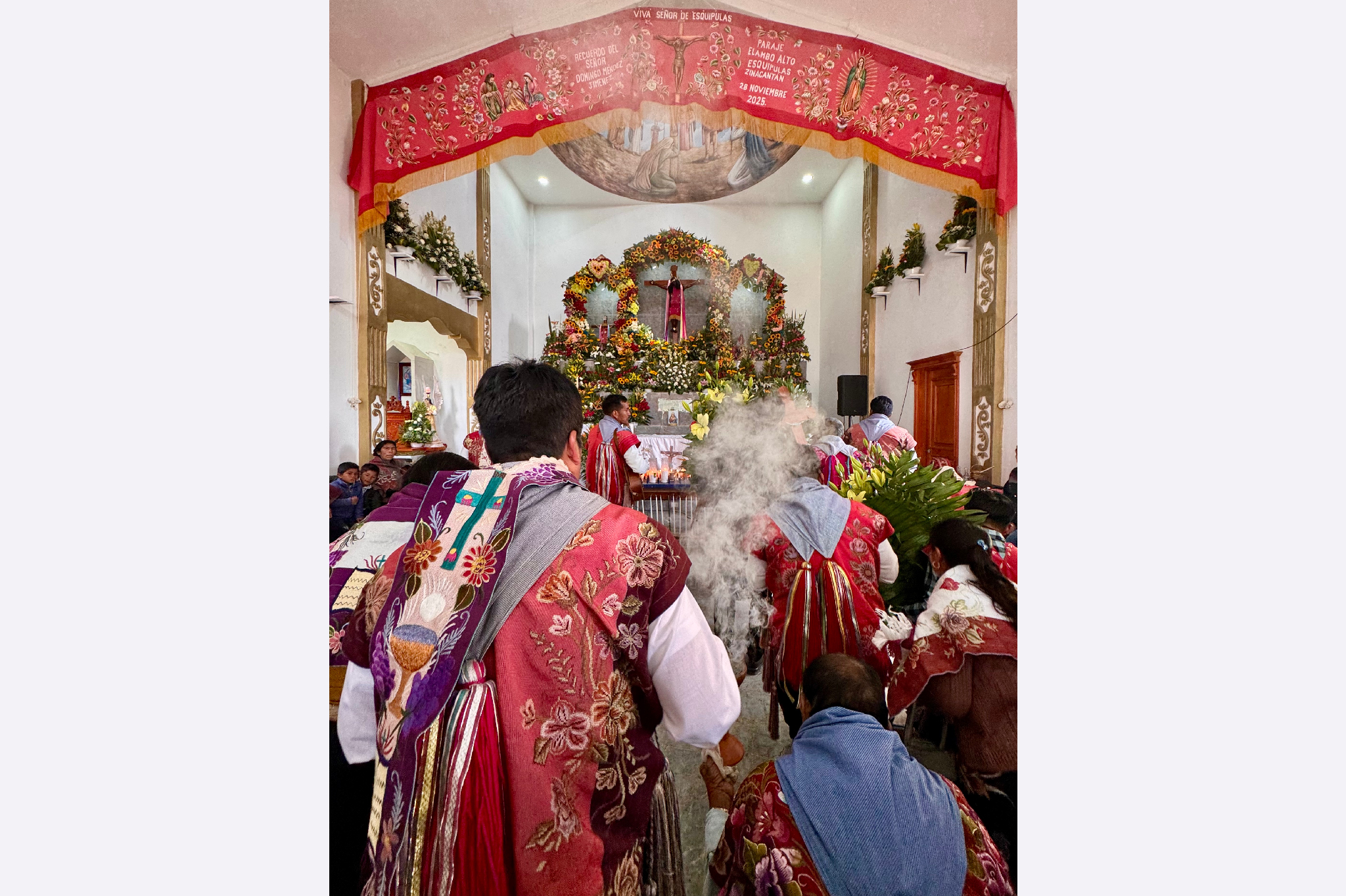
    The patron saint festival of Elambó Esquipulas in the Highlands of Chiapas opens with the resounding music of a band whose cymbals, clarinet, trumpets, and drum enliven the community's procession. We walk from the entrance of the village to the chapel of the Black Christ, draped in a pink mantle embroidered with colorful flowers and adorned with a curly wig of jet-black hair. The darkness of his skin stands out even more against the flowery backdrop and reflects, with a few glimmers in his arms outstretched on the cross, the candles. sown on the floor, burning amidst the incense that fills the altar.

    Once the initial greeting is given, the community kneels to pray the invocation of mercy in the Tsotsil language, under the guidance of Mariano, the catechist in charge, all imploring God for forgiveness for the world, in a murmur that begins like raging waves and then becomes a whisper and caress, like waves brushing against the sand of the beach, a sign of a pacified communal conscience.

    The Mass continues with biblical readings in Tsotsil focusing on the cross of Galilee, followed by a brief meditation that I lead for the community in Spanish. I summarize three key thoughts for the catechist-interpreter to develop with endless eloquence. I center on the biblical meaning of Jesus' cross as a result of his commitment to the excluded of his time. Then, I briefly recount the story of the Lord of Esquipulas in Guatemala, quoting my brother. jTotik Alfonso, though adding my own commentary, points out that its black color symbolizes the sufferings of the people that Christ bears. I see the image adorned with flowers and realize that the Crucified One offers us a loving embrace in the last breath of his life. It comes spontaneously to me to say this to the community, who listen attentively, and I see them receive that embrace with grateful expressions. And I conclude by inviting us all to celebrate the Lord of Esquipulas with our own commitment of love, caring, as he did in life, for those who suffer most in the community, beginning with children whose health is threatened by the soft drink and junk food industries, young people drawn to money, drugs, and alcohol, and women who suffer violence in their own homes and communities.

    The consecration of the bread and wine is experienced with profound devotion by the kneeling community. But this sacred moment of adoration of the body and blood of Jesus, the anointed of God, suddenly becomes an even deeper reverence thanks to the traditional song and dance of the Bolom Chon o jaguar song which expresses the deepest soul of the Tsotsil, Tseltal, and Tojolabal peoples, the Mayan peoples of the Chiapas Highlands. Traditional musicians play the harp, violin, and guitar with a slow, measured rhythm, like a mantra growing in a sonic spiral of infinite tenderness, lulling the incarnate God and Mother Earth, whom our feet touch with their dance. For it is worth remembering that, for the Mayan peoples, in the rites of ancestral tradition—such as those of the Tseltal people studied by the Jesuit— Eugenio Maurer In Bachajón, the dance has a religious meaning, because with the feet one caresses Mother Earth, the primordial gift of the Giver of Life.

    .

    ∂

    .

    The Christ of Esquipulas, which originated in Guatemala, is a powerful representation of the diverse faces of faith of the ancient Mayan peoples, celebrating Tezcatlipoca under Mexica influence, according to the Dominican chronicler. Friar Diego Durán, to ask for rain:

    […] it was made of a very shiny and jet-black stone [obsidian], the stone from which they make razors and knives for cutting. In the other cities it was made of wood carved in the figure of a man, all black from the temples down, with a white forehead, nose, and mouth, the color of an Indian, dressed in some fine attire in his Indian style. First, he had gold ear ornaments and others of silver. On his lower lip, he had a lip plug of crystalline beryl in which was inserted a green feather, and sometimes a blue one, which from the outside looked like an emerald or ruby. This lip plug was about a gem long, above a ponytail of hair that he had on his head (Durán, II, 1995: 47).

    Centuries later, in that image, the Christianized Mayan people venerate the Nazarene with new meanings. In every corner of Zinacantán I visited this week, I found new and astonishing alterations to the image and the meanings the community gives it. From the story of a charred black Christ who miraculously survived a fire to the icon that darkens because it absorbs the sins of the world, we encounter stories that recount the anxieties and longings of its faithful devotees, giving the Christ increasingly intense shades according to the skin color or the consciousness of the community that venerates him.

    Two scenes remain in my memory from these days exploring the Zinacanteco landscapes. Both hark back to the ancestral rites of the Tsotsil people.

    The first is the prayer of forgiveness when the entire community, in a collective surge, with cries, tears, and sighs, raises its prayer kneeling on the sedge –These are the pine needles laid like a green and fragrant carpet on the floor of the hermitage, chapel, or temple, supporting the feet of the community gathered amidst candles—the incense mingled with the scent of pine from the surrounding forests. A vestige of the people of the mist and the forest, as the poet from Tuxtla sings. Juan Bañuelos:

    .

    Dawn breaks. The humidity is like sleep: motionless. Only
    ascends
    a people with roots in the throats of birds
    whose song stirs the fragrant carpet of the rushes
    The smoke from the huts rises, mimicking Mayan fretwork patterns.
    while the cyclical serum of memory is filtered out

    .

    The second scene that lingers in my heart is the ritual dance of sonic and rhythmic adoration that moves the assembled community, caressing the earth that has borne fruit to the son of Mary, perhaps a jaguar Christ, according to the memory of the Mayan peoples. Bodies transfigured by a radiance of ancestral humanity that opens itself to the loving mystery.

    The Black Christs of Zinacantán continue to luminize in every place, with darker or lighter tones, depending on the land that welcomes and venerates them. Black Christ of Esquipulas during the time of the Captaincy General of Guatemala. Black Christ of Tila during the time of Chiapas' independence. Black Christ of Zinacantán during the time of the indigenous uprising. Black Christ of today's communities facing the mirage of prosperity from the flower and textile trade. Black Christs that will come in the troubled times we live in.

    What laments and what praises will future generations of the Tsotsil people sing when, half a century from now, the cry of wounded humanity makes the Black Christ even darker?

    What laments, praises, and dances do we experience when we realize that time is running out to seek and find solace for a humanity threatened with death by the world of the powerful?

    The black Christs of Zinacantán are a great paradox: an embrace of suffering and a promise of life.

    .

    Ts'ajal Nam, January 17, 2026

    .

    Note: I would like to read your comments in the final section of this page.

English