Tag: intersectionality

  • Amores no patriarcalesComet Ludo | The struggle doesn't continue, it's ongoing | 2014

    Non-patriarchal loves

    By Carlos Mendoza Álvarez

    “The patriarchy is a judge that judges us for being born | and our punishment is the violence you see […] And it wasn’t my fault, not how I walked, not how I dressed | and it wasn’t my fault, not how I walked, not how I dressed…” Thus began the performance by the Chilean collective Las Tesis at the height of the #MeToo movement, shortly before the Covid-19 pandemic that would later ravage humanity. I remember how, in 2020, protests spread across the world like a rising tide: gatherings in public squares, clotheslines denouncing sexual harassment in universities, companies, government offices, and public parks. A green-and-black wave of women’s collective action confronting patriarchy.

    At that time, colleagues at Universidad Iberoamericana Mexico City denounced fellow students, professors, and administrators through the clothesline for acts of sexual harassment. Thanks to these protests, a formal institutional protocol for reporting harassment was later established at the university, managed by various institutional committees and commissions. A human rights culture was also promoted to combat gender violence, integrating this issue into the curriculum and establishing the Center for Critical Gender Studies and Feminisms. Years earlier, a doctoral program had been created to investigate this phenomenon in contemporary society from an interdisciplinary perspective, thus contributing to the strengthening of feminist and LGBTQ+ collectives, while also designing proposals for the establishment of public policies on gender equality. I was tasked, along with feminist and queer colleagues, with exploring the best ways to support this initiative from the Division of Humanities and Communication, where I worked as a divisional coordinator at that time with a formidable team of young colleagues, experts in philosophy, communication, graphic arts, administration, and academic management.

    During those years, there was also a surge in denunciations from public figures emerging in diverse cultural spheres, such as the artistic, academic, and religious communities, expressing the outcry of more than half the world's population, fed up with gender-based violence, primarily against women, but also against queer individuals and groups. Thanks to this collective awakening, I discovered the admirable work of the Indian theologian Kochurani Abraham with women victims of gender-based violence inflicted against them by male leaders of three traditional Indian religions: Hinduism, Islam, and Christianity. Their work consisted of making this age-old violence visible and accompanying women on their path to liberation from the patriarchal burden by inventing new forms of belonging to their spiritual tradition, nurtured by mutual care and creativity in their commitment to intertwining spirituality with social justice and gender equality.

    But there were also excesses, such as cancel culture, which destroyed, with a click, the lives and careers of people accused without evidence, sometimes as a settling of scores, other times as the rotten fruit of rivalry, and still others with sufficient grounds for an anonymous denunciation out of fear of the corruption networks that kept the patriarchal pact intact, a political phenomenon analyzed by Rita Segato as a mandate of masculinity in her work Counter-pedagogies of cruelty.

    The case of Boaventura de Sousa Santos touched me very personally because years earlier I had organized, together with my dear colleague and friend Pablo Reyna, a colloquium on his scientific and poetic work, to frame the Honorary Doctorate through which he was awarded five degrees from universities within the Jesuit University System of Mexico for his notable contributions to epistemologies of the South, the World Social Forum, and the ecology of knowledges. A group of colleagues from the Center for Social Studies (CES) at the University of Coimbra accused him of sexual harassment in a British publication, which was later retracted. The accusation abruptly ended his career. This crisis, at the same time, brought to light a hidden problem of rivalry within Portuguese academia and its global connections. Now, five years later, we know that the accusations have not been proven, although the damage has already been done, according to the recent account of the Brazilian philosopher Marilena Chaui. As part of this sad story, Maria Paula Meneses, the Mozambican academic, who was one of the people accused of covering up for the Portuguese author, has just passed away, and a farewell message she made public last July before her death can be read.

    How to maintain the relevance of a colossal work like that of Boaventura, Maria Paula and Marilena, with their network of conversations about the world with decolonial and anticolonial colleagues such as Silvia Rivera-Cusicanqui   and  Gladys Tzul Tzul struggling from below, honoring first the memory of the victims of patriarchy, as well as those trapped in the spiral of resentment and hatred that expands in diverse human collectives, while continuing to call for the necessary accountability and the challenge of the communal discovery of truth?

    This week I participated in the Seminar on non-patriarchal practices led by our dear friend and fellow anthropologist Abraham Mena at Ecosur. It was a virtual session that allowed us to include critical theology in the academic conversation in this intercultural and Indigenous city, as an interlocutor with other social sciences and the humanities, in order to reflect on paths for overcoming patriarchy and its toxic masculinities.

    In my presentation I emphasized the need for intersectionality as a method to connect the diverse forms of violence suffered by "the wretched of the earth," starting with women, but including people rendered disposable by a hegemonic, patriarchal, capitalist, classist, and white supremacist society.

    I was surprised by the online questions that focused on best practices for dismantling patriarchy. My guiding thread in the dialogue was non-patriarchal loves like a compass to escape the entanglement of hegemonic power with its many heads, like the capitalist hydra the Zapatistas warned us about some years ago.

    These non-patriarchal loves are dissident loves that dismantle the toxic way of affirming the human condition as power, control, and the mandate of masculinity. Diasporic loves of queer people, but also the love of cisgender people who embrace diversity in their own bodies, minds, and spirits. And as an expression of that love, I also emphasized the importance of ritual that collectives create in their diversity to celebrate life as survivors: the mothers of disappeared persons, the migrants facing the train of horror, not by chance named La Bestia, and the native peoples intertwining ancestral tradition with Christianities of diverse confessional tones.

    I recounted, as a reference point for these new forms, the history of feminist liturgies that recreate their own sacramentality from the passage of divinity through lives, the bodies and the struggles of women, as she has explored Marilú Rojas in her research on the feminist ecotheology of liberation. She also brought to heart the queer/cuir liturgies of LGBTQ+ collectives, which never cease to celebrate the queer God as an incarnate divinity. As Ángel Méndez points out, there is nothing more queer than a humanized God.

    Non-patriarchal loves are, ultimately, diasporic loves, that is to say, going out towards others in all their diversity. Gender-fluid loves that are constantly being reconceptualized, as analyzed by Sylvia Marcos in the case of Zapatista women. What matters are the people who risk living each human relationship and creature in the context of love that does not control, impose, or kill, but celebrates life in its amazing diversity.

    Non-patriarchal loves that must be discovered in each story of those who dare to go out and encounter others (across differences and beyond them) as gift, offering, call, caress, cry, and communion.

    San Cristóbal de Las Casas, February 14, 2026

    Note: How do you weave together non-patriarchal loves?

  • Noticias de WallmapuGabriel Pozo Menares | Mapuche Calendar | Wallmapu, 2011

    Wallmapu News

    By Carlos Mendoza Álvarez

    p

    The light of dusk reaches Tirúa, in Mapuche lands, while Carlos, my Jesuit host who has been here for more than fifteen years (HistoriActiva Jesuit community of Tirúa), drives along the dirt road to visit friends who have opened their homes to share life in the area for years. We arrive and are greeted by the oldest daughter, along with her cats and dogs. She briefly interrupts the work she's preparing for her last semester of high school, as after graduation she plans to enroll in university to study teaching. Life goes on simply among the families who live here. Her father spent the day growing potatoes and then dedicated the afternoon to laying the floor of a new room in the house. They offer us mate as a ritual to accompany their conversation. Before leaving, the friends exchange bird food and make plans to recycle an old wooden door that will be installed in a budding eco-spirituality center.

    Wallmapu (Declaration of the Department of History on the term Wallmapu) is the term that refers to the ancestral lands of the Mapuche people (The Indigenous World 2025: Chile). Today, they are dominated by the forestry industry, which has contaminated the territory with invasive species such as eucalyptus and pine to mass-produce cellulose for export to the global packaging market.

    The Mapuche people today are divided between the frantic integration into the modern world of consumption on the one hand and, on the other, the defense of their territory, language, and traditional medicine under the leadership of Machi women, healers and spiritual ancestors.

    On both sides of the mountain range, divided between Chile and Argentina, the Mapuche people fight for their territorial and cultural survival, in the face of the overwhelming inertia of the modern world (Chile: Resistance to the forestry model in Wallmapu, Mapuche territory). For communities assimilated into today's modern model, it seems better to eat processed foods than seaweed and shellfish as the ancients did; or to drink Coca-Cola instead of herbal teas because it gives them greater status; they prefer to be evangelical Christians or Roman Catholics rather than follow the spirituality and language of their ancestors. Ultimately, it is a matter of "integration" into the modern world, even at the price of cultural assimilation and environmental depredation, which, in its symbolic undertone, is violence against the ancestors and against Mother Earth.

    Civil society networks such as “Churches and Mining”, or the initiatives for intercultural dialogue on ancient and modern astronomy promoted by some universities in the region, are modest attempts to accompany a people torn apart by internal contradictions between modernity and tradition.

    Perhaps eco-spirituality is being an "articulation," among others of a more social and political nature, that allows for these intersections. Carlos told me the anecdote of a grandmother who, attending a workshop on traditional medicine and eco-spirituality, said she didn't understand anything about the intersections of the three bodies (personal, communal, and territorial) that the workshop presented, because she had been thinking throughout the entire meeting about the meaning of that strange word written on the invitation: "articulation." A term that the grandmother kept thinking about until she finally realized that it surely referred to the articulations of bones, when she felt something in her body was out of alignment, impeding her mobility and causing pain. So she concluded that the workshop was a path to healing her joints. And ultimately, that was the objective of the workshop! That grandmother had followed it in her own way, even though she was absent from the rest of the talks.

    p

    p

    Before arriving in Mapuche lands, I was able to speak with university students at two forums in Santiago, Chile. The first was about the work of Gustavo Gutiérrez, one of the fathers of liberation theology, on the occasion of the first anniversary of his death (Gustavo Gutiérrez International Congress). In a traditional academic format with keynote lectures and presentations, over the course of a couple of days a clearer awareness emerged among attendees about the importance of style Latin American to speak of God, intimately connected to the experience of the poor and oppressed. A wisdom that is already part of the way some Roman Catholic and Protestant Christian communities understand their faith in a liberating God and promote the transformative role of victims in their own liberation processes, leaving behind lands of slavery and embarking on paths of new life.

    But we also began to see, not without some attendees' surprise, that it is necessary to open our hearts and our eyes to other exclusions, such as those experienced by women, queer/cuir people, undocumented migrants, relatives of missing persons, Afro-diasporic peoples, and indigenous peoples, to mention those who represent today's resistance to the violence that afflicts us in so many ways, with the Palestinian people today facing the genocide perpetrated by the Israeli government and its accomplices at heart.

    During the colloquium, several initiatives emerged to keep the memory of the great Peruvian theologian's work alive, through the work of the archives that house the recordings of the summer courses Gutiérrez offered in Lima for several years, a valuable resource that will reveal another angle of the author's thinking. Likewise, some of us proposed to investigate the relationship between Gustavo's thought and the work of Aníbal Quijano, his compatriot, who represents one of the most important sources of decolonial thought today, along with Frantz Fanon. The confluence of both thought styles, along with Black, feminist, queer/cuir and Palestinian liberation theology, will provide us with a more pertinent theoretical framework for understanding the intersectionality of violence and ongoing resistance in order to create alternative ways of life, governance, and spirituality that inspire communities located at the fractures of humanity.

    p

    p

    The other meeting, held with colleagues from the Chilean Society of Theology (UCSC hosted the Annual Conference of the Chilean Theological Society), was an opportunity to think together about possible paths to hope for communities facing systemic violence.

    My contribution to that annual event brought to the table the question of thinking about hope from a perspective of "combative decoloniality," like the dignified rage practiced by the Zapatista communities, or the indignation of women who face sexual or spiritual abuse in their respective religions. Because, from my perspective, it's about dismantling a vision of hope as a flight from the world in anticipation of consolation in the afterlife of eternal life.

    Rather, it's about discovering and strengthening the hope that "emerges" from the fractures of humanity. It's where survivors paddle against the current of the history of oppression and privilege, inhabiting the world with practices of mutual care, in the pedagogy of embodiment, and collective healing with memory, truth, and justice, as we explored at the recent Re-existe 2025 gathering.

    p

    p

    The sky of Wallmapu, with the crescent moon shining brightly, is today a living metaphor for the hope that surrounds us when we hear the heartbeat of the lands and stars of the South.

    p

    Tirúa, October 25, 2025

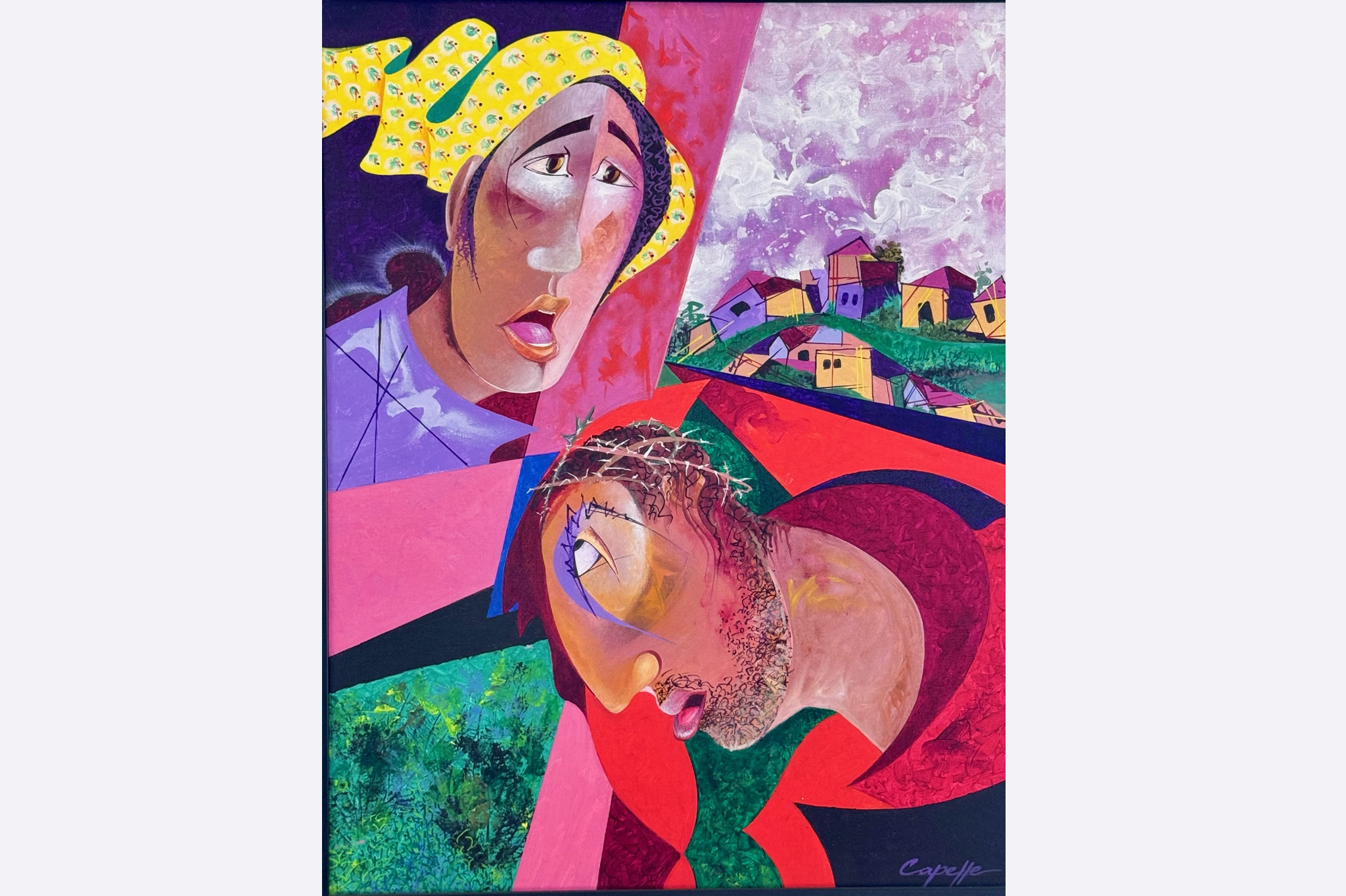
  • Sudáfrica, treinta y un años después del fin de ApartheidCapelle, Joseph. Stations of the Cross, IV: Jesus meets his mother, St. Martin de Porres Parish, Soweto, 2015

    South Africa, thirty-one years after the end of Apartheid

    By Carlos Mendoza Álvarez


    A Congolese refugee camp on the outskirts of Pretoria welcomes a small group of people from universities and churches interested in learning about their lives and stories. Ten families, each with four or five young children and some elders, greet us on the esplanade on a cold South African winter afternoon. Our guide is Lance Thomas, a colleague from the Centre for Faith and Community at the University of Pretoria (UP), who told us about his decolonial vision of accompanying vulnerable groups of houseless people and refugees. This is a splendid project that the university has been developing for more than ten years.

    During my visit to the UP a few days ago, I was struck by the creativity of this university community in connecting, among other ongoing projects, the world of unhoused people with different academic departments such as architecture, sociology, and theology, promoting a practical theology “on the street.” The recent inaugural lecture of the academic year by Prof. Stephan de Beer, discussing ways of building community and its spiritual dimension, while accompanying houseless families in creating projects to recover living spaces, is a prime example of this decolonial way of doing theology.

    Along the way, Lance warns us of the importance of not falling into the trap of victimization and the spontaneous desire to provide financial aid to the community we are about to visit. The aim is to see the conditions of that community up close to seek support strategies that address, as far as possible, the systemic causes that subject more than 250,000 refugees in South Africa from Burundi, the Democratic Republic of Congo, Rwanda, South Sudan, Somalia, and Zimbabwe, according to UNHCR.

    As I listen to Lance, I am strongly reminded of Ivan Illich’s warning never to lose sight of the importance of conviviality with others, as well as the friendship with the poor that was at the heart of Gustavo Gutiérrez’s liberation theology. Without falling into the trap of emotional manipulation, I resolved to be alerted to connect both poles: to think systemically and act compassionately.

    During spontaneous conversations with those who approached us at the camp to chat, I was struck by the deep gaze, as if open to painful memories, of two elderly people who told us stories of the seven years that had passed since they fled the war in the Democratic Republic of Congo. They have been jumping from one United Nations refugee camp to another in South Africa. Some were imprisoned for two years. The children who flit around with generous smiles and wide eyes “don't know what school is,” one of the community leaders tells me.

    A woman with an emphatic voice insists again and again on the discrimination they suffer as families from “their own South African brothers.” She shows me the document that UNHCR gave her seven years ago. Her only identity document, almost destroyed by the passage of time and dampened by her nervous hands, is not accepted by any South African authority. Another man approaches, full of anger and pain, saying that they can’t take it anymore and that if they don’t receive humanitarian aid, they will soon die. The woman returns, her voice desperate, to say that their neighbors threaten them at night and tell them to leave, to go back to their country. “But we have nowhere to go back to,” she says, heartbroken.

    One of our group members spent the entire time talking to one of the young women who is pregnant. The risk of inadequate medical care for her and her baby is real, due to the growing refusal of clinics in the country to accept refugees without valid permits. They immediately form a network of sisterhood.

    The impact of this visit, which I shared with a close group of friends and family in Mexico, sparked a desire to do something together with that refugee community. I will soon let you know here what we can do together.


    I told this story a few days later to those who attend my talks on “Collective Healing and Community Hope.” It is a mixed group of South Africans, white and “of color,” elders and young people, some of them documented immigrants. They are part of a pastoral network in Cape Town and neighboring cities. We talk about the abyssal line that separates the world of privilege from that of exclusion. I emphasize the intersectionality that must be discovered between the various narratives of “coming out” of those who live in the shadows of poverty, gender violence, racism, ableism, and so many other stories of domination in our unequal societies. The audience immediately connects with the narrative that makes people with disabilities visible, but they are reluctant to recognize the connections with the narratives of queer/cuir Social justice concerns them, but even gender equality makes them uncomfortable. I take my talks a step further, talking about refugees in South Africa and my recent visit to a community in that country, describing them as those who live “in the shadows of the shadows of the shadows,” evoking Frantz Fanon’s powerful metaphor of “the zone of no-being" (Black skin, white masks). And the audience begins to open their minds and hearts, little by little, to discover the power, beauty, and spirituality in those who call us to cross into the “zone of no-being,” to dare to name the systemic violence that concerns us all, and to begin processes of mutual recognition, listening, and personal and communal transformation.


    I realized then that when we talk about reconciliation with the South African people, we touch on a wound that is still open, even after decades of post-apartheid. “We are still segregated,” writes a colleague in a “silent conversation” we have as part of the afternoon workshop, commenting on flipcharts about violence in today's world. Thirty-one years after the collective trauma of apartheid for the peoples who inhabit these lands, no effective agrarian reform has yet been implemented, as 60% of the land belongs to white Afrikaners, contrary to the lies spread by Trump, who recently welcomed fifty Afrikaners as refugees fleeing “black persecution”. Another cynical deception by the dictator in office on land stolen from the indigenous peoples of North America. The distribution of wealth in the country of diamonds and tanzanite remains stalled by the corruption of the black elites who govern the country today. Many post-apartheid youths admire Elon Musk and Trevor Noah, hoping to one day migrate like them to the Big Apple or Los Angeles. Their dream is now reflected in the artificial world of the Netflix series “The Kings of Jo'burg", which is perceived by critical South African youth as a crude “Americanization” of life in this country.

    The wound of national reconciliation in the rainbow nation of Mandela and Desmond Tutu's time remains open. There is certainly skepticism in the country about its corrupt political class, as in my beloved Mexico. There is a certain resignation in the face of the failure of democracy, although small pockets of critical communities resist. The "3rd Black Power Pan-Afrikanist Decoloniality Winter School”, which will take place in Soweto at the end of July as a festival of combative decoloniality, will present another face of South Africa. One that emerges from the ancestral knowledge of African peoples.

    There is hope that South Africa, as the elder sister of the resistance movements of our times, will awaken from its slumber.


    Cape Town, July 5, 2025

English