
By Carlos Mendoza-Álvarez
This weekend concludes in Chiapas the International meeting of resistance and rebellions "Some parts of the whole" Organized by the Zapatista bases of young EZLN militia members and their leadership, a new generation has expressed—through plays, concerts, workshops, and dance—the self-criticism of their decades-old movement to reaffirm their worldview and their struggle to build other possible worlds.
This new generation was born in autonomous territories, after the armed and media uprising of 1994, where their perspective on life and understanding of the world below has enabled them to develop a creative imagination about the human and the cosmic. As Raúl Zibechi astutely points out (Zapatista self-criticism), the meeting represents a valuable innovation in the Latin American left of the last half-century due to its capacity for self-criticism and its persistence over more than three decades in defending its territory, its ways of life, and learning a mode of governance where one “commands by obeying.”
∂
After my stay in South Africa this summer, I returned to Mexico with a clearer awareness of the connections that exist between the resistances of “those below,” from the refugees on the outskirts of Pretoria and the artists of “combative decolonality” in Soweto, to the Palestinian resistance of the Sumud in Gaza, the West Bank, and everywhere else the clamor to stop the genocide of the Palestinian people emerges from public squares and digital campaigns.
Driven by this awareness of the urgency of continuing to learn from these social movements and build bridges, I was preparing to participate in the meeting of resistance groups at the Caracol Morelia, when the chaos generated by the storm that hit Mexico City a week ago prevented me from doing so. A massive urban sludge—created by the amount of rain that fell with a force unseen in 73 years, exacerbated by the garbage accumulated in the streets by an indolent citizenry that clogged urban drainage systems, and worsened by the appalling water policy of governments in modern times of chaotic growth in ancient Tenochtitlan—paralyzed the lives of millions of people. I was stranded for hours at the airport, unable to reach southeastern Mexico due to the chaos that lasted into the following days.
So I had to settle for attending the event virtually, thanks to the online broadcasts made by the organizers (Live broadcast from the Meeting of Resistances and Rebellions "Some Parts of the Whole") and various civil society organizations were present at the Caracol Morelia, near Altamirano, for workshops, plays, and concerts. Among the presentations of resistance to the pyramid of privilege, it is worth highlighting the presence of women's collectives dismantling patriarchy, students creating alternative education networks, farmers resisting extractivism, and settlers confronting gentrification, among many other local, regional, and "intergalactic" initiatives resisting the capitalist and patriarchal hydra.
∂
However, in my opinion, it remains to be explored in these anti-systemic meetings spiritual resistances of these collectives and peoples. Because it's not enough to expose the strategies of resistance to the many-headed hydra. Nor is it enough to organize networks of solidarity and support between collectives and peoples to dismantle the pyramid of privileges. Rowing against the current often leads to desolation. That's why it's necessary to go to the source from which the fighting hope who does not cease his creative imagination in the midst of catastrophe.
What inner and collective strength enables surviving individuals and communities living amidst increasing systemic violence to resist? How do they experience an awakening from the destiny imposed by the hegemony that kept them subjugated and made them declare that the world had to change? What processes of personal and collective healing have they developed to strengthen their resistance? How do survivors support, accompany, and care for one another? Because we cannot forget that resistance is a way of life that also involves symbols, rituals, and celebrations, as profound expressions of collective memory that allow for a connection with ancestors, with Mother Earth, and with divinity celebrated in so many ways. This dimension has been cultivated for millennia by the religions and spiritualities of humanity, from shamanism in Mongolia to monotheistic religions and their diverse ways of nurturing peoples to live with dignity and hope.
As we mentioned a few weeks ago here, in order to explore this spiritual and political source of resistance, a meeting called “Re-exists: The Spirit connecting the peripheries”. A group of sixty people from social and religious movements in Asia, Africa, Europe and our America, together with university people and artists located in the interstices of hegemonic power, will meet to share these and other questions, analyzing the reality we face and nourishing ourselves with ethical-political ideals and ancestral knowledge. We will seek to listen to individuals and collectives of survivors, through words, rituals and workshops, to “heart” what we have learned, crowning each day with an urban performance that will tie up loose ends to recognize the Ruah divine that gives life to the people.
In every neighborhood and city, in every network of people and communities, the urgency to do something concrete to dismantle the systemic violence that plagues us has awakened. There we can open our imaginations, our hearts, and our intelligence to propose collaborative projects. Community gardens, soup kitchens, meditation groups, performances in public squares, interactive classrooms, research projects in a dialogue of knowledge, and so many other ways of weaving networks of shared care flourish today in the cracks in the walls of the world-system of privilege and greed.
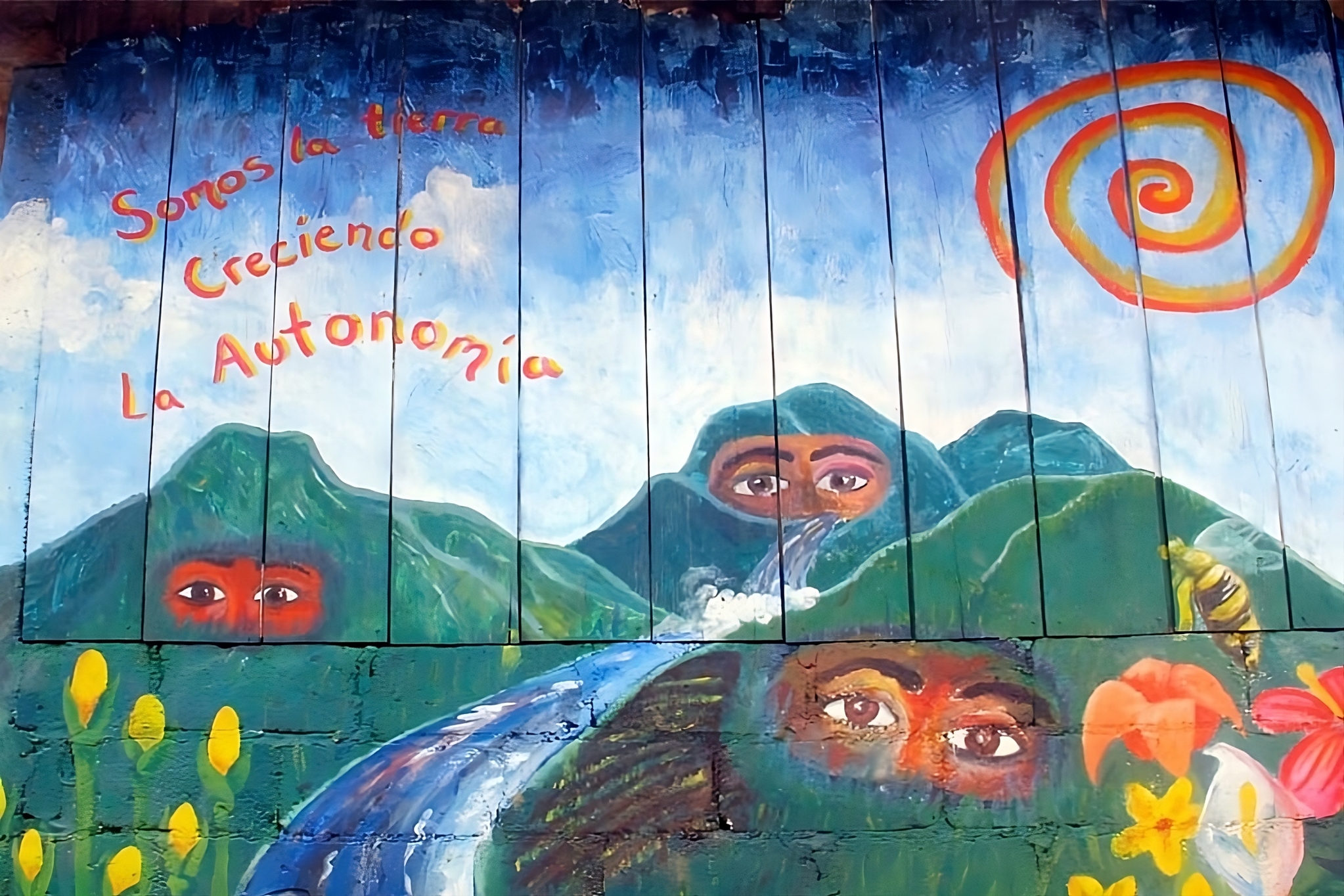
The storms that create floods and ecological chaos in the city represent a world crumbling. The water that flows down from the mountains to irrigate the land, on the other hand, is like the web of care woven by the survivors of yesterday and today. Let us listen to those who say, "We are the earth growing autonomy," as the Caracol de Oventic mural that accompanies these lines tells us.
Let us trust in our imaginative capacity to navigate the living waters with their underground rivers that connect Soweto with Gaza, with the Caracol Morelia, and with so many other places of survival, resistance, and re-existence.
Mexico City, August 16, 2025