Tag: loop

  • La Biblia como arma de genocidio o casa de vidaSliman Mansour. Revolution was the beginning (2016), oil on canvas, 200 x 500 cm

    The Bible as a weapon of genocide or a house of life

    By Carlos Mendoza-Álvarez


    The State of Israel began this week a new phase of the strategy of control of the territory of Palestine (Israel approves controversial West Bank settlement project). Israeli settler settlements in the West Bank will expand to divide the territory, which was the result of the 1993 Oslo Accords to relocate Palestinian residents into two isolated groups, leaving only one outlet to the Jordan River on the Jericho side.


    Christ at the Checkpoint, August 21, 2025   


    The ultimate goal is the creation of Greater Israel, once the possibility of a Palestinian state has been destroyed because, as Israeli Finance Minister Bezalel Smotrich said this week, “there is nothing to recognize, and no one to recognize” (Israel approves illegal settlement plan that would split occupied West Bank) once the genocide of the Palestinian people has been consummated.

    This plan of contemporary Israeli expansionism "after Gaza" suggests at least two main objectives: the first is the isolation of Palestinians in apartheid zones, in addition to the invasion of the Gaza Strip, with the goal of their expulsion or subsequent extermination; and the second is the control of the Jordan River as a strategic source of water resources for times of global scarcity.


    But this is not merely the military strategy of a rampaging Zionist state supported by global capitalism, particularly the governments of the United States and the United Kingdom. The ongoing Zionist plan demonstrates the perversity of an ideology of genocide that manipulates the Bible to justify the supremacy of one state over others, subordinating peoples of diverse ethnic and religious origins to a selective process of annihilation in the name of a supposed divine promise.

    Both Jewish and Christian Zionism, in fact, are the modern version of the manipulation of the biblical promises recounted by the saga of Abraham and Sarah as ancestors of the believers of the three monotheistic religions. The biblical account, in fact, tells us that God the Eternal promised the primordial couple offspring "as numerous as the stars of the sky and the sand on the seashore" (Gen 22:17). Hebrew Talmudic and ancient Christian commentaries saw in this double metaphor of the heavens and the earth the proclamation of the universality of the promise: the stars of the sky evoking the daughters and sons of Israel, and the sand on the seashore representing all the nations of the earth.

    The ideology of the “chosen people” was later developed in the Bible by a religious movement that perverted the announcement of the promise of the land, focusing it on the conquest of a territory as an exclusive monopoly of one people over other Semitic peoples. This “political theology” was devised by an interpretation of messianism in a Davidic key, present in the Bible since the time of the judges of Israel, which is called the “Joshua factor” by the Palestinian Lutheran theologian Mitri Raheb (Imperial Theology, Colonization, Settler Colonialism, and the Struggle for Decolonization: A Review Essay) as a source of the theology of empire.

    But the prophets of Israel, from Moses to John the Baptist—and Jesus of Nazareth and his community who were part of that lineage—were always critical of the powers that be, which have sought to supplant divine glory under various masks. Theology prophetic It is found at the origin of the Abrahamic faith as a universal vision of the promise and the land that includes all peoples. As the French Dominican biblical scholar Philippe Lefebvre (Conference: Jésus et le pouvoir – P. Lefebvre), prophetic messianism is present like an underground river throughout the Bible, from the book of Genesis to its fulfillment in the Passover of Jesus of Nazareth.

    And the Jesus movement in Galilee takes up this prophetic vein to radicalize it with the innovation of a messianism scatological, as another Dominican, José Luis Espinel, commented a few decades ago in Salamanca (Eschatological Messianism of Jesus from his prophetic actions). A prophetic tradition that announces the fulfillment of the promise for all peoples as a call to the universal love that flows from the wounds of a crucified Messiah.


    Palestinian Christians, as the Palestinian Lutheran theologian Munther Isaac (Faith, the Bible, and the Genocide in Gaza) call us today to decolonize the Bible, which has become the weapon of war of Israeli and Christian Zionism against the Palestinian people. There is no chosen people to conquer a land in the name of God, stealing it from its original inhabitants, from the ancient Canaanites and Jebusites to the Palestinians of today. Nor is there a promise of the land that justifies, in the name of God, an Israeli state imposed by war on territories inhabited by Semitic peoples for millennia.

    Christian churches of all denominations, as well as universities and political movements that appeal to the Bible as their source, face a grave dilemma: either continue to justify the genocide of the Palestinian people in the name of the God of Israel, or decolonize the Bible to recover the messianic and prophetic spirit of the divine and human word that frees all peoples from the slavery of earthly powers that supplant divine glory, with their current avatars, such as Trump and Netanyahu, or Milei and Bolsonaro, who are today's false messiahs.

    The promise of the land that Abraham and Sarah received in that story of origins when they left Ur in Sumeria in search of the Eternal One – as the Jewish thinker from Strasbourg André Neher says in his book The essence of prophecy – is only fulfilled in the silence symbolized by the desert as a land of incessant search for the Covenant.

    Hence, Christianity drinks from that source of original Hebrew prophecy to announce the arrival of “the new heavens and the new earth,” as the book of Revelation (21: 1) said in the context of the devastation of the old, idolatrous Roman imperial world and the Temple religion that perverted the divine promise.

    This radical critique of all imperial theology stemming from a prophetic and eschatological messianism that heralds the end of the corrupt world has been rejected by both old and new earthly powers that seek to continue domesticating the divine promise.

    But from the rubble of Gaza, the promise of the land emerges today, with renewed vigor, summoning all peoples of humanity and compelling all spiritual traditions to care for the lives of the innocent victims and their survivors. It calls us to continue searching for the promised land as a utopia in the midst of dystopia. It invites us to cultivate hope as a promise of life that emerges amid the threat of imminent death, like that experienced by Gazans today and other peoples threatened by necropower.

    The Bible is not a weapon of war but “the house of the people,” as Carlos Mesters said in Brazil in his beautiful and powerful parable (The parable of the house of the people of God). A house we are invited to inhabit, to recognize in our own stories the spring of life that emerges like living water gifted by God from the ruins of the power that kills.

    Let us reread and inhabit these messianic and prophetic testimonies of the promise of the land and the choice of divine love for all peoples, so that we may be inspired by the consolation that comes from God to the victims and their survivors, as a moving promise that is happening in the silence of the desert.


    Mexico City, August 24, 2025
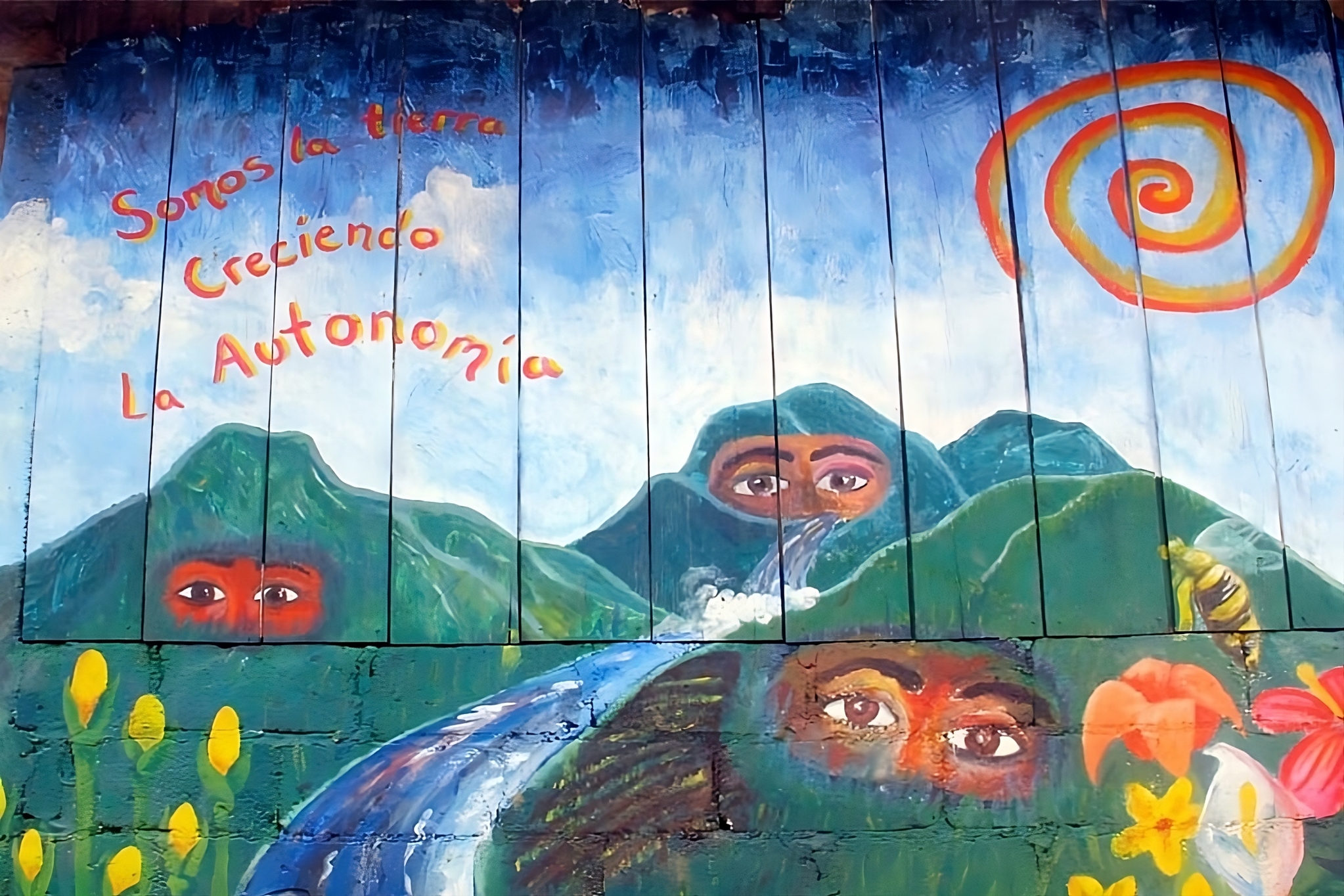
  • Entre aguas y tierra: de Soweto al Caracol MoreliaDetail of a mural, Caracol de Oventic. Sosa, J., Rivero, E., and Wolkovicz, P. (2015)

    Between water and land: from Soweto to Caracol Morelia

    By Carlos Mendoza-Álvarez


    This weekend concludes in Chiapas the International meeting of resistance and rebellions "Some parts of the whole" Organized by the Zapatista bases of young EZLN militia members and their leadership, a new generation has expressed—through plays, concerts, workshops, and dance—the self-criticism of their decades-old movement to reaffirm their worldview and their struggle to build other possible worlds.

    This new generation was born in autonomous territories, after the armed and media uprising of 1994, where their perspective on life and understanding of the world below has enabled them to develop a creative imagination about the human and the cosmic. As Raúl Zibechi astutely points out (Zapatista self-criticism), the meeting represents a valuable innovation in the Latin American left of the last half-century due to its capacity for self-criticism and its persistence over more than three decades in defending its territory, its ways of life, and learning a mode of governance where one “commands by obeying.”


    After my stay in South Africa this summer, I returned to Mexico with a clearer awareness of the connections that exist between the resistances of “those below,” from the refugees on the outskirts of Pretoria and the artists of “combative decolonality” in Soweto, to the Palestinian resistance of the Sumud in Gaza, the West Bank, and everywhere else the clamor to stop the genocide of the Palestinian people emerges from public squares and digital campaigns.

    Driven by this awareness of the urgency of continuing to learn from these social movements and build bridges, I was preparing to participate in the meeting of resistance groups at the Caracol Morelia, when the chaos generated by the storm that hit Mexico City a week ago prevented me from doing so. A massive urban sludge—created by the amount of rain that fell with a force unseen in 73 years, exacerbated by the garbage accumulated in the streets by an indolent citizenry that clogged urban drainage systems, and worsened by the appalling water policy of governments in modern times of chaotic growth in ancient Tenochtitlan—paralyzed the lives of millions of people. I was stranded for hours at the airport, unable to reach southeastern Mexico due to the chaos that lasted into the following days.

    So I had to settle for attending the event virtually, thanks to the online broadcasts made by the organizers (Live broadcast from the Meeting of Resistances and Rebellions "Some Parts of the Whole") and various civil society organizations were present at the Caracol Morelia, near Altamirano, for workshops, plays, and concerts. Among the presentations of resistance to the pyramid of privilege, it is worth highlighting the presence of women's collectives dismantling patriarchy, students creating alternative education networks, farmers resisting extractivism, and settlers confronting gentrification, among many other local, regional, and "intergalactic" initiatives resisting the capitalist and patriarchal hydra.


    However, in my opinion, it remains to be explored in these anti-systemic meetings spiritual resistances of these collectives and peoples. Because it's not enough to expose the strategies of resistance to the many-headed hydra. Nor is it enough to organize networks of solidarity and support between collectives and peoples to dismantle the pyramid of privileges. Rowing against the current often leads to desolation. That's why it's necessary to go to the source from which the fighting hope who does not cease his creative imagination in the midst of catastrophe.

    What inner and collective strength enables surviving individuals and communities living amidst increasing systemic violence to resist? How do they experience an awakening from the destiny imposed by the hegemony that kept them subjugated and made them declare that the world had to change? What processes of personal and collective healing have they developed to strengthen their resistance? How do survivors support, accompany, and care for one another? Because we cannot forget that resistance is a way of life that also involves symbols, rituals, and celebrations, as profound expressions of collective memory that allow for a connection with ancestors, with Mother Earth, and with divinity celebrated in so many ways. This dimension has been cultivated for millennia by the religions and spiritualities of humanity, from shamanism in Mongolia to monotheistic religions and their diverse ways of nurturing peoples to live with dignity and hope.

    As we mentioned a few weeks ago here, in order to explore this spiritual and political source of resistance, a meeting called “Re-exists: The Spirit connecting the peripheries”. A group of sixty people from social and religious movements in Asia, Africa, Europe and our America, together with university people and artists located in the interstices of hegemonic power, will meet to share these and other questions, analyzing the reality we face and nourishing ourselves with ethical-political ideals and ancestral knowledge. We will seek to listen to individuals and collectives of survivors, through words, rituals and workshops, to “heart” what we have learned, crowning each day with an urban performance that will tie up loose ends to recognize the Ruah divine that gives life to the people.

    In every neighborhood and city, in every network of people and communities, the urgency to do something concrete to dismantle the systemic violence that plagues us has awakened. There we can open our imaginations, our hearts, and our intelligence to propose collaborative projects. Community gardens, soup kitchens, meditation groups, performances in public squares, interactive classrooms, research projects in a dialogue of knowledge, and so many other ways of weaving networks of shared care flourish today in the cracks in the walls of the world-system of privilege and greed.

    The storms that create floods and ecological chaos in the city represent a world crumbling. The water that flows down from the mountains to irrigate the land, on the other hand, is like the web of care woven by the survivors of yesterday and today. Let us listen to those who say, "We are the earth growing autonomy," as the Caracol de Oventic mural that accompanies these lines tells us.

    Let us trust in our imaginative capacity to navigate the living waters with their underground rivers that connect Soweto with Gaza, with the Caracol Morelia, and with so many other places of survival, resistance, and re-existence.


    Mexico City, August 16, 2025

  • ¿Quiénes heredarán la tierra robada y gentrificada?Lucky Madlo Sibiya (South Africa, 1942), Untitled

    Who will inherit the stolen and gentrified land?

    By Carlos Mendoza-Álvarez OP


    The wars of yesterday and today are brutal rituals of territorial control as a space of privilege for a powerful group over the rest of the beings that inhabit it.

    Modern expansionism, which began in the late 15th century with interoceanic voyages financed by European kingdoms that became nascent empires, was an enterprise of control of routes and territories that expanded throughout the world in a brutal manner as an unprecedented colonization project. libido dominandi The conquistador found in this "civilizing" enterprise his perfect justification in the religious armor that accompanied the wars of conquest: those lands had to be conquered in the name of God.

    This is happening today in Palestine because of the greed of the Israeli state and the powers that support it to seize the territory of the Palestinian people, both Muslim and Christian. Such colonizing libido fuels the unbridled fury of Jewish settlers eager to seize more and more land in the West Bank and Gaza. This perverse logic leads a people who were victims of Nazism to now commit genocide against a brother nation.

    A similar, but even more perverse, greed fuels the transnational war industry for the benefit of corporations that enrich themselves exponentially by creating armed conflicts to fuel the war machine that generates trillions of dollars in profits each year around the world. In this case, it involves the control of financial and industrial territories to feed the arms industry in every corner of the planet.

    Israeli Zionism and Christian Zionism are two sides of the same coin. They write another disastrous page in the history of the greed for land as property, cynically manipulating the biblical promise of the land. Since the 19th century, this Zionism born in the United Kingdom was the one that paved the way for the later creation of the State of Israel, under the pretext of the Shoah. That same Zionism, in its version of perverse political messianism represented by the State of Israel, has now invented a criminal scenario with a Muslim enemy to be defeated in order to impose its military power in the Middle East, annihilating the Palestinian people and humiliating neighboring peoples, through the blatant manipulation of the Bible, as Mitri Raheb has shown in his essential book Decolonizing Palestine. The Bible, the land, the peopleThe Israeli machinery of drones, tons of missiles and millions of bots or automated accounts flooding social networks, has been spreading fake news throughout the virtual world that has left the entire world stunned, producing a “collective cognitive dissonance,” as analyzed in Brazil by João Cezar de Castro Rocha based on Leon Festinger's theory.


    And, strange as it may seem, the ongoing gentrification in many cities around the world, from Barcelona to Mexico City, is another expression of that same colonizer's will to dominate, now in its gentle version. hipster. Only this time, it's not about conquering territories to govern them through military occupation armies with the aura of an imperialist religious flag. I'm referring to the digital nomadic colonizers who take advantage of the power of their currencies, emboldened by their dreams of white and technological primacy, to inhabit residential neighborhoods in vibrant cities at a much lower cost than they would have in their countries of origin. Thus, these hipster herds nurture their cosmopolitan illusions enclosed in their urban bubbles, without coming into close contact with the population of the place they inhabit, but rather displacing them or subordinating them to their tastes and interests. This phenomenon represents the most recent and perverse version of settler colonialism that displaces previous inhabitants from their land.

    For the past five years, I've spent a period of time each year in Mexico City's Hipódromo Condesa neighborhood, where the Dominicans have for almost a hundred years animated a parish that was a religious center for the Mexican middle class with aspirations for urban modernity, though not so much religious ones. Every year I return, I'm surprised to see that the former residents have left, selling their homes, converting them into Airbnbs, or outright opening hipster-trendy businesses, ranging from vegan restaurants and light ice cream shops to bistros with Mexican fusion menus. But what has surprised me most is the proliferation of businesses specializing in angels, candles, Tarot readings, physical therapy, Bikram yoga, and other types of yoga, as well as countless spas with massage menus ranging from reflexology to tantric, not to mention, of course, Reiki mixed with "ancestral" techniques from the heart of Mexico.

    On the other hand, the Catholic parishes in that area of the city collapsed financially due to the lack of alms, but above all, their traditional religious population was aging. To the surprise of many religious ministers, in recent decades, La Condesa has become a laboratory for new religious expressions, as Hugo Suárez has documented (Images of Faith. Audiovisual Sociology of the Condesa neighborhood), a sociologist from Guadalajara, in a recent comparative study of the religious practices of residents of Condesa and Ajusco in Mexico City, one a hipster neighborhood and the other a working-class one. To complete this quick overview, it's important to note that in recent years, there has been an upswing in the number of believers in Catholic churches, especially in South America, characterized by a traditional Catholicism of intense and highly moralizing individual piety. This is an unexpected effect of gentrification in those parts.


    What criteria could help us understand the meaning spiritual From these old and new territorial control processes? Could humanity's religions pull from the vault of their memories some precious talisman that sheds light on us?

    The second beatitude of Matthew's Sermon on the Mount captures the poetic message of Christ as He preached in Galilee in a provocative way. This beatitude literally says: "Blessed are the meek, for they shall inherit the earth" (Matthew 5:5). The Greek word for the meek is πραΰς (praus). This term is associated with those who resist the powers that want to push them aside because they are considered redundant in the community. In Galilee in Jesus' time, these meek They were those who resisted the Roman power of taxes or military occupation.

    It is not, first and foremost, a question of understanding the meek as peaceful people according to the traditional reading of this text. Rather, it refers to those who resist violence without making a fuss, appearing invisible to the eyes of the world, because they deploy what today we might call strategies of resistance as survivors of many forms of violence.

    On the streets of our cities, we see some of these people out of the corner of our eyes, passing by us like shadows lying on a sidewalk, or living in cardboard houses under a bridge, or even lurking in the garbage looking for a piece of bread, a cigarette butt, or a can of beer with a drink to take. They are the disposables of consumer society, the ones surplus to requirements in a shopping mall, and whom we might bump into by chance or carelessness when entering the subway or when rolling down our car window at a stoplight at any urban intersection. When we approach these peripheries very close to us, we discover that, despite the subhumanization that surrounds them, these people organize, care for, and support one another.

    The promise of the land that Jesus announces to the meek It is subversive because it does not refer to the people of Israel, as imperial Davidic theology had previously intended and repeats today with its genocidal narrative. It is not about “possessing the land,” much less exploiting it, but about inherit it, that is, to receive it as a gift from the Abba who “makes his sun rise on the evil and the good, and sends rain on the righteous and the unrighteous” (Matthew 5:45). Jesus thus subverts the dominant narrative of his time, which consisted of distributing land according to religious strata that marked the economic and social scale, with the Temple playing a central role in Jerusalem as the religious capital of Judea.

    Therefore, the Galilean's greatest audacity lay in saying that the "meek" will inherit the earth, thus opening the promise of the earth to the most vulnerable in society. A world reversed from that produced by gentrification.

    To conclude these reflections, let us allow the Colombian poet José Eustasio Rivera to whisper that uncertain hope of those who resist colonization because they sense that, at the heart of their resistance, they are beginning to inherit the land:


    XIV


    I am a son of the mountain! For its coolest place
    I search, always singing, for the resounding hive;
    and in the silent caves my throat fills
    of nectarean honeycombs and of stone almonds.

    As I leave the waves, I fall asleep with pleasure
    on the dead leaves that my dog gleans;
    and through the branches, on my brown face
    the afternoon sun sets its moving arabesque.

    Inspired by a dream of distant tenderness,
    I caress the flowers; I crown myself with vines,
    and I embrace the trunks with deep emotion;

    that later, when I concentrate my thoughts alone,
    I seek the prize of the mountain, and in my spirit I find,
    the flowering shoot of a sweet illusion.


    Promised land, Bogotá, 1921.


    eSwatini, July 12, 2025

English