Tag: San Cristóbal School

  • Transfiguraciones mayas Acto cultural de los 500 OP Chiapas

    Mayan transfigurations Cultural event of the 500 OP Chiapas

    Welcome remarks

    By Carlos Mendoza Álvarez

    Good afternoon, dear brothers and sisters:

    This cultural event in the public square of the municipality of Zinacantán is a symbol of the dialogue between faith and reason that has been at the heart of the preaching of the Gospel, from its origins in the lands of Palestine with Jesus of Nazareth, two thousand years ago, to the present day in the Highlands of Chiapas.

    Jesus of Galilee was a preacher of good news for humanity, standing up to the powerful of his time, and accompanied by his messianic community even though he was betrayed by an angry mob.

    Jesus' loving sacrifice for a humanity reconciled with itself and with Mother Earth acquires a cosmic force with his resurrection from the dead, which is the most radical good news of all time.

    God is not a God of the dead, but of the living. And that is why the God of life is always on the side of the poor, the excluded, and the vulnerable, so that from there he may call everyone—victims and executioners alike—to heal humanity's mortal wounds and lead us to his fullness of life.

    On the occasion of the arrival of the first Dominican friars to the mainland of Abya Yala of the native peoples, five centuries ago on the coasts of Veracruz in 1526, we Dominican friars of today long to make a joyful, yet critical, memory of those five centuries of encounters and disagreements with the peoples of Mexico, especially those of Chiapas.

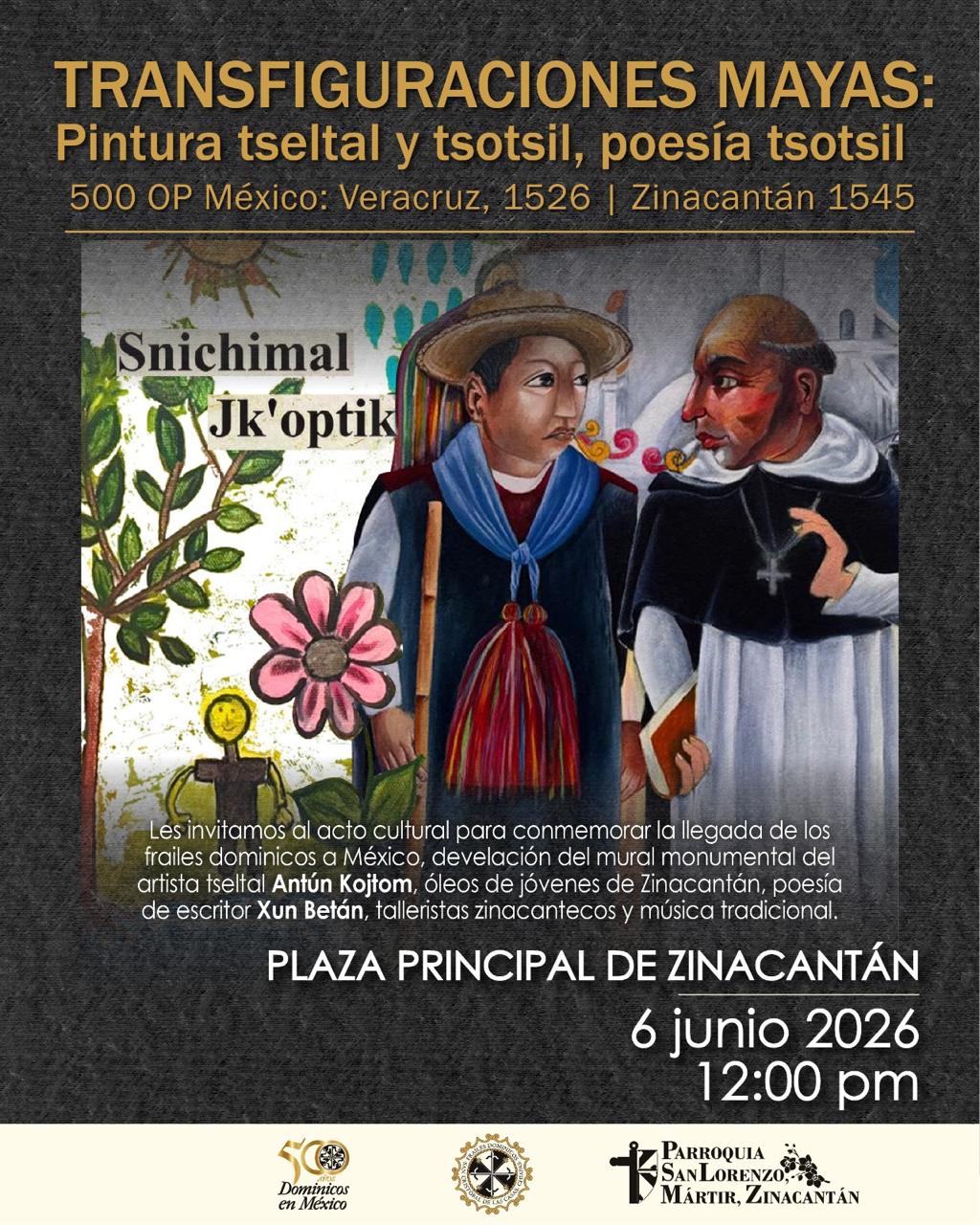
    The dialogue between faith and reason, we Dominican friars have promoted for eight centuries in spirituality, thought and the arts, always accompanied by the promotion of human dignity and its inalienable human rights, through justice and peace for all peoples and creatures, as did the first bishop of Chiapas, our brother Friar Bartolomé de Las Casas, through peaceful evangelization, and later followed in his footsteps by Friar Pedro Lorenzo de la Nada in the lands of the Pochutlas and the Lacandones, as can be seen in the mural that is about to be unveiled.

    The cultural event that brings us together today is a movement in three moments: image, word and music.

    The image

    Through murals, the Mayan peoples have long preserved their ancestral memory, the culmination of which are the murals of Bonampak. This tradition is renewed in contemporary Mayan art, such as that of the great master Antún Kojtom, a Tseltal artist from Tenejapa, who accepted the invitation of the Dominican friars to conceive, design, and paint the mural that will be unveiled in a few moments by the Provincial Prior of the Dominicans in Mexico, Friar Luis Javier Rubio Guerrero, the guest artist Antún Kojtom, and a friar representing the authorities of the San Lorenzo Mártir church.

    Next, nine paintings by young people from Zinacantán who participated in the introductory acrylic painting workshop offered by Master Antún last week will be exhibited. Their works reflect the ch'ulel, or spiritual strength, that accompanies them in their inner lives. We will then present them with certificates of recognition for their commitment.

    The word

    Since ancient times, human words have been a reflection of the divine word, especially poetry. In the second part of this cultural event, we will hear poetry from Xun Betan, a Tsotsil writer from Venustiano Carranza, and from the young people who participated in the workshop he led for several weeks in Zinacantán. We will also present certificates of recognition for their commitment.

    The music

    And to conclude, traditional music, that ancestral sound memory, will inspire us to look closely at the monumental mural by the master Antún Kojtom and the acrylics of his students. The sound waves of the traditional musicians from the Parish of San Lorenzo Mártir de Sots'leb will reach throughout the plaza, echoing in the sacred hills inhabited by the ch'ulelal, who also watch over us and accompany us today.

    We, the Dominican friars, offer this gift to the people of Zinacanteco. It was made possible thanks to the agreement of the three community authorities: the municipality, the churches, and the pastoral plan.

    A special word of gratitude to the Sertull Foundation of Mexico City for its generous support in funding this initiative, as well as to the Fray Bartolomé de Las Casas Human Rights Center for its support in educating about historical memory and the human rights of indigenous peoples.

    In conclusion, I invite the Dominican family (friars, sisters, and laity) to continue deepening, with rigor and hope, the historical memory of that complex past of the Dominicans in Chiapas, considering the challenges that lie ahead in our time:

    • to make visible the stories of women knowledgeable in ancestral Mayan spirituality and their current positions in the communities, as well as the people of the

    sexual diversity in its dignity, its rights and its community responsibility;

    • and to accompany children and young people in their processes as they passionately embrace technological modernity, with its opportunities and its serious risks of ecological, social and political devastation, in times of algorithms and artificial intelligence.

    May the contemporary Tsotsil and Tseltal art that we will contemplate in the mural and the acrylics, hear in the poems and celebrate with the traditional music allow us to celebrate the dialogue of knowledge between the peoples, with their diverse ancestral and contemporary spiritualities.

    May we continue to practice mutual listening in our times to promote the full life of the native peoples of the Highlands of Chiapas, especially the Zinacantec people.

    Welcome to this celebration of life for the people of Zinacanteco, past and present!

    Sots'leb, June 6, 2026

    Friar Carlos Mendoza Álvarez, OP

    Coordinator of cultural activities 500 OP Chiapas

  • JobeLab Una iniciativa de pensamiento crítico y espiritualidades diversas desde San Cristóbal de Las CasasJobeLab | San Cristóbal de las Casas, Chiapas | 2026

    JobeLab An initiative of critical thinking and diverse spiritualities from San Cristóbal de Las Casas

    By Carlos Mendoza Álvarez

    From the second half of the 20th century, Chiapas became a laboratory of new ways of inhabiting and thinking about the world, with the creative confluence of important social, political, cultural and spiritual processes.

    Among them, dynamism stands out synodal (or shared path by all the believing people with their diversity of ministries) of six decades, implemented by the Diocese of San Cristóbal de Las Casas with jTatik Samuel Ruiz as pastor walker And hundreds of local, regional, and international communities and groups, convened for justice and peace for the Indigenous peoples and other communities of this region of Chiapas. In an astonishing confluence of paths, the Indigenous Congress of 1974 marked the beginning of the public presence of Indigenous peoples with their own voice. Indigenous, mestizo, and international social and cultural movements also emerged, with research projects on the rich Mayan heritage, both ancient and modern, developed by teams of social anthropologists, archaeologists, and linguisticists. Waves of researchers arrived from Latin America, the United States, and Europe, and, with an academic model still largely based on extractive practices, made significant discoveries in the social sciences and humanities. The translation of the Bible into Mayan languages, initially promoted by the Summer School of Bible as part of a U.S. interventionist plan, evolved into intercultural dialogue, continued to this day by various Christian churches, including the Roman Catholic Church. Finally, the Zapatista movement, with its armed and media-driven uprising of 1994, became the watershed moment of a social, political, and cultural insurrection that continues to this day as one of the most radical critiques of the hegemonic system of the multi-headed capitalist hydra, including patriarchy and colonialism.

    The “San Cristóbal School” is a name proposed decades ago by Pablo Romo and others in academia and the arts to evoke the legacy of critical thought, resistance, and spirituality that emerged in Chiapas, as a counterpart to the Cuernavaca School, analyzed by Humberto Beck. In their connections and differences, both represent significant contributions to critical thought that arose in Mexico during the last century.

    In this way, recognizing the individuals, groups, organizations, and initiatives of civil society that have been an active part of these processes, as a collective inspired by them, with JobeLab -apocope of Jobel which is the Tsotsil name of San Cristóbal de Las Casas and laboratory To designate this city as a laboratory, we seek to give continuity to such a legacy in a new context, focusing on critical thinking and the spiritualities that have sustained them, such as those of the native peoples, Catholic Christianity, and more recently Buddhism and Islam.

    Through the initiative JobeLab. Ongoing dialogues and mutual support for re-existences We will continue to cultivate this heritage in the new scenario of the civilizational crisis that humanity faces in the second quarter of the 21st century, where peaceful coexistence between nations and the balance of planet Earth are at risk and call us to promote processes of resistance and re-existence.

    We will nurture this initiative based on two inspiring attitudes that are, at the same time, transversal axes of the talks, meetings and festivals that we will organize in various spaces of the city: hospitality and commensality.

    The hospitality It is one of the human gestures that most powerfully expresses our shared human condition, that is, our way of becoming individuals and communities as beings in relation to one another. This radical attitude of openness to otherness is a fundamental ethical and political act, where the religions and spiritualities of humanity celebrate a glimpse of divinity.

    The commensality, Like the other side of the moon, it is the nourishing soil where we receive the otherness of Mother Earth, of other humans who become our neighbors, and of Divinity, through food and drink created by the unique genius of each people. We celebrate this gift as an inclusive banquet where Divine Sophia prepares a table for all nations and creatures of the cosmos.

    Together with Carmen Reyes and Ricardo Hernández, Angélica Evangelista and Abraham Mena, I am enthusiastically participating in this project, drawing on the Dominican tradition of life and thought. In these exchanges, we seek to discover new expressions of the divine and human Word as a creative fire that redeems, animates, and shelters us in our present circumstances. times of hardship as a human species that puts itself and the Common Home at risk, leading us to the precipice of annihilation.

    This week two events will be the formal presentation of JobeLab, after the first event where the initiative germinated, on January 28, with a presentation on Gaza and Chiapas at the Charity temple in the city of San Cristóbal de Las Casas.

    On Wednesday, March 25th at 5:30 pm, we will hold the discussion “The School of San Cristóbal,” with the participation of Pablo Romo, who was one of the key figures in the diocesan process of promoting human rights, paving the way for the creation of the Fray Bartolomé de Las Casas Human Rights Center. Martha Elena Welsh, choreographer who animates in Xitla House In Mexico City, workshops were held to support people in situations of extreme vulnerability, facing various forms of violence. And Juan Carlos La Puente, a Peruvian with extensive international experience in providing spiritual support to human rights defenders, has been developing a methodology for this purpose from his base in Oregon, USA. permanent discernment as a path of body for people and communities in re-existence.

    And then, on Friday, March 27th at 5 p.m., we will explore another facet of re-existence: forgiveness as a path to reconciliation in contexts of violence. With the Muslim community of San Cristóbal de Las Casas, represented by Shaykh Yahya Rhodus and Shaykh Mudar Abudlghani, we will discuss forgiveness in Christian and Muslim traditions as a common path to peace, at a critical moment of violence in the Middle East. And we will do so accompanied by the extraordinary music and song of Nader Khan, a Canadian Sufi artist.

    We invite you to be a part of JobeLab From wherever we may be, whether attending talks and meetings, or imagining and creating similar spaces where we can come together and flourish as individuals and communities in resistance and re-existence, going beyond the spiral of violence that surrounds us, towards a world another world of hospitality and commensality.

    Jobel, March 23, 2026

  • La paz como caminos de insurrección mesiánica Sobre la Agenda Frayba 2026 Memorias subterráneasGabriela Soriano | Underground Memories | San Cristóbal de las Casas, Chiapas | 2026

    Peace as a path to messianic insurrection About the Frayba Agenda 2026 Underground Memories

    By Carlos Mendoza Álvarez

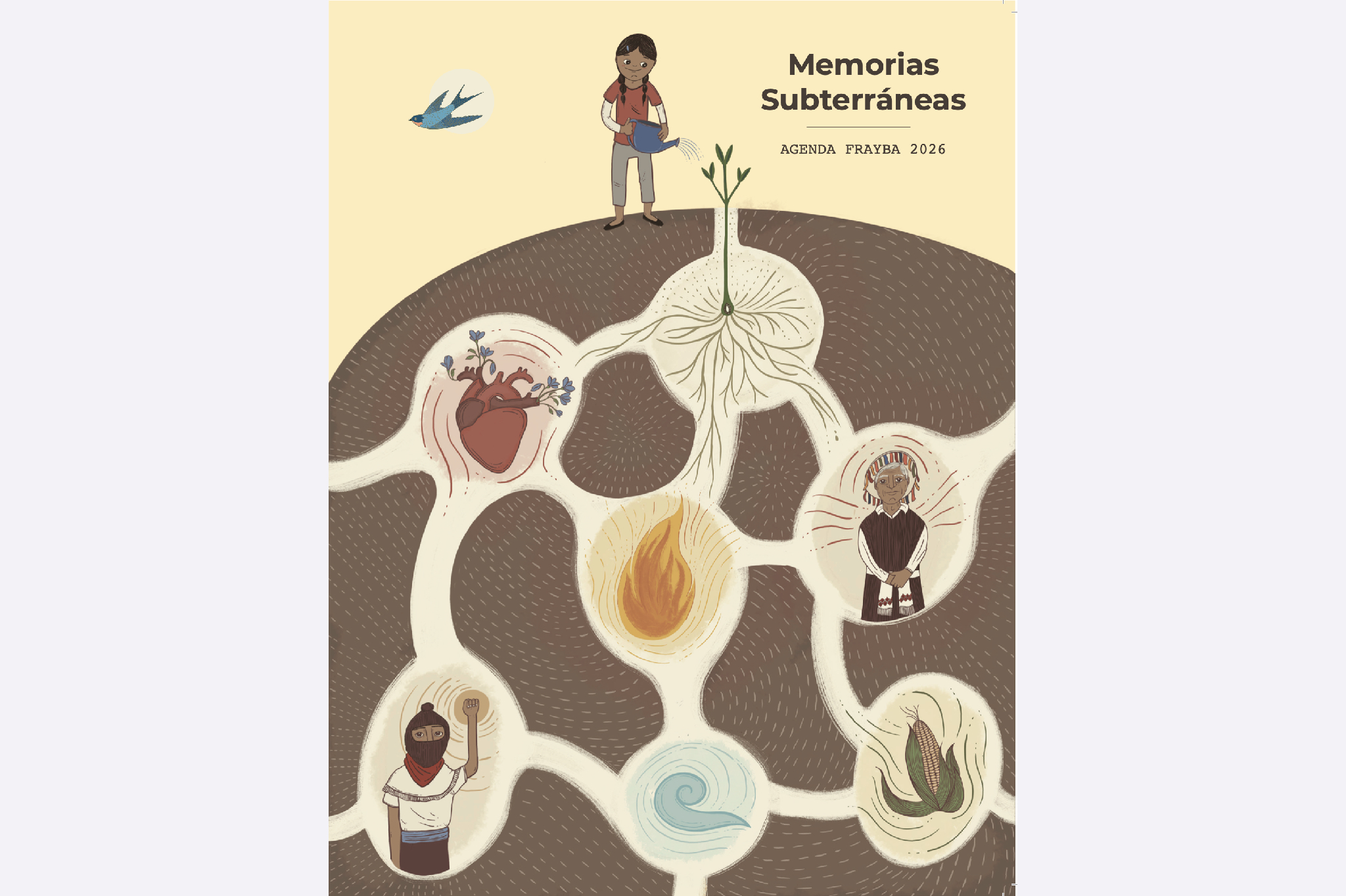
    Last Wednesday, the presentation of the fifteenth edition of the Frayba Agenda Titled “Underground Memories,” it was prepared by the Fray Bartolomé de Las Casas Human Rights Center in Chiapas. This annual publication, since 2011, preserves the living memory of the actions carried out in the promotion and defense of the human rights of the indigenous peoples of Chiapas, as well as of people in forced migration and refugees, who have been supported by this civil society organization over several decades. Frayba -as this organization is affectionately called- was born inspired by the winds of conciliar renewal of the diocese of San Cristóbal de Las Casas and the social processes that emerged as an expression of the indigenous movement of the second half of the twentieth century.

    Three articles reflecting on the local, regional, and national context—by Jorge Santiago, founder of several ecclesial and civil organizations, Susana Montes de la Commission for Support of Community Reconciliation (Coreco) and an interview with Carlos González, a member of the Coordination of National Indigenous Congress of Government Created by Pedro Faro, these are accompanied by a valuable graphic record of the key moments of three decades of peacebuilding in Chiapas. The editorial design and illustrations by Gabriela Soriano Segoviano reflect, with beautiful strokes of contemporary folk art, the connections of the underground memories of resistance that inspire the indigenous peoples of today, as well as civil society and the churches that walk with them.

    Below, I transcribe my participation in the round table discussion, on that rainy afternoon in San Cristóbal de Las Casas.

    “There is no path to peace, peace is the path”

    Mahatma Gandhi

    This year we are commemorating three decades of peacebuilding in Chiapas: Frayba, Coreco, Sipaz, the National Indigenous Congress, the Zapatista Movement, the San Andrés Accords, and many other initiatives of civil society, churches, and social movements. These networks emerged from the fertile soil of Chiapas, prepared more than six decades ago by the pastoral plan of the Diocese of San Cristóbal with the arrival of Bishop [name missing]. jTatik Samuel Ruiz, who, after an arduous and patient conversation and journey with the native peoples, led to the birth of an indigenous Church.

    A decade later, the Indigenous Congress of 1974 fostered the emergence of a collective consciousness among Indigenous peoples as historical subjects. And finally, the rise of the Zapatista movement, with its support bases and militias, proposed a different way of living and creating the political sphere as a shared endeavor. All these processes were accompanied by a vibrant and creative current of critical thought, which arose in the Highlands of Chiapas and the canyons of the Lacandon Jungle throughout the second half of the 20th century.

    The San Cristóbal School, so named by Pablo Romo, along with the Cuernavaca School, analyzed by Humberto Bech, have been, in my opinion, the two main Mexican contributions to critical thought in the second half of the 20th century. Both provide us today with a precise direction for confronting with clarity the growing spiral of systemic violence that, with the Puerto Rican decolonial thinker Nelson Maldonado-Torres, we call here the Great Catastropheand.

    Jorge Santiago's reflection on the Frayba Agenda 2026. Underground Memories The work we present today rightly underscores the centrality of the San Andrés Accords as a crucible of decades of struggle for peace with justice and dignity. The thinker from San Cristóbal points out that the historical demands of Indigenous peoples remain relevant, and that the Mexican state still owes a debt for honoring these historic accords.

    Two pastoral letters from jTatik Samuel Ruiz and Don Raúl Vera prepared the celebration of the Third Diocesan Synod, which took place from 1995 to 1999. This process allowed the diocese to reap the harvest of half a century of pastoral life and thus give a clear path of synodality to the life and commitments of this diocese. Both letters arose in a context of uncertainty due to the animosity and conflict on the part of Vatican authorities of that time, fueled by the Club of Rome, or a group of Mexican bishops who were declared enemies of liberation theology in Mexico and Latin America.

    The first pastoral letter So that justice and peace may meet (1996) is an ecclesial response to the armed uprising of 1994. It reflects the struggle for land by indigenous peoples, as well as the commitment to justice and peace made by this diocese, following the impetus of the Second Vatican Council and the Second General Conference of Latin American Bishops in Medellín. The second pastoral letter From pain to hope, The agreement, signed by both bishops in 1998, after the Acteal massacre, is a commitment to hope amid the pain of the survivors and a pledge to continue seeking peace with justice and dignity.

    The Vatican's violence against this pastoral project would later be unleashed against Don Raúl Vera, who was transferred to the Diocese of Saltillo on December 30, 1999, in a failed attempt to dismantle the synodal process. What his detractors never imagined was that this perverse decision would become the opportunity to sow the seeds of a liberating Church, now in lands of mining extraction and gender violence, which Don Raúl would embrace with fidelity to his mission as a pastor in those desert lands of northern Mexico.

    Finally, I would like to make two final comments to continue the conversation.

    The challenges of moving forward, after three decades of peacebuilding, are now unprecedented, as we find ourselves in the uncertain moment of civilizational collapse. A commitment to justice for Indigenous peoples is no longer enough; it is essential to integrate other forms of justice, such as gender justice (sexual diversity) and ecological justice, to understand the rebellions. transmodern that build individuals and collectives of survivors in contexts of global violence. The historical strength of the poor, which the first generation of liberation theology envisioned, is giving way to the unsubmissive reason of social and ecclesial movements that are already weaving networks of mutual support, dignity, resistance and diverse re-existences.

    It is also time to reformulate the theoretical framework for thinking about systemic violence. Liberation theology requires a radicalization that arises from dialogue with decolonial thought and theory. queer/cuir /queer and intersectionality to continue supporting peace processes, transitional justice, and diverse spiritualities of life that face the ongoing Great Catastrophe.

    Let us not forget that it is our task to honor the legacy of the ancestors of the liberating Church, but from the new subjectivities, bodies and territories in resistance, with the fruits of thought, art and spirituality that emerge as messianic insurrections anticipating other worlds, of dignity and life for everyone.

    The spirituality of messianic time is an interruption of the linear time of that Chronos that devours its children on altars of bloody sacrifices. Such a messianic force arises as an insurrection. peaceful In the face of systemic violence, that is, as a break from the vicious cycle of rivalry and violence, to establish processes of mutual recognition, beyond the violence that produces poverty, exclusion, and subjugation to hegemonic powers. It is a spirituality of life in the midst of death. Another time that (in)emerges as an anticipation of other possible worlds from the survivors of yesterday and today.

    Next Wednesday, March 25, at 6 p.m., we will continue our discussion on critical thinking emerging from Chiapas, with reflections by Pablo Romo on the San Cristóbal School and experiences of a spirituality of mutual support amidst violence, presented by our friend and Peruvian colleague Juan Carlos La Puente. Both reflections will be followed by a dance performance by Martha Elena Welsh.

    See you at the restaurant Belil, in the historic center of San Cristóbal de Las Casas, where with Ricardo and Carmen as hosts, along with Angélica and Abraham, we will continue opening dining spaces, where resistances and spiritualities emerge as a commitment to permanent dialogue and mutual support in the care of life.

    San Cristóbal de Las Casas, March 7, 2026

English