Tag: Chiapas

  • La paz como caminos de insurrección mesiánica Sobre la Agenda Frayba 2026 Memorias subterráneasGabriela Soriano | Underground Memories | San Cristóbal de las Casas, Chiapas | 2026

    Peace as a path to messianic insurrection About the Frayba Agenda 2026 Underground Memories

    By Carlos Mendoza Álvarez

    Last Wednesday, the presentation of the fifteenth edition of the Frayba Agenda Titled “Underground Memories,” it was prepared by the Fray Bartolomé de Las Casas Human Rights Center in Chiapas. This annual publication, since 2011, preserves the living memory of the actions carried out in the promotion and defense of the human rights of the indigenous peoples of Chiapas, as well as of people in forced migration and refugees, who have been supported by this civil society organization over several decades. Frayba -as this organization is affectionately called- was born inspired by the winds of conciliar renewal of the diocese of San Cristóbal de Las Casas and the social processes that emerged as an expression of the indigenous movement of the second half of the twentieth century.

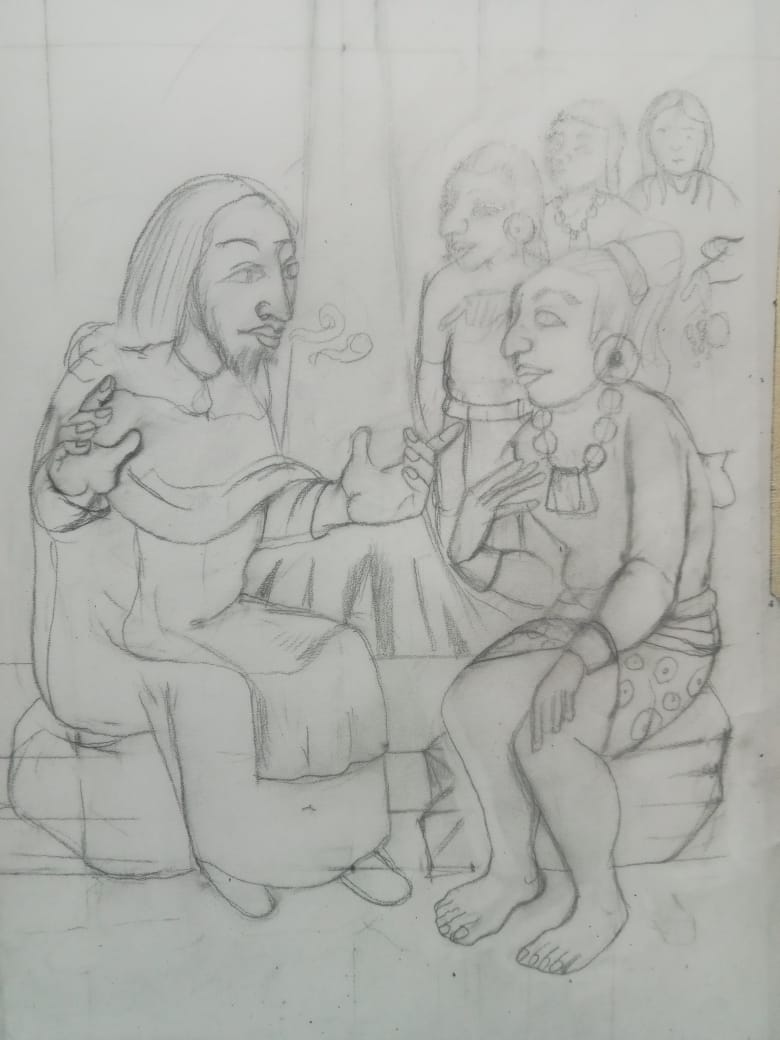
    Three articles reflecting on the local, regional, and national context—by Jorge Santiago, founder of several ecclesial and civil organizations, Susana Montes de la Commission for Support of Community Reconciliation (Coreco) and an interview with Carlos González, a member of the Coordination of National Indigenous Congress of Government Created by Pedro Faro, these are accompanied by a valuable graphic record of the key moments of three decades of peacebuilding in Chiapas. The editorial design and illustrations by Gabriela Soriano Segoviano reflect, with beautiful strokes of contemporary folk art, the connections of the underground memories of resistance that inspire the indigenous peoples of today, as well as civil society and the churches that walk with them.

    Below, I transcribe my participation in the round table discussion, on that rainy afternoon in San Cristóbal de Las Casas.

    “There is no path to peace, peace is the path”

    Mahatma Gandhi

    This year we are commemorating three decades of peacebuilding in Chiapas: Frayba, Coreco, Sipaz, the National Indigenous Congress, the Zapatista Movement, the San Andrés Accords, and many other initiatives of civil society, churches, and social movements. These networks emerged from the fertile soil of Chiapas, prepared more than six decades ago by the pastoral plan of the Diocese of San Cristóbal with the arrival of Bishop [name missing]. jTatik Samuel Ruiz, who, after an arduous and patient conversation and journey with the native peoples, led to the birth of an indigenous Church.

    A decade later, the Indigenous Congress of 1974 fostered the emergence of a collective consciousness among Indigenous peoples as historical subjects. And finally, the rise of the Zapatista movement, with its support bases and militias, proposed a different way of living and creating the political sphere as a shared endeavor. All these processes were accompanied by a vibrant and creative current of critical thought, which arose in the Highlands of Chiapas and the canyons of the Lacandon Jungle throughout the second half of the 20th century.

    The San Cristóbal School, so named by Pablo Romo, along with the Cuernavaca School, analyzed by Humberto Bech, have been, in my opinion, the two main Mexican contributions to critical thought in the second half of the 20th century. Both provide us today with a precise direction for confronting with clarity the growing spiral of systemic violence that, with the Puerto Rican decolonial thinker Nelson Maldonado-Torres, we call here the Great Catastropheand.

    Jorge Santiago's reflection on the Frayba Agenda 2026. Underground Memories The work we present today rightly underscores the centrality of the San Andrés Accords as a crucible of decades of struggle for peace with justice and dignity. The thinker from San Cristóbal points out that the historical demands of Indigenous peoples remain relevant, and that the Mexican state still owes a debt for honoring these historic accords.

    Two pastoral letters from jTatik Samuel Ruiz and Don Raúl Vera prepared the celebration of the Third Diocesan Synod, which took place from 1995 to 1999. This process allowed the diocese to reap the harvest of half a century of pastoral life and thus give a clear path of synodality to the life and commitments of this diocese. Both letters arose in a context of uncertainty due to the animosity and conflict on the part of Vatican authorities of that time, fueled by the Club of Rome, or a group of Mexican bishops who were declared enemies of liberation theology in Mexico and Latin America.

    The first pastoral letter So that justice and peace may meet (1996) is an ecclesial response to the armed uprising of 1994. It reflects the struggle for land by indigenous peoples, as well as the commitment to justice and peace made by this diocese, following the impetus of the Second Vatican Council and the Second General Conference of Latin American Bishops in Medellín. The second pastoral letter From pain to hope, The agreement, signed by both bishops in 1998, after the Acteal massacre, is a commitment to hope amid the pain of the survivors and a pledge to continue seeking peace with justice and dignity.

    The Vatican's violence against this pastoral project would later be unleashed against Don Raúl Vera, who was transferred to the Diocese of Saltillo on December 30, 1999, in a failed attempt to dismantle the synodal process. What his detractors never imagined was that this perverse decision would become the opportunity to sow the seeds of a liberating Church, now in lands of mining extraction and gender violence, which Don Raúl would embrace with fidelity to his mission as a pastor in those desert lands of northern Mexico.

    Finally, I would like to make two final comments to continue the conversation.

    The challenges of moving forward, after three decades of peacebuilding, are now unprecedented, as we find ourselves in the uncertain moment of civilizational collapse. A commitment to justice for Indigenous peoples is no longer enough; it is essential to integrate other forms of justice, such as gender justice (sexual diversity) and ecological justice, to understand the rebellions. transmodern that build individuals and collectives of survivors in contexts of global violence. The historical strength of the poor, which the first generation of liberation theology envisioned, is giving way to the unsubmissive reason of social and ecclesial movements that are already weaving networks of mutual support, dignity, resistance and diverse re-existences.

    It is also time to reformulate the theoretical framework for thinking about systemic violence. Liberation theology requires a radicalization that arises from dialogue with decolonial thought and theory. queer/cuir /queer and intersectionality to continue supporting peace processes, transitional justice, and diverse spiritualities of life that face the ongoing Great Catastrophe.

    Let us not forget that it is our task to honor the legacy of the ancestors of the liberating Church, but from the new subjectivities, bodies and territories in resistance, with the fruits of thought, art and spirituality that emerge as messianic insurrections anticipating other worlds, of dignity and life for everyone.

    The spirituality of messianic time is an interruption of the linear time of that Chronos that devours its children on altars of bloody sacrifices. Such a messianic force arises as an insurrection. peaceful In the face of systemic violence, that is, as a break from the vicious cycle of rivalry and violence, to establish processes of mutual recognition, beyond the violence that produces poverty, exclusion, and subjugation to hegemonic powers. It is a spirituality of life in the midst of death. Another time that (in)emerges as an anticipation of other possible worlds from the survivors of yesterday and today.

    Next Wednesday, March 25, at 6 p.m., we will continue our discussion on critical thinking emerging from Chiapas, with reflections by Pablo Romo on the San Cristóbal School and experiences of a spirituality of mutual support amidst violence, presented by our friend and Peruvian colleague Juan Carlos La Puente. Both reflections will be followed by a dance performance by Martha Elena Welsh.

    See you at the restaurant Belil, in the historic center of San Cristóbal de Las Casas, where with Ricardo and Carmen as hosts, along with Angélica and Abraham, we will continue opening dining spaces, where resistances and spiritualities emerge as a commitment to permanent dialogue and mutual support in the care of life.

    San Cristóbal de Las Casas, March 7, 2026

  • Somos tierra, somos viento Las enseñanzas del Jilol PedroCarlos Mendoza Álvarez | Prayer in the hills with Jilol Pedro | Sot's Leb, 2026

    We are earth, we are wind The teachings of Jilol Pedro

    By Carlos Mendoza Álvarez

    The rocky base of the mountain - through which the Ts'ajalsul or river of salt water - is the center of the world during the prayer of Peter, the young man Jilol or the healer of the Tsotsil people. Dressed in his black wool poncho, with two red crosses embroidered on the shoulders like the dalmatic of Saint Lawrence the Martyr, patron saint of Sots'leb -land of bats in Tsotsil, or Zinacantán- Pedro plants the candles and places the flowers already blessed before dawn.

    In a long ceremony held in the parish hall, on the eve of Ash Wednesday, the six gathered Jiloletic With dozens of catechists and some of the friars who walk with them, we were preparing to accompany them to six sacred sites in the Zinacanteco region to bring offerings to the hills that protect us from wars and evils, invoking God and the saints at every spring, rock at the bottom of the ravine, or hilltop where we would stop to pray after an exhausting sacred walk.

    Three times a year, according to ancestral tradition, prayers rise to the heavens from the hills of this region in the Chiapas Highlands, inhabited by the Tsotsil people of Zinacantán, to venerate Mother Earth in her sacred places and acknowledge the God of Life, who ceaselessly shelters all creatures that live here with the forests and springs. Jiloletic They are the ones who hold sacred power in these ceremonies. They have received the mandate—in dreams and through extraordinary signs throughout their lives, sometimes since childhood—to heal the community of its many ailments, illnesses, and the violence inflicted upon their bodies and crops. Healers of ancestral tradition, their spiritual authority is revered by the communities at pivotal moments, such as prayers on the hills to ask for bountiful harvests, abundant rains, and protection from war and other evils that threaten the people and creatures who inhabit these lands.

    Pedro is a young man from Jilol who led one of the six pilgrimage routes through the hills of Zinacantán earlier this year. His gentle nature, with a deep gaze and kind smile, becomes powerful when he begins to pray in Tsotsil, his voice strong and mantra-like, chanting invocations to the hills, the saints, and the... Ch'ul Spirit, with Jesus Christ and Mary as guides of protection and divine strength. We all kneel behind him, on the rushes carefully scattered by the catechists, to "plant the candles," already blessed, before the three Zinacanteco green crosses that mark this place as a sacred space, visited by other pilgrims throughout the year. The crosses are also venerated with white and yellow flowers that were also blessed and incensed before dawn.

    At some of the Stations of the Cross, Peter tells us a story about the holy place. Like that one about Lachikin, On the rocky hill beside the river, a group of soldiers are summoned who remained there after a past attempt to attack a woman bathing in the river, a criminal impulse that led them to the current where they drowned. But the hills rescued them and transformed them into guardians of these lands, protecting their inhabitants from war. That is why every year we must come to remind them of this duty, because they still dwell here. Many creatures inhabit the hills, and Jiloletic They have received the gift of seeing them and communicating with them in order to ask for protection for the communities.

    After hearing that brief story, the group continues along the path, advancing single file along a steep, rocky trail to climb the hillside and reach another ravine where another prayer will take place. But before setting off, the walkers each receive a small cup of soda, passed from mouth to mouth, like a ritual act of shared strength. Alejandro, the catechist coordinator, invites us to pick up the trash left behind by other careless pilgrims, especially bottles and plastic wrappers, as a sign of caring for the sacred place we have just venerated. A small symbol of the work of caring for Mother Earth that the diocese is painstakingly promoting as part of its spirituality and ecotheology.

    For several decades now, the Parish of Zinacantán—re-entrusted to the Dominican friars in 1975 after an absence of more than a century, in harmony with the Diocese of San Cristóbal de Las Casas in its commitment to the poor and indigenous peoples, along with the hundreds of catechists and lay ministers who support the communities—has been fostering the encounter between the ancestral spirituality of the Zinacantán people and the Christian spirituality of the Gospel of Christ, embodied in the life and culture of the Zinacantán communities. The prayer on the hills, for example, which they continue to practice, is a testament to this tradition. Jiloletic While celebrated independently, it is also an integral part of the parish's activities. Each of these key moments of the year culminates in a Eucharist where both traditions converge in a shared intention to care for the life of the community and venerate Mother Earth as the primordial gift of the God of Life, who nourishes us with his body that is earth and wind, water and fire, and in the height of love becomes the body of Christ to nourish the praying community.

    “We are earth, we are wind” was the mantra that arose in my heart as I silently accompanied the prayers of Jilol Pedro in each of the sacred sites we visited one cold morning with radiant sunshine in the hills of Zinacantán.

    Land that is nourished by springs, streams and rivers that flow between its rocky canyons.

    Wind that sways the treetops and carries in its chariot the birds that live there. Wind that fans the fire that humanized the ancestors.

    “We are earth, we are wind,” according to the wisdom of the prayer of the hills. That full awareness, embodied in breath, prayer, and shared words these days with the Jiloletic of Zinacantán, will endure in my memory like a spark of life that other traditions also receive in their own language.

    Perhaps not by chance, this week we received ashes on our heads, according to the symbolism of the Hebrew and later Christian people: we are earth prepared by God like an ancient potter. This gesture is accompanied by a call to conversion. But we are also the wind of God who breathes his own spirit into us. Ruah divine to make us living beings.

    Sots'leb, February 22, 2026

    Note: How do we connect today with our earth and wind selves?

  • La casa de la Palabra encarnada Una apuesta por el diálogo social y cultural en Chiapas al estilo de los dominicosPilar Emitxin | Embodied poetics | 2019

    The House of the Incarnate Word A commitment to social and cultural dialogue in Chiapas in the style of the Dominicans

    By Carlos Mendoza Álvarez

    A few days ago, we opened a new space for dialogue in the city of San Cristóbal de Las Casas on the feast day of Saint Thomas Aquinas. This was the first event in a year-long celebration of the fifth centenary of the arrival of the Dominican friars to Tierra Firme, as the American continent was then called. Abya Yala. Next June we will be holding various cultural and religious events, both in San Cristóbal and in Zinacantán, with the program 500-OP Chiapas which we will announce soon.

    Together with Abraham and Angélica, dear friends from Ecosur with whom we worked in university ministry at CUC years ago in Mexico City, and with Carmen and Ricardo, friends involved in social and cultural activism in the city, we have been imagining together a project to continue cultivating the great legacy of the School of San Cristóbal, as it is called Pablo Romo to critical thinking and inculturated liberation theology that has developed in the Highlands of Chiapas for more than half a century, with the specific contribution of the Dominicans in these lands. There are many cultural forums that currently exist here—such as CIDECI and Dialectics in the Museum. jTatik Samuel, El Paliacate, Galería MUY and many more – where it is possible to talk about urgent and important issues for the cosmopolitan society that lives here – a microcosm of Mayan, mestizo and foreign peoples – with its many local, regional and global connections.

    Since the 1970s, San Cristóbal de Las Casas has been the scene of important meetings such as the First Indigenous Congress convened by Bishop Samuel Ruiz and leaders of indigenous communities in 1974, it proved to be a watershed moment in the indigenous consciousness of Mexico, as it refers Fabiola Ramírez in her Master of Arts thesis at Tulane University. She also highlights the First International Symposium of Lascasistas, The event, organized by Manuel Velasco Suárez, Agustín Yáñez, and the Dominican friar Enrique Ruiz, was held in 1974. Both events shared a common thread—starting with the fifth centenary of the birth of Fray Bartolomé de Las Casas—the search for paths to promote justice for the indigenous peoples of Chiapas, subjected for almost five hundred years to a racist system, marked by centuries of social injustice and the suppression of their collective imaginaries in their cultural and religious expressions. The spirit of liberation theology, as a creative reception of the Second Vatican Council, was mediated by the prophetic force of the Second General Assembly of the Latin American and Caribbean Bishops in Medellín in 1968, ecclesial events in which they participated. jTatik Samuel Ruiz, made their presence felt with vigor and creative imagination in these lands.

    Two decades of sowing the Gospel in the diocese, with its message of liberation for oppressed peoples, allowed that seed to germinate into a diocesan synod, intimately connected with the indigenous cause, which found in the Zapatista movement one of its most relevant expressions for promoting the autonomy of native peoples. There were other fruitful fruits, such as indigenous theology, which, not without difficulty with Vatican authorities, also expressed the vitality of a profound ecclesial process that continues to this day.

    But the old Royal City of the colonial era, inhabited by a mestizo and Creole population that called itself intercultural, He had become accustomed to living with the "Indians" in modern times with a normalized racism, which was expressed as paternalistic assistance from the caxlanes or Creole chieftains towards the Indians, as Rosario Castellanos masterfully recounted in her collection of short stories Ciudad Real.

    The Zapatista uprising, in addition to its political effects—with the 1996 San Andrés Accords betrayed by the federal government and the creation of the Caracoles or Zapatista autonomous municipalities—had a cultural impact on the city, which suddenly became more cosmopolitan in its daily life, as they tell university students Immigrants in the Highlands of Chiapas since the years surrounding the uprising. As early as the 1950s, Harvard anthropologists and linguists from the Summer School of the Bible had arrived in the Jobel Valley to settle in the colonial city, turning it into a base for their research trips to the indigenous communities they studied, mostly using an extractive academic or religious model.

    But over time, the gentrification of the city of traditional neighborhoods It grew in an unusual way as a result of the rebellion of the canyons that impacted the Highlands of Chiapas in the last three decades.

    Today, more than fifty years after that Indigenous Congress of 1974, and thirty-two years after the Zapatista uprising of 1994, much has changed in San Cristóbal de Las Casas. Indigenous communities have achieved diverse forms of autonomy in the political, social, and cultural spheres, including religious matters, surpassing the vision of their initial proponents. These communities are no longer under the tutelage of political parties, churches, universities, or civil society organizations. The cultural fusion of Indigenous peoples with hip-hop music, audiovisual culture, and contemporary art will surprise many. Indigenous identity now transcends even revolutionary movements.

    And like a boomerang effect, the mixed-race and foreign population living in the city also blends into this landscape of identities. An event about Gaza primarily draws university students and members of civil society, but attracts few of the displaced Indigenous people who live in the northern part of the city. A hip-hop concert, on the other hand, fills plazas. And then there's the Sinaloan band invited to the Zinacantán festival, which will keep the Tsotsil youth on tenterhooks for hours, mesmerized by a professional stage that rivals any pop or ranchera music festival in any major city in the country—and, incidentally, managed by a young entrepreneur from Zinacantán.

    How can we participate in these ongoing cultural changes using the Dominican word itself, not only from the past but also from the present, in its diverse forms of life with friars, sisters, and lay people inspired by the charism of preaching? What signs of the times... deglobalization It is necessary to interpret in order to scrutinize the passage of the God of Life, As the Dominican friar Gustavo Gutiérrez said in Peru, what is needed for a humanity bewildered by global violence?

    The roaming This is a vital attitude of the Dominicans since their founding by Dominic of Guzmán in the 13th century, a time of transition from feudal to urban society. "Holy preaching," the initial name of Dominic's apostolic project conceived with Bishop Diego de Osma, the layman Peter Seila of Toulouse, and Wilhelmina and Raymonda Claret, sisters from Prouille in southern France, expresses the original inspiration of a spiritual tradition that has dedicated itself for eight centuries to seeking truth in every age, trusting in the power of the Word made flesh. Therefore, it is not just any truth that is being sought, but the truth that liberates, saves, and redeems humankind, humanity, and the cosmos from the bonds of evil, as did the Galilean.

    The Dominican-style study is, therefore, the spring of hope According to that beautiful reflection by Friar Timothy Radcliffe, former Master of the Order of Preachers, this spirit led the friars to disperse throughout Europe from the beginning, going to universities "to study and found monasteries," that is, communities of life centered on the Incarnate Word. This impetus took them as far as Mongolia in search of Genghis Khan. This itinerancy was described by Matthew of Paris, the staunch enemy of the new friars at the Sorbonne in the 13th century, who scornfully declared: "Their cloister is the oceans and their cell the world," thus defining for posterity the daemon or the genius of the religious order that was emerging in the medieval towns, as Father Chenu repeatedly reminded us doctoral students in Paris.

    Centuries later, already in Chiapas, that same itinerant journey led Friar Pedro Lorenzo to the Jataté canyons and the Lacandon Jungle to search there, “in the middle of nowhere,” as the prior of Santo Domingo de Ciudad Real admonished him for his rebellion, for the people who lived there. That is why from then on he decided to call himself Friar Pedro Lorenzo de la Nada, according to Jan de Vos.

    In our times of the Great Catastrophe—begun in Gaza and now spread throughout the world in the Trump era—itinerantness leads us to new territories to be created as places of conviviality of the Word. Here in the Highlands of Chiapas, we'll do it like new. itinerant space, where we can foster creative dialogues in search of the truth that saves.

    San Cristóbal de Las Casas, February 7, 2026

    Note: Let's continue the conversation with any comments you'd like to post below.

English