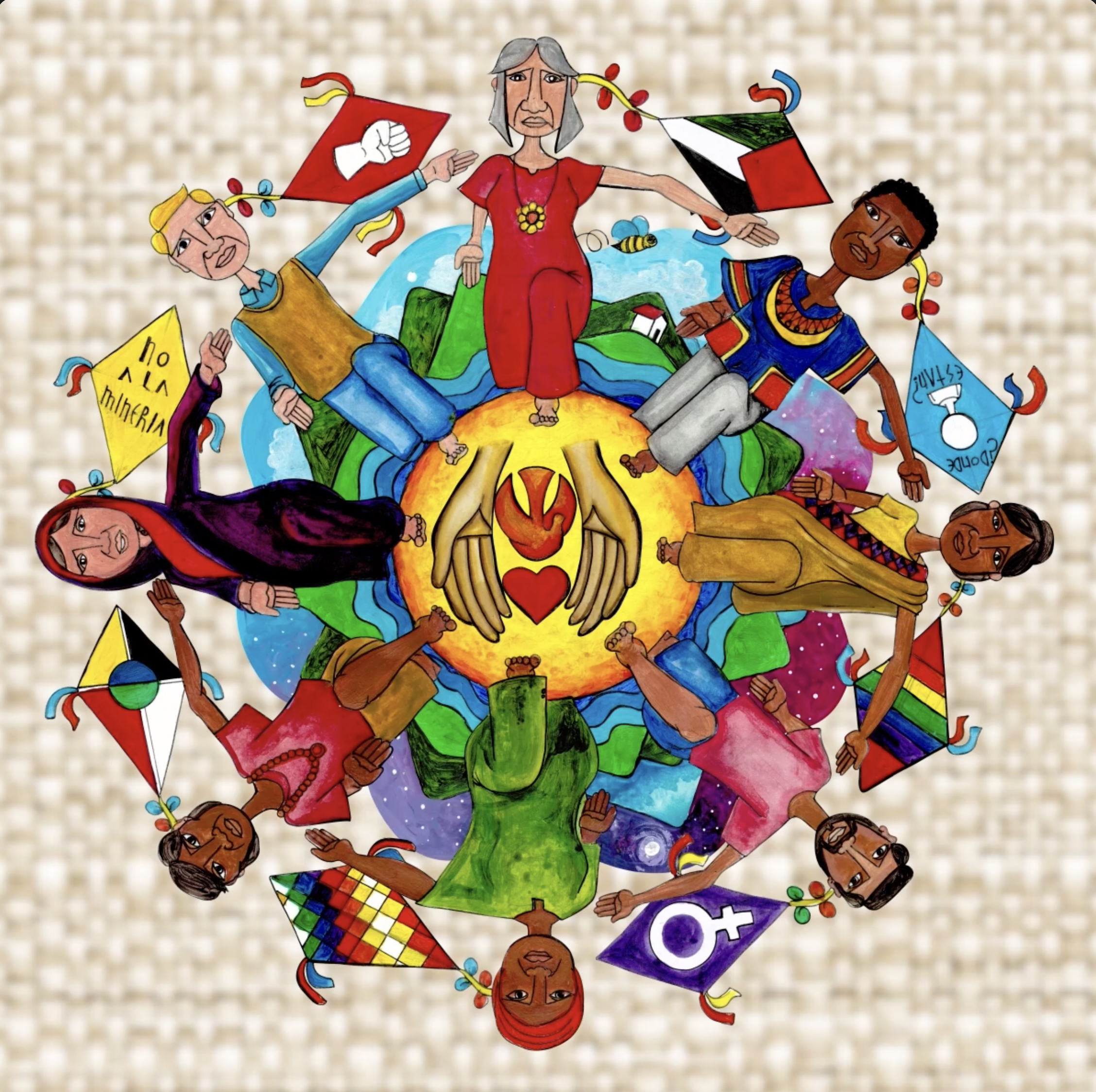
Tag: Blessed Mixture

  • De las resistencias a las re-existencias Sobre los aprendizajes descoloniales de la última décadaAlex Serpas | Re-exists: A Leap of Life | Acrylic paint on paper | El Salvador, 2025

    From resistance to re-existence On the decolonial learnings of the last decade

    By Carlos Mendoza-Álvarez

    I return to the story of the river of waters of life and thought that has been formed thanks to shared learning experiences with friends with whom I discover an inspiring way to live spirituality and to weave a theological and philosophical thought that is meaningful and mobilizing for the times we live in our era of global uncertainty.

    Mutual Spiritual and Theological Accompaniment was the first stream that began to flow, irrigating the lands of my theological work, which I cultivated with people on the margins of society. I sought a spirituality of life that flourishes amidst the cracks of power, first in Mexico and the United States, then throughout the continent, and now reaching Europe and Africa. Thus, little by little, I explored spaces of great vitality, diverse spiritualities with their own theological knowledge outside the university, such as the public square, pastoral service, and social activism. These were spiritualities I had sensed since my youth, but which I now listened to with greater attention, both heart and mind.

    ∂

    The other tributary of the valley of decolonial practices and knowledge was one I began to navigate with Pablo Reyna, Araceli Téllez, Eduardo Velasco, and several colleagues from the Ibero-American University of Mexico City more than a decade ago. It was during the time of the #YoSoy132 student movement, which rose up against the corruption of the Mexican political system; also during the protests over the forced disappearance of the Ayotzinapa students; and, later, during the #MeToo movement, ignited by feminist comrades in public squares around the world to dismantle the age-old patriarchy.

    I joined the learning process to “decolonize the university,” to which David Fernández—who began his rectorship at the Ibero-American University in Mexico City inspired by the thought and martyrdom of his Jesuit colleague Ignacio Ellacuría of the Central American University of El Salvador, and advised by the sharp intellect of the great Mexican thinker Gustavo Esteva—had called us, from my position as an academic and administrator. In my capacity as Divisional Director of Humanities and Communication at Ibero Mexico City, I proposed holding a colloquium in 2016 called “For a Change of World,” where we invited students, faculty, researchers, administrative staff, and university service personnel to raise the most urgent social problems of our time and discuss ways to address them, considering their root causes as part of our university vocation, and making the crucial “epistemological” shift to learn from the knowledge of the peoples and social movements that creatively and hopefully confronted these forms of violence. The keynote address given by Leonardo Boff on the challenges of our time was memorable at that colloquium.

    From that auspicious moment, a series of talks, workshops, and academic colloquia followed, each bringing together three diverse and complementary perspectives and analyses: social movements resisting various forms of violence; academics learning and researching alongside these movements; and artists' collectives creating performances, choreographies, music, paintings, sculptures, plays, and literature to tell and recreate the life stories emerging from the cracks of a violent world. Over time, it proved to be a fascinating formula, full of cognitive, social, cultural, and spiritual challenges, revealing itself as a specific path to "decolonizing" the university, thus opening it to other processes of knowledge and transformation of reality arising from the peripheries of the hegemonic world.

    The 2017 colloquium “At the Crossroads of North and South” on the poetic and academic work of Boaventura de Sousa Santos was another memorable moment. Rappers, singing and dancing to the poetry of the Portuguese author's INKZ (Incapable) writing, interacted with Searching Mothers from Mexico and Argentina, with young women from the Community Guards of Cherán in Michoacán, and with healers from Bojayá in Colombia, healing the trauma of the massacre perpetrated by paramilitaries and the army, among many other experiences of victims turned survivors. In this way, we explored new paths of the “ecology of knowledges”—a barely explored territory that we will have to traverse in the years to come.

    Later, the conference on decolonial theologies organized in 2019 by the international theology journal Concilium in Mexico City—a publishing initiative I was part of as an editorial advisor and later as a director, which kept the flame of the Second Vatican Council alive—in collaboration with the Ibero-American University and the Dominican Catholic University Center (CUC) at the National Autonomous University of Mexico (UNAM), brought together several of these threads into a master knot. An ecumenical prayer service in the Santo Domingo Church in Mexico City, co-led by a Dominican Catholic bishop and an Afro-Puerto Rican queer bishop, opened the event, which then brought together social movements from Mexico, Guatemala, El Salvador, Colombia, Brazil, and Argentina on the Santa Fe campus of the university. There, they engaged in inspiring conversations with investigative journalists, anthropologists, philosophers, and theologians in roundtables of mutual listening. Each day was accompanied by three-way discussions, following the format that had revealed to us a new model of university in its infancy. Other times we organize round tables with renowned figures, such as that extraordinary conversation between Rita Segato, Raúl Zibechi and Amador Fernández Savater about the spiritualities that animate resistances, a topic for the three figures outside of their usual reflections on critical theory that they agreed to explore, carried out at the CUC of the University Parish of the Dominicans, to close the event with provocative intuitions about “political hope”.

    ∂

    Up until then, we called these conversations “Resist” until, in dialogue with Nelson Maldonado-Torres during a colloquium in Boston in the spring of 2022, I realized the need to name this deeper phase of the decolonization of life and thought with a new expression. It was crucial to focus on the “re-existences” created by Afro-diasporic peoples, women in their struggle against patriarchy, queer collectives, mothers searching for their missing children in Argentina and Mexico, collectives of people in forced migration, people with disabilities (or different abilities, depending on the desired emphasis) creating living spaces, and so many other communities in resistance that invent, day after day, new ways of life, communal organization, and spiritualities of Buen Vivir (Good Living).

    Inspired by this intuition, together with Elías González and Juan Carlos La Puente, we organized two festival-meetings at ITESO in Guadalajara, both titled “Re-existe” (Re-exists), the first in 2023 and the second in 2025. Thanks to the vision of its rector, Alexander Zatyrka, and the creative imagination of a handful of theologians from Peru, Kenya, Nigeria, Catalonia, India, and Mexico, we were able to bring together eighty invited guests and hundreds of students and faculty at both events. The heart of both discussions and festivals beat with a focus on the spiritualities that sustain, with “combative hope,” the people and communities located on the fringes of the hegemonic world. Mining extractivism was analyzed in its connections to white supremacist racism and xenophobic immigration policies, with their strategies of ethnic cleansing and extermination focused on controlling territories and subjectivities through new settler colonialisms, such as those that gave rise to countries like the United States, South Africa, and Israel. There, we sought to unravel the processes of awakening, healing, and self-empowerment deployed by communities in resistance. Histories that, little by little, transform into re-existences.

    The harvest of these wonderful encounters was also expressed as a celebratory ritual thanks to the support of Fran, Diego, Glenda, and Lau, popular educators from the Bendita Mezcla collective, formed by the younger generations of the Base Ecclesial Communities of Our America. And so, these conversations reached their aesthetic climax with the comic book talent of Katsumi Lemus, the rap and hip hop of the comrades from Psicolexia and Semillero 259 from Chiapas, the performances of the Portland, Oregon, artists' collective, the dancers of Jauja in the Andean highlands, and so many other people who create glimmers of beauty in the cracks of necropower.

    We now dream of reuniting in Mother Africa in 2028, where we can honor the living memory of those peoples who teach us so much today about the power of their recovered ancestral heritage. Peoples who are living testaments to the creativity of the diaspora and the profound thought that arises from centuries-old wounds transformed into bodies and territories of dignity and hope, as in South Africa and Kenya, South Sudan and the Congo.

    In the context of the great catastrophe (Nakba) that we face today—whether as “war against humanity” according to the Zapatistas in Chiapas, as genocide in Palestine denounced in its ideological apparatuses of Jewish and evangelical Zionism by Silvana Rabinovich and Mitri Raheb, or as technofascism throughout the world according to decolonial thought—these encounters are more urgent than ever to weave networks of mutual recognition and political hope, promoting a sharp analysis of the complexity of the catastrophe.

    But perhaps the greatest challenge lies in sharing the initiatives for caring for territories and the processes of autonomy cultivated by many groups located in the cracks of the hegemonic world, where the life of the peoples is preserved and enhanced as a seed of hope for humanity and for the Common Home that welcomes us into its bosom.

    ∂

    On this urgent topic, a book on decolonial political theology has been in the works for a year. It is a decolonial analysis because it arises from the cracks in necropower during the great catastrophe. But such an approach is insufficient if it is not enriched by the anthropological analysis of mimetic desire, which explains the violence within subjectivity in relation to the otherness of one's neighbor and the other God. This decolonial political theology remains open to ongoing critique thanks to the horizon of apophatic thought, which warns us against any usurpation of the divine. It is a collective work that I gradually developed, together with colleagues who participated in the colloquia I organized with the support of Martin, Matthew, and Francis, enthusiastic doctoral students at Boston College, during the five years I lived in Massachusetts. The New York-based publisher Orbis Books is the home that welcomes us for the publication of this work, where we will give an account of our feelings and thoughts of re-existence in times of necropower.

    I will share more details about this book, which is in the final stage of the publishing process, in future posts.

    Jobel, September 12, 2026

  • Una flor de composta O sobre las re-existencias en medio de la catástrofeCarlos Mendoza | Re-exists 2025 | Opening Ritual 23 IX 25

    A compost flower Or about re-existences in the midst of catastrophe

    By Carlos Mendoza Álvarez


    At the end of September, more than eighty people from survivor groups around the world gathered for a meeting of mutual listening, deepened by attentive dialogues with university students and nourished by provocations from artist groups. We were received with the magnificent hospitality of the Jorge Manzano Chair from ITESO that became home for a few days.

    We began by celebrating the resistances that transform what seems like waste through love, inspired during the opening ceremony by the renowned Catalan singer Lídia Pujol who whispered that “from the compost that is rottenness, the flower can emerge” (Babel). She had discovered this wisdom in the poetry of her 12th-century countryman Ramon Llull, who recounted that “having found a friend who was dying without love, when he asked him why he was dying without love, he replied that no one had made him know about love or had taught him to be a lover.”

    Angelica, from the lands of Malaysia, scattered grains of rice and Himalayan salt as an offering during the inaugural ritual, during which we prepared to listen attentively to the otherness that welcomes us as Mother Earth and inhabits us as Divinity that animates us with its ineffable breath of life.

    Five tables, each with representatives from six collectives, divided into Spanish and English language groups, were the place where we listened to each other each morning, exchanging experiences to awaken, heal, and embrace each other, drawing on the inner vulnerability of each person and collective. Each table had two listeners, who identified the similarities and differences between the experiences described, thus weaving together a mutual accompaniment of solidarity and hope to confront the local and global horror we were describing. Raúl, a young Mayan popular educator through hip hop in Chiapas, commented that "no one had ever sat at a table to listen to my knowledge." Nancy, a Latina feminist theologian from the United States, along with Bosque, a biologist and environmental-spiritual activist from Cuernavaca, were tasked, like other members of academia and organized civil society present at the meeting, with cultivating this attentive listening to weave a common narrative amidst the differences of each experience and context.

    Thus, we respectfully explored the sacred ground of resistance and re-existence. First, by approaching the horror, which we named according to the stories each person told. Sofía, for example, shared her experience as a young Ecuadorian migrant lawyer in Barcelona, where for several years she has worked with undocumented domestic workers in a feminist "coalition" that led them to form a union to strengthen them in the fight for their rights as migrant women while allowing them to develop artisanal skills to support their cause. Sofía's reflection echoed that of Alex, a graphic designer and popular artist who accompanies the Ecclesial Base Communities of El Salvador in the face of President Bukele's state of emergency. Now in its fourth year under an authoritarian leader, this regime of exception produces a filthy life for poor youth in the Salvadoran peripheries accused of criminality to whitewash a regime that has been colluding with criminal mafias for years. The resistance of both groups, in Catalonia and El Salvador, exuded an "interiority" that inspires them in their daily struggles. Christian spirituality in the Salvadoran case and feminist sorority in the Catalan case.

    But it wasn't just about sharing the spoken word; it was about exploring other languages through workshops on body language and sound expression, or through the Jauja dance in the Peruvian Andean highlands as a path of resistance for a people, thus discovering other modes of communication between the seeking mothers and the healing companions who came from South Dakota or Malaysia. These other languages allowed us to overcome language barriers and helped us create powerful nonverbal communication bonds.

    And to tie knots in the fabric of the threads intertwined in each day, the performances, like the one prepared with much love and talent by a Portland collective to celebrate the water that makes us up, thus helping us feel that we are water. To the rhythm of hip hop and rap as an alternative urban art proposal, the Mayan collectives of Chiapas that educate children threatened by drug cartels in the outskirts of cities in the mountains of southeastern Mexico, turned out to be a balm to heal wounds still open from other violence. Like that narrated by Vero looking for her son Diego, missing for ten years, or the violence against girls in Pakistan that Sabine recounted in her Support work in working-class neighborhoods of Faisalabad, in the Punjab region of PakistanThanks to this rapper performance, we all joined in the dance, while drawing symbols on the mural painted by Yara as part of a performance also dedicated to the water being killed in the planet's rivers, lakes, and seas.

    We concluded each day with a harvest moment, where the popular narrative of Blessed Mixture, formed by young people from the Ecclesial Base Communities of Our America, helped us celebrate what we heard and shared through symbols, songs, and rituals. The guiding figures were the bees, a symbol of Mother Earth's resilience, which we welcomed with a wax candle produced by them, burning their flame in the palm of our hand to feel the pain of endangered species. This gesture was accompanied by a drop of honey poured into the other hand to give us a taste of their sweetness as survivors.

    Then came the little house of Acteal, which was placed in the center of the circle of participants to remind us of the martyrdom of some human bees. pacifist collective of Las Abejas linked to the Zapatista bases, opting for the path of active non-violence in their shared struggle with justice and dignity for the indigenous peoples, suffered the murder of 45 of its members, among them four pregnant women, who were massacred on December 22, 1997 in Chiapas in the community hermitage while they were praying for peace, a crime perpetrated by paramilitaries with the complicity of the federal army (Acteal Massacre, Chiapas. Serious human rights violations by the Mexican State in 1997). His memory continues to sting like a splinter that hurts the lives of the indigenous peoples who seek other possible worlds.

    We closed those moments of harvest by making kites with messages of peace for women violated by patriarchy and for the Palestinian people resisting the ongoing genocide by the Israeli state. These artifacts helped us direct our hearts and gaze toward a future with dignity and hope for the people in resistance.


    ∂


    The visit to the community of El Salto, in the suburbs of Guadalajara, led us to cross the abysmal line of the ongoing ecocide that the environmental collective that received us on the “Tour of Horror” (A Leap of Life) describes itself as “an industrial paradise with an environmental hell.” The Lerma-Santiago River basin, which runs 708 kilometers across western Mexico, is an open wound for Mexican territory and for the animal and plant species and people who inhabit it. Since the post-war industrial boom of the last century, polluting industry has spread across this vast region like a social and environmental virus. To date, more than 90 highly toxic pollutants have been identified, many of them carcinogenic, of which only a few, more visible, are treated with a couple of treatment plants. Sofía and Pedro, young environmentalists from the area, tell us that the transnational corporations established in this basin, such as Nestlé, Toyota, IBM, and many others, claim to be green companies today, when in reality, their local parts suppliers are the ones producing the most pollution because they do not comply with current national and international regulations.15 transnational corporations pollute the Santiago River, according to an international report.). ITESO is part of a network of universities in the region that study the water problem (Industry and nature in conflict: will there be a
    future for water in Lerma-Chapala?) in constant collaboration with the collectives of residents and environmentalists who seek to save the watershed with its inhabitants of diverse species.

    Among the members of the group welcoming us is Emmanuel, a little boy of barely ten years old. Wearing cowboy boots and a cowboy hat, he leads his mother's hand as they show us the polluted wetlands, filled with the fetid odor of the city's sewage and the invasive species that inhabit them, such as tilapia, a contaminated fish sold in many markets across the country. The ecological present for this little boy from Guadalajara is catastrophic, but a possible future is beginning to emerge with community organizing.


    ∂


    One of the morning rituals was presided over by Cecelia Firethunder, a Lakota grandmother who told us about her people's long journey of healing their wounds in resistance in the United States. Her experience as a child in a sunflower field that welcomed her in a dance of dignity and strength when she faced discrimination at school has continued to inspire her ever since, as she accompanies her people in awakening from centuries-old segregation, to heal their wounded memories by recovering their language, their knowledge, and their ancestral rituals. It is then possible to walk forward creating new ways of eating, like the initiative shared by her compatriot Nick Hernández to recover lands and methods of communal organization and indigenous Lakota agriculture (Makoce. Agricultural Development) in the heart of the Indian reservations, which have been territories controlled by the US government for two hundred and fifty years.


    ∂


    From the compost that is rotten, the flower can emerge, as Lídia Pujol said.

    But for that moment to arrive in our time of environmental collapse, it is necessary to first recycle the waste produced by extractive, racist, and patriarchal capitalism to recover the organic essence of the resistance of communities of survivors, including Mother Earth.

    At the end of the meeting, we each returned to our places of origin and life choices, certain that as long as there is resistance, there will be hope, because there, in the midst of catastrophe, the lilies of re-existence sprout.


    Guadalajara, September 28, 2025

English