Tag: ancestry

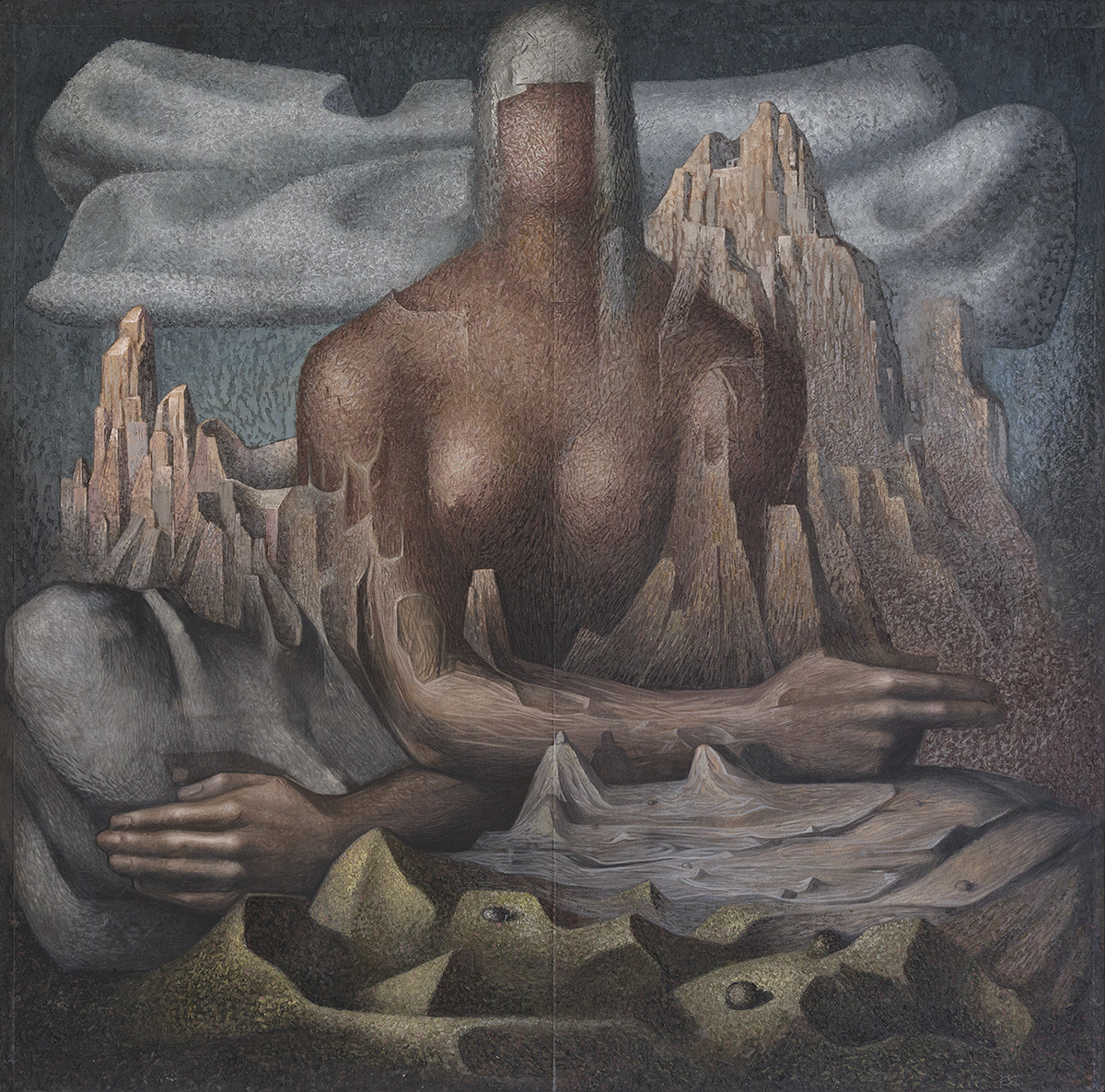
  • En las laderas volcánicas del altiplano mexicano Sobre la vida que resiste y florece en las grietas del mundoJorge González Camarena | The Mountain | Encaustic on Masonite | BBVA Mexico Collection | ca. 1980

    On the volcanic slopes of the Mexican plateau About life that endures and flourishes in the cracks of the world

    By Carlos Mendoza Álvarez

    The fumarole of the Popocatépetl volcano is perceived from afar as a powerful sign of sacred land, venerated by the ancient Mexicans and later by the "graniceros" of today, who preserve the prayer with offerings to the ancestral mountains of the Cholula valley, heart of the volcanic axis of the Mexican highlands.

    Returning to the landscape of childhood, scanning for signs to sow dreams of words and true encounters, brought to my memory surprising episodes of life.

    The first was the campsite on the slopes of Iztaccíhuatl, or the Sleeping Woman, which we, the colleagues from the Emiliano Zapata Preparatory School, organized fifty years ago. The camaraderie of Raúl, Arturo, Adrián, Juan, and Alfredo, among other dear friends, forged a sacred friendship in that place that endures to this day. The youthful rituals of student camping were enlivened by periods of silence, games, cooking, and celebration, listening in the heart of the forest to the progressive rock music of our generation, from Pink Floyd and Queen to Emerson, Lake & Palmer and other British bands that populated our collective imagination.

    Another memorable moment in volcanic lands was the ascent to the Popocatépetl crater, with Friar Raúl Vera as our novice master, guided by Güero, a young, expert mountaineer from Amecameca, in the State of Mexico, one early morning in the spring of 1980. After a great effort in the final part of the climb, well-equipped with ice axes, mountain boots, and goggles for the glare of the snow, the group of ten novices and their master reached the crater. We found the volcano's chimney exhaling sulfurous vapors, still silent, as Don Goyo—as Popocatépetl is called because of March 12, the day of Saint Gregory, on which, since ancient times, its feast day has been celebrated with offerings to ask for rain—would not reactivate its active cycle until December 21, 1994, after seventy years of volcanic inactivity. Peering towards the inner cone from the crater's ridge, amidst an astonishing silence, we celebrated "the Mass on the world," according to that phrase by Teilhard de Chardin, that remarkable scientist and Jesuit mystic of the cosmic Christ, Alpha and Omega of the evolution of the cosmos.

    As a sacred place, this land of volcanoes has also suffered the siege of evil, but with the triumph of life, leaving scars on the wounded social body.

    I remember the harrowing experience of four friars who volunteered to mediate, for humanitarian and evangelical reasons, the ransom payment for a kidnapping victim. It happened in 1994, that fateful year for Mexico, when disparate worlds collided like tectonic plates: the modernity of President Salinas, marked by the greed and corruption of the Mexican political system, clashed head-on with the guerrilla movements that still survived in the country after their persecution by the Mexican state since the Dirty War of the 1970s. Living through the experience of mediating the ransom payment for a kidnapped person was a profound experience, bringing me face to face with the fragility of human life in the face of the abyss of evil. The cursed money of that thirty-million-dollar ransom symbolized, on the one hand, the perversion of the powerful members of the Mexican elite who amassed such wealth, and on the other, the wickedness of those who used human life as a banner of justice for dubious social causes. As part of the ransom delivery route, the kidnappers, who were guiding us by satellite phones—very rare even then—made us cross the Paso de Cortés, right between the two sacred volcanoes, to reach Puebla and deliver the cursed briefcases there. This wasn't possible because, according to those manipulating us, we were being followed by the government. After a few days of uncertainty, we were able to deliver the ransom in a working-class neighborhood of Mexico City, and the person was released hours later. The four friars who volunteered to be mediators will never forget that experience of humanitarian assistance amidst a wave of criminal violence, with perpetrators on both sides. Violence that, unfortunately, persists to this day in new forms of necropower.

    Years later, I returned to that area through Tlamacas, a mountain refuge also located in Paso de Cortés, during a dramatic moment for a community there on a spiritual retreat led by Friar Ricardo Villarreal at the Hermitage of Silence. In the middle of the night, after a day of meditation, the community was attacked by bandits. Their collective trauma did not prevent this contemplative meditation community from continuing on its path of inner healing and strengthening of its communal life, uniting body, mind, and spirit in a journey of spirituality in motion, through sacred walks, Christian and Buddhist mantras, and service to the community. The silence of the forest, with its human and other inhabitants, had been desecrated by criminal gangs.

    In recent decades, the plume of Don Goyo (Goyo's volcano) has persisted, sometimes exhaling sulfurous vapors and volcanic ash accompanied by lava. Thus, it presides over the dawns of the Puebla-Tlaxcala valley, with its history of earthquakes and social movements of indigenous peoples, of youth demanding democracy, and of collectives dedicated to the spirituality of the land.

    Popocatépetl is the guardian of Iztaccíhuatl, also called "La Volcana" (The Volcano) by the farming communities that live on its slopes, or Rosita because its August festival gratefully celebrates the rains and the fertility of the crops. She is the beloved Sleeping Woman of Mexica mythology, reimagined in recent times as the guardian of the planet's chakras, according to the mythology of Regina created by Antonio Velasco Piña.

    A few days ago, I had the good fortune to visit the territory of San Juan Tianguismanalco and Santiago Xalitzintla, accompanied by Víctor and Carolina, with their young son Emik, who live there and lovingly care for it. For me, this short trip was a reunion with sacred land. I experienced that day as a ritual within the spiral of time, to once again tread that sacred ground of my youth, now with dreams in my heart of returning to the land of my ancestors.

    I met a young and talented witness to the communities organized in defense of their land, connected by family ties and choice to the villages, forests and springs, birds and insects, reptiles and rodents, cornfields and greenhouses that inhabit it. A land of volcanoes with lush avocado, apple, peach, and pear trees. A territory of flowers and aromatic plants with healing essences used in traditional therapies. Ancestry and agroecology find in this land a strength deeply rooted in the land, a promise of life in a present lived with hope amidst so many global uncertainties.

    The dream of Tabor - another holy mountain that has always accompanied me as a symbolic place of ancient and new transfigurations, from that of Jesus of Galilee to that of the peoples in resistance and re-existence - is now revived with impetuous force in these parts, now in these sacred mountains.

    The volcano evokes the virtuous triangle I've been discovering with friends like Juan Carlos from Peru, Kochurani from India, and Laurel from the United States and El Salvador, as well as with collectives from diverse latitudes, to represent our learning process of sowing combative hope where life is threatened. One vertex of the triangle is the practice of mutual support among individuals and collectives resisting systemic violence as a source of life. The other vertex is the creative experiences where we learn to re-exist, reinventing ourselves from the ruins amidst the Great Catastrophe we are experiencing. And the third vertex is the spiritual and theological seedbeds, with ethical and mystical depth, that we can cultivate collectively to learn to care for ourselves and flourish as individuals and creatures of the cosmos. Soon, in this land of volcanoes, we will create a virtual and in-person seedbed on the decolonial theology we are developing in community.

    We will see how the breath of the divine Ruah makes us discover, with exquisite respect for the territory and its inhabitants, new calls to inhabit together the sacred land of the Puebla highlands.

    And speaking of resistance to necropower in the territories, we must now also consider the digital realm where artificial intelligence, manipulated by transnational corporations and authoritarian governments, is designing techno-fascism. For this reason, next Thursday, July 9th, the JobeLab collective, formed by friends from San Cristóbal de Las Casas, will hold the discussion “Disarming Power and Rescuing the Human: Readings on Leo XIV’s Encyclical 'Magnifica Humanitas'‘ at La Madriguera bookstore in San Cristóbal de Las Casas. We will have the participation of experts in computer science, communication, anthropology, philosophy, and theology. Chiapas is a prize for its natural resources, coveted by the industry behind AI, so it is crucial to understand what we are facing. We hope to see you there.

    San Juan Tianguismanalco, July 2, 2026

  • Navidad en lo secretoCarlos Mendoza | Tsotsil birthplace | Nachig, Chiapas | 2025

    Secret Christmas

    By Carlos Mendoza-Álvarez

    Christmas Eve was shaping up to be different this year, a stark contrast to the frigid weather of Boston, which gave way to the cool but sunny days of the Chiapas Highlands. Of course, it wasn't just a difference in climate, but above all, a shift in cultural perspective. The chants of the Episcopalian monks from Cambridge, in Massachusetts, which I had enjoyed for several years, now gave way to prayers of forgiveness and reconciliation according to the traditional Tsotsil rite of the Chiapas Highlands, led by one of the catechists or Eucharistic ministers.

    During these days, the Tsotsil communities of the Zinacantán parish adorn their chapels with thousands of flowers. Sunflowers, birds of paradise, roses, and gladioli surround the birth of the Christ Child, especially the bromeliad or flower of Niluyarilo. This species, endemic to the Chiapas Highlands, is now endangered due to its overuse in some religious festivals in the Chiapa de Corzo area. The Nativity scene is adorned with garlands of seeds and fruits, representing an explosion of life from Mother Earth, who gives thanks for the arrival of the Christ Child. Bananas, tangerines, pears, oranges, pomegranates, and lemons hang from bowers as if falling from the sky. Paradoxically, the world above blossoms and rains down delicious fruits to nourish the community gathered around the newborn Messiah.

    Joseph and Mary inhabit that sacred green cave, dressed in traditional Tsotsil clothing. He is wearing the Pok'u'ul or a pink poncho embroidered with flowers, carrying a leather satchel on his shoulder and huaraches on his feet. She, adorned with her il chil k'uk'umal or the feathered huipil, also replete with embroidery of flowers and birds. Life flourishes everywhere in these communities, although they face new problems such as the growing presence of drug trafficking and criminal gangs. The historical strength of these Mayan peoples is community unity, although division now appears within the communities between groups that only want to follow the Bible and others that keep the traditions of their ancestors alive, for example, the processions to sacred hills, like the community of Pinar Salinas, which keeps their ancestral traditions alive. These communities have a dynamic cultural identity that, with each new generation, acquires its own unique characteristics. Such is the case of church choirs that now prefer to play instruments from norteño bands, such as the tololoche for strings and the snare drum for percussion, instead of the drum and chirimía of the ancestral music they keep alive for pilgrimages to the hills of the Chiapas Highlands and, every year, in their pilgrimage to Tepeyac in the Valley of Anáhuac.

    My surprise was great when Petul, the catechist and interpreter, during Christmas Mass, translated my very brief biblical reflections into lengthy descriptions of what I was saying about the story of Mary, the child, and the shepherds in the Gospel of Matthew. I had no choice but to trust his skill as an interpreter, glancing at the congregation to nod whenever I recognized a word in the catechist's voice. My intention was to emphasize the importance of the angels' message to the shepherds in Bethlehem: “Glory to God in the highest, and on earth peace to those on whom his favor rests” (Luke 2:14), which invites us to do something similar. Let us learn to be like the shepherds—I would say to the congregation with emphatic gestures—who became a mirror reflecting God's glory through peace here on earth, so threatened by wars. The sermon concluded by reminding the assembled community that this message was even more urgent today because Bethlehem is in Palestine, besieged by a cruel war waged in the name of God. The community responded with a resounding “Long live the Christ Child born in Palestine!” followed by the traditional reveille, sung with gusto by the choir.

    Is there anything to celebrate on the fringes of the privileged world? In what places does God draw near to us to be a spark of light illuminating the nations? Who can help us see those sparks amidst the long night that humanity is traversing?

    The first thing that comes to mind is that reflection by Hannah Arendt in her book The Human Condition, pointing out that in every human birth there is a promise of a future for all humanity. The thinker drew from the wellspring of her Hebrew tradition to speak of the future as something to be fulfilled through justice, as an interruption of evil in history. But perhaps she overlooked the heart of the promise God made to Abraham and Sarah in its spiritual sense, which consists of the promise being a gift from the Eternal, offering His very being to wounded humanity. It is no coincidence that this promise has a name, the one that Hebrew and Christian faith call "Messiah": the one anointed by the divine Ruah to console the suffering people. A Messiah who is slow in coming, who makes the wait long, and, paradoxically, who is already present "in secret," inviting us to enter that space of redemption "through the narrow gate." What does this metaphor mean? This thought takes on even greater significance when we celebrate the birth of a Galilean child two thousand years ago in Palestine.

    The birth of Mary's son in Bethlehem of Palestine, as recounted by the Synoptic Gospels, is a sign worth following as a guiding light in the darkness. That Hebrew child, son of migrants fleeing Roman power represented by Herod and seeking refuge in Egypt, is the promise fulfilled of messianic times. Those who arrive with birth pangs in the most fragile part of the human condition, exposed to so much violence, both ancient and new. His childhood, recounted in retrospect by the evangelists, will unfold over time, especially during the brief period of barely three years he lived as an itinerant preacher in Galilee. He announced the fulfillment of the new times that we will be able to recognize in the present time when “the blind see, the deaf hear, and good news is announced to the poor” (Luke 7:22).

    We are invited to pass through the narrow gate of the Messiah, which is the gate of humility: “You must become like a child to enter the kingdom of heaven” (Matthew 18:3), said Jesus, the Galilean. The Bible is full of stories from this other perspective, as Anna sang in the book of Samuel: “He raises the poor from the dust and lifts the needy from the ash heap, to make them sit with princes and inherit a throne of glory.” Or also the hymn of Jesus that praises his heavenly Abba because “he has hidden the things of the kingdom from the wise and understanding and revealed them to little children,” the nepioi from the Gospel of Luke in Greek (10:21).

    The arrival of the Messiah subverts the logic of the powerful and builds a new world from the perspective of those who live amidst the ruins. Like in Gaza and the Highlands of Chiapas.

    My first few weeks in Tsotsil lands have allowed me to reconnect with the Ch'ulel, This spiritual force, with its multiple meanings, is what I discovered forty-five years ago in these communities, when we visited as Dominican novices with Friar Raúl Vera. It is the spirit of the Chiapas Highlands, manifest in its hills, forests, and mist, its animals and naguales, that inspires the communities to flourish and prosper. Since then, I have returned at least once a year to the Chiapas Highlands and the canyons of Ocosingo to continue exploring the faith of the Mayan peoples, with their ancestral spirituality nourished by faith in Jesus of Nazareth as Messiah and Son of God.

    Now I am about to explore and enjoy, for an extended period, the faith-based life of these communities, with its new expressions in spirituality and art, as well as its struggle for justice against the necropower groups that have reached even here with their tentacles of corruption, easy money, and the false illusion of happiness based on armed force, drugs, alcohol, and criminal pacts. A few days ago, Angélica, a dear friend from Ecosur, told me that there are several ongoing sociological and anthropological research projects on urban Indigenous children and youth in Jobel. These are supported by initiatives from civil society and churches, such as Melel Xojobal to provide alternatives for education, social life, and recreation to this population highly vulnerable to the criminal networks that take over the northern area of this city, which has the largest indigenous population in Mexico.

    Celebrating Christmas in this land is a call to return to the margins of my motherland to relearn the language of the little ones of the Kingdom. In the heart of my longings I seek to return to the sources of faith, that which I inherited from my ancestors of blood and spirit in the order of preachers.

    A quiet Christmas. A time of grace and truth thanks to the child messiah, adorned with flowers and song, tears and whispers of life, who does not surrender to evil in this remote region in the mountains of southeastern Mexico. Communities that, in secret, transform adversity into gifts of life.

    Jobel, December 27, 2025

    Note: Comment below what Christmas means to you.

English