Category: messianic times

  • Los sionismos que nos acechan Sobre el (ab)uso de la Biblia en tiempos de la Gran NakbaJuan Fuentes | Critical Zionism Studies | 2025

    The Zionisms that threaten us On the (ab)use of the Bible in times of the Great Nakba

    By Carlos Mendoza Álvarez

    In recent weeks, an alert was raised in Chiapas due to the presence of the Israeli group "Heroes for Life" in primary schools in Zinacantán. This group, comprised of young Israelis, offers activities such as English courses and school facility renovations, presenting itself as an "Israeli youth volunteer" experience with a smiling and friendly "humanitarian work" for vulnerable populations around the world. Apparently, many of them and their advisors are active or retired members of the Israeli army who have participated in various Zionist wars, as Herman Bellinghausen recently commented.

    A few weeks earlier, the Israeli consul in Mexico, Hilla Burk, accompanied by Israeli security advisors, was received by the Secretary of "People's Security," Óscar Aparicio Avendaño, at his offices in the state government building in Tuxtla Gutiérrez. To this day, the public has not been fully informed about the agenda of that meeting, nor about the agreements reached. According to news reports, in other states such as Chihuahua and Querétaro, Israeli advisory contracts already exist with the current governments regarding strategic security, which include contracts for the sale of "state-of-the-art" technology and weaponry from the growing transnational military industry.

    Adding to this Israeli activism in Mexico are the “healing retreats” organized by the Israeli organization Chabat in Cozumel and other Mexican Caribbean beaches, aimed at active and reserve members of the Israeli army who have participated in “the war to defend the State of Israel,” as reported by journalist Georgina Zerega. This is a euphemism to conceal their participation in the ongoing genocide against the Palestinian people in Gaza and the West Bank, as well as the invasion of southern Lebanon with the Greater Israel project, which, as analyzed by thinker Silvana Rabinovich, includes the construction of the Third Temple in Jerusalem as the supreme symbol of this religious war narrative. In some countries, such as Chile, Ireland, and Spain, campaigns have been launched to denounce crimes against humanity committed by Israeli soldiers who are identified passing through these countries, and whom organized civil society and some governments are seeking to bring before national and international courts.

    There is a plan for Israeli territorial expansion in Latin America beyond the Middle East, as investigative journalists have documented in Patagonia and Yucatán, strategic locations due to their natural resources such as water, minerals, and rare earth elements.

    Behind that humanitarian and tourism facade, Zionism deploys a perverse religious ideology based on a misnamed political theology of election and the promise of the land, making the Bible a weapon of war.

    Given this scenario, Christianity faces one of its greatest challenges amidst the civilizational crisis we are experiencing today: discerning the idolatries that supplant the name of God to bring about the death of peoples and the control of strategic territories. Judaism and Islam—in the critical expressions of their own spiritual traditions—will also have to discern the challenge of the Great Nakba, or Great Catastrophe of our time, as the Puerto Rican philosopher Nelson Maldonado-Torres calls the civilizational crisis of the coloniality of techno-fascism.

    Pope Leo XIV, for his part, has drawn attention to the “warlords” who control the war economy marked, from now on, by the abusive use of artificial intelligence for the benefit of an oligarchy of digital technocrats, among whom are the owners of the mega-companies of Silicon Valley in California.

    But as pastor and teacher in the See of Peter, the transcultural Pope has also denounced the blasphemy of those who use God's name to wage war, without explicitly mentioning Zionism or Trumpism. Indeed, in his first Encyclical Letter, "Magnifica Humanitas," Leo XIV denounces "the ideologies of death" that cause suffering and wars due to the greed of the modern world in its "posthumanist" version, which prepares the way for a species superior to humankind, generated by algorithms, and "transhumanist" because it subordinates humanity to the system controlled by biotechnological devices. This is an apocalypse of humanity that Ivan Illich had already predicted six decades earlier.

    In this context, Christian communities throughout the world—in their diversity of traditions as collectives of believers, academics, and artists, together with social movements of prophetic and liberation inspiration—are called to understand and deactivate Zionism, both Jewish and evangelical, which lies at the root of Israeli territorial expansionism today, particularly in Latin America and the Caribbean, with the complicity of the extreme right that haunts political life in Argentina, Chile, Ecuador, El Salvador, Guatemala, Mexico, and the United States.

    First and foremost, it is about honoring the name of God as divine Wisdom that guides our steps toward justice, peace, and mercy in a world at global war, or, as Silvana Rabinovich calls it, an ongoing “omnicide.” The name of God denotes both the unfathomable divine mystery and the inalienable dignity of creation as the work of His love, which no power in this world can supplant or control. Neither ancient demonology nor the hierarchies of today's necropower lords can replace the divine Glory that always transcends political power, as the Italian thinker Giorgio Agamben has so astutely analyzed.

    Secondly, it is important to dismantle the political-religious ideology (not political theology in the strict sense) that today turns the Bible into a weapon of war, especially against the Palestinian people and the Semitic peoples of Palestine, both Christian and of other religious traditions. In this regard, Mitri Raheb and Munther Isaac—Palestinian Lutheran theologians resisting the genocide of their people—constantly emphasize the importance of dismantling the Zionist ideology that has manipulated the theology of the land promise and divine election for the exclusive benefit of the Jewish people.

    It is important to remember, as the Mexican-Lebanese intellectual Alfredo Jalife-Rahme points out, that the Zionist lobby in the United States and Great Britain created the Zionist ideology in the 19th century as an expression of the colonialism of the Jews of the Diaspora, who are not Semites but descendants of the Jewish presence in the countries of Central and Eastern Europe in the 19th century. Zionism originated as a political ideology for the control of the territory of Palestine for the exclusive benefit of the Jewish people.

    And third, we must remember that the Zionist expansionism that has reached Mexico, specifically Chiapas, requires critical monitoring by civil society, churches, and governments regarding its plans to control territories. This expansion is justified by the ideological narrative disseminated by the Israeli state under Netanyahu and his Minister of National Security, Itamar Ben-Gvir, with its brazenly promoted genocidal and expansionist logic of Greater Israel. The Zionist project is rooted in a powerful war industry that makes Jewish and Christian Zionism a threat to humanity and our common home.

    Following the threads of decolonial theology, both Jewish and Christian, it is necessary to reread the Bible as the book of faith of the Semitic peoples in the promise of the living God, who is progressively opening himself to all nations of humanity as recipients of the messianic times that overcome fratricidal violence and establish a new humanity. This is a theology of “the meek who will inherit the earth” (Matthew 5:5), according to the poetic imagination of Jesus of Galilee, as Mitri Raheb reminds us, stemming from the God of life's preferential option for the poor and excluded of all times. It is a theology of the promise fulfilled in the event of the resurrection of Jesus, the Christ of God, which brings to its most radical expression the manifestation “not of a God of the dead, but of the living” (Matthew 22:32). Promise and choice that the Abba of Jesus always fulfills from those excluded from hegemonic systems of domination to summon all the peoples of the earth to the feast of desire, as proposed by the Mexican queer theologian Ángel Méndez.

    Once the civil society of Chiapas and Mexico discovers the threads woven today by Jewish and Christian Zionism, which is expanding throughout the world in complicity with techno-fascist companies and governments that promote discrimination against peoples and religions, it will be necessary to promote communities of encounter between diverse spiritual traditions, in mutual support, nurturing the resistance to evil with such diverse faces.

    Caring for the children and youth of Chiapas in the face of the threat of Zionism today, together with the accountability of authorities at different levels of government in the financing and management of public security, will allow the creation of environments of unrestricted respect for human dignity, with special attention to the most marginalized and vulnerable people and communities.

    Then we must promote the celebration of divine blessing for all nations, not only for the Jewish people who in their Zionist version are betraying their vocation to be witnesses of the Eternal, as described by André Neher, the great French Jewish thinker of the 20th century.

    Let us not forget that messianic times come to all peoples - in the midst of the history of humanity threatened with death, but promised fullness by the God of Life - thanks to the righteous people of history who give their lives for the world that came from God, not from the powerful of this world.

    San Cristóbal de Las Casas, June 20, 2026
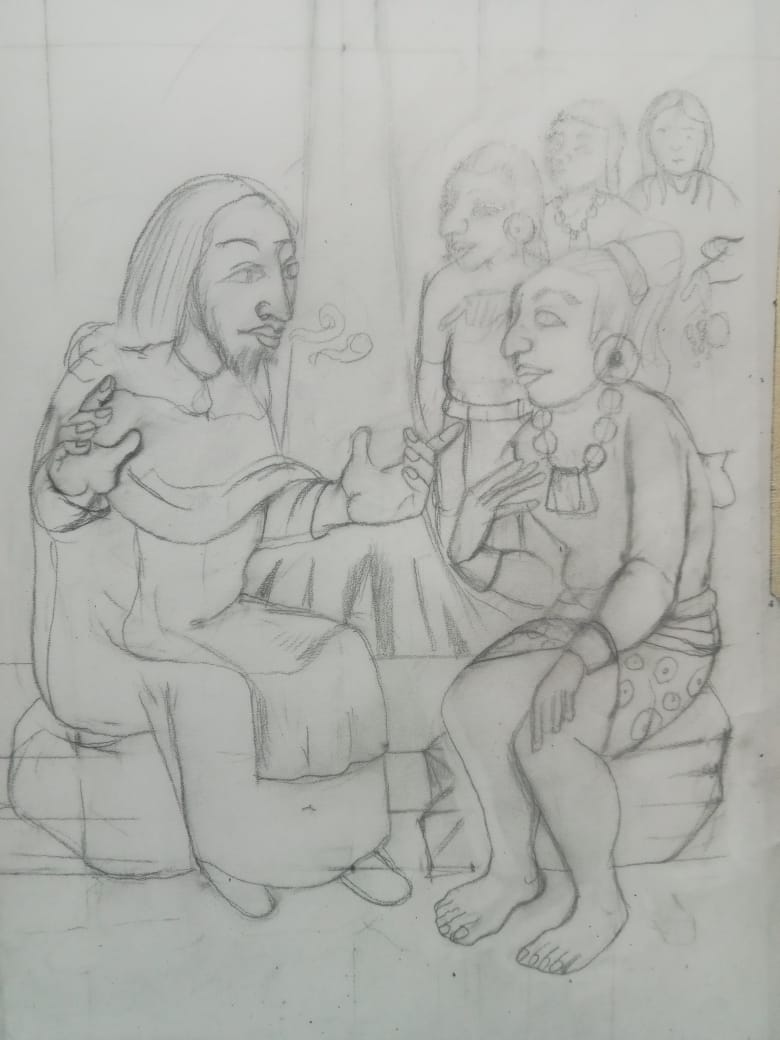
  • La fiesta de la Ruah divina Reflexiones sobre la memoria viva de los pueblos en movimientoAntún Kojtom | Mural 500 OP Chiapas | Detail: sketch of Friar Pedro Lorenzo de la Nada with Lacandon Sage | Sots´leb, 2026

    The Feast of the Divine Ruah Reflections on the living memory of peoples on the move

    By Carlos Mendoza-Álvarez

    Fifty days after Easter, Christian communities around the world celebrate the overabundance of divine love, reaping the fruits of the messianic age, gathered with joy in the midst of suffering, as the Hebrew poet says: “Those who sow in tears will reap with songs of joy” (Psalm 126:5).

    Two thousand years ago, after mourning the brutal execution of Jesus, the Galilean, by the Roman Empire—in collusion with the Temple authorities of Jerusalem and the enraged mob as part of the infernal mimetic cycle—a period of mourning was necessary for his community of friends and companions to grasp the senselessness of the innocent's death. This question still arises today in the grieving hearts of those who have survived lynchings, both ancient and modern. It is a questioning of the meaning of absence that also beats in the hearts of the Mothers Searching for their disappeared children in Mexico today, a cry that becomes a plea to find their offspring and help them "come home.".

    Celebrate that Love is as strong as death and, even more, that Love conquers hate or that Life resists and re-exists At first glance, it seems like an evasion that ignores the suffering of the victims and the urgency of justice. On the contrary, it seems to me that precisely in that hopeful suffering The heart beats with the ethical, political, and spiritual indignation of survivors of so much violence. A cry that is expressed in the public squares of Gaza and Tehran, Beirut and Mexico, Kakuma and Dadaab in Kenya, by those who dedicate their bodies, hearts, and minds to the service of life in the midst of death.

    The celebration of Pentecost is rooted in the joy of peoples who, after confronting horror, are able to go further in healing from trauma and quietly cultivating hope. Without denying the painful past, nor the undeniable need to hold the perpetrators accountable, what matters to those who survived is to stand up and live again with hope. This is what I have been learning, step by step, from the collectives queer/cuir  who face gender phobias of various kinds, women facing abuse and femicide, as well as indigenous peoples who strengthen their resistance through processes of autonomy of bodies and territories, from the Inuit in Canada to the Mapuche in the far south of our continent.

    How can we celebrate the harvest of the divine Ruah in these times of such profound uncertainty? We are witnessing alarming signs of a return to barbarism at the hands of genocidal governments in the Middle East and Africa, as well as in failed states trapped by the complicity of their rulers with transnational criminal organizations, as is the case in Mexico, El Salvador, and Nicaragua. This spiral of genocidal hatred is being transmitted in real time through the attacks of the Israeli Zionist state, which is committing crimes against humanity with the complicity of the United States and the European Union, and the indifference of the international community, against entire populations that stand in the way of its geopolitical power.

    Strengthening resistance movements must also confront fundamental debates to find the path to utopia in times of dystopia. Collective memory, which lies at the heart of these processes, is now a battleground. Who tells the story and how they tell it are questions the Zapatistas in Chiapas, like the Sumud Global Flotilla, are asking themselves, attempting to give visibility to those who always remain in the shadows of the power that kills.

    We Dominicans are not exempt from these debates, especially now that we commemorate 500 years since the arrival of the friars to what we now call Veracruz in Mexico, on July 25, 1526. The great feat of evangelization—which undoubtedly brought missionaries inspired by Renaissance utopia and by the zeal for reform of the religious orders to return to their origins of following Christ—was also marked by the libido dominandi of the conquerors who followed that maxim of Western modernity so forcefully expressed by Enrique Dussel: conquiro, ergo sum, that is, "I conquer, therefore I am".

    When recounting the history of the Dominican presence in this region of the continent—called Tierra Firme by Western navigators and Mesoamerica by later geographers—we cannot forget that a fundamental contradiction marked the evangelizing work of the Dominican friars in the 16th century, as rigorously studied by Friar Daniel Ulloa Herrero in his doctoral dissertation at El Colegio de México: an observant current led by Friar Domingo de Betanzos, and a prophetic tendency championed by Friar Bartolomé de Las Casas. Undoubtedly, there were many nuances between these two tendencies when it came to evangelizing the colonized lands that later gave rise to the golden age of New Spain, the era of the Baroque churches along the Dominican route from Mexico City to Guatemala, traversing the entire central and southern regions of the Viceroyalty of New Spain.

    The splendor of the Baroque art of the convent churches of Puebla, Oaxaca, and Chiapas has shaped a worldview in which Mexico was the axis mundi From that early era of modernity, a meeting point between Asia and Europe, Mexico City was also a laboratory for cosmopolitan culture, as Friar Julián Pablo Fernández liked to say when he was prior of the ruins of the Imperial Convent of Santo Domingo in Mexico City. This era gave birth to a Creole and mestizo culture of universal value, as UNAM historian José Rubén Romero Galván recounts. However, we cannot forget that this Creole culture subjugated and rendered invisible the Indigenous peoples, as contemporary decolonial readings emphasize.

    These reflections come to mind when accompanying a great Tseltal Maya painter, the master Antún Kojtom, who is currently creating a mural commemorating the arrival of the Dominicans in Chiapas, on a wall located in the main square of Sots'leb, between the temple and the market, in the municipal capital of Zinacantán.

    For the past six months we have been discussing the narrative of the emerging mural, emphasizing what we now call a "dialogue of knowledge" between the Mayan peoples of Chiapas and the Dominican friars.

    We chose a tone conversational The mural depicts scenes that highlight the ancestral religion of the Tsotsil people, particularly their religious roles such as grandmothers, seers, and stewards, with their ritual prayers on the hills, ancestral blessings, and community responsibilities. Through this narrative, we seek to underscore the centuries-old legacy that remains alive today in the pastoral life of the parish of San Lorenzo Mártir in Zinacantán.

    In the center of the mural appears the meeting between a Tsotsil steward and a Dominican friar, Fray Bartolomé de Las Casas, both standing with the same dignity, exchanging words, each with his symbol of authority, the staff of command for the first, the Bible for the second.

    On the right, a third scene brings together the prophetic Church that has flourished in the Highlands of Chiapas and the Lacandon Jungle from the 16th century to the present day: a group of friars, with Friar Matías de Córdoba who promoted the independence of Chiapas in the 19th century and Friar Raúl Vera with jTotik Samuel beside him, bishops of the Church of the poor and excluded in the 20th century. Above their heads, like kites moved by the wind of the divine Ruah, are the martyrs of the San Cristóbal Church of recent decades: Ignacio Pérez López, pre-deacon of Chicomuselo, Father Marcelo Pérez, parish priest of Guadalupe in Jobel, Simón Pedro Pérez López, member of Las Abejas de Acteal, and Guadalupe Vázquez Luna, survivor of the Acteal massacre.

    On the far right appears a highly symbolic scene for the recreation of the historical memory of the Dominican friars in Chiapas, recounting stories of creative rebellion: Friar Pedro Lorenzo de la Nada conversing with a Lacandon sage, both seated on rocks in the shade of a large ceiba tree, the sacred tree of the Maya, with the glyphs of the flowery word emerging from their mouths. The friar moves his hands, signifying eloquence, as he listens. The Lacandon sage touches his heart with one hand and points to Mother Earth with the other. One is dressed in his white habit and black cape; the other, adorned with a jade necklace and white loincloth. They are accompanied by a group of Lacandon women, young people, and children, attentive to the dialogue. This scene seeks to represent the apostolic adventure undertaken by a friar who wanted to go beyond the limits of Christian norms, as Jan de Vos masterfully recounts in his biography of Friar Pedro Lorenzo. What we felt was most important to highlight about the founder of modern Palenque was the audacity of the rebellious friar who "went into nowhere," as the prior of the Santo Domingo de San Cristóbal convent told him when Friar Pedro Lorenzo insisted on going into the jungle to find its inhabitants and announce the Good News. Escaping from the convent, he was lost for several years, later reappearing in the land of the Tsendal people, where he founded Palenque. During his apostolic journey, he reached Pochutla and Lake Lacam-Tum, now known as Miramar, a sacred center for the Lacandon people. From that time, some baptismal records are preserved in the diocesan archives, bearing his new name: Friar Pedro Lorenzo de la Nada (Friar Pedro Lorenzo of Nothingness).

    When sharing the sketches of the mural in progress with friends, there has been no shortage of praise for the initiative, especially since it was the result of a long dialogue with civil and religious authorities in Zinacantán. Others have appreciated that the invited artist is a renowned master of contemporary Mayan art. Some critical voices have pointed out the underrepresentation of women, or the prominence of the friars in the images. For my part, once I had agreed with Maestro Antún on the tone From the narrative with the importance of the symbols of the two traditions to be represented in the mural, I received with respect and great admiration the visual proposal of the artist who, with his own genius, will undoubtedly leave us a pictorial legacy that is the gift of the Dominican friars to the people of Zinacantán in this commemoration.

    In a couple of weeks we will be celebrating this event in San Cristóbal de Las Casas and Zinacantán.

    I'll tell you about the new seeds being sown on this path of living memory.

    Jobel, May 22, 2026

  • Navidad en lo secretoCarlos Mendoza | Tsotsil birthplace | Nachig, Chiapas | 2025

    Secret Christmas

    By Carlos Mendoza-Álvarez

    Christmas Eve was shaping up to be different this year, a stark contrast to the frigid weather of Boston, which gave way to the cool but sunny days of the Chiapas Highlands. Of course, it wasn't just a difference in climate, but above all, a shift in cultural perspective. The chants of the Episcopalian monks from Cambridge, in Massachusetts, which I had enjoyed for several years, now gave way to prayers of forgiveness and reconciliation according to the traditional Tsotsil rite of the Chiapas Highlands, led by one of the catechists or Eucharistic ministers.

    During these days, the Tsotsil communities of the Zinacantán parish adorn their chapels with thousands of flowers. Sunflowers, birds of paradise, roses, and gladioli surround the birth of the Christ Child, especially the bromeliad or flower of Niluyarilo. This species, endemic to the Chiapas Highlands, is now endangered due to its overuse in some religious festivals in the Chiapa de Corzo area. The Nativity scene is adorned with garlands of seeds and fruits, representing an explosion of life from Mother Earth, who gives thanks for the arrival of the Christ Child. Bananas, tangerines, pears, oranges, pomegranates, and lemons hang from bowers as if falling from the sky. Paradoxically, the world above blossoms and rains down delicious fruits to nourish the community gathered around the newborn Messiah.

    Joseph and Mary inhabit that sacred green cave, dressed in traditional Tsotsil clothing. He is wearing the Pok'u'ul or a pink poncho embroidered with flowers, carrying a leather satchel on his shoulder and huaraches on his feet. She, adorned with her il chil k'uk'umal or the feathered huipil, also replete with embroidery of flowers and birds. Life flourishes everywhere in these communities, although they face new problems such as the growing presence of drug trafficking and criminal gangs. The historical strength of these Mayan peoples is community unity, although division now appears within the communities between groups that only want to follow the Bible and others that keep the traditions of their ancestors alive, for example, the processions to sacred hills, like the community of Pinar Salinas, which keeps their ancestral traditions alive. These communities have a dynamic cultural identity that, with each new generation, acquires its own unique characteristics. Such is the case of church choirs that now prefer to play instruments from norteño bands, such as the tololoche for strings and the snare drum for percussion, instead of the drum and chirimía of the ancestral music they keep alive for pilgrimages to the hills of the Chiapas Highlands and, every year, in their pilgrimage to Tepeyac in the Valley of Anáhuac.

    My surprise was great when Petul, the catechist and interpreter, during Christmas Mass, translated my very brief biblical reflections into lengthy descriptions of what I was saying about the story of Mary, the child, and the shepherds in the Gospel of Matthew. I had no choice but to trust his skill as an interpreter, glancing at the congregation to nod whenever I recognized a word in the catechist's voice. My intention was to emphasize the importance of the angels' message to the shepherds in Bethlehem: “Glory to God in the highest, and on earth peace to those on whom his favor rests” (Luke 2:14), which invites us to do something similar. Let us learn to be like the shepherds—I would say to the congregation with emphatic gestures—who became a mirror reflecting God's glory through peace here on earth, so threatened by wars. The sermon concluded by reminding the assembled community that this message was even more urgent today because Bethlehem is in Palestine, besieged by a cruel war waged in the name of God. The community responded with a resounding “Long live the Christ Child born in Palestine!” followed by the traditional reveille, sung with gusto by the choir.

    Is there anything to celebrate on the fringes of the privileged world? In what places does God draw near to us to be a spark of light illuminating the nations? Who can help us see those sparks amidst the long night that humanity is traversing?

    The first thing that comes to mind is that reflection by Hannah Arendt in her book The Human Condition, pointing out that in every human birth there is a promise of a future for all humanity. The thinker drew from the wellspring of her Hebrew tradition to speak of the future as something to be fulfilled through justice, as an interruption of evil in history. But perhaps she overlooked the heart of the promise God made to Abraham and Sarah in its spiritual sense, which consists of the promise being a gift from the Eternal, offering His very being to wounded humanity. It is no coincidence that this promise has a name, the one that Hebrew and Christian faith call "Messiah": the one anointed by the divine Ruah to console the suffering people. A Messiah who is slow in coming, who makes the wait long, and, paradoxically, who is already present "in secret," inviting us to enter that space of redemption "through the narrow gate." What does this metaphor mean? This thought takes on even greater significance when we celebrate the birth of a Galilean child two thousand years ago in Palestine.

    The birth of Mary's son in Bethlehem of Palestine, as recounted by the Synoptic Gospels, is a sign worth following as a guiding light in the darkness. That Hebrew child, son of migrants fleeing Roman power represented by Herod and seeking refuge in Egypt, is the promise fulfilled of messianic times. Those who arrive with birth pangs in the most fragile part of the human condition, exposed to so much violence, both ancient and new. His childhood, recounted in retrospect by the evangelists, will unfold over time, especially during the brief period of barely three years he lived as an itinerant preacher in Galilee. He announced the fulfillment of the new times that we will be able to recognize in the present time when “the blind see, the deaf hear, and good news is announced to the poor” (Luke 7:22).

    We are invited to pass through the narrow gate of the Messiah, which is the gate of humility: “You must become like a child to enter the kingdom of heaven” (Matthew 18:3), said Jesus, the Galilean. The Bible is full of stories from this other perspective, as Anna sang in the book of Samuel: “He raises the poor from the dust and lifts the needy from the ash heap, to make them sit with princes and inherit a throne of glory.” Or also the hymn of Jesus that praises his heavenly Abba because “he has hidden the things of the kingdom from the wise and understanding and revealed them to little children,” the nepioi from the Gospel of Luke in Greek (10:21).

    The arrival of the Messiah subverts the logic of the powerful and builds a new world from the perspective of those who live amidst the ruins. Like in Gaza and the Highlands of Chiapas.

    My first few weeks in Tsotsil lands have allowed me to reconnect with the Ch'ulel, This spiritual force, with its multiple meanings, is what I discovered forty-five years ago in these communities, when we visited as Dominican novices with Friar Raúl Vera. It is the spirit of the Chiapas Highlands, manifest in its hills, forests, and mist, its animals and naguales, that inspires the communities to flourish and prosper. Since then, I have returned at least once a year to the Chiapas Highlands and the canyons of Ocosingo to continue exploring the faith of the Mayan peoples, with their ancestral spirituality nourished by faith in Jesus of Nazareth as Messiah and Son of God.

    Now I am about to explore and enjoy, for an extended period, the faith-based life of these communities, with its new expressions in spirituality and art, as well as its struggle for justice against the necropower groups that have reached even here with their tentacles of corruption, easy money, and the false illusion of happiness based on armed force, drugs, alcohol, and criminal pacts. A few days ago, Angélica, a dear friend from Ecosur, told me that there are several ongoing sociological and anthropological research projects on urban Indigenous children and youth in Jobel. These are supported by initiatives from civil society and churches, such as Melel Xojobal to provide alternatives for education, social life, and recreation to this population highly vulnerable to the criminal networks that take over the northern area of this city, which has the largest indigenous population in Mexico.

    Celebrating Christmas in this land is a call to return to the margins of my motherland to relearn the language of the little ones of the Kingdom. In the heart of my longings I seek to return to the sources of faith, that which I inherited from my ancestors of blood and spirit in the order of preachers.

    A quiet Christmas. A time of grace and truth thanks to the child messiah, adorned with flowers and song, tears and whispers of life, who does not surrender to evil in this remote region in the mountains of southeastern Mexico. Communities that, in secret, transform adversity into gifts of life.

    Jobel, December 27, 2025

    Note: Comment below what Christmas means to you.

English