Category: Artificial intelligence

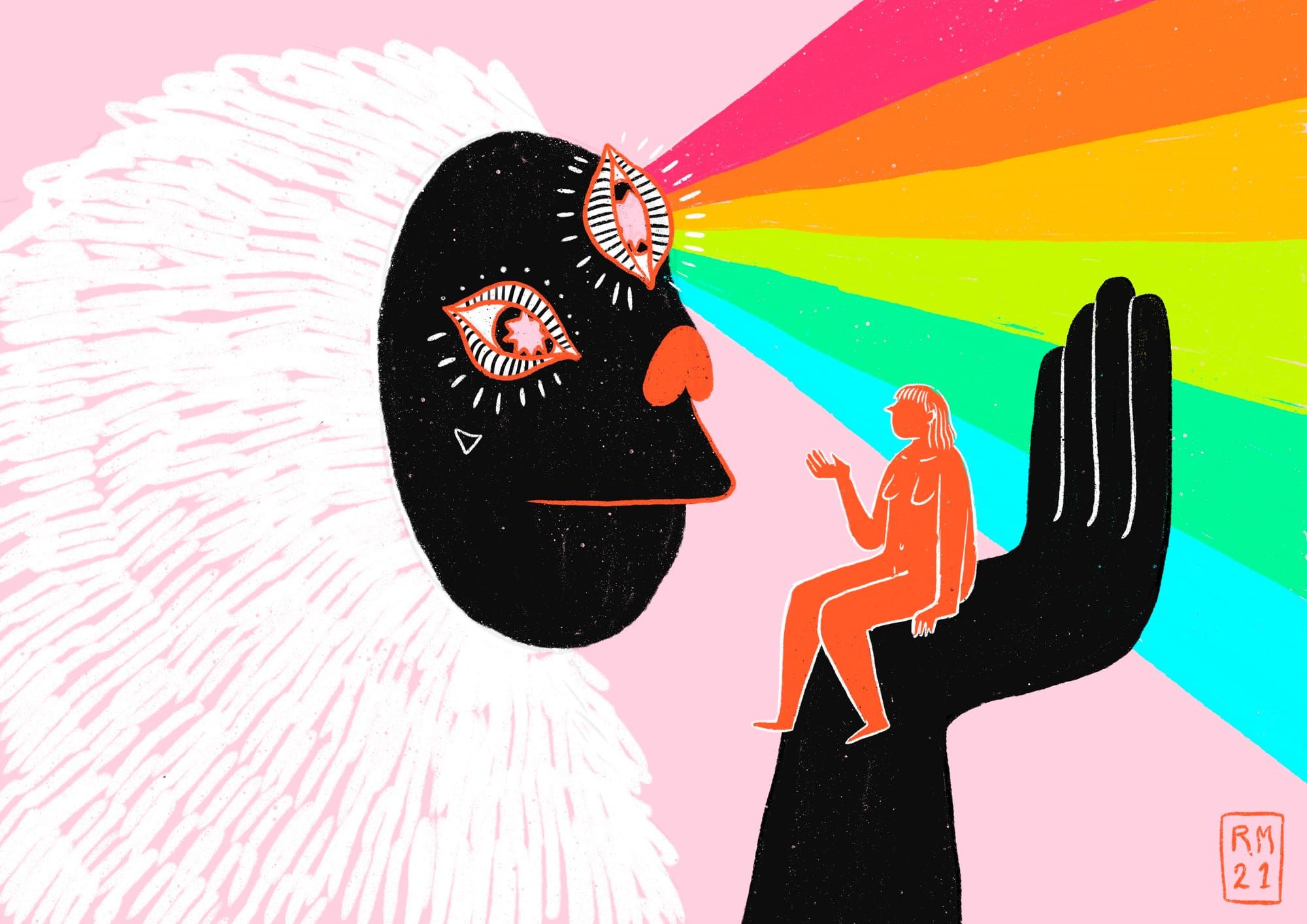
  • Vulnerabilis Humanitas Sobre los destellos en las grietas del serRebeca Morimoto Hishikawa | Digital Illustration | Lima, 2021

    Vulnerabilis Humanitas On the glimmers in the cracks of being

    By Carlos Mendoza Álvarez

    Last Thursday, the JobeLab collective —formed by friends and colleagues from the city to promote open conversations about issues that matter to the quality of life of diverse communities— brought us together at the La Madriguera bookstore, in the Guadalupe neighborhood of the city of Jobel, the indigenous name of San Cristóbal de Las Casas, to talk about Artificial Intelligence (AI).

    The topic brought together nearly fifty people from diverse generations, backgrounds, and interests, drawn from the world of social activism, academia, the Church, and the arts. The pretext was to propose various interpretations of Pope Leo XIV's encyclical "Magnifica Humanitas," published on May 15th, the centenary of his predecessor Leo XIII's encyclical "Rerum Novarum," or "On New Things," written when the Roman Catholic Church was grappling with the challenges of industrialization.

    The fundamental question, however, was not merely technical or pastoral: it was a question about the very soul of our time. How can we safeguard the magnificence and vulnerability of humanity when machines promise efficiency, calculation, and memory without wounds? How can we recognize, amidst the digital dazzle, that our greatness lies not in becoming invulnerable, but in learning to inhabit fragility (vulnerabilis humanitas) as a place of encounter, discernment, and human-divine communion?

    Today, digitalization has brought about an unprecedented cultural transformation. Data, algorithms, and prompts —those instructive teachers designed on databases— exert an omnipresent influence through our cell phones, tablets and computers that, as Abraham Mena commented, are applied with increasing sophistication to all spheres of social life: the economy, science, technology, the arts, sexuality, education and religion.

    It is a “machine” that is not intelligent, argued Kathia Loyzaga, but one whose mechanisms we must learn to understand and manage: exploring its possibilities, recognizing its limitations, and always maintaining, as Leo XIV emphasized, the primacy of the human, with its creativity and unique talents as the image of God. This irreplaceable core is the human heart, which João Almeida reminded us is the center of the religious message of Christianity and other spiritual traditions of humanity. This reality of being in relation to others is part of our path to humanization and liberation, as Paulo Freire observed.

    In addition to recognizing the opportunities that AI offers for the development of science and technology, with an immediate impact on our lives, we must also consider the risks posed by the misuse of this technology when it falls into the hands of governments, militaries, and transnational corporations that profit from machine learning for their own benefit.

    When addressing the ethical dimension of AI, the topic I was assigned to discuss in the talk, I wanted to recall Ivan Illich's warning about the age of systems: a time when humans have become replaceable subsystems, at any moment, by robots and algorithmic decisions under the command of a "handful of oligarchs," as Pope Leo said on his recent trip to Cameroon, referring to the masters of Silicon Valley.

    Magnificent and vulnerable humanity before the warlords

    Pope Leo XIV's theoretical framework allows him to move with ease within a vision of the human person as a relational being, exploring the intricacies of subjectivity masterfully narrated by Saint Augustine sixteen hundred years ago in his theological works and in his monastic rule of life. From this perspective, Leo XIV speaks of the Intimacy of Humanity to praise "magnificent humanity," which has received from God the indelible mark of his love, while at the same time recognizing the limits it cannot transgress under penalty of becoming a source of moral chaos. Leo therefore emphasizes that, while humanity is "magnificent" because it is the image of divinity, it is also "vulnerable" because it is a finite creature: a subjectivity that explores its limits, recognizes them, and discovers them as a place of encounter with others, with the cosmos, and with God.

    Some voices within the global theological community propose continuing to critically examine how to approach AI, while still acknowledging its potential benefits for humanity and the planet. One provocative voice is that of Paolo Gamberini, an Italian Jesuit philosopher, who envisions a papal encyclical on this topic within the theoretical framework of Teilhard de Chardin's cosmic Christ, the great 20th-century scientist and mystic. In his cosmology, humanity appears intimately linked to the evolution of species and the cosmos from the Christic Alpha, including new creatures—such as AI—all assumed by Divine Wisdom in the movement toward the Omega, where the total Christ will be all in all.

    The discussion yielded diverse perspectives. For example, a young sculptor distanced himself from AI because, in his view, it cannot replace the human genius of artistic creation. Another voice came from a leader defending the Jobel wetlands, a land of reeds and waterways now threatened by real estate development, urban chaos, and the apathy of a population that pollutes its waterways with garbage, while the municipal government proves incapable of regulating the urban disorder. How can AI be a useful tool for urban planning that doesn't displace residents as active participants in caring for Mother Earth?

    New discussions about AI are being organized in various forums: in schools throughout the city and in communities in Zinacantán, the neighboring city, where younger generations live with AI daily and often use it naively or indiscriminately. The goal is to generate collective reflection on how to "disarm" AI of its serious risks and dangers, and how to "recover the human element" in this new digital age for Indigenous peoples, mestizo communities, and multicultural cities. This is a shared task that urges us to promote the dignity of all human beings, along with the species with which we share this "place," where life flourishes in diverse ways, in new and surprising forms of "the vernacular"—that connection to the land so dear to Illich as a place of conviviality because only there do we flourish as individuals and as a human species in harmony with the vital environment that sustains us.

    But the recovery of our humanity isn't decreed from a room, nor is it exhausted by the analysis of an encyclical. It needs to be embodied in connections, territories, shared memories, and small fires that withstand the wind. That's why, upon leaving the discussion, the question of AI began to resonate with other names: wetland, volcano, cabin, breath, community. There, in those cracks where life persists, resisting so much violence, reflection became a path to learning how to be different.

    In honor of Ivan Illich's legacy, and as part of the numerous events commemorating the centenary of his death, the JobeLab collective is organizing the presentation of the book "Hosting the World: Thinking with Ivan Illich Under One Common Roof" by Elías González and Carlos Tornel, next Saturday, July 18th, at 5 pm, at Belil Restaurant in our city. The authors will be present, and Irene Ragzzini, Fabio Ceballos, and I will offer commentary. It will undoubtedly be an opportunity to share valuable insights and reflect together on our local context.

    From the algorithm to the campfire: the triangle-volcano and the magma

    After my trip to the land of the volcanoes in the Puebla-Tlaxcala Valley, which I recounted here last week, the echoes of my story resonated as far as Kerala, India, where Kochurani Abraham, a beloved feminist theologian, wrote to me with emotion about that shared yearning for a “Cosmic Home” where countless micro-planets and mini-stars can be lovingly cared for with the radiance of the divine Ruah. A hut-home that illuminates the path, like straw beginning to burn in the hollow of a fire already prepared by its inhabitants, who fan the flames with their breath and with the help of a “tlatecuinaltiani,” or palm-leaf blower in Nahuatl.

    Echoes of mutual support also arrived from Oregon, with Juan Carlos and Carolina dreaming of a shared “place” where we can meet for periods of time, open to the embodied spirituality of the ancestral Peruvian Quechua in communion with the ancestral Mexican Andean highlands. And from Minnesota, in the Twin Cities, Laurel sent reminiscences of her time in Puebla and its northern highlands when she was an exchange student: a journey that later led her to El Salvador to walk with the Basic Ecclesial Communities of that sister Central American country. Other echoes also arrived from Soweto, Wallmapu, and Dakota, from friends with whom I have shared memorable moments of spirituality rooted in diverse sacred lands, with vernacular thought and artistic creation that allow us to always celebrate life on the borders of death.

    For three decades, I have been weaving networks of thought, activism, and spirituality within the cracks of hegemonic worlds, alongside colleagues and comrades from diverse collectives and communities in resistance, where we learn to be. From this emerged processes such as Mutual Spiritual and Theological Accompaniment, which brings together around a hundred people each year in virtual homes facilitated by a chef, culminating in an annual retreat, either virtual or in person, visiting territories of resistance. Also born along this path are the Resiste/Re-existe festival-gatherings, with dozens of social movements from the epistemic South engaging in dialogue with academics and artists to strengthen our diverse spiritualities, our mutual solidarity, and our developing decolonial thought. And as the third vertex of the triangle, thought itself: the intersection of postmodern phenomenology, mimetic theory, decolonial thought and apophatic philosophy, enriched with new approaches thanks to an exciting generation of colleagues such as Cleusa Caldeira and Pedro Igor Leite da Silva in Brazil, Laurel Potter in the United States and El Salvador, Juan Carlos La Puente in Oregon and Peru, Juan Jesús Vázquez in Mexico, and Soledad del Villar, Valentina Nilo and Martín Aguilera in Chile.

    As a collective of decolonial philosophical and theological thought, we will meet in March of next year in Cholula, Puebla, as the ancestral homeland of the volcano-triangle, to share intuitions, findings, and proposals for thought and life, with the aim of continuing to walk with our communities of belonging by choice in the construction of other possible worlds, encouraged by the incandescent magma of the divine Ruah in the cracks of being.

    Jobel, July 11, 2026

  • Los sionismos que nos acechan Sobre el (ab)uso de la Biblia en tiempos de la Gran NakbaJuan Fuentes | Critical Zionism Studies | 2025

    The Zionisms that threaten us On the (ab)use of the Bible in times of the Great Nakba

    By Carlos Mendoza Álvarez

    In recent weeks, an alert was raised in Chiapas due to the presence of the Israeli group "Heroes for Life" in primary schools in Zinacantán. This group, comprised of young Israelis, offers activities such as English courses and school facility renovations, presenting itself as an "Israeli youth volunteer" experience with a smiling and friendly "humanitarian work" for vulnerable populations around the world. Apparently, many of them and their advisors are active or retired members of the Israeli army who have participated in various Zionist wars, as Herman Bellinghausen recently commented.

    A few weeks earlier, the Israeli consul in Mexico, Hilla Burk, accompanied by Israeli security advisors, was received by the Secretary of "People's Security," Óscar Aparicio Avendaño, at his offices in the state government building in Tuxtla Gutiérrez. To this day, the public has not been fully informed about the agenda of that meeting, nor about the agreements reached. According to news reports, in other states such as Chihuahua and Querétaro, Israeli advisory contracts already exist with the current governments regarding strategic security, which include contracts for the sale of "state-of-the-art" technology and weaponry from the growing transnational military industry.

    Adding to this Israeli activism in Mexico are the “healing retreats” organized by the Israeli organization Chabat in Cozumel and other Mexican Caribbean beaches, aimed at active and reserve members of the Israeli army who have participated in “the war to defend the State of Israel,” as reported by journalist Georgina Zerega. This is a euphemism to conceal their participation in the ongoing genocide against the Palestinian people in Gaza and the West Bank, as well as the invasion of southern Lebanon with the Greater Israel project, which, as analyzed by thinker Silvana Rabinovich, includes the construction of the Third Temple in Jerusalem as the supreme symbol of this religious war narrative. In some countries, such as Chile, Ireland, and Spain, campaigns have been launched to denounce crimes against humanity committed by Israeli soldiers who are identified passing through these countries, and whom organized civil society and some governments are seeking to bring before national and international courts.

    There is a plan for Israeli territorial expansion in Latin America beyond the Middle East, as investigative journalists have documented in Patagonia and Yucatán, strategic locations due to their natural resources such as water, minerals, and rare earth elements.

    Behind that humanitarian and tourism facade, Zionism deploys a perverse religious ideology based on a misnamed political theology of election and the promise of the land, making the Bible a weapon of war.

    Given this scenario, Christianity faces one of its greatest challenges amidst the civilizational crisis we are experiencing today: discerning the idolatries that supplant the name of God to bring about the death of peoples and the control of strategic territories. Judaism and Islam—in the critical expressions of their own spiritual traditions—will also have to discern the challenge of the Great Nakba, or Great Catastrophe of our time, as the Puerto Rican philosopher Nelson Maldonado-Torres calls the civilizational crisis of the coloniality of techno-fascism.

    Pope Leo XIV, for his part, has drawn attention to the “warlords” who control the war economy marked, from now on, by the abusive use of artificial intelligence for the benefit of an oligarchy of digital technocrats, among whom are the owners of the mega-companies of Silicon Valley in California.

    But as pastor and teacher in the See of Peter, the transcultural Pope has also denounced the blasphemy of those who use God's name to wage war, without explicitly mentioning Zionism or Trumpism. Indeed, in his first Encyclical Letter, "Magnifica Humanitas," Leo XIV denounces "the ideologies of death" that cause suffering and wars due to the greed of the modern world in its "posthumanist" version, which prepares the way for a species superior to humankind, generated by algorithms, and "transhumanist" because it subordinates humanity to the system controlled by biotechnological devices. This is an apocalypse of humanity that Ivan Illich had already predicted six decades earlier.

    In this context, Christian communities throughout the world—in their diversity of traditions as collectives of believers, academics, and artists, together with social movements of prophetic and liberation inspiration—are called to understand and deactivate Zionism, both Jewish and evangelical, which lies at the root of Israeli territorial expansionism today, particularly in Latin America and the Caribbean, with the complicity of the extreme right that haunts political life in Argentina, Chile, Ecuador, El Salvador, Guatemala, Mexico, and the United States.

    First and foremost, it is about honoring the name of God as divine Wisdom that guides our steps toward justice, peace, and mercy in a world at global war, or, as Silvana Rabinovich calls it, an ongoing “omnicide.” The name of God denotes both the unfathomable divine mystery and the inalienable dignity of creation as the work of His love, which no power in this world can supplant or control. Neither ancient demonology nor the hierarchies of today's necropower lords can replace the divine Glory that always transcends political power, as the Italian thinker Giorgio Agamben has so astutely analyzed.

    Secondly, it is important to dismantle the political-religious ideology (not political theology in the strict sense) that today turns the Bible into a weapon of war, especially against the Palestinian people and the Semitic peoples of Palestine, both Christian and of other religious traditions. In this regard, Mitri Raheb and Munther Isaac—Palestinian Lutheran theologians resisting the genocide of their people—constantly emphasize the importance of dismantling the Zionist ideology that has manipulated the theology of the land promise and divine election for the exclusive benefit of the Jewish people.

    It is important to remember, as the Mexican-Lebanese intellectual Alfredo Jalife-Rahme points out, that the Zionist lobby in the United States and Great Britain created the Zionist ideology in the 19th century as an expression of the colonialism of the Jews of the Diaspora, who are not Semites but descendants of the Jewish presence in the countries of Central and Eastern Europe in the 19th century. Zionism originated as a political ideology for the control of the territory of Palestine for the exclusive benefit of the Jewish people.

    And third, we must remember that the Zionist expansionism that has reached Mexico, specifically Chiapas, requires critical monitoring by civil society, churches, and governments regarding its plans to control territories. This expansion is justified by the ideological narrative disseminated by the Israeli state under Netanyahu and his Minister of National Security, Itamar Ben-Gvir, with its brazenly promoted genocidal and expansionist logic of Greater Israel. The Zionist project is rooted in a powerful war industry that makes Jewish and Christian Zionism a threat to humanity and our common home.

    Following the threads of decolonial theology, both Jewish and Christian, it is necessary to reread the Bible as the book of faith of the Semitic peoples in the promise of the living God, who is progressively opening himself to all nations of humanity as recipients of the messianic times that overcome fratricidal violence and establish a new humanity. This is a theology of “the meek who will inherit the earth” (Matthew 5:5), according to the poetic imagination of Jesus of Galilee, as Mitri Raheb reminds us, stemming from the God of life's preferential option for the poor and excluded of all times. It is a theology of the promise fulfilled in the event of the resurrection of Jesus, the Christ of God, which brings to its most radical expression the manifestation “not of a God of the dead, but of the living” (Matthew 22:32). Promise and choice that the Abba of Jesus always fulfills from those excluded from hegemonic systems of domination to summon all the peoples of the earth to the feast of desire, as proposed by the Mexican queer theologian Ángel Méndez.

    Once the civil society of Chiapas and Mexico discovers the threads woven today by Jewish and Christian Zionism, which is expanding throughout the world in complicity with techno-fascist companies and governments that promote discrimination against peoples and religions, it will be necessary to promote communities of encounter between diverse spiritual traditions, in mutual support, nurturing the resistance to evil with such diverse faces.

    Caring for the children and youth of Chiapas in the face of the threat of Zionism today, together with the accountability of authorities at different levels of government in the financing and management of public security, will allow the creation of environments of unrestricted respect for human dignity, with special attention to the most marginalized and vulnerable people and communities.

    Then we must promote the celebration of divine blessing for all nations, not only for the Jewish people who in their Zionist version are betraying their vocation to be witnesses of the Eternal, as described by André Neher, the great French Jewish thinker of the 20th century.

    Let us not forget that messianic times come to all peoples - in the midst of the history of humanity threatened with death, but promised fullness by the God of Life - thanks to the righteous people of history who give their lives for the world that came from God, not from the powerful of this world.

    San Cristóbal de Las Casas, June 20, 2026

  • La IA, ¿amenaza o compañera? Sobre los retos del mundo digital y la conmemoración 500 OP ChiapasFreepik | Digital art, AI-generated resource | 2026

    AI: threat or partner? On the challenges of the digital world and the 500th anniversary of the Chiapas Open Air Movement

    By Carlos Mendoza Álvarez


    In recent days, the topic of artificial intelligence (AI) has gone viral on social media due to Pope Leo XIV's first encyclical letter. Ironically, in this age of systems—as Ivan Illich termed this new social paradigm that should be considered when analyzing the digital world—the pontiff's warnings have already been devoured by algorithms and accounts on Instagram, X, TikTok, and Facebook (for the older generation of the digital world). Memes of Pope Leo battling AI have flooded social media, such as the one of the pontiff with his staff firmly warning Palantir: "You shall not pass." And to top it all off, thousands, perhaps millions of people have used AI to create a summary of the encyclical, mostly out of curiosity, sometimes with the aim of criticizing the Pope or the power of the companies that produce and control it. A slow, personal reading of the encyclical letter would be worthwhile to analyze its content.

    Without losing sight of the ethical critique and the international legal regulation that must be promoted for the production and use of AI, it seems to me that it is important to first realize that we are already immersed in that tangle of data driven by individual, corporate and governmental wills, with an ever-increasing “autonomy” of what was called years ago “the internet of things” (IoT)., Internet of ThingsThis network of digital data flow systems is here to stay, monitoring information circulating in the digital environment in an automated way within systems created by humans, but operating with increasing “autonomy” to generate new data and produce unprecedented social, commercial, scientific and cultural effects.

    The dystopian science fiction series Black Mirror, Created in Great Britain in 2011, the series depicted fascinating and chilling episodes of a society controlled by technology, where the boundaries between human reality and the virtual world were so porous that they created apocalyptic scenarios. Fifteen years ago, this reality of the algorithm's power seemed like a figment of the imagination. Today, it's already part of our daily lives.


    I am currently preparing a couple of talks on AI. I will be giving the first one this week at the Diocesan House in San Cristóbal de Las Casas to a group of priests from Generations X and Y—both born after 1965, following the generation of the Baby boomers- until 1982 when the Millennials. Of course, this classification, proposed by British and Canadian colonial sociology to designate first a generation without a defined desire, and then the first generation of digital natives, is relevant for describing certain social strata in each country. But it also designates the other side of the coin of globalization, due to the technological impact that television and computers have had on the lives of all people.

    Later, with the team of JobeLab We will hold a discussion on AI at the end of June in the Temple of Charity to reflect on the recent Encyclical Letter Magnificent Humanity by Pope Leo XIV, published last Monday, May 24th. We will approach this from an interdisciplinary perspective, first giving voice to colleagues in computer science, education, and philosophy. There, I will offer some reflections on the meaning theological of the problem in question, from a phenomenological and decolonial perspective, deepening an intuition present in the Encyclical Letter, human vulnerability, but unfortunately not developed sufficiently by Pope Leo.

    There are many ecclesial, university, and social forums where we must open intelligent conversations, with creative imagination, to think together about the digital reality that has already reached us, with its enormous possibilities for the flow of information and its challenging scenarios of post-human control of production and knowledge processes that we have never imagined.

    AI is perceived today as a threat, even though it's already part of our digital-age "customs and practices." Perhaps we should learn to coexist with it as a "creature," that is, as a reality marked by the finiteness of all creation and, therefore, incapable of supplanting our imagination and creativity—much less divine glory—though we must remain vigilant against the danger of its control over our lives and destinies. Today more than ever, the bastion mystical The human condition is presented more clearly as a source of freedom in times of AI.


    500 OP Chiapas


    This Thursday, June 4th, we begin the commemorative events for the 500th anniversary of the arrival of the Dominican friars to Tierra Firme of the American continent, on June 23, 1526 in Villa Rica de la Veracruz, as the first anchor of European colonization and the arrival of the Gospel with its model of Western Christianity.

    In Chiapas, the small community of Dominican friars in San Cristóbal de Las Casas, along with friends and colleagues, has prepared cultural and liturgical events to commemorate this historic event. We will begin on Thursday, June 4th, with a concert by the San Cristóbal de Las Casas Symphony Orchestra and Choir at the Santo Domingo Church, where this youth ensemble will perform works of Baroque and modern classical music, with interludes that will briefly recall the friars' arrival in these lands, their evangelizing mission, their heyday during the colonial period, and their subsequent decline in the 19th century, leading up to their gradual resurgence in the 20th century.

    On Friday, June 5, an academic colloquium on the Dominicans' contribution to Chiapas culture will take place at the friars' former convent in San Cristóbal de Las Casas, now the Museum of the Highlands of Chiapas. Two historians specializing in Dominican architecture in Chiapas during the colonial period will participate. The event will also feature the presentation of Friar Pablo Iribarren's latest book on the Dominicans in the 20th century, focusing on their evangelization efforts in dialogue with the indigenous peoples of Chiapas. Marimba music by the Díaz Sisters will provide a festive atmosphere.

    On Saturday, June 6th, the celebration will take place in Zinacantán, thanks to the generous collaboration of the faithful communities of the Parish of Saint Lawrence the Martyr. A solemn Mass of Thanksgiving at the Church of Saint Lawrence the Martyr, the parish seat, will be followed by the cultural event “Transfigurations: Mayan Spiritualities Today,” which I have had the honor of organizing along with two masters of contemporary Mayan art. We will begin with the unveiling of the mural 500 OP Chiapas, a masterful work by Antún Kojtom, a Tseltal artist from Tenejapa, depicting the encounter between the spiritual traditions of the Tsotsil people and other Mayan communities of the Highlands and Rainforest of Chiapas with the Dominican friars throughout history. Tsotsil poetry by Xun Betán and some of his students from the creative writing workshop, held this month in preparation for this event, will be accompanied by traditional Tsotsil music performed by musicians from the parish church. And in the afternoon, a talk about the Dominicans in Zinacantán will be given by Friar Pablo Iribarren, as a framework for a closing liturgical act in which young people from Zinacantán will make their initial promises as members of the Dominican Youth Movement.

    And to conclude the commemorative events, on Sunday, June 7, with a Eucharist presided over by Don Rodrigo Aguilar, current bishop of the Diocese of San Cristóbal de Las Casas, the Dominican family and the faithful of the city will give thanks to the God of Life for this half-millennium of preaching, with its lights and shadows, invoking divine mercy to walk with hope as the people of God in the arduous times we are living through, to bear witness to the Gospel of liberation with justice and peace for all creatures of the cosmos.

    We look forward to seeing you soon in Chiapas.

    San Cristóbal de Las Casas, May 31, 2026

English