Category: Geopolitics and spirituality

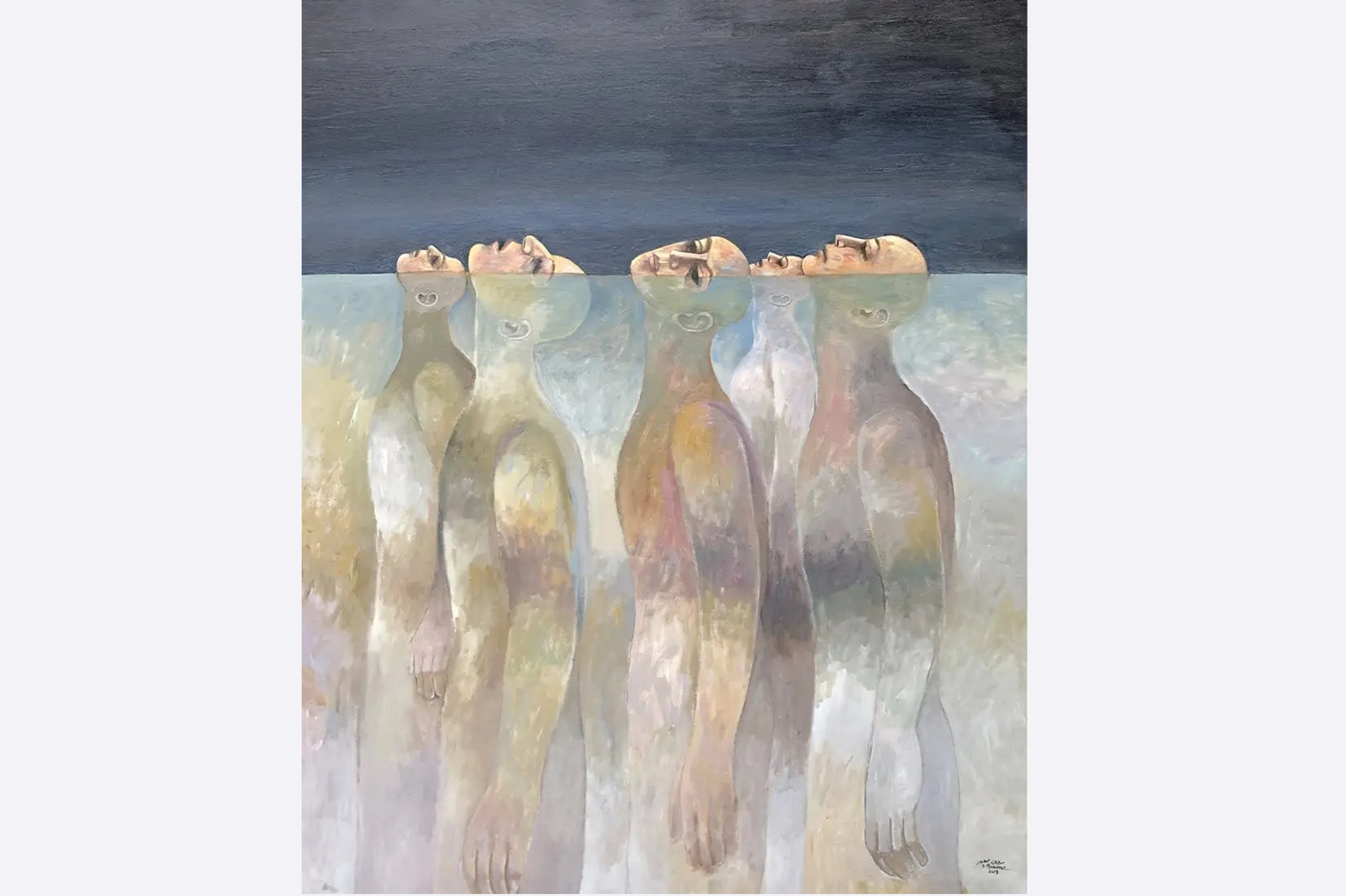
  • La Biblia como arma de genocidio o casa de vidaSliman Mansour. Revolution was the beginning (2016), oil on canvas, 200 x 500 cm

    The Bible as a weapon of genocide or a house of life

    By Carlos Mendoza-Álvarez


    The State of Israel began this week a new phase of the strategy of control of the territory of Palestine (Israel approves controversial West Bank settlement project). Israeli settler settlements in the West Bank will expand to divide the territory, which was the result of the 1993 Oslo Accords to relocate Palestinian residents into two isolated groups, leaving only one outlet to the Jordan River on the Jericho side.


    Christ at the Checkpoint, August 21, 2025   


    The ultimate goal is the creation of Greater Israel, once the possibility of a Palestinian state has been destroyed because, as Israeli Finance Minister Bezalel Smotrich said this week, “there is nothing to recognize, and no one to recognize” (Israel approves illegal settlement plan that would split occupied West Bank) once the genocide of the Palestinian people has been consummated.

    This plan of contemporary Israeli expansionism "after Gaza" suggests at least two main objectives: the first is the isolation of Palestinians in apartheid zones, in addition to the invasion of the Gaza Strip, with the goal of their expulsion or subsequent extermination; and the second is the control of the Jordan River as a strategic source of water resources for times of global scarcity.


    But this is not merely the military strategy of a rampaging Zionist state supported by global capitalism, particularly the governments of the United States and the United Kingdom. The ongoing Zionist plan demonstrates the perversity of an ideology of genocide that manipulates the Bible to justify the supremacy of one state over others, subordinating peoples of diverse ethnic and religious origins to a selective process of annihilation in the name of a supposed divine promise.

    Both Jewish and Christian Zionism, in fact, are the modern version of the manipulation of the biblical promises recounted by the saga of Abraham and Sarah as ancestors of the believers of the three monotheistic religions. The biblical account, in fact, tells us that God the Eternal promised the primordial couple offspring "as numerous as the stars of the sky and the sand on the seashore" (Gen 22:17). Hebrew Talmudic and ancient Christian commentaries saw in this double metaphor of the heavens and the earth the proclamation of the universality of the promise: the stars of the sky evoking the daughters and sons of Israel, and the sand on the seashore representing all the nations of the earth.

    The ideology of the “chosen people” was later developed in the Bible by a religious movement that perverted the announcement of the promise of the land, focusing it on the conquest of a territory as an exclusive monopoly of one people over other Semitic peoples. This “political theology” was devised by an interpretation of messianism in a Davidic key, present in the Bible since the time of the judges of Israel, which is called the “Joshua factor” by the Palestinian Lutheran theologian Mitri Raheb (Imperial Theology, Colonization, Settler Colonialism, and the Struggle for Decolonization: A Review Essay) as a source of the theology of empire.

    But the prophets of Israel, from Moses to John the Baptist—and Jesus of Nazareth and his community who were part of that lineage—were always critical of the powers that be, which have sought to supplant divine glory under various masks. Theology prophetic It is found at the origin of the Abrahamic faith as a universal vision of the promise and the land that includes all peoples. As the French Dominican biblical scholar Philippe Lefebvre (Conference: Jésus et le pouvoir – P. Lefebvre), prophetic messianism is present like an underground river throughout the Bible, from the book of Genesis to its fulfillment in the Passover of Jesus of Nazareth.

    And the Jesus movement in Galilee takes up this prophetic vein to radicalize it with the innovation of a messianism scatological, as another Dominican, José Luis Espinel, commented a few decades ago in Salamanca (Eschatological Messianism of Jesus from his prophetic actions). A prophetic tradition that announces the fulfillment of the promise for all peoples as a call to the universal love that flows from the wounds of a crucified Messiah.


    Palestinian Christians, as the Palestinian Lutheran theologian Munther Isaac (Faith, the Bible, and the Genocide in Gaza) call us today to decolonize the Bible, which has become the weapon of war of Israeli and Christian Zionism against the Palestinian people. There is no chosen people to conquer a land in the name of God, stealing it from its original inhabitants, from the ancient Canaanites and Jebusites to the Palestinians of today. Nor is there a promise of the land that justifies, in the name of God, an Israeli state imposed by war on territories inhabited by Semitic peoples for millennia.

    Christian churches of all denominations, as well as universities and political movements that appeal to the Bible as their source, face a grave dilemma: either continue to justify the genocide of the Palestinian people in the name of the God of Israel, or decolonize the Bible to recover the messianic and prophetic spirit of the divine and human word that frees all peoples from the slavery of earthly powers that supplant divine glory, with their current avatars, such as Trump and Netanyahu, or Milei and Bolsonaro, who are today's false messiahs.

    The promise of the land that Abraham and Sarah received in that story of origins when they left Ur in Sumeria in search of the Eternal One – as the Jewish thinker from Strasbourg André Neher says in his book The essence of prophecy – is only fulfilled in the silence symbolized by the desert as a land of incessant search for the Covenant.

    Hence, Christianity drinks from that source of original Hebrew prophecy to announce the arrival of “the new heavens and the new earth,” as the book of Revelation (21: 1) said in the context of the devastation of the old, idolatrous Roman imperial world and the Temple religion that perverted the divine promise.

    This radical critique of all imperial theology stemming from a prophetic and eschatological messianism that heralds the end of the corrupt world has been rejected by both old and new earthly powers that seek to continue domesticating the divine promise.

    But from the rubble of Gaza, the promise of the land emerges today, with renewed vigor, summoning all peoples of humanity and compelling all spiritual traditions to care for the lives of the innocent victims and their survivors. It calls us to continue searching for the promised land as a utopia in the midst of dystopia. It invites us to cultivate hope as a promise of life that emerges amid the threat of imminent death, like that experienced by Gazans today and other peoples threatened by necropower.

    The Bible is not a weapon of war but “the house of the people,” as Carlos Mesters said in Brazil in his beautiful and powerful parable (The parable of the house of the people of God). A house we are invited to inhabit, to recognize in our own stories the spring of life that emerges like living water gifted by God from the ruins of the power that kills.

    Let us reread and inhabit these messianic and prophetic testimonies of the promise of the land and the choice of divine love for all peoples, so that we may be inspired by the consolation that comes from God to the victims and their survivors, as a moving promise that is happening in the silence of the desert.


    Mexico City, August 24, 2025

  • ¿Quiénes heredarán la tierra robada y gentrificada?Lucky Madlo Sibiya (South Africa, 1942), Untitled

    Who will inherit the stolen and gentrified land?

    By Carlos Mendoza-Álvarez OP


    The wars of yesterday and today are brutal rituals of territorial control as a space of privilege for a powerful group over the rest of the beings that inhabit it.

    Modern expansionism, which began in the late 15th century with interoceanic voyages financed by European kingdoms that became nascent empires, was an enterprise of control of routes and territories that expanded throughout the world in a brutal manner as an unprecedented colonization project. libido dominandi The conquistador found in this "civilizing" enterprise his perfect justification in the religious armor that accompanied the wars of conquest: those lands had to be conquered in the name of God.

    This is happening today in Palestine because of the greed of the Israeli state and the powers that support it to seize the territory of the Palestinian people, both Muslim and Christian. Such colonizing libido fuels the unbridled fury of Jewish settlers eager to seize more and more land in the West Bank and Gaza. This perverse logic leads a people who were victims of Nazism to now commit genocide against a brother nation.

    A similar, but even more perverse, greed fuels the transnational war industry for the benefit of corporations that enrich themselves exponentially by creating armed conflicts to fuel the war machine that generates trillions of dollars in profits each year around the world. In this case, it involves the control of financial and industrial territories to feed the arms industry in every corner of the planet.

    Israeli Zionism and Christian Zionism are two sides of the same coin. They write another disastrous page in the history of the greed for land as property, cynically manipulating the biblical promise of the land. Since the 19th century, this Zionism born in the United Kingdom was the one that paved the way for the later creation of the State of Israel, under the pretext of the Shoah. That same Zionism, in its version of perverse political messianism represented by the State of Israel, has now invented a criminal scenario with a Muslim enemy to be defeated in order to impose its military power in the Middle East, annihilating the Palestinian people and humiliating neighboring peoples, through the blatant manipulation of the Bible, as Mitri Raheb has shown in his essential book Decolonizing Palestine. The Bible, the land, the peopleThe Israeli machinery of drones, tons of missiles and millions of bots or automated accounts flooding social networks, has been spreading fake news throughout the virtual world that has left the entire world stunned, producing a “collective cognitive dissonance,” as analyzed in Brazil by João Cezar de Castro Rocha based on Leon Festinger's theory.


    And, strange as it may seem, the ongoing gentrification in many cities around the world, from Barcelona to Mexico City, is another expression of that same colonizer's will to dominate, now in its gentle version. hipster. Only this time, it's not about conquering territories to govern them through military occupation armies with the aura of an imperialist religious flag. I'm referring to the digital nomadic colonizers who take advantage of the power of their currencies, emboldened by their dreams of white and technological primacy, to inhabit residential neighborhoods in vibrant cities at a much lower cost than they would have in their countries of origin. Thus, these hipster herds nurture their cosmopolitan illusions enclosed in their urban bubbles, without coming into close contact with the population of the place they inhabit, but rather displacing them or subordinating them to their tastes and interests. This phenomenon represents the most recent and perverse version of settler colonialism that displaces previous inhabitants from their land.

    For the past five years, I've spent a period of time each year in Mexico City's Hipódromo Condesa neighborhood, where the Dominicans have for almost a hundred years animated a parish that was a religious center for the Mexican middle class with aspirations for urban modernity, though not so much religious ones. Every year I return, I'm surprised to see that the former residents have left, selling their homes, converting them into Airbnbs, or outright opening hipster-trendy businesses, ranging from vegan restaurants and light ice cream shops to bistros with Mexican fusion menus. But what has surprised me most is the proliferation of businesses specializing in angels, candles, Tarot readings, physical therapy, Bikram yoga, and other types of yoga, as well as countless spas with massage menus ranging from reflexology to tantric, not to mention, of course, Reiki mixed with "ancestral" techniques from the heart of Mexico.

    On the other hand, the Catholic parishes in that area of the city collapsed financially due to the lack of alms, but above all, their traditional religious population was aging. To the surprise of many religious ministers, in recent decades, La Condesa has become a laboratory for new religious expressions, as Hugo Suárez has documented (Images of Faith. Audiovisual Sociology of the Condesa neighborhood), a sociologist from Guadalajara, in a recent comparative study of the religious practices of residents of Condesa and Ajusco in Mexico City, one a hipster neighborhood and the other a working-class one. To complete this quick overview, it's important to note that in recent years, there has been an upswing in the number of believers in Catholic churches, especially in South America, characterized by a traditional Catholicism of intense and highly moralizing individual piety. This is an unexpected effect of gentrification in those parts.


    What criteria could help us understand the meaning spiritual From these old and new territorial control processes? Could humanity's religions pull from the vault of their memories some precious talisman that sheds light on us?

    The second beatitude of Matthew's Sermon on the Mount captures the poetic message of Christ as He preached in Galilee in a provocative way. This beatitude literally says: "Blessed are the meek, for they shall inherit the earth" (Matthew 5:5). The Greek word for the meek is πραΰς (praus). This term is associated with those who resist the powers that want to push them aside because they are considered redundant in the community. In Galilee in Jesus' time, these meek They were those who resisted the Roman power of taxes or military occupation.

    It is not, first and foremost, a question of understanding the meek as peaceful people according to the traditional reading of this text. Rather, it refers to those who resist violence without making a fuss, appearing invisible to the eyes of the world, because they deploy what today we might call strategies of resistance as survivors of many forms of violence.

    On the streets of our cities, we see some of these people out of the corner of our eyes, passing by us like shadows lying on a sidewalk, or living in cardboard houses under a bridge, or even lurking in the garbage looking for a piece of bread, a cigarette butt, or a can of beer with a drink to take. They are the disposables of consumer society, the ones surplus to requirements in a shopping mall, and whom we might bump into by chance or carelessness when entering the subway or when rolling down our car window at a stoplight at any urban intersection. When we approach these peripheries very close to us, we discover that, despite the subhumanization that surrounds them, these people organize, care for, and support one another.

    The promise of the land that Jesus announces to the meek It is subversive because it does not refer to the people of Israel, as imperial Davidic theology had previously intended and repeats today with its genocidal narrative. It is not about “possessing the land,” much less exploiting it, but about inherit it, that is, to receive it as a gift from the Abba who “makes his sun rise on the evil and the good, and sends rain on the righteous and the unrighteous” (Matthew 5:45). Jesus thus subverts the dominant narrative of his time, which consisted of distributing land according to religious strata that marked the economic and social scale, with the Temple playing a central role in Jerusalem as the religious capital of Judea.

    Therefore, the Galilean's greatest audacity lay in saying that the "meek" will inherit the earth, thus opening the promise of the earth to the most vulnerable in society. A world reversed from that produced by gentrification.

    To conclude these reflections, let us allow the Colombian poet José Eustasio Rivera to whisper that uncertain hope of those who resist colonization because they sense that, at the heart of their resistance, they are beginning to inherit the land:


    XIV


    I am a son of the mountain! For its coolest place
    I search, always singing, for the resounding hive;
    and in the silent caves my throat fills
    of nectarean honeycombs and of stone almonds.

    As I leave the waves, I fall asleep with pleasure
    on the dead leaves that my dog gleans;
    and through the branches, on my brown face
    the afternoon sun sets its moving arabesque.

    Inspired by a dream of distant tenderness,
    I caress the flowers; I crown myself with vines,
    and I embrace the trunks with deep emotion;

    that later, when I concentrate my thoughts alone,
    I seek the prize of the mountain, and in my spirit I find,
    the flowering shoot of a sweet illusion.


    Promised land, Bogotá, 1921.


    eSwatini, July 12, 2025

  • Adiós, “America”.Photo by Elizabeth Scholl for The Huntington News

    Goodbye, “America.”

    By Carlos Mendoza-Álvarez


    Since I was a child, I have had an ambivalent relationship with American culture. On the one hand, enjoying its cartoons like every childhood of the 20th century, then its multicultural music, from the jazz we listened to at family parties and the rhythms of the time like Twist  and Rock & Roll, that moved the elders at home to dance. Baseball, “the king of sports,” was the sport we enjoyed most at home, which my dad and my family passionately followed on the radio and later on television. I experienced the Apollo 13 moon landing as a 9-year-old boy in front of the television, admiring the latest marvel of human civilization.

    But I also remember reading the newspapers and watching TV scenes of Uncle Sam's constant military invasions around the world as a teenager, with the sad stories of the wars promoted by US imperialism during the Vietnam era. As a high school student, I became more aware of US interventions in Latin America, from its support for dictatorships in South America to the CIA's funding of paramilitary groups to dismantle guerrilla movements across the continent and in my own country.


    My education in Mexico laid the foundation for critical thinking, first at the Benemerita Autonomous University of Puebla, where I began studying philosophy, and then at National Autonomous University of Mexico (UNAM for its acronym in Spanish), where I completed my bachelor's degree, though I didn't graduate, following the advice of my Dominican superiors. Postgraduate studies in Switzerland and France opened my eyes to new perspectives on the traditions of European phenomenological thought and contemporary Hebrew philosophy.

    I never imagined living for a long time in “the heart of the empire” until an invitation arrived from Boston College, (BC) to join its prestigious Theology Department. I arrived in Massachusetts at the height of my academic career after 25 years of teaching and research in Mexico, Switzerland, France, and Chile, to build bridges between the South and the North through classes in liberation theology and Latin American thought. But my background also included, to the surprise of my Boston colleagues, decolonial thought and queer theory. These are three avenues I explored and connected over the years to reflect on the crisis of modernity and its effects on the experience of subjectivity open to the revelation of another world.

    I was received with great professional attention by the BC authorities and with polite respect for my colleagues, recognized as the best in their disciplines in the international academic world, according to the dominant model of knowledge. I began my work in January 2021, in the middle of winter and during the critical phase of the pandemic. The campus seemed like a ghost town, frozen in time by the frigid cold and the mandated lockdown. I offered my first classes in through a hybrid model, with half the students in the classroom wearing masks and the other half online. I survived the first year of isolation thanks to the invaluable support of Sole, a beloved Chilean doctoral student who served as my teaching assistant, and Neto, a kind-hearted Salvadoran colleague.

    Once established as a Senior Scholar, I threw myself into teaching, discovering to my surprise the tremendous workload entailed in an educational model that prioritizes the undivided attention of the "instructor" over students who follow instructions to the letter, with little creative imagination to independently search for sources, problematize topics, and suggest new interpretations. It was also important to adapt the bibliography to English only texts because the students didn't read other languages. To top it all off, I discovered that Spanish wasn't recognized as a "scientific language." Then the warning signs went off, as I began to perceive the power of white academia, still present on the East Coast of the country, so famous for its liberal thinking, but ultimately with an internalized colonialism yet to be defused.

    I set about immersing myself in this experience of a new educational model, abandoning my initial intention upon accepting this invitation, which was to focus on writing two outstanding books to complete my second theological trilogy, this time on the idea of "tradition" that communicates divine revelation according to the Christian narrative. Those manuscripts are still on my desk. I sensed it was important to pursue the research in another way, so I began a project called Beyond Global Violence Initiative (BGVI) as a platform for promoting academic conversations with colleagues from the South and North on pressing issues facing the humanities today. Thanks to the initial support of academic authorities and, above all, the generosity of colleagues from various latitudes who responded to the invitation, I was able to organize five colloquia to weave collective reflections on modern subjectivity in the face of civilizational catastrophe, following the path of phenomenology, mimetic theory, and apophatic thought. A book in progress on political theology, scheduled to appear in 2026, will be the rich harvest of these gatherings.


    The initial academic project of building bridges between South and North was going well until we welcomed Palestine. Then I began to perceive the strangeness, later transformed into suspicion, and finally into distrust, on the part of some colleagues and academic authorities regarding these investigations with their social and political implications, of openly critiquing the theologies of empire, such as in its form of Israeli or Christian Zionism. With some fellow professors, doctoral students, and a few undergraduate students who shared this concern about the ongoing genocide of the Palestinian people, we organized two academic events to learn about current Palestinian thought. But I began to receive messages of "concern" from academic authorities and outright rejection from some students who, emboldened Trump supporters, openly and at times aggressively expressed themselves against decolonial critique of extractive capitalism, heteronormative patriarchy, and white supremacist racism.

    The fear promoted by the Trump administration since its first term grew massively from the beginning of its second term. It focused on controlling thought in American universities. Its strategy became more aggressive since taking office in January 2025. Through "hate rhetoric"—analyzed through a mimetic lens by the Brazilian colleague João Cezar de Castro Rocha, first in Brazil and then in the United States and other far-right countries in government—the movement Make America Great Again (MAGA) increasingly and viciously controlled minds and universities through social media and censorship policies. The problem wasn't just Trump, but the more than 70 million voters who supported him and who, even amid the US geopolitical military expansionism, continue to subscribe to his imperial dictatorial policies (on immigration, gender, and white supremacist racism), all of which are amalgamated with the "theological" ideology of political messianism.

    American colonialism is closely linked to Israeli Zionism and both are part of the new phase of the coloniality of power, with its replicas in far-right movements around the world, as the Puerto Rican thinker Nelson Maldonado-Torres has put it with the idea of the "principle of coloniality" (The US at 250, Coloniality, and Political Zionism in Perspective).Therefore, theology as critical thought, which emerges from the life and practice of Christian communities in diverse contexts who experience the glimmerings of redemption, is urgently called to dismantle this false political theology. Failure to do so justifies the imperial narrative.

    An event scheduled for last April as part of our BGVI research project sought to reflect, together with Hilari Rantisi (Centering Human Life, Disrupting Injustice Without Replicating It), a Palestinian-American colleague at Harvard, on peacebuilding in times of war, comparing Zionist colonialism in Palestine with British colonialism in Kenya's recent past. We had organized it with a BC colleague, but ultimately decided to cancel it due to institutional pressure and to avoid the real risk of deportation and even criminalization for those of us who are foreign professors and students, since we could have been accused of supporting "terrorist groups" and threatening national security.

    In that tense atmosphere, BC no longer offered me the necessary security to continue my theological work, to the point of offering me private legal assistance in case of emergency, not institutional, but rather a lawyer specializing in immigration matters. So, with the support of my Dominican religious superior in Mexico, I decided to resign from BC at the end of the spring academic semester to return to my homeland and continue my theological work in freedom.

    The climate of self-censorship that spread like a contagion was most evident when I said goodbye in a letter from my colleagues at BC. I received a single, empathetic response that emphasized "the emotional effects" I suffered from this veiled censorship, without commenting on the reasons for my resignation or the call I made in my letter to reconsider what kind of theology we were pursuing at that university.


    Today, as I conclude my institutional collaboration with Boston College,I write these lines to say "Goodbye, America." That name stolen from the entire continent, but which, in Spanish and Portuguese, as Maria Clara Bingemer, my dear Brazilian colleague, says, we write with an accent, "América." I will not use that name again to refer to a country that has based its two-and-a-half-century history on the theft of territories, fueled by a messianic colonialism of the invasions of American and Caribbean lands, planning and financing constant wars of dominion across the planet. I say goodbye to its theology of dominion and prosperity, disguised as democracy and the free world.

    To my US colleagues who remain silent in the face of their government's imperialism, I hope they may soon awaken from the slumber that has lulled them, whether out of fear of censorship or the complicity of white colonial privilege that prevents them from seeing the corruption of the power that shelters and protects them, based on the global war of the Western world system that creates more and more victims crying out to heaven.

    The giant has feet of clay and will one day fall. Meanwhile, those of us who stand in the crevices of power, wherever we are, weave other ways of life, from the inner freedom of thought and solidarity, from the social, political, academic, and religious peripheries.

    Ivan Illich and Gustavo Esteva, walking with Jean Robert, Sylvia Marcos, and peoples in resistance like the Zapatistas in the epistemic South, opened up the path of life for “deprofessionalized intellectuals” as listeners to peoples in resistance.

    On these routes, fruitful dialogues are woven: South-South, South-North, and many other geographical, political, and spiritual directions, sowing the seeds of new worlds.

    Goodbye, “America.” Hello, free world.


    eGoli / Jo'Burg, June 29, 2025

English