By Carlos Mendoza Álvarez
The “Huaca Mach'ay” is the ancestral sacred cave carved from sillar, the name given to ignimbrite, a volcanic rock found in the highlands of Arequipa, Peru. For thousands of years, pilgrims have venerated these places as the womb of Mother Earth, coming here to experience the birth of new life. As a community of friends, we have traveled from the north and south to Arequipa, the Castilian name for Ari Kepay, which in Quechua means “here we stay.”.
That cosmic womb welcomes us one sunny morning in the Andean highlands, accompanied by Fiorella as our guide. With her activism in defense of the Chili River and its valley, threatened by the hydroelectric and real estate industries, she listens to our questions and other ways of being visitors in her territory. We are a group of companions from the Mutual Spiritual and Theological Accompaniment who, over the course of eleven years, have shared the emotion of telling our stories of vulnerability, righteous anger, and hope, learning from individuals and collectives resisting diverse forms of violence in Oregon and Chiapas, Arequipa and Barcelona, Monterrey and Lima.
As the start of our annual in-person gathering, Belissa welcomes us to her hometown, “the white city,” so named for the volcanic stone that adorns its houses with facades sculpted with baroque flourishes, a reminder of its colonial and racist past, as it was a city built for Spanish colonizers. We didn't come for cultural tourism or to kayak the rapids of the Chili River. We arrived here after monthly meetings in “virtual homes” over a four-month cycle, where we shared our stories of vulnerability and resilience, of awakening with diverse commitments to life. Each of us was invited by a loved one who had already experienced the power of a spirituality rooted in our own wounds, open to those of other individuals and groups, with whom it is possible to weave threads of hope. Adrián, as a companion to young day laborers and queer people on the West Coast of the United States; Bosque, as an activist for deliberative democracy on environmental justice issues in Monterrey; Belissa as a doctor walking with health collectives for the care of neurodivergent children in vulnerable situations in Arequipa; Rachel as a pastor exploring new pastoral ministries for queer communities in Oregon.
∂
The Apus are the guardian mountains of the memory of this place where the Pacific Desert begins, stretching from Arequipa in Peru to Atacama in Chile. Misti, Chachani, and Pichu Pichu are the three silent witnesses to the stories of the Inca and mestizo peoples who coexist with the creatures of the ravines: birds, reptiles, and endemic cacti of this remarkable ecological niche. Modern exploitation is causing the glaciers to melt, and the rivers are being turned into irrigation ditches. We witness the socio-environmental devastation accelerated by the impoverishment of the lives of internally migrating peasant communities from remote provinces in the Andes Mountains, drawn by the mirage of the modern city that expels them from the highlands to the outskirts of beautiful Arequipa.
The river is the lifeblood of the Andean spine, formed by rocks that descend from the volcano, explains Jorge, an anthropologist from Arequipa who calls himself a “Renaissance man” as he recounts his struggle to defend the territory as a member, along with Fiorella, of the citizen initiative “Save the Chilina Valley.” His aspiration as a young ecotourism entrepreneur is centered on protecting the legacy of his ancestors, confronting the mafias that seek to control the territory with their tentacles extended into the real estate industry, local and regional governments, and the indifference of the local population. A coalition of several civil society organizations has so far managed to halt the construction of a sixth hydroelectric plant in the river canyon, a project that lacks environmental planning and is the spearhead of a land-use change across the entire valley to build resorts for extreme sports tourism. The value of this civil society initiative lies in the recovery of the social fabric of the Arequipa community to mobilize it to take charge of the care of its territory, with the tremendous challenge of weaving a common cause amidst perverse private interests.
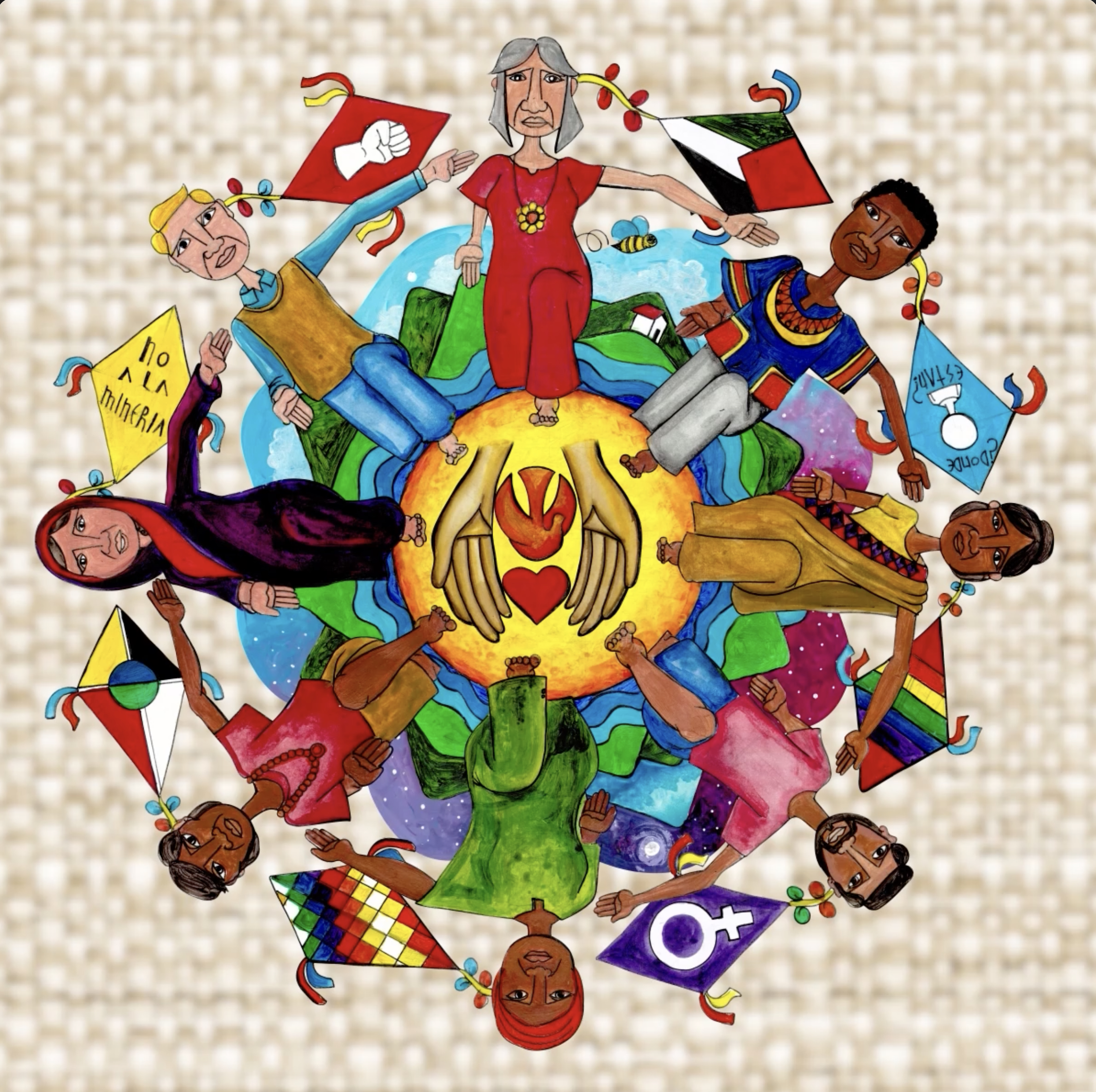
At the end of the visit, we perform our traditional ritual of gratitude for what we have learned from our hosts. The veneration of the sacred place and its ancestors is followed by a blessing from everyone gathered in a circle around those who opened their hearts and shared their struggles with us, thus connecting who we are with our hosts and supporting each other in our resistance and new ways of re-existing.
∂
“Mothering” is an intimate act, but also a collective one. It represents a new dimension for me, ever since Kochurani helped me perceive in my own life the reality of giving birth to life. It's a capacity we rarely acknowledge, yet it's a source of life and dignity. It's not an experience exclusive to women when they conceive the offspring of the human species. It's an act of conceiving and giving birth that celibate women also experience through processes and acts of bringing life into the world in any of its forms: caring for our grandparents, for example; or protecting a territory from extractive mining companies; and even giving birth to new forms of communal governance in small pockets of resistance. That's why men are also called to “mother,” thus empowering the feminine dimension of our deepest being.
Fiorella shuddered when, in the ritual of gratitude, I thanked her for her diverse motherhood, which ranges from caring for her young son to the community care of the threatened river.
May these encounters where the Pacific desert begins, with the Apus as guardians of our intersecting paths, be a propitious occasion to be reborn wherever we find ourselves, putting down roots to stay wherever we arrive.
Ari Kepay, October 3, 2026