Category: Autonomous Communities

  • Transfiguraciones mayas Acto cultural de los 500 OP Chiapas

    Mayan transfigurations Cultural event of the 500 OP Chiapas

    Welcome remarks

    By Carlos Mendoza Álvarez

    Good afternoon, dear brothers and sisters:

    This cultural event in the public square of the municipality of Zinacantán is a symbol of the dialogue between faith and reason that has been at the heart of the preaching of the Gospel, from its origins in the lands of Palestine with Jesus of Nazareth, two thousand years ago, to the present day in the Highlands of Chiapas.

    Jesus of Galilee was a preacher of good news for humanity, standing up to the powerful of his time, and accompanied by his messianic community even though he was betrayed by an angry mob.

    Jesus' loving sacrifice for a humanity reconciled with itself and with Mother Earth acquires a cosmic force with his resurrection from the dead, which is the most radical good news of all time.

    God is not a God of the dead, but of the living. And that is why the God of life is always on the side of the poor, the excluded, and the vulnerable, so that from there he may call everyone—victims and executioners alike—to heal humanity's mortal wounds and lead us to his fullness of life.

    On the occasion of the arrival of the first Dominican friars to the mainland of Abya Yala of the native peoples, five centuries ago on the coasts of Veracruz in 1526, we Dominican friars of today long to make a joyful, yet critical, memory of those five centuries of encounters and disagreements with the peoples of Mexico, especially those of Chiapas.

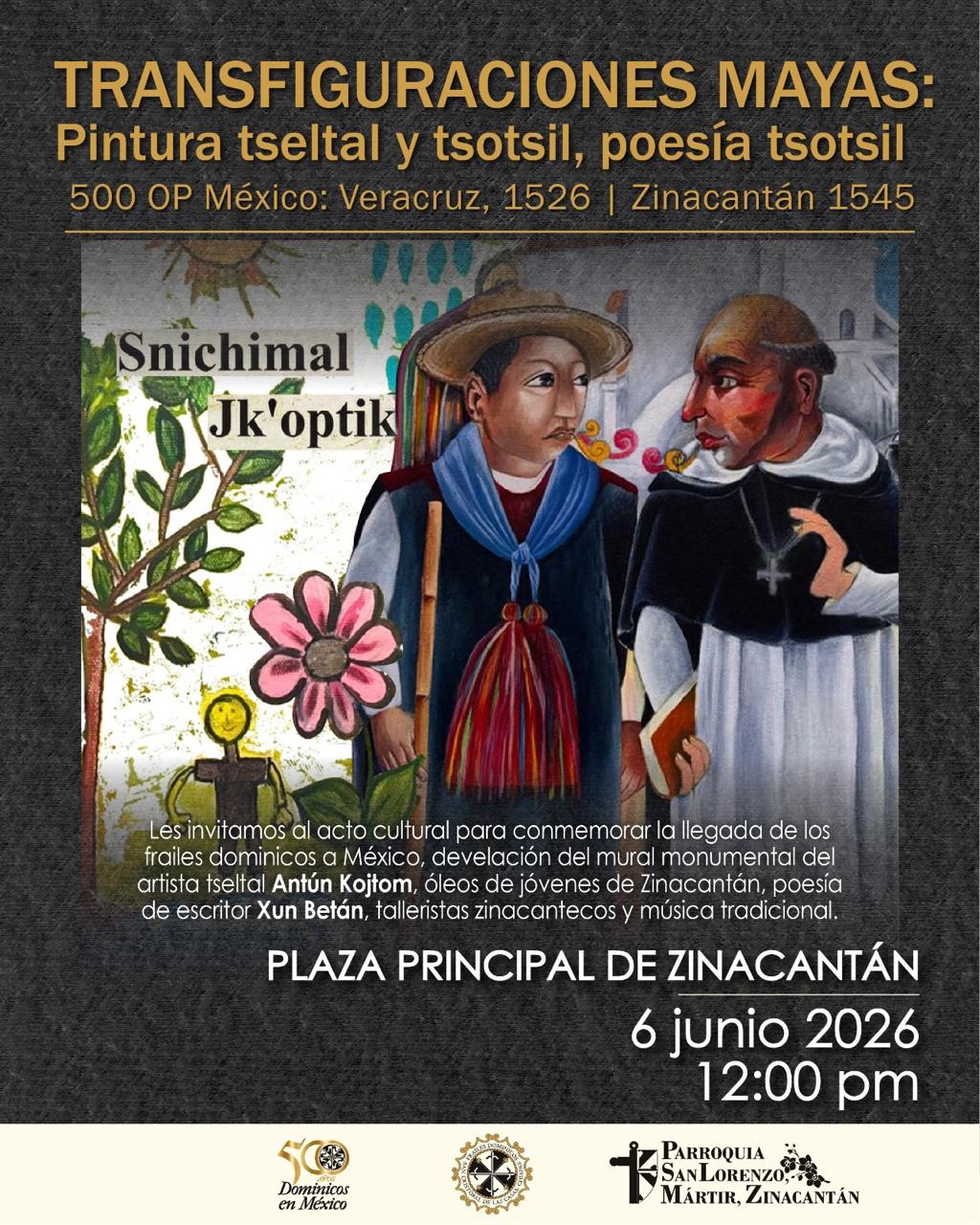
    The dialogue between faith and reason, we Dominican friars have promoted for eight centuries in spirituality, thought and the arts, always accompanied by the promotion of human dignity and its inalienable human rights, through justice and peace for all peoples and creatures, as did the first bishop of Chiapas, our brother Friar Bartolomé de Las Casas, through peaceful evangelization, and later followed in his footsteps by Friar Pedro Lorenzo de la Nada in the lands of the Pochutlas and the Lacandones, as can be seen in the mural that is about to be unveiled.

    The cultural event that brings us together today is a movement in three moments: image, word and music.

    The image

    Through murals, the Mayan peoples have long preserved their ancestral memory, the culmination of which are the murals of Bonampak. This tradition is renewed in contemporary Mayan art, such as that of the great master Antún Kojtom, a Tseltal artist from Tenejapa, who accepted the invitation of the Dominican friars to conceive, design, and paint the mural that will be unveiled in a few moments by the Provincial Prior of the Dominicans in Mexico, Friar Luis Javier Rubio Guerrero, the guest artist Antún Kojtom, and a friar representing the authorities of the San Lorenzo Mártir church.

    Next, nine paintings by young people from Zinacantán who participated in the introductory acrylic painting workshop offered by Master Antún last week will be exhibited. Their works reflect the ch'ulel, or spiritual strength, that accompanies them in their inner lives. We will then present them with certificates of recognition for their commitment.

    The word

    Since ancient times, human words have been a reflection of the divine word, especially poetry. In the second part of this cultural event, we will hear poetry from Xun Betan, a Tsotsil writer from Venustiano Carranza, and from the young people who participated in the workshop he led for several weeks in Zinacantán. We will also present certificates of recognition for their commitment.

    The music

    And to conclude, traditional music, that ancestral sound memory, will inspire us to look closely at the monumental mural by the master Antún Kojtom and the acrylics of his students. The sound waves of the traditional musicians from the Parish of San Lorenzo Mártir de Sots'leb will reach throughout the plaza, echoing in the sacred hills inhabited by the ch'ulelal, who also watch over us and accompany us today.

    ∂

    We, the Dominican friars, offer this gift to the people of Zinacanteco. It was made possible thanks to the agreement of the three community authorities: the municipality, the churches, and the pastoral plan.

    A special word of gratitude to the Sertull Foundation of Mexico City for its generous support in funding this initiative, as well as to the Fray Bartolomé de Las Casas Human Rights Center for its support in educating about historical memory and the human rights of indigenous peoples.

    In conclusion, I invite the Dominican family (friars, sisters, and laity) to continue deepening, with rigor and hope, the historical memory of that complex past of the Dominicans in Chiapas, considering the challenges that lie ahead in our time:

    • to make visible the stories of women knowledgeable in ancestral Mayan spirituality and their current positions in the communities, as well as the people of the

    sexual diversity in its dignity, its rights and its community responsibility;

    • and to accompany children and young people in their processes as they passionately embrace technological modernity, with its opportunities and its serious risks of ecological, social and political devastation, in times of algorithms and artificial intelligence.

    May the contemporary Tsotsil and Tseltal art that we will contemplate in the mural and the acrylics, hear in the poems and celebrate with the traditional music allow us to celebrate the dialogue of knowledge between the peoples, with their diverse ancestral and contemporary spiritualities.

    May we continue to practice mutual listening in our times to promote the full life of the native peoples of the Highlands of Chiapas, especially the Zinacantec people.

    Welcome to this celebration of life for the people of Zinacanteco, past and present!

    Sots'leb, June 6, 2026

    Friar Carlos Mendoza Álvarez, OP

    Coordinator of cultural activities 500 OP Chiapas
  • La paz como caminos de insurrección mesiánica Sobre la Agenda Frayba 2026 Memorias subterráneasGabriela Soriano | Underground Memories | San Cristóbal de las Casas, Chiapas | 2026

    Peace as a path to messianic insurrection About the Frayba Agenda 2026 Underground Memories

    By Carlos Mendoza Álvarez

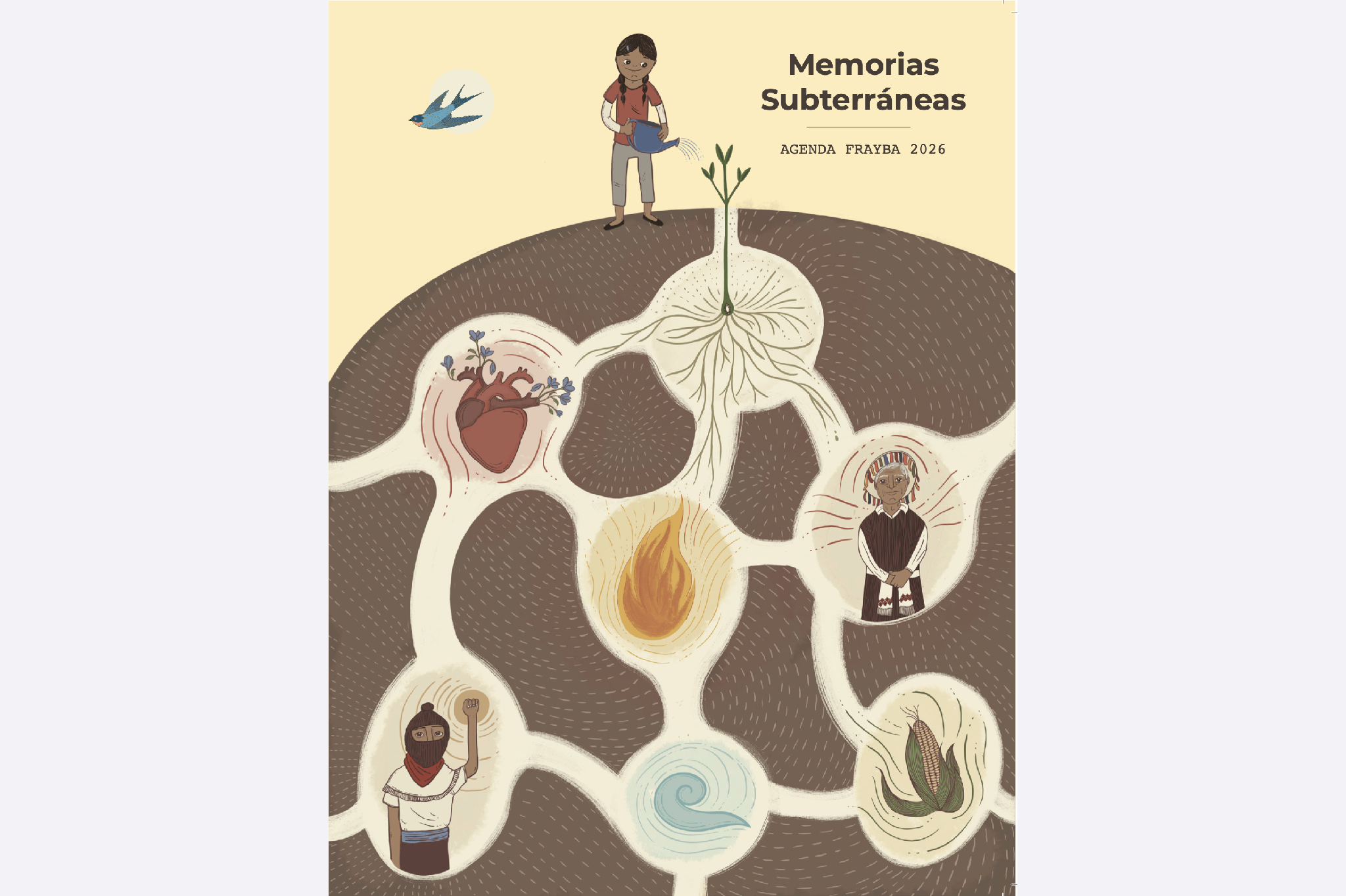
    Last Wednesday, the presentation of the fifteenth edition of the Frayba Agenda Titled “Underground Memories,” it was prepared by the Fray Bartolomé de Las Casas Human Rights Center in Chiapas. This annual publication, since 2011, preserves the living memory of the actions carried out in the promotion and defense of the human rights of the indigenous peoples of Chiapas, as well as of people in forced migration and refugees, who have been supported by this civil society organization over several decades. Frayba -as this organization is affectionately called- was born inspired by the winds of conciliar renewal of the diocese of San Cristóbal de Las Casas and the social processes that emerged as an expression of the indigenous movement of the second half of the twentieth century.

    Three articles reflecting on the local, regional, and national context—by Jorge Santiago, founder of several ecclesial and civil organizations, Susana Montes de la Commission for Support of Community Reconciliation (Coreco) and an interview with Carlos González, a member of the Coordination of National Indigenous Congress of Government Created by Pedro Faro, these are accompanied by a valuable graphic record of the key moments of three decades of peacebuilding in Chiapas. The editorial design and illustrations by Gabriela Soriano Segoviano reflect, with beautiful strokes of contemporary folk art, the connections of the underground memories of resistance that inspire the indigenous peoples of today, as well as civil society and the churches that walk with them.

    Below, I transcribe my participation in the round table discussion, on that rainy afternoon in San Cristóbal de Las Casas.

    ∂

    “There is no path to peace, peace is the path”

    Mahatma Gandhi

    This year we are commemorating three decades of peacebuilding in Chiapas: Frayba, Coreco, Sipaz, the National Indigenous Congress, the Zapatista Movement, the San Andrés Accords, and many other initiatives of civil society, churches, and social movements. These networks emerged from the fertile soil of Chiapas, prepared more than six decades ago by the pastoral plan of the Diocese of San Cristóbal with the arrival of Bishop [name missing]. jTatik Samuel Ruiz, who, after an arduous and patient conversation and journey with the native peoples, led to the birth of an indigenous Church.

    A decade later, the Indigenous Congress of 1974 fostered the emergence of a collective consciousness among Indigenous peoples as historical subjects. And finally, the rise of the Zapatista movement, with its support bases and militias, proposed a different way of living and creating the political sphere as a shared endeavor. All these processes were accompanied by a vibrant and creative current of critical thought, which arose in the Highlands of Chiapas and the canyons of the Lacandon Jungle throughout the second half of the 20th century.

    The San Cristóbal School, so named by Pablo Romo, along with the Cuernavaca School, analyzed by Humberto Bech, have been, in my opinion, the two main Mexican contributions to critical thought in the second half of the 20th century. Both provide us today with a precise direction for confronting with clarity the growing spiral of systemic violence that, with the Puerto Rican decolonial thinker Nelson Maldonado-Torres, we call here the Great Catastropheand.

    ∂

    Jorge Santiago's reflection on the Frayba Agenda 2026. Underground Memories The work we present today rightly underscores the centrality of the San Andrés Accords as a crucible of decades of struggle for peace with justice and dignity. The thinker from San Cristóbal points out that the historical demands of Indigenous peoples remain relevant, and that the Mexican state still owes a debt for honoring these historic accords.

    Two pastoral letters from jTatik Samuel Ruiz and Don Raúl Vera prepared the celebration of the Third Diocesan Synod, which took place from 1995 to 1999. This process allowed the diocese to reap the harvest of half a century of pastoral life and thus give a clear path of synodality to the life and commitments of this diocese. Both letters arose in a context of uncertainty due to the animosity and conflict on the part of Vatican authorities of that time, fueled by the Club of Rome, or a group of Mexican bishops who were declared enemies of liberation theology in Mexico and Latin America.

    The first pastoral letter So that justice and peace may meet (1996) is an ecclesial response to the armed uprising of 1994. It reflects the struggle for land by indigenous peoples, as well as the commitment to justice and peace made by this diocese, following the impetus of the Second Vatican Council and the Second General Conference of Latin American Bishops in Medellín. The second pastoral letter From pain to hope, The agreement, signed by both bishops in 1998, after the Acteal massacre, is a commitment to hope amid the pain of the survivors and a pledge to continue seeking peace with justice and dignity.

    The Vatican's violence against this pastoral project would later be unleashed against Don Raúl Vera, who was transferred to the Diocese of Saltillo on December 30, 1999, in a failed attempt to dismantle the synodal process. What his detractors never imagined was that this perverse decision would become the opportunity to sow the seeds of a liberating Church, now in lands of mining extraction and gender violence, which Don Raúl would embrace with fidelity to his mission as a pastor in those desert lands of northern Mexico.

    ∂

    Finally, I would like to make two final comments to continue the conversation.

    The challenges of moving forward, after three decades of peacebuilding, are now unprecedented, as we find ourselves in the uncertain moment of civilizational collapse. A commitment to justice for Indigenous peoples is no longer enough; it is essential to integrate other forms of justice, such as gender justice (sexual diversity) and ecological justice, to understand the rebellions. transmodern that build individuals and collectives of survivors in contexts of global violence. The historical strength of the poor, which the first generation of liberation theology envisioned, is giving way to the unsubmissive reason of social and ecclesial movements that are already weaving networks of mutual support, dignity, resistance and diverse re-existences.

    It is also time to reformulate the theoretical framework for thinking about systemic violence. Liberation theology requires a radicalization that arises from dialogue with decolonial thought and theory. queer/cuir /queer and intersectionality to continue supporting peace processes, transitional justice, and diverse spiritualities of life that face the ongoing Great Catastrophe.

    Let us not forget that it is our task to honor the legacy of the ancestors of the liberating Church, but from the new subjectivities, bodies and territories in resistance, with the fruits of thought, art and spirituality that emerge as messianic insurrections anticipating other worlds, of dignity and life for everyone.

    The spirituality of messianic time is an interruption of the linear time of that Chronos that devours its children on altars of bloody sacrifices. Such a messianic force arises as an insurrection. peaceful In the face of systemic violence, that is, as a break from the vicious cycle of rivalry and violence, to establish processes of mutual recognition, beyond the violence that produces poverty, exclusion, and subjugation to hegemonic powers. It is a spirituality of life in the midst of death. Another time that (in)emerges as an anticipation of other possible worlds from the survivors of yesterday and today.

    ∂

    Next Wednesday, March 25, at 6 p.m., we will continue our discussion on critical thinking emerging from Chiapas, with reflections by Pablo Romo on the San Cristóbal School and experiences of a spirituality of mutual support amidst violence, presented by our friend and Peruvian colleague Juan Carlos La Puente. Both reflections will be followed by a dance performance by Martha Elena Welsh.

    See you at the restaurant Belil, in the historic center of San Cristóbal de Las Casas, where with Ricardo and Carmen as hosts, along with Angélica and Abraham, we will continue opening dining spaces, where resistances and spiritualities emerge as a commitment to permanent dialogue and mutual support in the care of life.

    San Cristóbal de Las Casas, March 7, 2026

  • De pirámides y autonomías Sobre la geometría política de “el Común” para el año que comienzaGaudí | Sagrada Familia, Barcelona | Hyperboloid, 2025

    Of pyramids and autonomies On the political geometry of “the Commons” for the coming year

    By Carlos Mendoza-Álvarez

    The pyramids above and below

    A few days ago, Cideci-Unitierra was the epicenter of the seedbed Of pyramids, of stories, of love and, of course, heartbreak, dedicated to discussing, in my opinion, the old topic of the libido dominandi Or the desire for power that has resided in the human heart since the dawn of recorded history. Although, in reality, the reflections revolved around the recent history of the Mayan peoples of the Chiapas Highlands, who four decades ago decided to put an end to the power of local strongmen, landowners, and the corrupt mestizo government that imposed its rule upon them in modern times.

    On the occasion of the 32nd anniversary of the Zapatista Army of National Liberation's armed uprising, more than 1,300 participants—first at the Jacinto Canek Caracol, located in a working-class neighborhood in the northern part of the city of Jobel, and later at the Oventik Caracol—gathered to hear trusted figures from the rebel movement speak about the lust for power that opposes "the common good" by constructing pyramids of privilege and domination. The discussions focused, for example, on analyzing with Barbara Zamora The legal strategies of the Mexican state to consolidate private land ownership, dispossessing indigenous peoples of their territories with legal tricks, including the mega-projects of the Fourth Transformation.

    But there was also courageous discussion about the small and large pyramids of power built by left-wing revolutionary movements from the second half of the 20th century to the present to protect their privileges once they had seized political power. The persistence of these power pyramids in modern governments and state administrations seems to be a constant, unfolding on different scales in right-wing and left-wing political models, always at the mercy of the tyrannies in power.

    The self-criticism that the EZLN has shown regarding its own control and decision-making practices is, in the opinion of Raúl Zibechi, This is unprecedented in modern leftist movements. In a fascinating presentation dedicated to tracing the uses and abuses of power in the Latin American left that won political power—especially in Nicaragua, El Salvador, and Bolivia—the Uruguayan sociologist, who has worked alongside guerrilla movements first and social movements later for half a century, posed a crucial question to the Zapatista comrades, as well as to those of us who are attentive to the path they are forging: Are pyramids of power necessary and inevitable? What are their organizational and temporal limits to prevent them from becoming new strongman regimes and tyrannies?

    Between avant-gardes and rearguards

    I was surprised that this think tank didn't emphasize critical thinking, which half a century ago had already warned us about the risks of leftist revolutions becoming new tyrannies. Specifically, decolonial thought has for years been proposing the urgent need to overcome the complex of the vanguards typical of the left in the last century, who lost their way in the whim of speaking on behalf of the masses. corset Marxist class struggle, with its organic intellectuals, especially in its version of proletarian revolution to overthrow the bourgeois state, has been challenged and surpassed by the voices and practices of subaltern groups who no longer need a privileged caste to speak on their behalf. Indigenous peoples, women's collectives, and LGBTQ+ communities, among other subjectivities in resistance, construct their own thought through their ways of life and organization based on mutual care, imbued with ethical, political, and spiritual strength. Today, it is impossible to deny their knowledge and their forms of communal organization, through which they have resisted diverse forms of oppression for centuries.

    It is necessary to dismantle this will to dominate on all fronts where it manifests itself by building pyramids at the top and bottom. It is about going “to the rearguard of social movements,” as Boaventura de Sousa Santos said, to learn from them as experts in the resistance they have faced for centuries, especially Indigenous peoples. Feminisms community like the one from Lorena Cabnal In Guatemala, they emerge as a critical voice against the prominence of academia. extractivist Made by white, urban, and privileged women. These feminisms are linked as an instance of critical reflection alongside women's collectives confronting patriarchy, now opening their networks of care and thought to the mothers of disappeared persons searching for their loved ones, as well as to indigenous women in resistance.

    I was surprised that the "Of Pyramids, of Stories, of Loves and, of course, Heartbreaks" seedbed didn't put at the center these voices that have been clamoring for other ways of for decades. horizontality of power.

    The inevitable shift: from the pyramids of autonomies to the hyperbolic dimension of heteronomies

    A significant change in the perception of the construction of "the common" that Commander Moisés put on the table was that of the generational changes that the Zapatista bases experience in their youth.

    The insurgent-militiaman-Zapatista base triad that shaped the Zapatista movement four decades ago no longer accounts for the other forms of belonging expressed by the generations born in the Caracoles of the autonomous territories. Now, young Zapatista subjectivities are discovering new ways of building resistance and rebellions of righteous anger in the arts, health, and communications, among other fields. Radiologists, theater artists, dentists, and documentary filmmakers are already actively participating as voices of resistance in the autonomous territories, now surrounded not by the federal army but by other ways of life offered by the government and criminal mafias, each in their own way, to win over and buy the attention of Indigenous youth, including the Zapatistas.

    The narrative of the autonomous communities It was of paramount importance in confronting the capitalist hydra thirty-two years ago to underscore the strategy of resistance, creating other processes of caring for life such as eat, learn and live, Following the narrative of Gustavo Esteva's "revolutionary verbs," the Zapatistas are now identifying pyramids at the bottom that require a radical change in narrative.

    Within this same framework, critical thinking is currently moving towards... heteronomies, such as the proposal of Silvana Rabinovich Rooted in the Hebrew philosophy of Emmanuel Levinas in fruitful dialogue with Enrique Dussel, this approach seeks to understand "the commons" in its genesis, from the asymmetry of intersubjective relations—that is, from the difference of each subjectivity and collective. It is not to deny autonomies but to explain their conditions of possibility. It is a commitment to preventing the dominance of power pyramids in order to give way to relations of diversity where [the concept of "commons" persists]. a surplus of the difference that sustains life.

    It is a philosophical concept that has some relation to the scientific theory of baryogenesis that particle physics, along with the Big Bang theory, proposes to explain the asymmetric origin of the universe between matter and antimatter. One of the spatial figures of this primordial cosmological phenomenon would be hyperboloid, like a saddle, where the asymmetry of the expanding universe prevails.

    In its philosophical sense, heteronomy is the ethics of otherness. The face of the other is the source of heteronomous ethics, that is, a way of being that has its own nomos or law in the other, especially, the other vulnerable. This relationship of openness to otherness brings with it a critical principle for power relations where the “autonomous” subject, individual or collective, is decentered and the possibility of “the common” as a source of “the political” is opened thanks to the recognition of that otherness which is a clamor or a caress.

    ∂

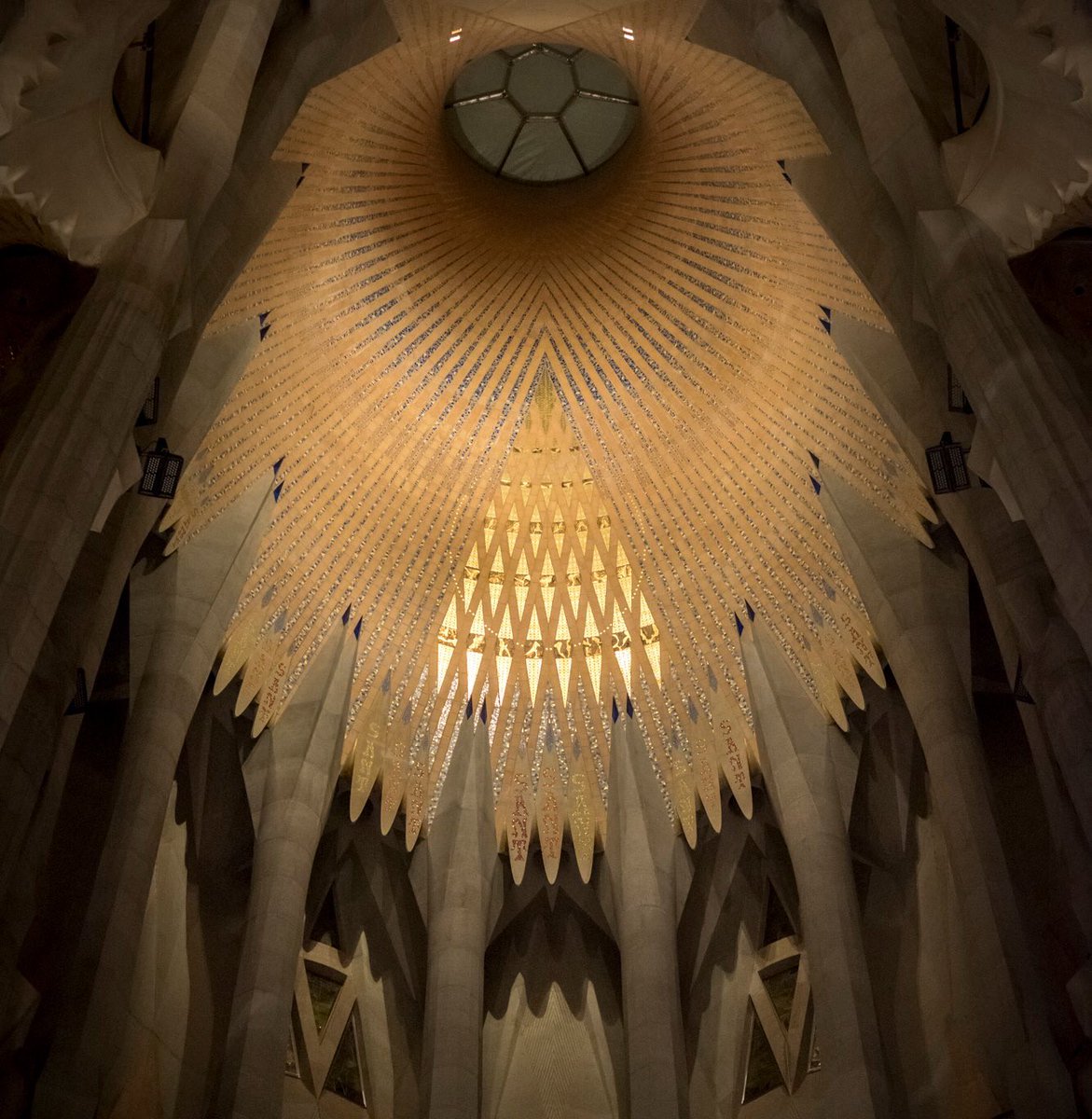
    Christian theology has since anciently quenched its thirst for mystery in a loving divine communion with the divinity. triuna. Community in difference It is the oxymoron (or apparent contradiction) of faith in a child messiah who will defy the pyramids of his time, both those of the Roman Empire and those of the sacrificial religion of the Temple of Jerusalem. Perhaps it was not by chance that Gaudí designed the basilica of the Holy Family In Barcelona, his emblematic work, following the hyperboloid shape of the asymmetry in motion, generating a powerful sacred space that brings us into communion in diversity.

    Perhaps the new Zapatista subjectivities, born of the autonomies, are now opening up to the horizon of affirming the differences that unite us in the common responsibility of creating those other worlds., where other worlds fit. An alternative space with smaller, provisional pyramids, but with hyperbolic worlds that preserve and enhance "the common good" amidst diverse lifestyles. These young people will also create their own spiritualities to symbolize and celebrate the source of "the common good" that fuels the fire of rebellion and righteous anger.

    Many other subjectivities in resistance thus open paths of hope for us from their struggle for "the common" that includes diversity as a route to travel in the year that begins.

    The Highlands of Chiapas, January 3, 2026

    Note: What do you think about the autonomies and heteronomies to be built in our time?

English